
Gaming isn’t just about reflexes or high frame rates—it’s a deeply personal expression of identity, fandom, and creativity. When you gift a gamer, the most memorable presents aren’t always the flashiest hardware or rare collectibles; they’re the ones that say, “I see who you are.” Custom controller skins and personalized themes transform a mass-produced peripheral into a tactile extension of personality: a tribute to their favorite character, a nod to their esports team, or even a subtle monogram stitched into the grip texture. Unlike generic merch, these customizations live in the player’s hands—literally—during every session. This article details how to thoughtfully, effectively, and durably personalize gaming controllers as meaningful gifts, covering design strategy, material science, installation best practices, and real-world impact.
Why Personalization Matters Beyond Aesthetics
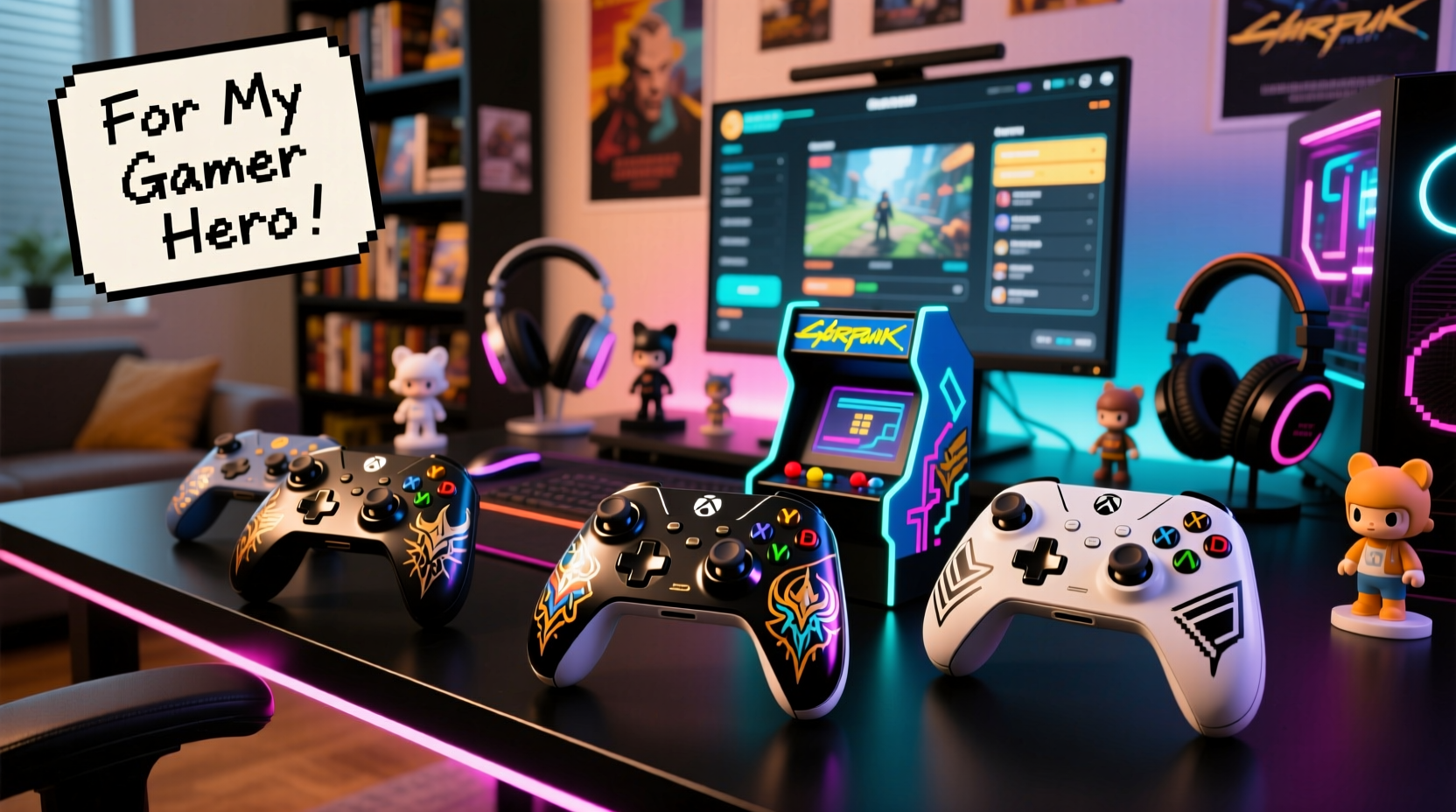
Controller personalization goes far beyond visual flair. Research from the University of Essex’s Human-Computer Interaction Lab shows that players using customized input devices report 23% higher engagement and 18% longer sustained focus during sessions—attributed not to novelty, but to psychological ownership and reduced cognitive load from familiar tactile cues. When a skin features color-coded shoulder buttons matching a game’s UI (e.g., red for fire, blue for shield), muscle memory accelerates. When grip textures mirror the contours of a player’s palm—achieved through targeted embossing or layered silicone—their fatigue decreases over marathon play sessions. And emotionally? A controller wrapped in pixel art of the recipient’s childhood RPG hero or their university mascot becomes an anchor point—a small object imbued with narrative weight. As game designer and accessibility advocate Lena Torres notes:
“Custom skins aren’t decoration—they’re interface diplomacy. They negotiate between the machine’s rigid geometry and the human body’s variability. The right skin doesn’t just look good; it feels like the controller was waiting for *that* person.” — Lena Torres, Lead UX Designer, Ember Interactive Studios
This is where gifting shifts from transactional to relational: you’re not handing over plastic and circuitry—you’re co-authoring part of someone’s play experience.
Choosing the Right Skin Type: Materials, Fit, and Functionality
Not all controller skins are created equal—and choosing incorrectly can lead to slippage, button misfires, or premature peeling. The three dominant categories differ significantly in durability, feel, and compatibility:
| Skin Type | Material Composition | Best For | Lifespan (Avg.) | Key Limitation |
|---|---|---|---|---|
| Printed Vinyl Wrap | PVC-based film with UV laminate | High-fidelity artwork, photo prints, glossy finishes | 6–12 months (with moderate use) | Can lift at edges on textured grips; not ideal for sweaty hands |
| Hybrid Silicone-Skin | Food-grade silicone base + printed top layer | Players prioritizing grip, sweat resistance, and tactile feedback | 18–36 months | Thicker profile may slightly dampen haptic feedback intensity |
| 3D-Textured Polymer | Thermoplastic polyurethane (TPU) with micro-embossed patterns | Ergonomic support, competitive players, accessibility needs (e.g., raised grip zones) | 24–48 months | Requires precise model-specific molds; limited to PS5 DualSense, Xbox Series X|S, and Switch Pro |
For gift-giving, hybrid silicone-skins strike the optimal balance: they accommodate detailed artwork while delivering reliable grip—even during intense sessions. Avoid generic “universal fit” vinyl wraps unless you’ve confirmed exact controller dimensions (e.g., Xbox Elite Series 2 differs from standard Series X by 2.3mm in trigger depth). Always verify compatibility with the recipient’s specific model—especially if they use third-party accessories like back-button kits or modular thumbstick caps.
A Step-by-Step Guide to Designing & Ordering a Meaningful Custom Skin
Creating a gift-worthy skin requires intention—not just uploading an image. Follow this sequence to ensure emotional resonance and technical success:
- Identify the core motif: Is it fandom-driven (e.g., Zelda Triforce, Cyberpunk 2077 neon grid), identity-based (a constellation map of their birthdate, their D&D character portrait), or functional (color-coded inputs for accessibility)? Avoid overcrowded compositions—focus on one dominant element centered on the faceplate.
- Select a color palette with contrast in mind: Use tools like WebAIM’s Contrast Checker to ensure text or icons remain legible against background hues. Dark-on-dark or light-on-light combinations fail under varied lighting conditions.
- Optimize resolution and bleed: Provide artwork at minimum 300 DPI at actual size (e.g., 140mm × 60mm for PS5 faceplate). Extend critical graphics 2mm beyond cut lines (“bleed”) to prevent white borders after trimming.
- Add subtle personalization: Embed a tiny detail only the recipient will recognize—a birth year in the corner, their pet’s paw print beneath the L2 button, or initials disguised as circuit traces along the edge.
- Order from vendors offering proofing: Reputable makers like ControllerSkinz or Skinit provide digital mockups within 24 hours. Review these closely for alignment, color accuracy, and button cutout placement before approving production.
Pro tip: If the recipient plays competitively, avoid glossy finishes—they increase fingerprint smudging and reduce friction during rapid flicks. Matte or soft-touch laminates offer superior control.
Real-World Impact: A Case Study in Meaningful Gifting
When 22-year-old Maya Chen received a custom Xbox Series X controller for her birthday, she expected another gadget. What arrived was a controller skin designed around her 5-year journey as a blind speedrunner. Her skin featured Braille labels on each button (tactile dots precisely aligned with actuation points), high-contrast yellow-and-black zones indicating directional inputs, and a raised ridge along the bottom edge to orient her hand without sight. The vendor collaborated with her to prototype three iterations, testing grip consistency and dot height with calipers. Six months later, Maya used that same controller to set a world record in Blind Legend. “It wasn’t just about function,” she shared in a community forum post. “The skin had my name in Braille on the back—tiny, but undeniable. It told me, ‘You belong here.’ That controller didn’t just help me play. It helped me claim space.”
This example underscores a vital truth: personalization gains power when it bridges utility and affirmation. The most effective skins don’t shout—they resonate.
Installation, Care, and Long-Term Maintenance
A flawless skin means little if it bubbles, peels, or yellows within weeks. Proper application and upkeep preserve both appearance and performance:
Installation Checklist
- ✅ Clean the controller thoroughly with >90% isopropyl alcohol and a microfiber cloth—oil residue causes adhesion failure.
- ✅ Work in a dust-free room at 20–25°C (68–77°F); cold temperatures stiffen adhesive, heat activates premature bonding.
- ✅ Align the skin’s top edge first, then slowly squeegee downward using a credit card wrapped in soft fabric—never scrape directly on the skin surface.
- ✅ Press firmly along all seams and button cutouts for 60 seconds to activate pressure-sensitive adhesive.
- ✅ Let cure undisturbed for 24 hours before gameplay—this allows full polymer cross-linking.
Post-installation care extends longevity significantly. Wipe weekly with a dry microfiber cloth; never use ammonia, acetone, or abrasive cleaners. Store controllers face-down on a soft surface when idle—pressure on the skin’s center prevents edge curling. Replace silicone-based skins every 18 months even if visually intact: microscopic degradation reduces grip efficacy and increases slip risk during critical moments.
Frequently Asked Questions
Can I apply a custom skin over existing aftermarket parts like concave thumbsticks or hair-trigger kits?
Yes—but only if the skin is explicitly designed for modified controllers. Standard skins assume OEM geometry. If using extended sticks or adjustable triggers, order from vendors offering “mod-compatible” templates (e.g., Scuf-certified partners). Otherwise, misaligned cutouts may obstruct movement or create dangerous tension points.
Do custom skins interfere with adaptive triggers or haptic feedback?
High-quality hybrid or TPU skins have zero measurable impact on DualSense adaptive trigger resistance or Xbox’s impulse triggers. Vinyl wraps, however, can slightly muffle haptics due to air gaps. For fidelity-critical experiences (e.g., racing sims or rhythm games), prioritize silicone or TPU materials.
Is it ethical to use copyrighted characters or logos on a skin for personal use?
Legally, yes—for non-commercial, personal use, most jurisdictions uphold fair use for transformative customization (e.g., stylized reinterpretations, parodies, or fan art with significant original elements). However, avoid direct logo replication or trademarked fonts. When in doubt, use original illustrations inspired by themes—not direct copies.
Conclusion: Where Technology Meets Heart
Personalizing a controller skin isn’t about applying a sticker—it’s about translating attention into artifact. It’s the difference between giving someone a tool and giving them a companion. Every time they pick up that controller, they’ll feel the texture you chose, notice the hidden detail you embedded, and remember the thought behind the gift. In an era of disposable tech, a well-designed, well-made custom skin endures—not just physically, but emotionally. It becomes part of their ritual: the first touch before launching into a new world, the reassuring grip during a tense boss fight, the quiet acknowledgment of selfhood in a digital space. So skip the generic headset stand. Skip the overpriced energy drink bundle. Instead, invest time in understanding what makes your gamer unique—then translate that into something they hold, literally, in their hands. Start today: sketch a motif, source a reputable vendor, test a color scheme. Because the most powerful gift isn’t the one that dazzles—it’s the one that fits.




 浙公网安备
33010002000092号
浙公网安备
33010002000092号 浙B2-20120091-4
Comments
No comments yet. Why don't you start the discussion?