
Finding the perfect foundation shade is a challenge even with in-store testers. When shopping online—without the luxury of swatching on your skin—the process becomes significantly more complex. Yet, millions of consumers make successful foundation purchases remotely every year. The key lies in understanding your skin’s undertones, mastering lighting conditions, leveraging digital tools, and using strategic comparison methods. With the right approach, you can confidently select a foundation that blends seamlessly, matches your complexion, and performs well under real-world conditions.
Understand Your Skin’s Undertone
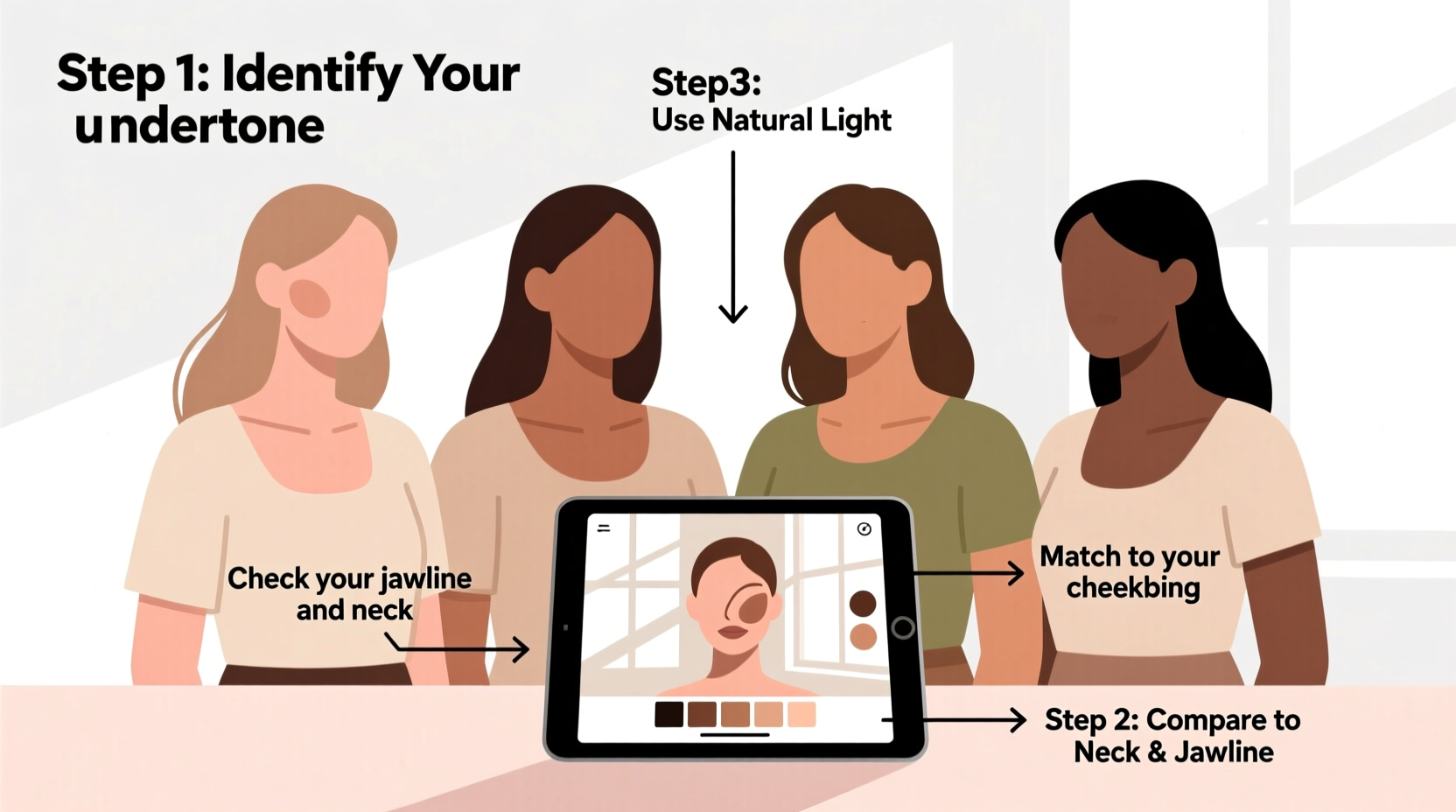
Your skin's undertone is the subtle hue beneath the surface that influences how colors interact with your complexion. It plays a far greater role in foundation matching than surface-level darkness or lightness. There are three primary undertones: warm, cool, and neutral.
- Warm undertones feature yellow, golden, or olive hues. People with warm undertones often tan easily and may notice their veins appear greenish under natural light.
- Cool undertones have pink, red, or bluish undertones. Those with cooler skin may burn before tanning and typically see blue or purple veins.
- Neutral undertones are a balanced mix, sometimes leaning slightly warm or cool depending on the season or sun exposure.
To determine your undertone, examine the inside of your forearm in natural daylight. Avoid fluorescent or overly yellow lighting, which distorts perception. If your veins appear green, you likely have warm undertones. If they look blue or purple, you’re probably cool-toned. If it’s difficult to tell, you may be neutral.
“Undertone accuracy is more important than surface match. A foundation with the wrong undertone will always look ‘off,’ no matter how close the shade seems.” — Lena Torres, Celebrity Makeup Artist
Analyze Lighting Conditions Accurately
Lighting dramatically affects how your skin—and any foundation—appears. What looks like a perfect match under bathroom LEDs might look ashy or orange in daylight. To avoid mismatches, evaluate your skin in consistent, neutral lighting.
The best time to assess your skin tone is mid-morning or mid-afternoon near a north-facing window, where indirect sunlight provides balanced, full-spectrum illumination. Avoid golden hour (sunrise/sunset) and artificial overhead lights, which add warmth and distort color perception.
When reviewing product photos online, look for images taken in natural daylight. Brands that show models outdoors or in bright, diffused light offer more reliable visual references. Pay attention to user-generated content—real customer photos uploaded on retailer sites often reflect true-to-life results.
Common Lighting Pitfalls
| Light Type | Effect on Foundation Match | Solution |
|---|---|---|
| Incandescent Bulbs | Adds warmth; hides redness but deepens shadows | Avoid for evaluation |
| Fluorescent Lights | Washes out skin; emphasizes gray or sallowness | Use only for final check |
| Natural Daylight | Most accurate for tone and undertone assessment | Primary reference |
| Phone Flash | Creates harsh contrast and unnatural highlights | Never rely on flash photos |
Leverage Online Tools and Shade Finders
Many beauty brands now offer AI-powered shade matching tools that guide users through a series of questions about skin tone, undertone, and previous foundation experiences. These systems use algorithms trained on thousands of skin profiles to recommend suitable shades.
Brands like Fenty Beauty, L’Oréal True Match, and Lancôme Le Teint Particulier utilize virtual try-on technology powered by augmented reality. By uploading a selfie under proper lighting, you can preview how different shades appear on your actual face. While not 100% accurate, these tools significantly reduce guesswork.
Some platforms integrate community feedback. For example, Sephora’s “Shade Finder” includes reviews from customers with similar skin tones, often noting whether a shade runs warm, cool, or oxidizes over time. Look for phrases like “matches my NC30 perfectly” or “a bit darker than N40 but great for summer.”
Follow a Step-by-Step Selection Process
Purchasing foundation online requires a methodical approach. Jumping straight to checkout based on a photo leads to disappointment. Instead, follow this proven sequence:
- Determine your current match (if applicable): Note the exact shade name and brand of your current foundation. Even if it’s discontinued, it serves as a reference point.
- Identify your undertone: Use the vein test, jewelry test, or consult past makeup experiences to confirm warm, cool, or neutral.
- Assess seasonal variation: Are you selecting a winter or summer foundation? Many people need two shades—one for pale winter skin and another for tanned summer tones.
- Use digital shade finders: Input your details into brand-specific tools. Take multiple selfies in natural light for AR try-ons.
- Research real-user reviews: Search Reddit threads (like r/MakeupAddiction), YouTube swatches, and retailer reviews for feedback on oxidation, finish, and blendability.
- Select two potential shades: Choose one slightly lighter and one slightly darker than your perceived match, especially if the brand has limited return policies.
- Check return policy: Confirm whether opened foundations can be returned. Some clean beauty brands allow returns within 30 days even if used.
Mini Case Study: Sarah’s Online Foundation Success
Sarah, a 34-year-old professional in Chicago, struggled for years with mismatched foundations bought online. Her skin is light with neutral-cool undertones, prone to redness around the nose. After trying several “porcelain” shades that turned ashy, she decided to systematize her approach.
She started by identifying her baseline: she wore NARS Sheer Glow in “Honeymoon,” a light-neutral shade. Using this as a reference, she searched for equivalents in other brands. She took a high-resolution selfie in morning light near her kitchen window and uploaded it to the Fenty Beauty Virtual Try-On. The tool recommended “230,” which aligned with community notes describing it as ideal for light-medium skin with neutral undertones.
Before purchasing, she watched five YouTube swatches and noticed that “230” blended smoothly into necklines without a visible line. She ordered it along with “220” for comparison. Upon arrival, she tested both on her jawline in daylight. “230” matched perfectly; “220” was slightly too pink. She kept the correct shade and returned the other within the 30-day window. This structured method saved her time, money, and frustration.
Build a Personalized Foundation Checklist
To ensure consistency in future purchases, maintain a personal reference guide. This checklist helps eliminate guesswork each time you buy a new formula or switch brands.
- ✅ Current foundation shade and brand
- ✅ Skin undertone (warm/cool/neutral)
- ✅ Seasonal variation noted (winter vs. summer)
- ✅ Lighting conditions used for testing
- ✅ Digital tool recommendations recorded
- ✅ Swatch videos reviewed
- ✅ Two-shade strategy applied (when possible)
- ✅ Return policy confirmed
This checklist becomes especially valuable when trying new finishes—matte, dewy, sheer, or full coverage—as formulas behave differently on skin even within the same shade family.
FAQ: Common Questions About Online Foundation Matching
Can I trust influencer swatches?
Influencer swatches can be helpful, but verify their skin similarity to yours. Look for creators who disclose their exact shade and undertone. A swatch on someone with deeper skin may not accurately represent how a light shade appears on fair skin due to contrast effects.
Why does my foundation look different after a few hours?
This is often due to oxidation—a chemical reaction between the foundation and your skin’s pH, oils, or environmental factors. Foundations with higher pigment concentration or certain silicones are more prone to darkening. To test for oxidation, apply a small amount and monitor changes over 2–3 hours.
What if I have different tones on my face and neck?
This is common, especially with sun exposure or hormonal changes. Always match foundation to your neck and décolletage, not just your face. Applying foundation only to the face risks creating a stark mask-like effect. Blend down to the chest for a seamless look.
Final Tips for Long-Term Success
Mastering online foundation selection isn’t about getting it right once—it’s about building a repeatable system. Over time, you’ll develop intuition for how certain brands run (e.g., some are universally deeper or warmer). Keep a log of what works and what doesn’t. Note whether a brand’s “natural” finish leans satin or greasy, or if their cool shades tend to emphasize redness.
Consider investing in a color-correcting primer if you frequently struggle with undertone mismatches. Peach or yellow correctors can neutralize sallowness; lavender tones brighten dullness. Applied beneath foundation, they create a more uniform canvas and extend wear.
Finally, don’t overlook formulation. A perfect shade in a drying matte formula may emphasize texture, while a slightly imperfect match in a radiant serum foundation might blur imperfections effectively. Sometimes, finish matters more than absolute color precision.
Conclusion: Confidence Starts with the Right Match
Selecting the right foundation shade online without samples is entirely achievable—with preparation, observation, and smart tools. You don’t need physical testers to find your match. What you do need is a clear understanding of your skin, disciplined evaluation methods, and the willingness to learn from each purchase.




 浙公网安备
33010002000092号
浙公网安备
33010002000092号 浙B2-20120091-4
Comments
No comments yet. Why don't you start the discussion?