
Installing Christmas lights without a plan is like assembling furniture without the instruction manual: possible, but fraught with frustration, wasted time, and last-minute compromises. Too many homeowners climb ladders only to discover their 200-foot spool of warm white LEDs won’t reach the gable peak—or that their outdoor outlet can’t safely power three strands of icicle lights plus a netted tree. A thoughtful layout isn’t about perfection; it’s about intentionality. It transforms installation from a chaotic weekend scramble into a confident, efficient, and visually cohesive project. This guide walks through every pre-installation decision—from measuring rooflines to mapping circuits—with real-world precision. No assumptions. No guesswork. Just actionable clarity.
1. Measure Twice, Map Once: The Foundation of Every Layout
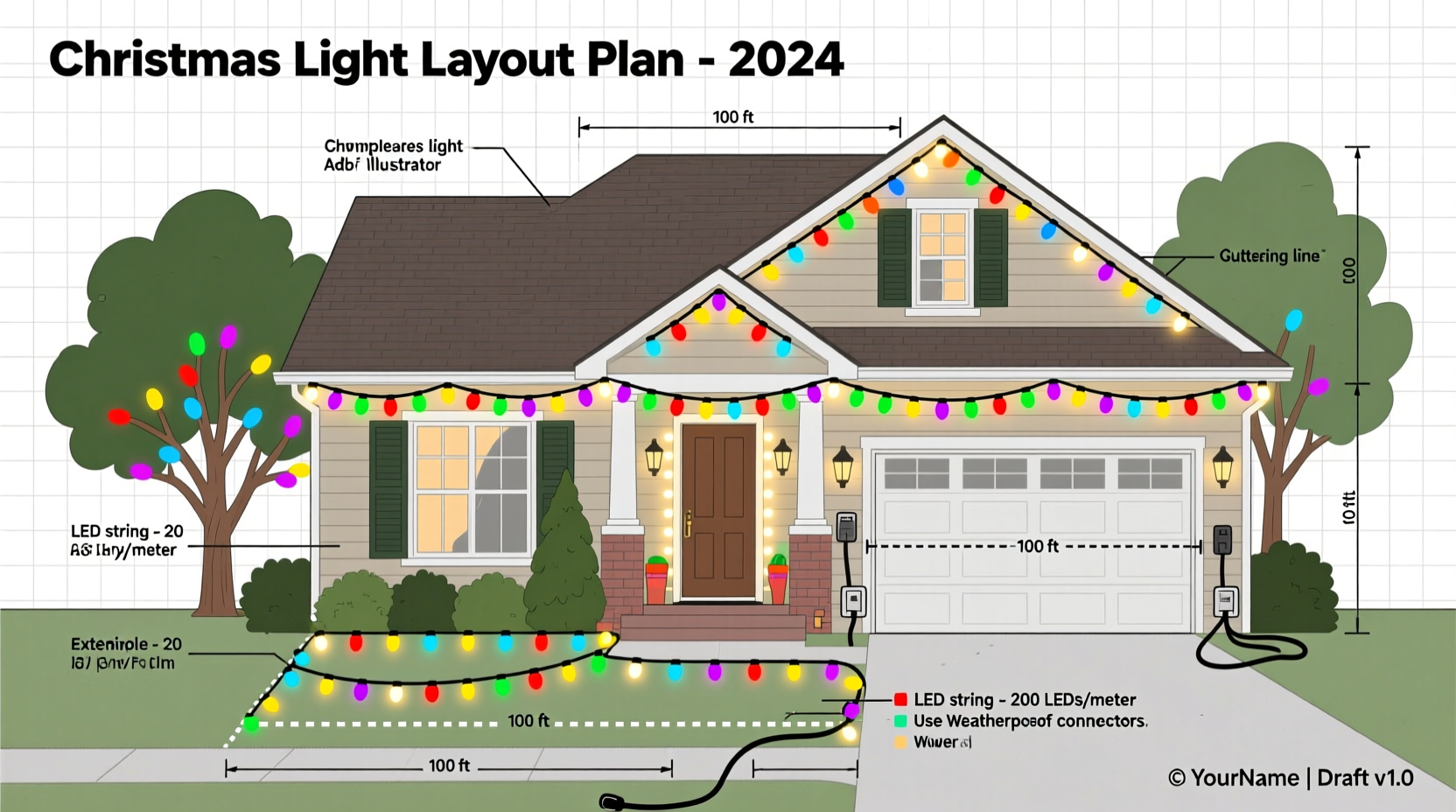
Start not with lights—but with your house. Accurate measurements are non-negotiable. Use a laser distance measurer (ideal for rooflines and eaves) or a heavy-duty fiberglass tape measure (minimum 100 feet). Record dimensions for every surface you intend to light: roof peaks, dormers, soffits, columns, railings, windows, doors, and landscape features like trees or shrubs. Don’t rely on memory or estimates—even a 6-inch miscalculation per window frame adds up fast across ten windows.
Sketch a simple floor plan of your home’s exterior, viewed from above. Label each side (North, South, East, West) and note key architectural features: bay windows, covered porches, garage doors, chimneys, and downspouts. Then create elevation drawings—front, rear, left, and right profiles—showing height, overhangs, and vertical elements. For multi-story homes, measure both upper and lower levels separately. Include door and window heights—not just widths—to determine where vertical accents will land.
Once measured, convert raw data into usable “light-ready” lengths. Most LED mini lights come in standard strand lengths: 3.5 ft (50 bulbs), 12 ft (100 bulbs), 25 ft (150 bulbs), or 33 ft (300 bulbs). Net lights cover 4×4 ft or 6×6 ft areas. Icicle lights typically span 8–12 ft vertically. Always add 10% extra length per run to accommodate bends, dips, and anchoring points—especially along rooflines where wind or snow load may require slack for secure fastening.
2. Calculate Electrical Load and Circuit Capacity
A stunning light display means nothing if it trips breakers—or worse, overheats wiring. Before choosing a single strand, calculate your total wattage load and match it to your circuit’s safe capacity. Most residential outdoor outlets are on 15-amp or 20-amp circuits. At 120 volts, that’s 1,800 watts (15A × 120V) or 2,400 watts (20A × 120V) maximum. But electrical safety standards require you to use no more than 80% of that capacity continuously—so 1,440W or 1,920W, respectively.
Modern LED lights consume dramatically less power than incandescent ones. A typical 100-bulb LED mini strand uses 4.8–7.2 watts; a 300-bulb strand uses 14–21 watts. Icicle lights range from 15–35 watts per 8-ft strand. Net lights vary widely: a 4×4 ft LED net might draw 12–20 watts, while larger 6×6 ft versions can pull 30–45 watts. Always check the manufacturer’s label or spec sheet—not the box art—for exact wattage.
| Light Type | Typical Wattage per Unit | Max Strands per 15A Circuit (80% Rule) | Notes |
|---|---|---|---|
| 100-bulb LED Mini Strand | 5.5 W | ~260 strands | Based on 1,440W limit; assumes no other loads |
| 300-bulb LED Mini Strand | 18 W | ~80 strands | Realistic max: 60–70 to allow for controllers & extension cords |
| 8-ft Icicle Light Strand | 25 W | ~57 strands | Higher heat output; avoid daisy-chaining >3 per outlet |
| 4×4 ft LED Net Light | 16 W | ~90 nets | Ensure mesh is rated for outdoor use and wind exposure |
| Smart RGB Pixel String (50-pixel) | 35–45 W | ~32 strings | Requires dedicated controller & power injection every 100 pixels |
Remember: extension cords reduce available amperage. A 100-ft 16-gauge cord on a 15A circuit loses ~15% voltage at full load—potentially causing dimming or flickering. Use 14-gauge cords for runs over 50 ft, and never exceed 100 ft total length from outlet to farthest light. Plug-in timers and smart controllers also draw 1–3 watts—factor them in.
3. Design with Intention: Creating Visual Hierarchy and Flow
A successful layout doesn’t just *cover* surfaces—it guides the eye. Begin by identifying your home’s natural focal points: the front door, main entryway, prominent gable, or a signature architectural detail like stone veneer or arched windows. These become anchor zones where lighting should be densest and most dynamic—perhaps using warm white mini lights for crisp definition, then adding a subtle RGB accent strip behind the doorframe for depth.
Apply the 60/30/10 rule—a design principle borrowed from interior styling: 60% dominant color/temperature (e.g., soft white for rooflines and soffits), 30% secondary (e.g., cool white for railings and columns), and 10% accent (e.g., amber or deep blue for porch posts or tree wraps). Avoid scattering color randomly. Instead, assign roles: warm white for structure, cool white for contrast, and color accents only where they reinforce shape—not camouflage it.
For rhythm and balance, use repetition. If you outline three windows with 12-ft strands, use the same length and spacing for all. Varying lengths create visual noise. Likewise, maintain consistent spacing between bulbs: 4 inches for mini lights, 6 inches for C7/C9 bulbs, 8 inches for icicles. Use a spacer tool—or even a marked ruler taped to a clipboard—to ensure uniformity during installation.
“Most failed displays aren’t about bad lights—they’re about inconsistent scale and unbalanced density. Your eye reads light like typography: too much weight in one area overwhelms the rest.” — Marcus Lin, Lighting Designer & Founder of LuminaFest Holiday Workshop
4. The Pre-Installation Checklist: What to Finalize Before Ladder Time
This checklist ensures nothing gets overlooked—and prevents mid-project delays. Complete every item before purchasing lights or scheduling helpers.
- Verify outlet locations and GFCI status: Test each outdoor outlet with a GFCI tester. Replace faulty units or install new weatherproof outlets if needed.
- Confirm ladder access and safety zones: Note overhead power lines, fragile gutters, and slippery surfaces. Rent scaffolding for steep roofs or tall gables instead of overreaching.
- Inventory mounting hardware: Choose clips based on surface type—gutter clips for metal gutters, shingle tabs for asphalt roofs, adhesive hooks for smooth stucco or vinyl siding. Order 20% more than calculated to account for breakage or misplacement.
- Plan cord routing and concealment: Map paths from outlet to first light, then between sections. Use outdoor-rated cord covers or paint-matched conduit where cords cross walkways or driveways.
- Select controllers and timers: Decide whether you’ll use basic plug-in timers, Wi-Fi-enabled smart plugs, or advanced DMX controllers for animated sequences. Ensure compatibility with your light types (e.g., some RGB controllers require specific voltage).
- Arrange storage and labeling system: Assign labeled bins for each zone (e.g., “Front Roofline,” “Porch Columns,” “Backyard Tree”). Include a printed layout sketch inside each bin.
5. Real-World Example: The Anderson Family’s Two-Story Colonial
The Andersons live in a 1920s brick colonial with a steep gabled roof, wide front porch with four square columns, and two large maple trees in the front yard. Last year, they bought lights impulsively—three 100-ft spools of generic warm white LEDs and two sets of net lights—only to realize mid-installation that the roofline required 185 linear feet (not 100), the columns needed vertical drops of 9 feet each (but their strands were only 8 ft), and their 15A circuit tripped when powering the porch lights and two tree nets simultaneously.
This year, they followed a structured plan. First, they measured meticulously: 22 ft across the front roofline, 9 ft per column (×4 = 36 ft total), 12 ft around the porch railing, and 15 ft circumference per tree (×2 = 30 ft). They sketched an elevation showing where lights would start and stop—e.g., roofline lights ending 6 inches below the ridge cap to avoid wind shear. Next, they calculated load: 12 strands of 100-bulb LEDs (6.2W each = 74.4W), 4 vertical column strands (8 ft × 4 = 32 ft → four 8-ft strands = 24.8W), 12 ft of railing lights (one 12-ft strand = 6.2W), and two 4×4 ft net lights (16W each = 32W). Total: 137.4W—well under their 1,440W limit. They installed a dedicated 20A GFCI outlet near the porch and used 14-gauge extension cords routed under shrubbery to conceal them. Installation took 3.5 hours—not two frantic days.
6. Common Pitfalls—and How to Avoid Them
Even experienced decorators fall into predictable traps. Here’s how to sidestep them:
- Assuming all “outdoor-rated” lights are equal: Some claim outdoor use but lack proper IP ratings (e.g., IP44 means splash-resistant; IP65 is jet-water resistant). For exposed rooflines or coastal areas, specify IP65 or higher.
- Ignoring voltage drop in long runs: On 12V or 24V low-voltage systems (common in landscape lighting), voltage loss over 50+ ft causes end-of-string dimming. Use power injection—connecting additional power supplies midway—or switch to 120V LED strings for architectural work.
- Overlooking seasonal maintenance: Lights installed tightly against wood soffits trap moisture, accelerating rot. Leave a ¼-inch gap between light clips and wood surfaces. Clean gutters before hanging lights to prevent debris buildup behind strands.
- Forgetting the “off-season” plan: Uncoiling tangled lights in November wastes hours. Wind strands around flat cardboard reels (labeled with length and zone) and store vertically in clear plastic bins. Include a photo of the prior year’s layout for reference.
7. FAQ: Practical Questions Answered
How do I know if my lights are compatible with my existing extension cords?
Check the cord’s gauge (thickness) and length. For 100-ft runs, use 14-gauge or thicker. Avoid daisy-chaining more than three standard extension cords—each connection increases resistance and fire risk. Look for cords rated for “continuous outdoor use” and UL-listed for wet locations.
Can I mix LED and incandescent lights on the same circuit?
Technically yes—but strongly discouraged. Incandescents draw 5–10× more wattage, quickly overwhelming circuits designed for LEDs. More critically, mixing types creates inconsistent color temperature (incandescents are warmer, ~2700K; LEDs vary widely) and dimming behavior. Stick to one technology per circuit for reliability and aesthetics.
What’s the best way to test a layout before committing?
Create a full-scale mock-up using painter’s tape on windows, doors, and railings to mark light paths. Walk around at dusk with a smartphone flashlight to simulate glow and assess balance. For complex designs, use free tools like SketchUp Free or the Philips Hue Visualizer to drag-and-drop virtual lights onto a photo of your home.
Conclusion
Planning your Christmas light layout isn’t a delay—it’s the single most impactful step you’ll take toward a display that looks professional, operates safely, and brings genuine joy—not stress—for years to come. It turns installation from a physical challenge into a creative act: measuring becomes observation, calculating becomes foresight, and mapping becomes storytelling with light. You’ll spend less time untangling wires and more time enjoying the glow with your family. Start today—not with a ladder, but with a tape measure, a notebook, and 45 minutes of focused attention. Your future self, standing on the porch in December, sipping cocoa and admiring crisp, evenly spaced lights exactly where you intended them, will thank you.




 浙公网安备
33010002000092号
浙公网安备
33010002000092号 浙B2-20120091-4
Comments
No comments yet. Why don't you start the discussion?