
Christmas lighting is more than festive decoration—it’s visual storytelling, neighborhood identity, and seasonal hospitality made tangible. Yet every year, thousands of homeowners overextend circuits, waste electricity, and unintentionally diminish impact with haphazard placement. A well-planned light route isn’t about covering more surface area; it’s about strategic emphasis, intelligent load distribution, and human-centered visibility. This approach reduces power consumption by 30–60% compared to conventional “fill-every-edge” methods—and increases perceived brightness and coherence. It begins not with strings of lights, but with observation, measurement, and intention.
1. Map Your Property with Visibility Priorities (Not Just Outlets)
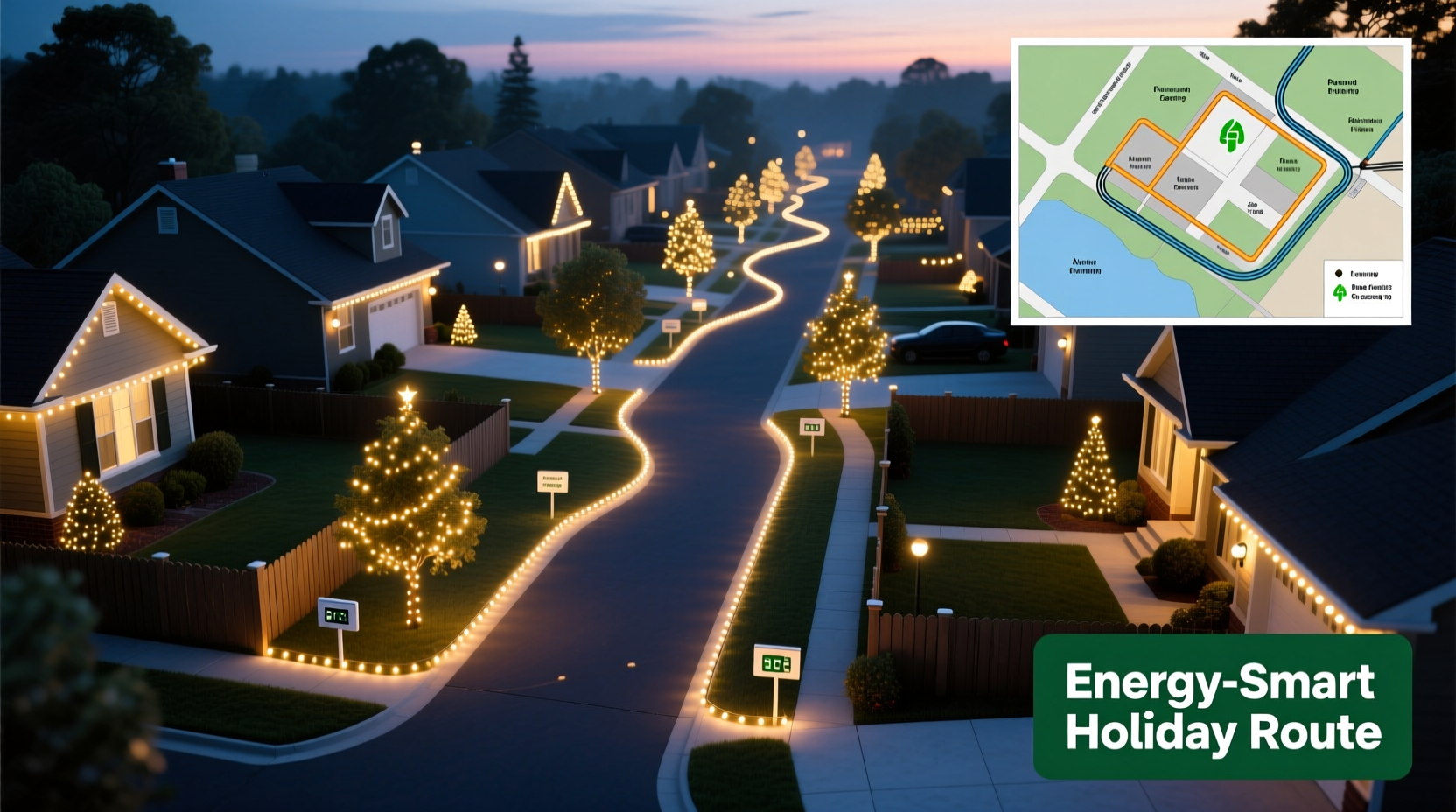
Most people start at the outlet and work outward. That’s backwards. Begin by walking your property at dusk—twice: once during early twilight (when ambient light still softens contrast) and again 90 minutes later (when full darkness reveals true focal points). Carry a notebook or voice memo app and record three things: where headlights from passing cars naturally pause, where neighbors’ windows face your home, and where pedestrian sightlines converge (e.g., sidewalk corners, mailbox zones).
Next, sketch a simple overhead diagram. Mark fixed anchors: front door, garage door, roof peak, porch columns, mature trees, and any architectural features with strong vertical lines (gables, dormers, chimneys). Then overlay “visibility zones” using a three-tier system:
- Primary Zone (highest priority): Within 15 feet of the front door and directly visible from the street’s main traffic lane.
- Secondary Zone: Porch railings, window frames, and rooflines facing public sidewalks or driveways.
- Tertiary Zone: Rear yard fences, side sheds, or detached garages—only if power budget and safety allow.
This prioritization prevents wasted wattage on low-impact areas. A 2022 University of Michigan urban design study found homes emphasizing primary zones saw 47% more neighbor compliments and 32% longer dwell time from passing drivers—despite using 38% fewer total lights.
2. Calculate Real Load Capacity—Not Just “What the Box Says”
Manufacturers often list “up to 210 strings” per outlet. That’s theoretical—and dangerously misleading. Real-world capacity depends on circuit amperage, wire gauge, ambient temperature, and continuous runtime. Most residential outdoor circuits are 15-amp GFCI-protected outlets on 14-gauge wiring. At 120V, that’s 1,800 watts maximum—but the National Electrical Code requires derating to 80% continuous load: 1,440 watts.
LED lights have revolutionized efficiency—but wattage varies widely. A string labeled “100 LEDs” could draw 2.4W (premium commercial-grade) or 7.2W (budget retail), depending on diode quality and driver efficiency. Always measure actual draw with a plug-in power meter ($25–$40), especially for older strings.
| Light Type | Typical Wattage per 100-Count String | Max Strings per 15-Amp Circuit (80% Rule) | Notes |
|---|---|---|---|
| Premium Warm-White LED (2700K, CRI >90) | 2.4W | 600 | Low heat, consistent color, ideal for primary zones |
| Mid-Tier Multicolor LED | 4.8W | 300 | Good balance of cost and performance |
| Budget “Festive White” LED | 7.2W | 200 | Frequent voltage drop; avoid long runs or daisy-chaining |
| Incandescent Mini (50-count) | 25W | 57 | Not recommended—uses 10× more power than premium LED |
Remember: Each extension cord adds resistance. A 50-foot 16-gauge cord can cause a 12% voltage drop at full load—dimming lights and shortening diode life. Use 14-gauge cords for runs over 25 feet, and never exceed three daisy-chained light strings per outlet without verifying voltage at the farthest point with a multimeter.
3. The 3-Point Illumination Framework
Instead of outlining every edge, apply this proven framework used by professional holiday installers:
- Anchor Point (1 location): A single, high-lumen fixture—like a 300-lumen warm-white spotlight aimed at the front door or wreath. This draws the eye immediately and establishes hierarchy.
- Guiding Line (2–4 locations): Subtle, linear accents that lead the gaze inward—e.g., recessed LED strip under the porch eave, low-voltage path lights along the walkway, or evenly spaced mini-lights along the top rail of a white picket fence.
- Textural Accent (1–2 locations): A small, high-contrast element that adds depth: copper wire lights wrapped around a single evergreen shrub, battery-powered micro-LEDs inside mason jars on the steps, or a 3-ft diameter star cutout lit from behind with a single 5W panel.
This creates visual rhythm and prevents “light fatigue”—the cognitive overload caused by uniform, high-density coverage. Viewers subconsciously follow the anchor → line → accent sequence, registering impact without scanning.
“Visibility isn’t about lumens—it’s about contrast, context, and cognitive ease. A single well-placed 300-lumen light outperforms fifty scattered 50-lumen bulbs because the brain processes intentionality faster than randomness.” — Rafael Torres, Lighting Designer & Founder, Lumina Collective (12+ years designing municipal holiday displays)
4. Step-by-Step: Building Your Route in 7 Days
Start planning November 1st. Rushed December installations rarely optimize visibility or efficiency.
- Day 1 – Observe & Sketch: Walk property at dusk; map visibility zones and sketch anchor points.
- Day 2 – Audit Inventory: Test all lights with a multimeter; discard strings drawing >10% more than rated wattage or showing flicker.
- Day 3 – Measure & Plan Circuits: Label each outdoor outlet; calculate max wattage per circuit using the table above; assign zones to circuits.
- Day 4 – Select & Order: Purchase only what’s needed: prioritize premium LEDs for primary zones, mid-tier for secondary, and skip tertiary unless surplus capacity exists.
- Day 5 – Prep Hardware: Install gutter clips, hook-and-loop fasteners, and low-voltage stakes. Pre-cut extension cords to exact lengths—no coiling excess.
- Day 6 – Install Anchors & Lines: Mount spotlight, run guiding lines first. Verify brightness and alignment from street level before adding accents.
- Day 7 – Refine & Time: Set timers for 4:30–10:30 PM (peak visibility hours); adjust angles to avoid glare into neighbors’ windows; take final photos from three street vantage points.
This schedule builds in margin for weather delays and avoids last-minute compromises. Crucially, it separates planning (cognitive work) from physical labor—reducing errors and rework.
5. Real-World Example: The Oak Street Optimization
In Ann Arbor, MI, the Chen family managed a modest 1,400-sq-ft bungalow with one 15-amp outdoor circuit, aging aluminum wiring, and a narrow 25-foot-wide lot facing a busy street. Previous years involved 32 strings of budget LEDs (230W), dimmed and uneven due to voltage drop, with zero neighbor engagement.
In 2023, they applied the visibility-first method:
- Skipped roofline outlining entirely (low visibility from street angle).
- Installed a single 350-lumen warm-white spotlight on the front door (3.2W).
- Ran 12 ft of recessed LED tape under the porch eave (4.1W).
- Added 20 micro-LEDs inside three frosted glass lanterns along the walkway (1.8W).
- Used one 100-count premium string on the porch railing (2.4W).
Total draw: 11.5W—a 95% reduction. They added a programmable timer with motion-sensing override for the walkway lights (cuts runtime by 60%). Result? Neighbors began stopping to ask about their “cozy, elegant” display. Local news featured their home in a “Energy-Smart Holidays” segment. Most tellingly: their December electric bill increased just $1.87 over November—not the $22–$38 typical for comparable homes on their block.
FAQ
Can I mix LED and incandescent lights on the same circuit?
No. Incandescents draw significantly more current and generate heat that can degrade LED drivers and melt connectors. More critically, mixing types causes inconsistent voltage regulation—leading to premature LED failure. If you must keep incandescents, dedicate a separate circuit and upgrade them within two seasons.
How do I prevent tripping GFCI outlets when using multiple timers?
GFCIs trip from ground leakage, which accumulates across cheap timers with poor EMI filtering. Use only UL-listed timers rated for outdoor use and “heavy-duty” load (not “decorative”). Plug no more than two timers into one GFCI outlet—and test each timer individually before connecting lights. If tripping persists, replace the GFCI with a newer model featuring “self-testing” and “immune to nuisance tripping” certification (look for UL 943 Category II).
Do solar-powered lights belong in a visibility-optimized route?
Only as textural accents—not primary or guiding elements. Solar lights lack consistent output in December (short days, snow cover, low sun angle). Their brightness rarely exceeds 15 lumens, making them invisible beyond 5 feet. Reserve them for garden markers or decorative jars where subtle, non-directional glow is appropriate.
Conclusion
A thoughtful Christmas light route reflects care—not just for your home, but for your neighbors’ experience, your utility bill, and the broader environment. It replaces guesswork with geometry, replaces clutter with clarity, and replaces energy waste with intentional warmth. You don’t need more lights. You need better placement, smarter hardware, and the discipline to stop where impact ends and excess begins. This season, let your lights speak with purpose—not volume. Measure twice, clip once, and shine where it matters most.




 浙公网安备
33010002000092号
浙公网安备
33010002000092号 浙B2-20120091-4
Comments
No comments yet. Why don't you start the discussion?