
Saying no is one of the most difficult social skills to master. Whether it’s a birthday party, work event, or last-minute dinner invite, turning someone down can feel awkward—especially when you care about their feelings. Yet learning to decline gracefully isn’t just polite; it’s essential for maintaining healthy boundaries and personal well-being.
The key lies not in avoiding invitations altogether, but in communicating your refusal with sincerity, respect, and clarity. When done right, a declined invitation doesn’t damage relationships—it strengthens them by fostering honesty and mutual understanding.
Why Polite Declines Matter
People often fear that saying no will make them seem unkind, disinterested, or aloof. But consistently accepting every invitation out of guilt or obligation leads to burnout, resentment, and reduced presence—even if you show up physically.
A thoughtful decline shows emotional intelligence. It signals that you value both your time and the other person’s effort in extending the invitation. According to Dr. Laura Mitchell, a communication psychologist at Columbia University:
“Authenticity in relationships includes the ability to say ‘no’ without shame. When delivered with empathy, a refusal can actually deepen trust.” — Dr. Laura Mitchell, Communication Psychologist
Politeness isn’t about always saying yes—it’s about honoring others while staying true to yourself.
Key Principles for Graceful Refusals
Before crafting your message, keep these foundational principles in mind. They form the backbone of any effective, respectful decline.
- Respond promptly. Delaying your reply adds uncertainty and may cause unnecessary planning on the host’s part.
- Express appreciation first. Acknowledge the effort behind the invitation.
- Be honest—but not overly detailed. Share enough context to feel genuine, but avoid oversharing or inventing excuses.
- Offer an alternative (if possible). Suggesting another time shows continued interest in the relationship.
- Maintain a warm tone. Use positive language even when delivering a negative response.
Step-by-Step Guide to Declining Any Invitation
Follow this five-step process to compose a courteous and clear refusal every time:
- Open with appreciation. Thank the person for including you. This validates their gesture regardless of your response.
- State your decision clearly. Use direct language: “I won’t be able to attend,” rather than vague phrases like “I’m not sure.”
- Give a brief reason (optional). Keep it simple: scheduling conflict, prior commitment, health reasons, etc.
- Reaffirm your regard for the person or occasion. Mention that you wish them well or would have loved to be there.
- Close warmly. End with good wishes, enthusiasm for future plans, or a kind personal note.
This structure ensures clarity without coldness. It prevents misunderstandings while preserving goodwill.
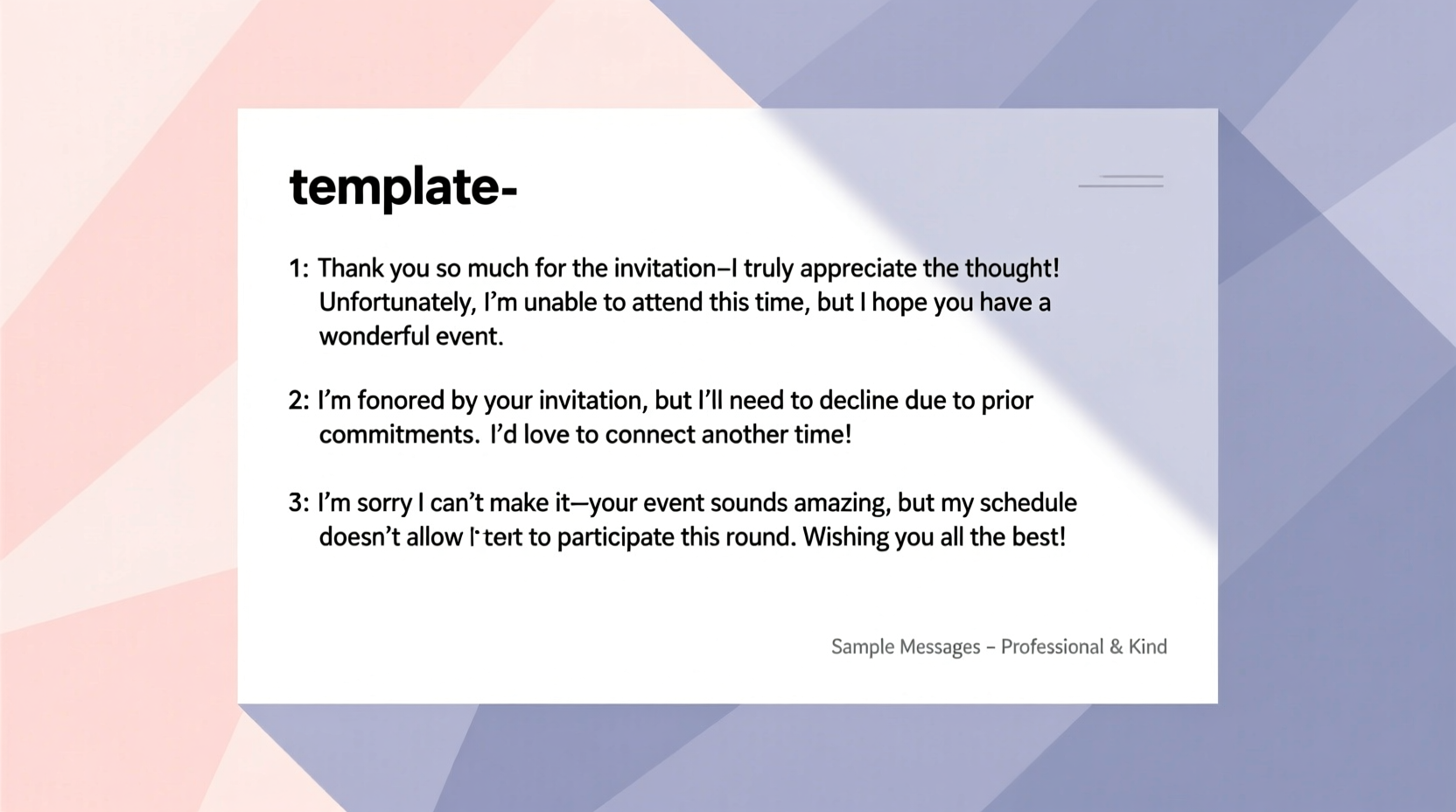
Sample Messages for Common Scenarios
Different situations call for different tones. Below are realistic examples tailored to frequent types of invitations.
| Scenario | Message Example |
|---|---|
| Birthday Party (Friend) | “Hey Jamie, thank you so much for inviting me to your birthday celebration! I’d love to celebrate with you, but I already have a prior family commitment that weekend. I’m really sorry to miss it—I hope it’s amazing and full of joy. Let’s plan something just the two of us soon!” |
| Work Social Event | “Hi Maria, thanks for sending the details for the team dinner. I appreciate the invite, but I won’t be able to join due to a personal appointment. Wishing everyone a great evening, and I’ll catch up with you all next week!” |
| Wedding (Out-of-Town) | “Dear Sarah and Tom, congratulations again on your engagement! Your wedding sounds absolutely beautiful, and I’m honored to be included. After careful thought, I regret that I won’t be able to travel for the event due to existing commitments. Please know I’m sending my warmest wishes and will be cheering you on from afar.” |
| Last-Minute Dinner Invite | “Thanks for thinking of me tonight! That sounds fun, but I’ve already got plans at home I can’t change. Another time soon?” |
| Volunteer Request (Overcommitted) | “Hi David, I truly admire the work you’re doing with the community garden. Unfortunately, my schedule is completely full this month, and I wouldn’t be able to give the role the attention it deserves. I hope the event goes wonderfully!” |
Do’s and Don’ts of Declining Invitations
To refine your approach, consider this comparison of effective versus counterproductive behaviors.
| Do’s | Don’ts |
|---|---|
| Do express gratitude immediately | Don’t ignore the invitation |
| Do be concise and sincere | Don’t fabricate dramatic excuses |
| Do respond in a timely manner | Don’t apologize excessively |
| Do reaffirm your connection | Don’t over-explain or justify |
| Do suggest a future meetup if appropriate | Don’t leave the door open ambiguously (“Maybe next time…” without follow-up intent) |
Real-Life Scenario: Navigating a Close Friend’s Surprise Party
Lena received a text from her best friend, Maya, asking her to help organize a surprise birthday party for their mutual friend, Jordan. Excited at first, Lena realized the event fell on the same weekend as her sister’s graduation—an important family milestone she had already committed to attending.
She responded:
“Maya, thank you so much for trusting me with this! I’m honored you thought of me to help plan Jordan’s surprise. I know how much he means to you, and I love that you’re doing something special. Unfortunately, I’ll be out of town for my sister’s graduation that weekend and won’t be able to assist. I’m really sorry—I wish I could be there! If you need moral support or ideas ahead of time, I’m all ears. And I’ll make sure to celebrate with Jordan the week after!”
The result? Maya appreciated Lena’s honesty and didn’t take it personally. In fact, she later said she respected Lena for prioritizing family. The friendship remained strong, and they scheduled a coffee date the following month to reconnect.
This example illustrates how transparency, paired with warmth and recognition of the occasion’s importance, preserves relationships even when you can’t participate.
When You Need to Say No Repeatedly
Sometimes, the same person invites you frequently—perhaps a colleague who hosts weekly happy hours or a relative who organizes monthly gatherings. If you find yourself declining often, it’s wise to address the pattern gently.
In such cases, consider adding a layer of reassurance:
“I always appreciate your invites—they mean a lot. While I can’t make it this time, I genuinely value our time together and look forward to connecting when my schedule allows.”
If the person seems hurt or confused over multiple declines, a brief conversation (in person or via voice note) can clarify your intentions without drama.
Checklist: Crafting the Perfect Polite Decline
Use this checklist before sending any refusal message to ensure it strikes the right balance:
- ✅ Opened with gratitude
- ✅ Clearly stated inability to attend
- ✅ Provided a short, honest reason (without over-justifying)
- ✅ Expressed regret or well-wishes
- ✅ Closed with warmth or future intent
- ✅ Proofread for tone and clarity
- ✅ Sent within 24–48 hours of receiving the invite
Running through these points helps prevent miscommunication and ensures your message feels considerate, not dismissive.
Frequently Asked Questions
What if I don’t want to give a reason?
You’re under no obligation to explain why you’re declining. A simple, “Thank you for the invite—I won’t be able to make it this time, but I hope you have a wonderful event!” is perfectly acceptable. Personal boundaries deserve respect, even without justification.
Is it worse to decline late or not respond at all?
Not responding is almost always worse. Silence can be interpreted as disrespect or indifference. Even a late decline is better than radio silence. Apologize briefly for the delay and offer your regrets: “So sorry for the late reply—I just saw your message. I won’t be able to attend, but I hope everything goes beautifully!”
How do I say no to someone who gets easily offended?
With extra empathy. Focus on affirming your relationship: “I always enjoy spending time with you, which makes it extra hard to miss this. I really wish I could be there, but I’m tied up with something I can’t reschedule. Can we plan something just us soon?” This softens the refusal while reinforcing connection.
Final Thoughts: Saying No Is an Act of Respect
Declining an invitation doesn’t have to come at the cost of kindness. In fact, when done with care, it reflects maturity, self-awareness, and respect—for both yourself and the person inviting you.
Every time you decline politely, you model healthy communication. You teach others that it’s okay to set limits, honor priorities, and still maintain meaningful connections. Over time, this builds deeper, more authentic relationships rooted in honesty rather than obligation.




 浙公网安备
33010002000092号
浙公网安备
33010002000092号 浙B2-20120091-4
Comments
No comments yet. Why don't you start the discussion?