
When winter storms knock out grid power, holiday cheer shouldn’t go dark. A portable power station—battery-powered, silent, and emissions-free—can keep your Christmas lights glowing through even multi-day outages. But success isn’t just about plugging in and hoping. It requires understanding your lights’ true energy draw, matching it to the right station, accounting for cold-weather battery degradation, and wiring safely indoors or outdoors. This guide distills field-tested practices from emergency preparedness specialists, off-grid electricians, and homeowners who’ve kept their displays lit through ice storms, hurricanes, and subzero blackouts. No speculation. Just actionable physics, real-world constraints, and decisions that prevent tripped breakers, premature battery drain, or fire hazards.
1. Calculate Your Lights’ Real Power Demand (Not Just What’s on the Box)
Manufacturers often list “maximum” or “peak” wattage for light strings—especially older incandescent sets—which can be wildly misleading. A 100-light incandescent string might claim “40W,” but if it’s wired in parallel (common in newer sets), actual draw could be 65W under load. LED strings are more consistent, but cheap imports frequently understate consumption by 15–25% due to unregulated drivers.
Here’s how to measure accurately:
- Use a Kill A Watt meter (or similar plug-in power monitor). Plug your fully assembled light string—including extension cords and any controllers—directly into the meter, then into a wall outlet.
- Let it run for 10 minutes to stabilize. Note both watts (W) and VA (volt-amps). For resistive loads like most lights, they’ll be nearly identical—but if you’re using smart controllers or dimmers, VA may be higher due to reactive power.
- Multiply per-string draw by total strings—but only those you’ll run simultaneously. Don’t count spares or backup strings.
Example: You have 8 strings of warm-white 200-LED mini lights. Each draws 7.2W measured. Total load = 8 × 7.2W = 57.6W.
2. Match Your Power Station to Runtime & Conditions
A power station’s advertised capacity (e.g., “2000Wh”) is its DC battery storage—not AC output capability. Two critical specs determine whether it’ll work for your display: continuous AC output rating (in watts) and usable battery capacity (in Wh). Many stations throttle output below 10°C (50°F); some cut off entirely below −10°C (14°F).
| Power Station Tier | Typical Continuous AC Output | Usable Capacity (Wh) | Realistic Runtime for 60W Load (at 10°C) | Best For |
|---|---|---|---|---|
| Budget (e.g., Jackery 500) | 300–500W | 400–450Wh | 5–6 hours | Small indoor tree + 2–3 window strings |
| Mid-Range (e.g., EcoFlow Delta 2) | 1000–1800W | 1024–1300Wh | 12–14 hours | Full outdoor roofline + porch + indoor tree |
| Heavy-Duty (e.g., Bluetti AC300 + B300) | 3000W+ | 3072–6144Wh | 36–60+ hours | Large residential displays, commercial setups, multi-day resilience |
Note: Runtime assumes 85–90% inverter efficiency and accounts for ~15% cold-weather capacity loss. At −5°C (23°F), a station rated for 1000Wh may deliver only 850Wh usable energy.
Also consider portability. A 60-lb unit with wheels makes sense for a garage-to-porch setup—but if you need to carry it up stairs to a second-floor living room, weight and handle ergonomics matter more than raw capacity.
3. The Critical Safety & Wiring Checklist
Portable power stations eliminate carbon monoxide risk—but introduce new hazards if misused. Overloading, improper grounding, moisture exposure, and daisy-chaining cause most failures during holiday use.
- Never exceed 80% of the station’s continuous AC output rating. Running a 1000W station at 950W continuously risks thermal shutdown and shortens inverter lifespan.
- Use only outdoor-rated, 16-gauge (or thicker) extension cords. Indoor cords overheat when coiled or buried under snow. Look for “SJTW” or “STW” rating on the jacket.
- Keep all connections elevated and dry. Place the power station on a non-conductive surface (rubber mat, dry plywood) inside a covered porch or garage—not directly on concrete or snow-melt puddles.
- No daisy-chaining power strips. Use a single, high-quality surge-protected power strip rated for outdoor use (UL 1449 Type 3) if you need multiple outlets. Avoid “Christmas light timers” with built-in outlets unless explicitly certified for generator/station use.
- Verify GFCI protection. If your station has a GFCI outlet (most do), test it monthly with the “TEST” button. If not, plug into a GFCI-protected outlet—or add a portable GFCI adapter.
“More holiday electrical incidents occur from cord damage and moisture ingress than from battery failure. Treat every outdoor connection like it’s exposed to rain—even if it’s ‘just’ snow.” — Carlos Mendez, NFPA Certified Electrical Safety Instructor
4. Step-by-Step Setup for Reliable, All-Night Operation
This sequence prioritizes reliability over speed. Skipping steps increases failure risk during critical hours—like Christmas Eve.
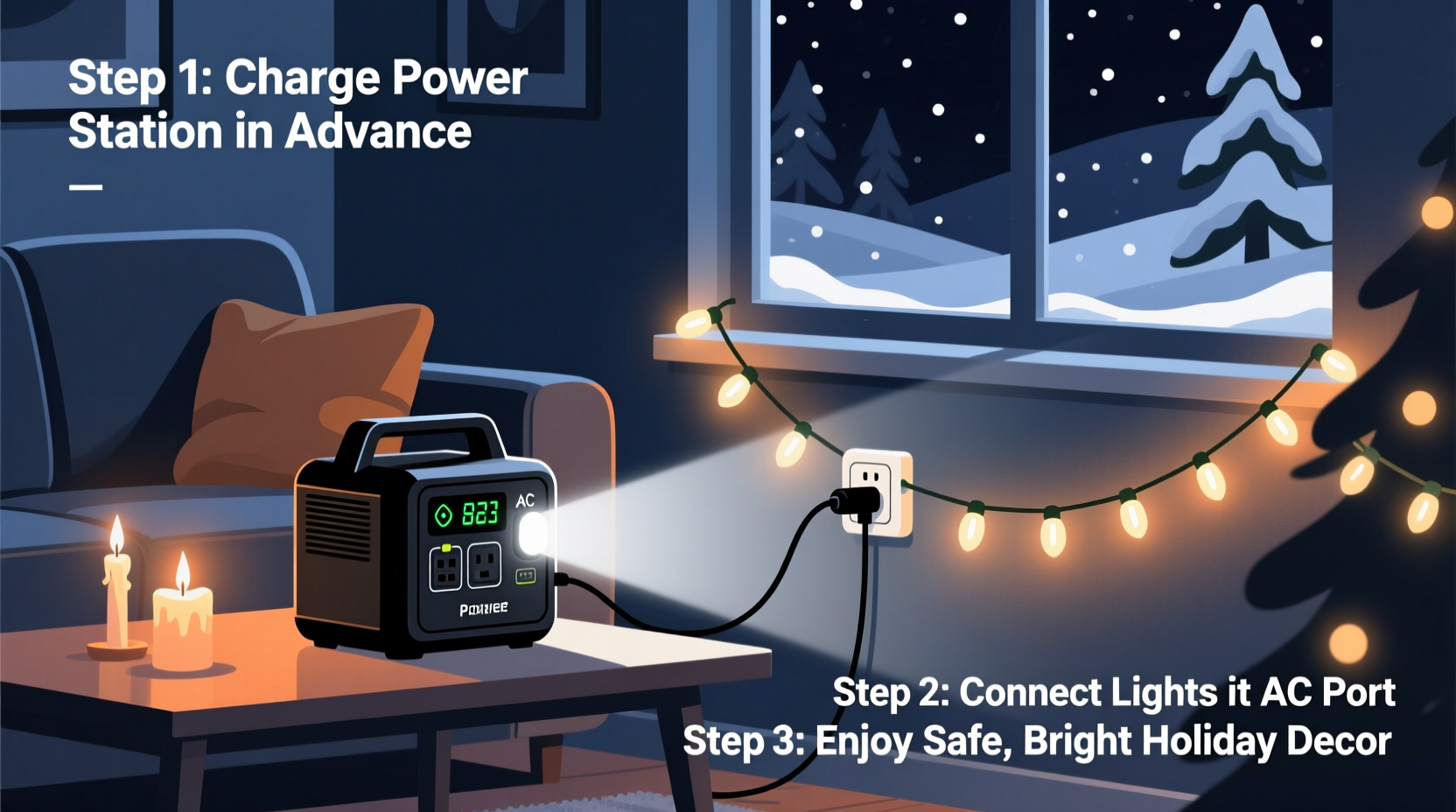
- Charge fully before outage begins. Plug into grid power 48 hours ahead. Let it reach 100%, then rest for 2 hours to stabilize cell voltage. Avoid storing at 100% for >72 hours—set to 60–80% if outage isn’t imminent.
- Test the full chain cold. With station charged, connect lights *before* the outage hits. Run for 30 minutes at night. Check for flickering, overheating cords, or inverter fan noise spikes.
- Pre-warm the station if temps are below 5°C (41°F). Bring it indoors for 1–2 hours before deploying. Lithium batteries perform best between 10–25°C (50–77°F). A 5°C increase in battery temperature can improve usable capacity by 8–12%.
- Deploy with redundancy logic. Prioritize circuits: Tree first → Front windows → Porch → Roofline. Use a manual switch or timed power strip to stagger startup—avoiding inrush current surges when all controllers boot simultaneously.
- Monitor hourly for first 3 hours. Check station display for voltage sag (<115V AC indicates overload), battery % drop rate, and cord warmth. If any cord feels warm to touch, unplug immediately and inspect connections.
5. Mini Case Study: The Vermont Ice Storm (December 2022)
In northern Vermont, a 72-hour ice storm downed power lines across three counties. Sarah R., a teacher and avid holiday decorator, lost grid power on December 20th at 4:15 p.m. Her display included 12 strands of 150-LED warm white lights (measured at 8.4W each), a 24W animated reindeer, and a 12W LED star projector—total load: 126W.
She used an EcoFlow Delta 2 (1024Wh usable, 1800W AC output) stored in her insulated garage. Following the pre-storm checklist, she’d charged it to 95% and warmed it to 12°C (54°F) for 90 minutes before moving it to her covered front porch. She ran lights from 4:30 p.m. to 8:00 a.m. daily, using a timer to shut off at dawn. On Day 2, she noticed the battery dropped faster after midnight—investigating, she found snow had drifted over the station’s exhaust vents. Clearing them restored expected runtime.
Result: Lights stayed on for 71 consecutive hours. Battery retained 19% charge at outage end—enough to power her Wi-Fi router and phone charger for another 12 hours. Key insight: Ventilation and thermal management mattered more than raw capacity.
6. FAQ: Addressing Common Concerns
Can I leave my power station outside overnight during an outage?
No. Even “weather-resistant” stations aren’t waterproof or rated for sustained subzero exposure. Condensation inside the unit can cause short circuits. Always place it under cover—a porch roof, carport, or garage doorway—with airflow maintained. Never enclose it in plastic or a sealed box.
What if my lights flicker or dim after 2 hours?
Flickering usually signals one of three issues: (1) Voltage sag from overloaded inverter—unplug non-essential strings; (2) Low battery state—some stations reduce AC voltage as charge drops below 20%; (3) Loose connection or corroded outlet—check all plugs and twist connections firmly. If flickering persists after checking these, stop use and consult the manufacturer.
Do I need a pure sine wave inverter?
Yes—for anything with electronics, including LED controllers, timers, or animated figures. Modified sine wave inverters can damage microcontrollers, cause audible buzzing in transformers, and reduce LED lifespan by up to 40%. All reputable portable power stations now use pure sine wave output—verify this spec before purchasing.
Conclusion
Powering Christmas lights with a portable station isn’t about convenience—it’s about continuity. It’s the quiet hum of a battery keeping tradition alive while neighbors sit in darkness. It’s the relief of knowing your child’s excitement won’t be dimmed by a downed transformer. But that reliability doesn’t come from gear alone. It comes from measuring, not guessing. From testing before crisis, not improvising during it. From respecting the physics of cold batteries and the fragility of outdoor wiring. Choose capacity wisely, prioritize thermal management, wire with discipline, and treat every connection as mission-critical. When the next outage arrives—and it will—you won’t just keep your lights on. You’ll keep your peace of mind glowing too.




 浙公网安备
33010002000092号
浙公网安备
33010002000092号 浙B2-20120091-4
Comments
No comments yet. Why don't you start the discussion?