
Every holiday season, millions of homeowners experience the same frustrating sequence: lights go up, the outlet is plugged in—and suddenly, the living room goes dark. A loud click, a dead circuit, and a cascade of unlit garlands. Tripped breakers aren’t just inconvenient—they’re a warning sign. Overloaded circuits generate heat, degrade wiring insulation, and increase fire risk. According to the U.S. Fire Administration, electrical distribution and lighting equipment cause an estimated 25,000 home fires annually—nearly 10% of which occur in December. The good news? Most Christmas light-related breaker trips are entirely preventable with basic electrical literacy, simple math, and disciplined setup habits. This guide walks through proven, code-aligned methods used by professional lighting installers and residential electricians—not theoretical advice, but field-tested practices that keep circuits stable, lights bright, and homes safe.
Understand Your Circuit’s Real-World Capacity
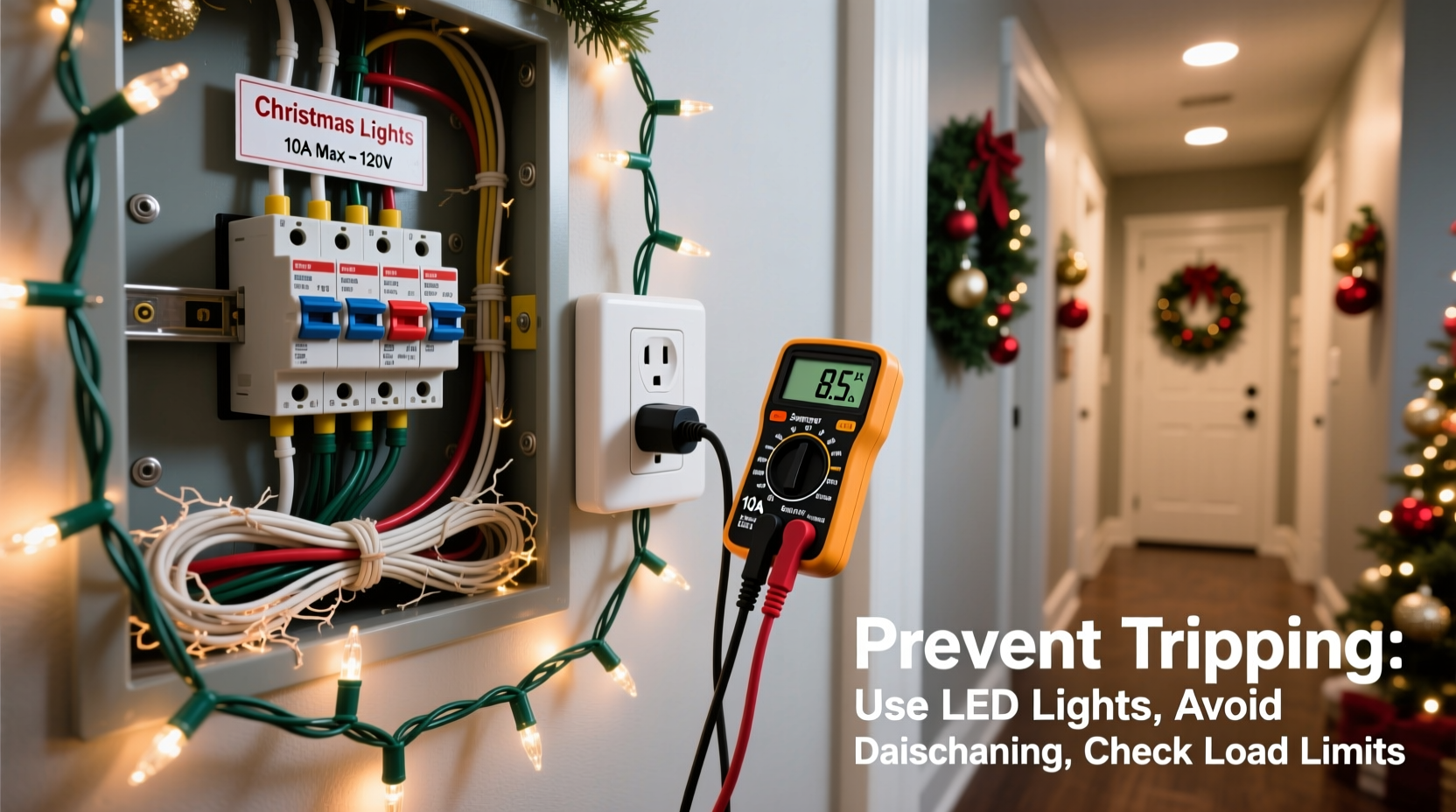
Most people assume “15-amp circuit = 1800 watts” and stop there. But that number is a maximum *theoretical* rating—not a safe continuous load. The National Electrical Code (NEC) requires circuits to operate at no more than 80% of their rated capacity for continuous loads (defined as those lasting three hours or more—exactly how long your lights will run on Christmas Eve). So a standard 15-amp, 120-volt household circuit has a safe continuous load limit of just 1440 watts (15 × 120 × 0.8). A 20-amp circuit drops to 1920 watts.
Yet many homeowners plug in five strands of incandescent mini-lights (each drawing ~210 watts) into one outlet—totaling over 1000 watts—then add a heated wreath (150W), LED tree lights (60W), and a fiber-optic snowfall projector (75W). That’s already 1300+ watts before counting the coffee maker sharing the same circuit. Add voltage drop from long extension cords or daisy-chained outlets, and resistance spikes—triggering the breaker’s thermal-magnetic trip mechanism.
Calculate Load Accurately—Not Just by Strand Count
Christmas light wattage varies wildly—and packaging often misleads. “Energy-efficient” labels may refer only to per-bulb output, not total string draw. Always calculate based on actual measured or manufacturer-specified wattage—not assumptions.
| Light Type | Avg. Watts per 100 ft | Max Safe Strands per 15A Circuit (1440W) | Key Notes |
|---|---|---|---|
| Incandescent Mini-Lights (2.5V, 50 bulbs) | 210–240 W | 5–6 strands | High heat; sensitive to voltage drop; avoid daisy-chaining beyond 3 strings |
| LED Mini-Lights (50–100 bulbs) | 4–7 W | 150–200+ strands | Low heat; verify UL listing—cheap imports often omit surge protection |
| C7/C9 Incandescent (25 bulbs) | 175–225 W | 6–8 strands | Commonly overloaded on porch circuits; check socket ratings |
| LED C9 Retrofit Bulbs | 1.5–3 W per bulb | 300–500+ bulbs | Use only with compatible sockets; avoid mixing with incandescent on same circuit |
| Projected Lights / Animators | 35–120 W | 12–40 units | Often overlooked in load calcs; many include internal transformers that spike inrush current |
Note: These numbers assume direct connection to a dedicated outlet. Add 15–25% overhead if using extension cords longer than 25 feet or gauge smaller than 16 AWG. For example, a 50-foot, 18-gauge cord adds ~3.2 ohms resistance—reducing effective voltage at the last string by up to 9 volts. That forces LEDs to draw more current to maintain brightness, pushing the circuit closer to its thermal limit.
Strategic Outlet & Power Distribution Plan
Breaker trips rarely stem from a single overloaded outlet—they result from poor *distribution*. Holiday lighting should never rely on one receptacle. Instead, treat your home like a micro-grid: map circuits, assign zones, and isolate high-draw devices.
- Map your circuits first. Use a circuit tracer or methodically turn off each breaker while testing outlets, lamps, and GFCI receptacles. Note which outdoor outlets, garage plugs, and interior wall sockets fall under each breaker.
- Assign lighting zones by circuit. Example: Front porch + driveway lights → Circuit A (20A, GFCI-protected). Living room mantle + tree + window frames → Circuit B (15A, AFCI-protected). Backyard fence + patio → Circuit C (dedicated 20A).
- Never daisy-chain power strips or multi-outlet adapters. UL 1363-rated power strips are designed for office electronics—not sustained 12+ hour loads of 1000+ watts. Their internal bus bars overheat silently.
- Use outdoor-rated, heavy-duty extension cords (12–14 AWG) with built-in circuit breakers. Look for models with 15A resettable breakers—these act as localized fail-safes before your main panel trips.
- Plug high-wattage items into different phases. In split-phase 240V systems (standard in U.S. homes), adjacent breakers in the panel often sit on opposite legs. Plugging a 1000W projector into Breaker 3 (Leg A) and a 900W heated wreath into Breaker 4 (Leg B) balances load across the service—reducing neutral current and transformer stress.
Real-World Case Study: The Overlooked Porch Circuit
In December 2023, a homeowner in Portland, Oregon, repeatedly tripped the same 15-amp breaker every evening at 5:30 p.m. They’d checked strand counts, replaced fuses, and even bought a new “heavy-duty” power strip. An electrician discovered the root cause wasn’t the lights—it was the circuit’s hidden load profile. The porch outlet shared the circuit with: two recessed kitchen can lights (60W each), a refrigerator’s ice maker (85W), and the garage door opener’s logic board (12W). During early winter evenings, when daylight faded, the homeowner turned on all kitchen lights, activated the ice maker, opened the garage door, and switched on the porch lights—all within 90 seconds. The combined inrush current (especially from the fridge compressor cycling on) pushed the circuit past 1440W for >3 seconds, triggering the thermal trip.
The fix was surgical: the electrician relocated the porch outlet to a dedicated 20-amp circuit with GFCI protection and installed a timed outlet for the ice maker (delaying its cycle until after lights were on). No new lights were purchased. No strands removed. Just precise load management.
“People think breakers trip because of ‘too many lights.’ In reality, it’s almost always about timing, shared loads, and inrush current. A single 150W LED projector can trip a circuit if it powers on the exact millisecond a furnace blower kicks in.” — Marcus Delaney, Master Electrician & NEC Code Trainer, IAEI Pacific Chapter
Actionable Prevention Checklist
- ☑️ Verify circuit amperage at your breaker panel—not the outlet faceplate.
- ☑️ Calculate total wattage of all devices on the circuit—not just lights (e.g., refrigerators, aquarium heaters, sump pumps).
- ☑️ Measure actual voltage at the outlet under load using a multimeter (should be ≥114V; below 110V indicates serious voltage drop).
- ☑️ Replace any outlet older than 15 years—loose contacts increase resistance and heat.
- ☑️ Install a whole-house surge protector (UL 1449 Type 2) to prevent transient spikes from damaging LED drivers and tripping breakers.
- ☑️ Label every circuit breaker clearly—include outlet locations and max recommended wattage (e.g., “Porch: Max 1400W LED / 900W Incandescent”).
- ☑️ Test GFCI and AFCI outlets monthly—a failing GFCI can intermittently trip under normal load.
Frequently Asked Questions
Can I use a 30-amp generator outlet to power my lights safely?
No—unless your entire lighting system is wired directly to the generator via a transfer switch. Plugging a standard 15-amp extension cord into a 30-amp generator outlet bypasses all overcurrent protection. Generators have internal breakers, but mismatched cords create fire hazards: 15-amp cords overheating on 30-amp circuits can melt before the generator’s breaker trips. Always match cord rating to outlet rating.
Why do my LED lights trip the breaker when incandescents didn’t?
Counterintuitively, low-wattage LEDs can cause more nuisance trips due to power factor and harmonic distortion. Cheap LED drivers draw current in short, high-amplitude bursts rather than smoothly. This creates harmonic currents that overheat neutral wires and confuse electronic breakers. Choose LEDs with power factor >0.9 and UL 8750 certification—these include active power factor correction.
Is it safe to plug two 15-amp power strips into one outlet using a “Y” adapter?
No. This violates NEC 210.21(B)(1) and voids UL listing. A standard duplex outlet is rated for 15 amps total—not 15 amps per socket. A “Y” adapter forces both strips to share the same hot/neutral pair, doubling contact resistance at the outlet. Under load, this creates arcing, carbon tracking, and temperatures exceeding 200°F inside the receptacle. It’s a leading cause of outlet fires.
Conclusion: Safety Is the First Decoration
Preventing Christmas light breaker trips isn’t about limiting joy—it’s about honoring the quiet discipline of safety that makes celebration possible. Every properly calculated load, every labeled circuit, every replaced aging outlet is a choice to protect what matters most: your family, your home, and the peace of mind that comes with knowing your lights shine without risk. You don’t need expensive gadgets or rewiring to start. Begin tonight: open your breaker panel, identify one circuit, and write down every device connected to it. Then apply the 80% rule. Swap one incandescent strand for LED. Replace that frayed 100-foot extension cord with a 14-gauge outdoor model. These aren’t chores—they’re acts of care, woven into the tradition itself.




 浙公网安备
33010002000092号
浙公网安备
33010002000092号 浙B2-20120091-4
Comments
No comments yet. Why don't you start the discussion?