
Every year, the joy of decorating for Christmas is often cut short by a familiar frustration: untangling a chaotic knot of holiday lights. What should be a festive tradition becomes a test of patience, with delicate wires twisting into impossible snarls. But there’s a surprisingly effective, low-cost solution hiding in plain sight—paper towel rolls. This humble household item isn’t just for cleaning spills; it can revolutionize how you store your Christmas lights and eliminate tangles for good.
The method is simple, sustainable, and accessible to nearly everyone. By repurposing empty paper towel tubes, you create a structured spool that keeps each strand neatly wound, protected, and instantly ready for next year’s display. No more wasted hours or broken bulbs. This guide walks you through exactly how to implement this clever storage hack, why it works so well, and how to adapt it for different types of lighting.
Why Christmas Lights Tangle—and How Paper Towel Rolls Solve It
Tangled Christmas lights are more than just an annoyance—they’re a predictable outcome of improper storage. When lights are haphazardly stuffed into boxes or loosely wrapped around cardboard, even slight movement during storage causes loops to shift, twist, and lock together. The longer they sit, the tighter the knots become.
Physics plays a role too. According to research published in the Proceedings of the National Academy of Sciences, any long, flexible strand has a high probability of self-entanglement when agitated—even slightly. That means every time you move a box in the attic or basement, your lights are getting knottier.
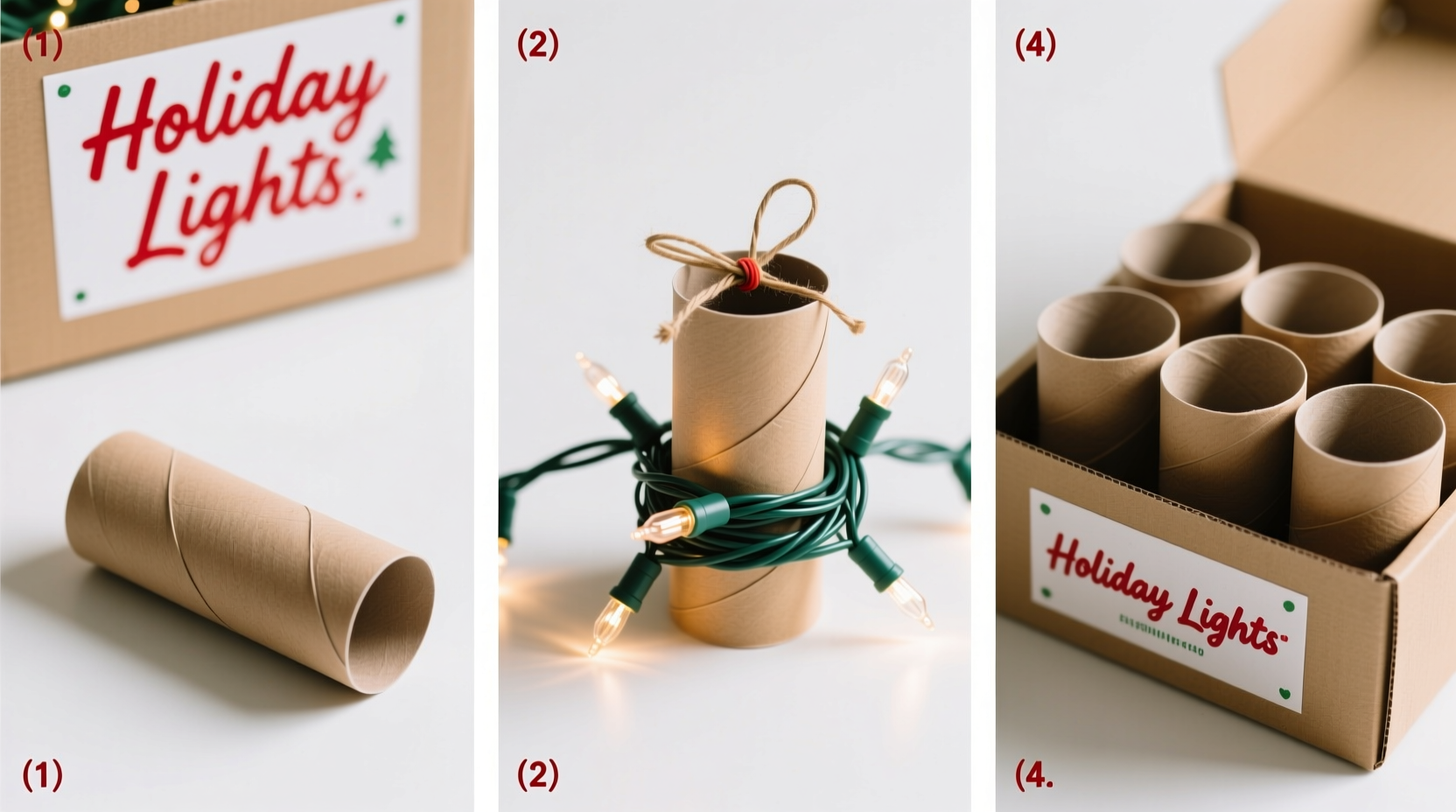
Paper towel rolls act as passive organizers. Their cylindrical shape allows you to wrap lights in a single, consistent direction without backtracking or overlapping. The open center provides ventilation and makes it easy to thread the plug end through for secure fastening. Most importantly, the rigid structure prevents crushing and shifting, which are primary causes of tangles.
“Using a firm core like a paper towel roll stops random coiling and maintains tension control during winding. It’s one of the most underrated yet effective methods for seasonal cord storage.” — Dr. Linda Chen, Home Organization Researcher, University of Minnesota Extension
Step-by-Step Guide: Wrapping Lights on Paper Towel Rolls
This process takes only a few minutes per string but saves hours later. Follow these steps carefully to ensure maximum effectiveness.
- Gather Supplies: Collect your used Christmas lights, empty paper towel rolls, masking tape or twist ties, and a permanent marker.
- Prepare the Roll: Flatten one end of the tube slightly and tape it shut. This prevents the bulb ends from slipping through.
- Start Wrapping: Hold the plug end securely and begin wrapping the lights around the roll. Keep tension light but consistent—do not stretch or compress the strand.
- Wrap in One Direction: Move in a straight spiral from one end of the roll to the other. Avoid zigzagging or doubling back, as this creates friction points.
- Secure the End: Once fully wrapped, thread the male plug through the center of the roll and loop it over the outside to hold tension. Alternatively, use a twist tie or small piece of tape to fasten both ends.
- Label Clearly: Use a marker to write the light type (e.g., “Warm White Mini,” “Blue Icicle”) and length on the side of the roll.
- Store Vertically or Horizontally: Place rolls in a bin, basket, or shelf where they won’t be crushed. Stack horizontally if space is limited, but avoid heavy items on top.
Repeat this process for each strand. For large displays with multiple sets, consider color-coding with colored tape or storing by location (e.g., “Front Porch,” “Tree Topper”).
Comparison: Storage Methods That Work (and Those That Don’t)
Not all storage techniques are created equal. Here’s how the paper towel roll method stacks up against common alternatives.
| Method | Tangle Prevention | Durability | Cost | Eco-Friendliness |
|---|---|---|---|---|
| Paper Towel Rolls | Excellent | Good (if undamaged) | Free (repurposed) | High (recycled material) |
| Plastic Reels | Excellent | Excellent | $$ | Low (plastic waste) |
| Loose Box Storage | Poor | Fair | Free | Medium |
| Cardboard Tube + Zip Ties | Good | Fair | Free | High |
| Balled-Up Wrap | Very Poor | Poor | Free | High |
The data shows that while commercial reels offer durability, the paper towel roll method wins on cost, accessibility, and environmental impact—all while delivering near-perfect tangle prevention when done correctly.
Real Example: A Family’s Holiday Transformation
The Peterson family in Portland, Oregon, once spent an average of three evenings each December untangling lights. With two outdoor trees, a roofline display, and indoor garlands, their setup included over 1,500 bulbs. “We’d pull out the storage tub and groan,” says Sarah Peterson, a teacher and mother of three. “The kids would lose interest within minutes.”
In 2021, she saw a social media post about using toilet paper rolls for lights. She adapted the idea using larger paper towel cores. That season, she labeled each roll by color and location, then stored them upright in a plastic crate. The following year, her son unwrapped the first strand in under 30 seconds—with zero tangles.
“It changed everything,” Sarah says. “Now we decorate in one night instead of dragging it out. We even started adding new strands because it doesn’t feel like a chore anymore.”
Adapting the Method for Different Light Types
While the basic technique works for most strings, adjustments improve results based on light size and fragility.
- Miniature Lights: These thin-wired strands benefit most from paper roll storage. Wrap tightly but gently—about 1.5–2 inches between wraps—to prevent slippage.
- C7 and C9 Bulbs: Larger bulbs require wider spacing. Use the full diameter of the roll and wrap one bulb per turn to avoid pressure on sockets.
- Icicle Lights: Due to their staggered design, wrap vertically from top to bottom, ensuring droplets don’t press against each other.
- LED Rope Lights: These are stiffer but prone to kinking. Wrap slowly and avoid sharp bends—use two rolls if the strand exceeds 25 feet.
- Fairy Lights (Battery-Operated): Store the battery pack inside the roll’s core after removing batteries to prevent corrosion.
For extra protection, slide each wrapped roll into a reusable grocery bag before boxing. This adds a dust barrier and keeps labels visible.
Checklist: Year-End Light Storage Routine
Follow this checklist annually to maintain order and prevent future tangles.
- Test all lights before storage to replace burned-out bulbs or faulty strands.
- Wipe down cords with a dry cloth to remove dust or outdoor residue.
- Ensure paper towel rolls are clean, dry, and structurally sound.
- Wind each strand separately—never combine multiple sets on one roll.
- Secure both ends and label clearly with type, color, and use case.
- Store in a climate-controlled area away from rodents and moisture.
- Place rolls in a labeled container for quick access next season.
Frequently Asked Questions
Can I use this method for extension cords too?
Absolutely. Paper towel rolls work well for shorter extension cords (under 25 feet). For heavier-duty cords, consider thicker mailing tubes or PVC pipe scraps, but the winding principle remains the same: consistent, unidirectional wrapping prevents internal twisting.
What if I run out of paper towel rolls?
Save rolls throughout the year or collect from friends. Alternatively, cut paper towel tubes in half crosswise to double your supply—ideal for shorter strands like tree toppers or mantle lights. You can also use sturdy toilet paper rolls for very small fairy lights.
Do I need to wrap the lights perfectly tight?
No. Over-tightening can stress wires and lead to breakage. Wrap snugly enough to prevent slippage, but allow slight give. Think of it like rolling a sleeping bag—not compressed, but compact.
Conclusion: End the Tangle Cycle for Good
Christmas should be about celebration, not struggle. The simple act of reusing paper towel rolls transforms how you interact with one of the season’s most frustrating tasks. It’s not just about saving time—it’s about reclaiming the joy of decoration, reducing waste, and building sustainable habits that last for years.
This method costs nothing, requires minimal effort, and delivers outsized returns in convenience and peace of mind. Whether you have a single string or a professional-grade display, the paper towel roll technique scales effortlessly. Start this year, and you’ll wonder how you ever managed without it.




 浙公网安备
33010002000092号
浙公网安备
33010002000092号 浙B2-20120091-4
Comments
No comments yet. Why don't you start the discussion?