
Every year, thousands of pets—especially curious puppies, energetic kittens, and bored indoor cats—investigate holiday decorations with their mouths. Christmas tree wires are particularly vulnerable: thin, insulated, often dangling within reach, and sometimes emitting faint warmth or subtle electromagnetic hums that intrigue sensitive animal senses. Chewing them poses serious risks—not just to your pet’s health (electrocution, internal burns, intestinal obstruction), but also to your home’s fire safety. Yet punitive methods—spraying bitter apple indiscriminately, yelling, or isolating pets during the holidays—undermine trust and ignore the root causes: boredom, teething, anxiety, or instinctual exploration. This article outlines evidence-based, compassionate strategies grounded in veterinary behavior science, feline and canine ethology, and real-world home safety standards. No gimmicks. No fear-based tactics. Just actionable, species-specific solutions that respect your pet’s needs while safeguarding your tree—and your peace of mind.
Why Pets Target Tree Wires: Beyond “Just Chewing”
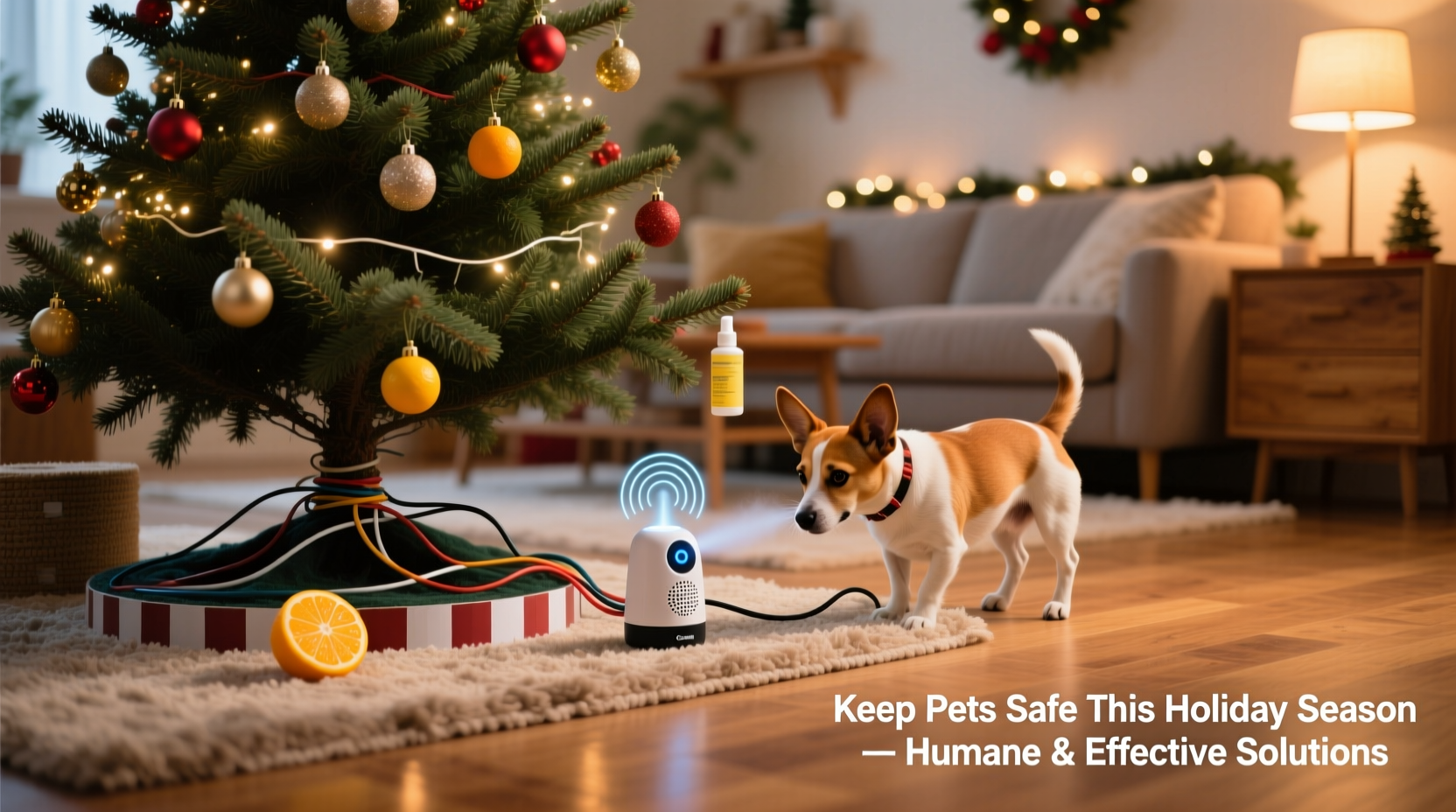
It’s easy to dismiss wire-chewing as misbehavior—but it’s rarely that simple. Veterinarians and certified applied animal behaviorists emphasize that oral exploration serves multiple biological functions:
- Puppies (under 6 months): Actively teething; wires mimic the texture and resistance of chew toys—but without the safety design.
- Kittens and young cats: Driven by predatory play—wires sway like prey, and the faint vibration triggers hunting instincts.
- Senior dogs and anxious pets: May chew due to cognitive decline, separation distress, or redirected frustration when confined away from the decorated room.
- All pets: Drawn to novelty, scent residues (e.g., pine sap on nearby cords), or the static charge that builds on plastic-coated wires in dry indoor air.
Crucially, most pets do not understand electricity as a danger. Their nervous systems register only texture, movement, taste, and sound—not voltage. Punishment after the fact is ineffective and counterproductive: it teaches fear of you or the tree area, not avoidance of wires.
A Humane Prevention Framework: The 5-Layer Safety System
Relying on one method—like a single deterrent spray—is rarely enough. Instead, adopt a layered approach that addresses motivation, access, environment, enrichment, and supervision. Each layer reinforces the others, creating redundancy without relying on aversion alone.
- Physical Barrier Layer: Prevent access before temptation arises.
- Sensory Deterrence Layer: Make wires unappealing using safe, non-toxic stimuli.
- Environmental Redirection Layer: Modify the space to reduce attraction and increase alternatives.
- Behavioral Enrichment Layer: Meet underlying needs (chew, hunt, explore) elsewhere.
- Supervision & Monitoring Layer: Use technology and routine to catch early signs of interest.
This framework mirrors recommendations from the American Veterinary Society of Animal Behavior (AVSAB), which states: “Effective prevention prioritizes environmental management over correction—especially during high-risk periods like holidays.”
Layer-by-Layer Implementation: Practical Steps You Can Take Today
1. Physical Barrier Layer: Secure, Invisible, and Pet-Safe
Barriers must be sturdy enough to withstand pawing and chewing, yet visually unobtrusive. Avoid tape-based solutions—they peel, leave residue, and can trap fur. Prioritize materials rated for pet environments:
- Cord covers: Use rigid, flexible PVC or rubber cord concealers (minimum 1-inch diameter) anchored at base and top with furniture straps—not nails or staples that could injure paws.
- Base enclosure: Build a low, open-topped barrier around the tree stand using smooth-surface wood or acrylic panels (at least 18 inches tall). Leave no gaps larger than 2 inches—cats can squeeze through astonishingly small openings.
- Vertical routing: Run all cords up the back of the tree trunk, secured with reusable fabric cable ties (not zip ties, which can cut into bark or skin). Tuck excess length inside the tree skirt—not beneath it, where pets dig.
2. Sensory Deterrence Layer: Taste, Smell, and Texture Shifts
Not all deterrents work equally across species—or individuals. Cats dislike citrus and mint; dogs respond better to bitter compounds. Always test on a small skin patch first and discontinue if irritation occurs.
| Deterrent Type | Safe For Dogs? | Safe For Cats? | Application Method | Reapplication Frequency |
|---|---|---|---|---|
| Food-grade bitter apple spray (alcohol-free) | Yes | No — can cause salivation, vomiting, or liver stress | Spray lightly on cord surface; avoid oversaturation | Every 2–3 days or after cleaning |
| Diluted lemon or orange essential oil (1 drop per 1 tbsp water) | Yes (diluted) | No — highly toxic; causes respiratory distress and liver failure | NOT RECOMMENDED for cats; avoid entirely | N/A |
| Unsalted, unsweetened almond butter (thin layer) | No — high fat, risk of pancreatitis | No — not toxic but attracts licking, then chewing | Avoid — counterproductive | N/A |
| Textural wrap: Soft, tightly woven cotton braid (no loose threads) | Yes | Yes | Wrap around cord; secure with fabric tape | Weekly inspection for fraying |
“Deterrents fail when used in isolation. A cat who loves the crinkle of a wrapper will chew through bitter spray if the cord is dangling and unattended. Barriers plus enrichment—that’s what changes behavior long-term.” — Dr. Lena Torres, DVM, DACVB, Veterinary Behavior Specialist, Cornell University College of Veterinary Medicine
3. Environmental Redirection Layer: Reduce Attraction, Increase Alternatives
The tree itself is a sensory hotspot—light reflections, rustling tinsel, moving ornaments, and even the scent of pine. Minimize its appeal without sacrificing festivity:
- Hang breakable or shiny ornaments above 3 feet—out of paw-reach for cats and small dogs.
- Use matte-finish ornaments instead of mirrored or metallic ones to reduce light-triggered chasing.
- Place the tree away from windowsills, cat trees, or furniture that provides launch points.
- Run a white-noise machine or nature sound playlist near (but not directly behind) the tree to mask the subtle 60-Hz hum from transformers—confirmed to attract some cats, per a 2022 study in Applied Animal Behaviour Science.
4. Behavioral Enrichment Layer: Chew, Hunt, and Explore Elsewhere
Redirecting doesn’t mean distraction—it means fulfilling the same need in a safer context. Match the behavior to the species:
- For puppies: Rotate frozen Kongs filled with low-sodium broth and mashed pumpkin (no xylitol); freeze for 6+ hours to extend chew time. Offer one 30 minutes before unsupervised tree time.
- For kittens and cats: Daily 10-minute interactive play sessions with wand toys ending in a “kill” (a treat or small meal) to satisfy predatory sequence. Place puzzle feeders near their sleeping area—not near the tree—to reinforce calm zones.
- For senior or anxious pets: Introduce Adaptil (dog) or Feliway (cat) diffusers 72 hours before tree setup. Pair with consistent pre-decorating routines (e.g., same walk time, same quiet music) to lower baseline stress.
5. Supervision & Monitoring Layer: Proactive, Not Reactive
Assume your pet will investigate—then plan accordingly. Passive monitoring tools reduce guilt and improve consistency:
- Install a pet-safe motion sensor camera (e.g., Furbo or Wyze Cam Pan) pointed at the tree base—not the ornaments—with custom activity zones set only on the floor perimeter.
- Set daily phone alerts for “wire zone activity” and review clips each evening to spot early patterns (e.g., circling, pawing, sniffing).
- Establish a “tree check” ritual: Every time you enter the room, pause for 5 seconds and scan cords for displacement or bite marks—before you’ve even set down your coffee mug.
Mini Case Study: Maya’s Rescue Terrier Mix and the “Wiggle Wire” Problem
Maya adopted 8-month-old Pip, a spirited terrier mix, in November. Within days of setting up her first real Christmas tree, Pip began targeting the extension cord running from the tree to the wall outlet—a thin, black cord that “wiggled” slightly when the tree lights cycled on. She’d grab it gently at first, then escalate to vigorous shaking. Spray deterrents failed; Pip licked them off and chewed harder. Maya tried covering the cord with a decorative basket—Pip tipped it over and chewed the cord underneath.
Working with a certified dog trainer specializing in enrichment, Maya implemented the 5-Layer System:
- She replaced the cord with a thick, braided USB-C-style power cable (rated for 15A) and routed it vertically up the tree trunk using soft fabric ties.
- She wrapped the base 12 inches of cord in a washable, textured cotton sleeve—Pip found it dull and unfamiliar.
- She placed Pip’s favorite squeaky hedgehog toy inside a cardboard box with holes cut in the sides—positioned 4 feet from the tree—to redirect investigative energy.
- She introduced two 5-minute “chew focus” sessions daily using a sterilized deer antler (for durability) and froze marrow bones overnight.
- She installed a motion sensor with a gentle chime (not startling) that activated only when Pip crossed an invisible line 3 feet from the tree—giving her time to intervene calmly.
Within 9 days, Pip stopped approaching the tree base entirely. By Christmas Eve, she’d learned to settle on her bed facing the tree—watching quietly, tail thumping softly. “It wasn’t about stopping her,” Maya shared. “It was about giving her something better to do—and making the ‘wrong’ thing boring, inaccessible, and uninteresting.”
Step-by-Step Holiday Prep Timeline (Start Now)
Begin preparation at least 10 days before tree setup to allow for habit formation and product acclimation:
- Day 1–2: Audit all cords. Discard damaged ones. Purchase cord covers, fabric ties, and pet-safe deterrents.
- Day 3–4: Introduce new chew items and puzzle feeders during calm moments—not as bribes. Let pets explore them freely.
- Day 5: Install motion sensor and run a 24-hour test. Adjust sensitivity and alert settings.
- Day 6–7: Begin daily enrichment sessions (play, chew, sniff) at consistent times. Note pet’s engagement level.
- Day 8: Set up tree base barrier and route first cord—leave lights unplugged. Let pets investigate the structure safely.
- Day 9: Apply first round of deterrent (if using) and monitor for reaction. Add textural wraps.
- Day 10: Decorate fully—then conduct a 30-minute supervised observation session. Note any lingering interest points and adjust barriers.
FAQ: Addressing Real Concerns
Can I use aluminum foil around cords? It worked for my neighbor’s cat.
Aluminum foil deters many cats due to its crinkly sound and unfamiliar texture—but it’s not universally effective, and it poses risks. Foil can tear, exposing sharp edges. If ingested (even small pieces), it may cause gastrointestinal blockage. More importantly, it teaches avoidance through startle—not understanding. Use foil only as a short-term diagnostic tool (e.g., 24 hours) to confirm whether texture/sound is the primary trigger—then replace it with a safer, permanent solution like a fabric cord sleeve.
My dog only chews wires when I’m not home. Is crate training the answer?
Crating is appropriate *only* if your dog is already crate-conditioned and relaxed in it. Forcing crate use during holidays adds stress and may worsen anxiety-driven chewing. Instead, combine environmental management (barriers, deterrents) with departure training: practice short absences while the tree is present, rewarding calm behavior before you leave. If chewing persists only in your absence, consult a board-certified veterinary behaviorist—this may indicate separation-related distress requiring tailored intervention.
Are battery-operated LED lights safer than plug-in ones?
Battery-operated lights eliminate electrical hazards from cords—but introduce new concerns. Many contain lithium coin-cell batteries, which are extremely dangerous if swallowed (causing severe internal burns in under 2 hours). If using battery lights, ensure compartments are screw-secured and inaccessible to paws or teeth. Never use them on lower branches where pets can bat or dislodge them. For most households, properly managed plug-in lights with GFCI-protected outlets remain the safer overall choice.
Conclusion: Safety Is an Act of Empathy, Not Control
Preventing pets from chewing Christmas tree wires isn’t about outsmarting them—it’s about honoring their biology, respecting their instincts, and designing a home where curiosity doesn’t lead to crisis. The most effective solutions don’t rely on fear, pain, or confusion. They rely on clarity: clear boundaries, clear alternatives, and clear communication through consistency. When you choose a textured cord sleeve over a shock collar, when you offer a frozen bone instead of yelling, when you install a motion sensor instead of shutting your pet out of the living room—you’re not just protecting wires. You’re deepening trust. You’re modeling patience. You’re choosing compassion as your holiday tradition.
This season, let your tree sparkle—not just with lights, but with intention. Start implementing one layer of the 5-Layer System today. Then add another tomorrow. Small, humane choices compound into meaningful safety. And when your pet chooses their bed over the baseboard, or their puzzle toy over the power strip—you’ll know you didn’t just save the holidays. You honored the quiet, joyful partnership you share.




 浙公网安备
33010002000092号
浙公网安备
33010002000092号 浙B2-20120091-4
Comments
No comments yet. Why don't you start the discussion?