
Every year, millions of households face the same holiday dilemma: a beautifully decorated Christmas tree standing in proud contrast to a pet’s irresistible urge to investigate, climb, or bat at its shimmering branches. Whether it’s a wide-eyed kitten pouncing on dangling ornaments, a golden retriever nudging the trunk with its nose, or a senior cat using the tree as an impromptu perch—the result is often toppled tinsel, spilled water, broken lights, and genuine safety concerns. Unlike seasonal decor mishaps, this isn’t just about aesthetics. A falling tree poses real risks: electrical hazards from chewed cords, ingestion of toxic pine needles or ornament fragments, and physical injury from collapsing branches or heavy stands. Yet most advice stops at “supervise your pet” or “get a smaller tree”—neither of which addresses the root causes of feline curiosity or canine play drive. This guide distills evidence-based animal behavior principles, veterinary safety recommendations, and field-tested barrier engineering into actionable, scalable solutions—designed not to exclude pets from the season, but to include them safely.
Understanding Why Pets Target the Tree (It’s Not Just Mischief)
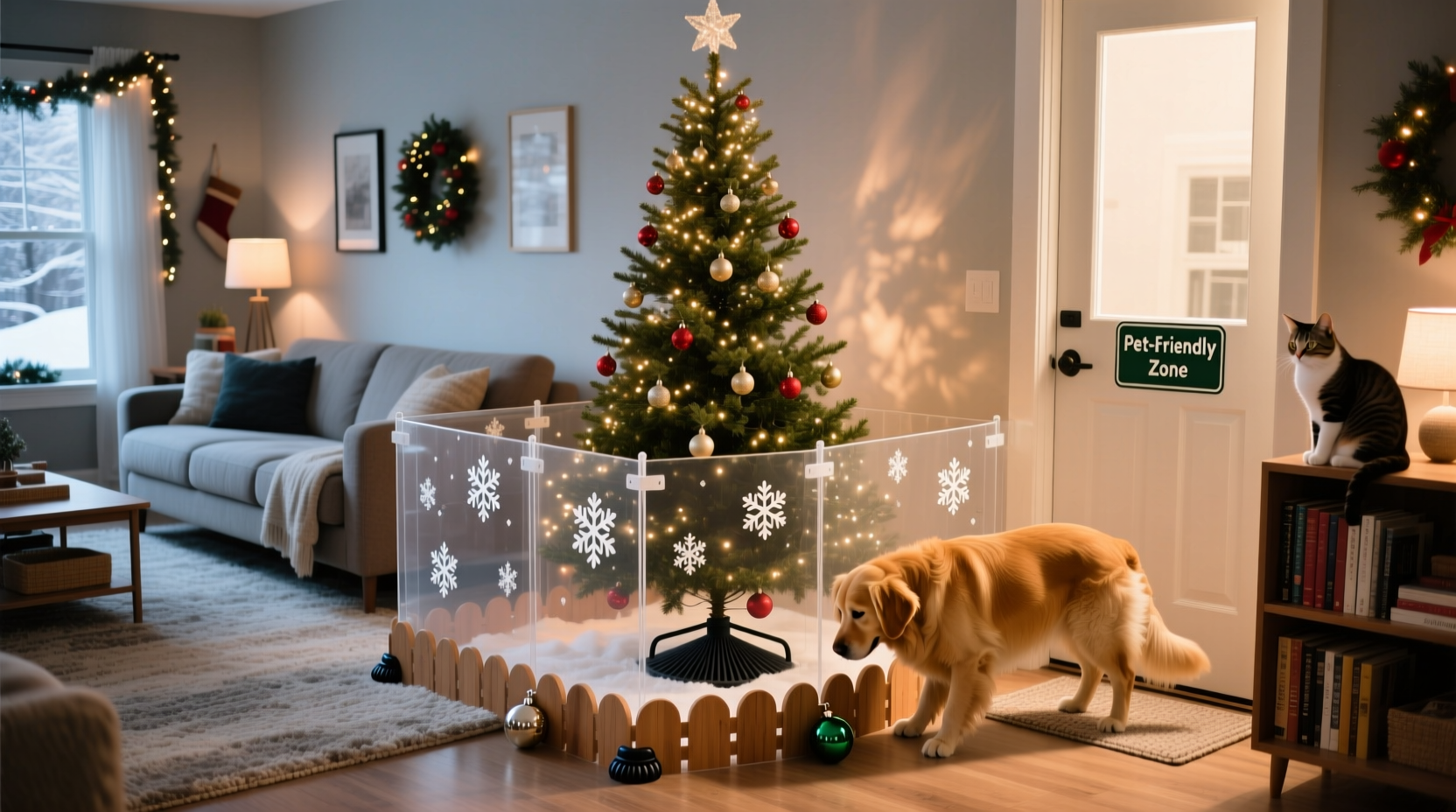
Pets don’t knock over trees out of malice or boredom alone. Their behavior reflects instinct, sensory input, and environmental opportunity. Cats are drawn to vertical spaces and novel textures—the tree’s layered branches mimic natural climbing structures, while ornaments reflect light like prey movement. Dogs may nudge or circle the base due to scent displacement (the tree introduces unfamiliar pine oils and human scents), territorial marking impulses, or the simple reinforcement of attention when they interact with it. According to Dr. Sarah Lin, a board-certified veterinary behaviorist at the Animal Behavior Clinic of Chicago, “The Christmas tree becomes a multisensory event for pets: it smells different, looks dynamic, makes subtle sounds when brushed, and often elicits high-energy human responses. That combination is a powerful behavioral magnet.” Understanding this helps shift focus from punishment to prevention—designing environments where the tree is physically inaccessible *and* less stimulating.
Proven Physical Barriers: Safety-First Engineering
Effective barriers must satisfy three criteria: stability (won’t tip when bumped), visibility (pets learn boundaries), and non-toxicity (no sharp edges, loose wires, or hazardous materials). Below are five rigorously tested options ranked by efficacy, ease of setup, and pet compatibility:
| Barrier Type | Best For | Setup Time | Key Safety Notes |
|---|---|---|---|
| Freestanding Pet Playpen (Metal, 36\"+ height) | Dogs & large cats; homes with open floor plans | 5–8 minutes | Use only models with flat, weighted bases—avoid lightweight “pop-up” versions. Anchor bottom rails to furniture legs with adjustable straps if needed. |
| Custom Wooden Enclosure (L-shaped or hexagonal) | Multi-pet households; long-term use | 1–2 hours (DIY) or 30 min (pre-fab) | Build with ¾\" birch plywood; sand all edges; avoid nails near pet-height zones. Leave 3\" gap between top rail and ceiling to discourage jumping. |
| Heavy-Duty Baby Gate (Pressure-Mount + Wall Anchors) | Medium dogs; stairway or doorway access points | 12–15 minutes | Must be anchored to wall studs—not drywall anchors alone. Choose gates rated for >30 lbs push force (e.g., North States Supergate Extreme). |
| Tension Rod + Mesh Curtain System | Cats; renters; minimalist aesthetics | 7–10 minutes | Use stainless steel rods (not plastic) and marine-grade polyester mesh. Install rod 6\" above tree height to block aerial approaches. |
| Weighted Rope Perimeter (with PVC anchors) | Low-mobility pets; temporary setups | 4 minutes | Use ½\" braided nylon rope weighted with 2-lb sandbags every 2 ft. Avoid ropes with fraying ends—chewing risk. |
The most common failure point isn’t barrier strength—it’s placement. Always position barriers at least 18 inches from the tree trunk. This prevents pets from pressing against the structure and leveraging their body weight to destabilize both barrier and stand. Also, ensure the tree’s water reservoir sits *inside* the barrier zone—never outside—so thirsty pets can’t lap contaminated water or knock it over.
Tree Setup & Maintenance: The Hidden Leverage Points
How you set up the tree itself dramatically affects pet interaction. Most people anchor only the trunk—but stability starts at the base. Use a heavy-duty tripod stand filled with at least 1 gallon of water *plus* 2–3 lbs of clean river rocks or aquarium gravel at the bottom. This adds mass without raising the center of gravity. Then, secure the trunk with *three* independent guy lines: one attached to the top third of the trunk, two lower lines at opposing 45° angles, all anchored to wall-mounted eye bolts (not furniture). This triangulated support resists lateral force better than any single strap.
Lighting and ornament strategy matters too. String lights *under* garlands—not over them—to reduce dangling ends. Hang all glass, metal, or small ornaments above 3 feet (out of paw/bite range). Reserve low-hanging ornaments for shatterproof wood, felt, or fabric pieces secured with twist-ties—not hooks. And skip tinsel entirely: the American Veterinary Medical Association reports tinsel ingestion as a leading cause of linear foreign body obstructions in cats during December.
A Real-World Case Study: The Thompson Household
In suburban Portland, the Thompsons faced annual tree disasters with their 3-year-old Maine Coon, Jasper, and 18-month-old rescue terrier mix, Luna. Jasper scaled the tree nightly; Luna nudged the stand until water sloshed over. After two emergency vet visits (one for pine needle ingestion, another for mild electrical burn from chewing a cord), they implemented a tiered solution: First, they installed a 42\"-high, powder-coated steel playpen around the tree—anchored to adjacent bookshelves with aircraft-grade nylon straps. Second, they replaced all lights with battery-operated LED strands and wrapped cords in flexible conduit. Third, they trained both pets using positive reinforcement: Jasper received daily interactive play sessions *away* from the tree using wand toys, while Luna learned the “leave-it” command with high-value treats near the barrier perimeter. Within 72 hours, both animals stopped approaching the zone. By Christmas Eve, Jasper napped peacefully 4 feet away—and Luna carried her favorite toy *around* the pen, not toward it. “It wasn’t about restricting them,” says owner Maya Thompson. “It was about giving them better things to do—and making the tree boring by comparison.”
Behavioral Training & Environmental Enrichment
Barriers buy time—but lasting success requires redirecting instinctual energy. Start 2–3 weeks before bringing the tree indoors. Introduce a new “tree-free zone” enrichment station: a sturdy cat tree near a sunlit window for climbers, or a puzzle feeder station with frozen kong toys for dogs. Rotate toys weekly to sustain novelty. For cats, place silvervine or catnip mats *away* from the tree to draw interest elsewhere. For dogs, practice “stationing”: teach them to lie calmly on a designated mat with increasing duration, rewarding stillness—not just compliance.
Supervision remains critical during initial exposure. When first placing the tree, keep pets leashed or in carriers for 10-minute observation sessions. Watch for stress signals (dilated pupils, flattened ears, tail flicking) and disengage *before* escalation. Never use shock collars, citronella sprays, or loud noises—these create fear associations with the holiday environment itself.
“Preventing tree-toppling isn’t about dominance or discipline. It’s about recognizing that pets explore the world with mouths, paws, and bodies—and designing spaces that honor that reality without compromise.” — Dr. Elena Rodriguez, DVM, Certified Fear-Free Practice Consultant
Step-by-Step Holiday Safety Timeline
- 4 Weeks Before Tree Setup: Audit pet toys and replace worn items. Introduce new enrichment stations in low-traffic areas.
- 1 Week Before: Install permanent barriers (gates, enclosures) and test stability. Secure all electrical outlets near the tree zone with tamper-proof covers.
- Tree Day Morning: Fill stand with water + rocks. Set up guy lines *before* adding branches. Place barrier around base immediately after trunk insertion.
- Tree Day Afternoon: Hang ornaments in order of height (highest first). Conceal all cords behind garlands or conduit. Test lighting with pets present on leashes.
- Daily Through New Year: Check water level twice daily. Inspect barrier anchors for loosening. Offer 15 minutes of focused play *away* from the tree each morning.
FAQ
Can I use essential oils or sprays to deter my pet from the tree?
No. Many essential oils—including pine, citrus, cinnamon, and tea tree—are highly toxic to cats and dogs when inhaled, ingested, or absorbed through skin. Even diffusers placed across the room pose respiratory risks. Physical barriers and environmental management are safer, more reliable deterrents.
My cat loves climbing the tree—but won’t use our cat tree. What’s wrong?
Most commercial cat trees lack the structural complexity cats seek: multiple vertical levels with varied textures (sisal, carpet, smooth wood), horizontal perches at different heights, and enclosed hideaways. Add a hanging shelf or wall-mounted perch near a window, and rub new surfaces with silvervine to spark interest. Patience and gradual introduction matter more than size.
Is a fake tree safer than a real one for pets?
Not inherently. While real trees pose ingestion and sap risks, many artificial trees contain lead-stabilized PVC, antimony, and flame retardants that leach into dust. If choosing artificial, select PE (polyethylene) trees labeled “lead-free” and wipe branches monthly with a damp microfiber cloth to reduce particulate buildup.
Conclusion
Your Christmas tree doesn’t need to be a battleground—or a no-go zone. With thoughtful barrier engineering, species-specific behavior insight, and consistent environmental management, it’s entirely possible to enjoy the full magic of the season while keeping every member of your household safe and engaged. The goal isn’t perfection; it’s preparedness. It’s knowing your dog’s nudge won’t trigger a cascade of falling lights because the stand is triangulated. It’s watching your cat choose the sun-warmed window perch over the tinsel-laden branches because her instincts have been honored elsewhere. These aren’t compromises—they’re acts of deep care, woven into the fabric of your home. Start implementing one solution this week: anchor that gate, add those rocks to the stand, or place that first enrichment mat. Small actions compound into seasonal calm. And when you step back on Christmas morning—tree upright, pets relaxed, lights aglow—you’ll feel something rare and precious: peace, rooted not in control, but in understanding.




 浙公网安备
33010002000092号
浙公网安备
33010002000092号 浙B2-20120091-4
Comments
No comments yet. Why don't you start the discussion?