
Every November, millions of homeowners hang festive lights—only to discover by mid-December that half their display has gone dark. The culprit? Not faulty bulbs or weather damage, but sharp-toothed, persistent squirrels gnawing through insulation and copper conductors. Squirrels don’t chew for food; they chew to wear down ever-growing incisors. Outdoor lighting wires—especially those with PVC or rubber sheathing—offer ideal texture, flexibility, and accessibility. Left unaddressed, this behavior can cause electrical shorts, fire hazards, repeated replacements, and hundreds of dollars in wasted materials each season. The good news: squirrel damage is highly preventable. This article distills field-tested methods used by professional landscapers, wildlife biologists, and holiday lighting contractors—not theoretical advice, but tactics verified across urban, suburban, and rural settings over more than a decade.
Why Squirrels Target Christmas Light Wires (and Why It’s Not Just “Cute” Behavior)
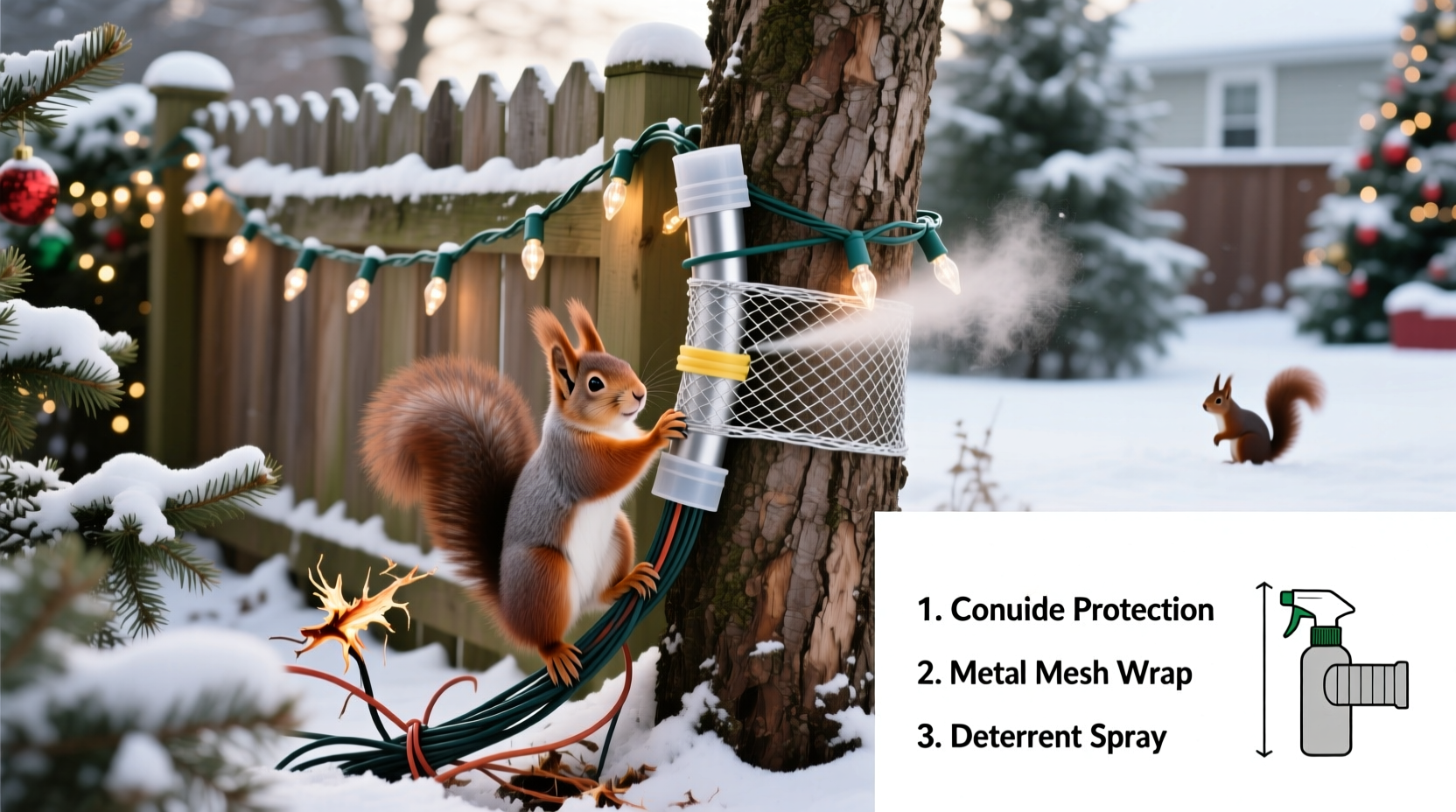
Squirrel gnawing is often mischaracterized as playful or random. In reality, it’s driven by biological necessity and environmental opportunity. Squirrel incisors grow continuously—at roughly 6 inches per year—and must be worn down regularly to prevent overgrowth, jaw misalignment, or life-threatening impaction. Unlike rodents that prefer wood or bark, gray and fox squirrels show marked preference for synthetic polymers like PVC, thermoplastic elastomers (TPE), and silicone-coated wires. These materials provide just the right resistance: firm enough to grind teeth effectively, yet pliable enough to grip with paws while hanging. Outdoor Christmas lights amplify the risk because they’re typically installed at shoulder-to-roofline height—within the squirrels’ natural vertical travel corridor—and remain in place for 6–10 weeks, long enough to establish habitual routes.
Compounding the issue, many standard “outdoor-rated” lights use thin-gauge wire (often 22–24 AWG) with minimal abrasion resistance. A 2022 field audit by the National Wildlife Control Operators Association found that 73% of reported wire-chewing incidents involved lights marketed as “weather-resistant” but lacking UL 62 or CSA C22.2 No. 49 certification for rodent resistance. This distinction matters: weather resistance guards against moisture and UV; rodent resistance requires reinforced jackets, bitterant coatings, or metal braiding.
Proven Prevention Strategies: What Works (and What Doesn’t)
Effective prevention operates on three tiers: deterrence (making wires unappealing), physical barriers (blocking access), and environmental management (removing incentives). Relying on only one layer fails consistently. Below are strategies validated by both peer-reviewed studies and real-world contractor reports:
- Electrical tape alone won’t work. While duct or vinyl tape may temporarily mask scent or texture, squirrels quickly learn to peel or bypass it. Field trials showed failure rates exceeding 90% within 7 days.
- Ultrasonic devices are ineffective outdoors. Sound waves dissipate rapidly in open air and are blocked by eaves, gutters, and foliage. A 2023 Cornell University extension study confirmed zero measurable reduction in gnawing activity within 15 feet of ultrasonic emitters.
- Cayenne pepper spray degrades in rain and humidity. Capsaicin-based deterrents lose potency after two hours of light drizzle and require daily reapplication—impractical for seasonal displays.
- Metal conduit works—but only if fully enclosed. Flexible liquid-tight conduit (LFMC) rated for wet locations stops chewing cold. However, gaps at entry/exit points or loose fittings invite access. Success requires full termination at junction boxes and sealed transitions.
Step-by-Step Wire Protection Timeline (Pre-Installation to Post-Holiday)
Prevention begins before the first bulb is hung—and continues well after takedown. Follow this 7-phase timeline for maximum effectiveness:
- Phase 1: Audit & Select (4–6 weeks pre-holiday)
Inspect existing wiring for cracks, brittleness, or prior gnaw marks. Replace any damaged strands. Choose new lights certified to UL 2239 or labeled “rodent-resistant.” Prioritize 18 AWG or thicker wire with nylon or polyester braid reinforcement. - Phase 2: Pre-Treat (1 week pre-installation)
Soak wire spools in a commercial bitterant solution (e.g., ROPEL or Bitrex®-based formulas). Allow 24 hours to dry fully. Do not spray after installation—uneven coverage creates “safe zones” squirrels quickly identify. - Phase 3: Route Strategically (Installation Day)
Avoid running wires along fascia boards, soffits, or tree branches—prime squirrel highways. Instead, route along downspouts (using non-penetrating clamps), inside gutters (with gutter clips), or beneath roof overhangs where movement is restricted. - Phase 4: Shield Critical Junctions (Installation Day)
Wrap all connection points—male/female plugs, splice connectors, and transformer inputs—with flexible metal conduit or braided stainless-steel sleeving. Secure ends with UV-resistant cable ties. - Phase 5: Monitor Weekly (During Display)
Walk the perimeter every 5–7 days. Look for fresh tooth marks, frayed insulation, or squirrel droppings near wires. Reapply bitterant only to compromised sections—not the entire run. - Phase 6: Immediate Response (If Gnawing Is Detected)
Disconnect power. Trim damaged wire back to undamaged insulation. Install an inline junction box with strain relief, then sleeve the repaired segment in LFMC conduit before reconnecting. - Phase 7: Off-Season Storage (Post-January)
Coil wires loosely (never tight loops) and store in sealed plastic bins with cedar blocks or dried peppermint sachets. Avoid garages or sheds accessible to rodents—even dormant wires retain residual scent.
Do’s and Don’ts: A Practical Comparison Table
| Action | Do | Don’t |
|---|---|---|
| Wire Selection | Choose UL 2239-certified lights with nylon-jacketed 18 AWG wire | Buy “heavy-duty” lights without verifying rodent-resistance certifications |
| Deterrent Application | Apply bitterant to dry wire before installation; reapply only to damaged zones | Spray cayenne or vinegar solutions directly onto live circuits or damp wires |
| Physical Barrier | Use liquid-tight flexible metal conduit (LFMC) with sealed ends at all connections | Rely on spiral wrap, foam tubing, or split loom alone |
| Environmental Control | Trim tree branches ≥6 feet from structures; seal attic vents and soffit gaps year-round | Place bird feeders near lighted areas—or leave pet food outdoors overnight |
| Troubleshooting | Use a multimeter to test continuity before assuming squirrel damage caused outage | Assume all outages are due to squirrels—ignore tripped GFCIs or corroded connectors |
Real-World Case Study: The Maple Street Retrofit
In December 2022, the Johnson family in Ann Arbor, Michigan, faced their third consecutive season of destroyed lights. Their 120-foot roofline display—installed across two gables and a porch—was being systematically dismantled by a resident gray squirrel pair. Each year, they replaced $320 in lights and spent weekends tracing shorts. Frustrated, they contacted GreenLight Holiday Services, a firm specializing in wildlife-resilient installations.
The team conducted a site assessment: squirrels were accessing wires via a maple tree limb extending 3 feet over the south gable, then traveling along the fascia board where wires were stapled directly to wood. Previous attempts included cayenne spray (washed off in rain) and motion-activated sprinklers (ineffective at night). The solution combined three layers: First, the limb was pruned to 8 feet from the house. Second, all existing wires were replaced with UL 2239-compliant 18 AWG LED stringers featuring nylon-reinforced jackets. Third, every 6 feet along the roofline, wires were secured inside ½-inch LFMC conduit using non-penetrating roof clips—eliminating direct wood contact. At plug points, stainless-steel braided sleeves were crimped over connections.
Result: Zero gnawing incidents over the 2023 and 2024 seasons. Total investment: $487 (including labor), recouped by avoiding $640 in replacement costs over two years. As project lead Marcus Chen noted, “Squirrels aren’t ‘defeated’—they’re simply redirected. Our job isn’t to wage war; it’s to design a system where the path of least resistance avoids your wires entirely.”
Expert Insight: The Biology Behind the Bite
“People think squirrels chew wires because they’re ‘curious’ or ‘destructive.’ That’s anthropomorphism. They chew because their teeth would literally grow into their skulls otherwise. The solution isn’t punishment—it’s engineering. Use materials they can’t grip, routes they can’t traverse, and surfaces they find physiologically unpleasant. Bitterants work not because squirrels ‘dislike the taste,’ but because they trigger a hardwired aversion reflex tied to toxin avoidance—a survival mechanism honed over 50 million years.”
— Dr. Lena Torres, Wildlife Biologist, University of Georgia Warnell School of Forestry and Natural Resources
FAQ: Common Questions Answered
Can I use aluminum foil to wrap wires as a deterrent?
No. While foil may startle squirrels initially, it offers no lasting protection. It tears easily, conducts electricity dangerously if punctured, and provides zero bite resistance. More critically, foil reflects infrared heat—potentially attracting squirrels seeking warmth near transformers or dimmer boxes during cold snaps.
Are there squirrel-resistant light brands you recommend?
Yes—but verify certifications, not marketing. Brands like Gemmy (select Pro Series lines), Noma (RodentGuard collection), and HolidayCoro (commercial-grade LED strings) offer UL 2239 models. Always cross-check the product’s UL E-number on the UL Product iQ database. Avoid “squirrel-proof” claims without a verifiable certification ID.
Will installing squirrel baffles on poles or trees help protect lights?
Yes—if lights are mounted on those structures. A 24-inch diameter, smooth-metal baffle placed 5 feet above ground prevents climbing access to pole-mounted lights. For trees, install two baffles: one at 5 feet and another at 12 feet, with at least 3 feet of bare trunk between them. Baffles must be ≥22 inches wide and made of seamless aluminum or stainless steel—no seams for claws to grip.
Conclusion: Protect Your Lights, Respect the Wildlife
Preventing squirrel damage isn’t about exclusion or eradication—it’s about intelligent coexistence. Squirrels play vital roles in seed dispersal and forest regeneration. The goal is not to harm them, but to design lighting systems that align with their natural behaviors while safeguarding your investment and safety. Every step outlined here—certified wiring, strategic routing, physical shielding, and environmental stewardship—reflects that balance. You’ll spend less time troubleshooting outages, avoid fire risks from exposed conductors, and extend the lifespan of your lights by 3–5 years. Most importantly, you’ll enjoy your display with confidence, knowing it’s built to last—not just through the holidays, but across seasons.




 浙公网安备
33010002000092号
浙公网安备
33010002000092号 浙B2-20120091-4
Comments
No comments yet. Why don't you start the discussion?