
The holidays are a time for warmth, joy, and beautifully decorated trees and mantles. But one persistent enemy can turn festive cheer into frustration: static cling. When the air is dry — especially common during winter months — tinsel refuses to stay in place, clinging instead to hands, arms, clothing, and nearby surfaces. This isn’t just annoying; it undermines the precision and elegance of your seasonal display. The good news is that static cling is not inevitable. With a better understanding of its causes and a few strategic interventions, you can hang tinsel smoothly and keep it where you want it.
Static electricity builds up when electrons transfer between materials through friction — a process known as triboelectric charging. In low-humidity environments, such as heated homes in winter, these charges have nowhere to dissipate. Tinsel, typically made from metallized plastic or mylar, is highly susceptible to this effect. As you handle it, electrons jump between your skin, clothes, and the tinsel itself, causing strands to repel each other or stick uncontrollably to everything but the tree. Solving this requires both environmental control and handling techniques.
Understanding the Science Behind Winter Static
Static electricity becomes more prevalent in winter due to reduced indoor humidity. Cold outdoor air holds less moisture, and when that air is warmed indoors without adding moisture, relative humidity can drop below 30%. At these levels, the air lacks sufficient conductivity to allow built-up charges to neutralize naturally. Materials like wool sweaters, synthetic fabrics, and rubber-soled shoes exacerbate charge accumulation through everyday movement.
Tinsel compounds the issue. Its thin, lightweight structure gives it a high surface-area-to-mass ratio, making it extremely responsive to electrostatic forces. Even a small charge can cause visible repulsion or attraction. This isn’t just an aesthetic nuisance — it increases decoration time, leads to uneven distribution, and may even damage delicate ornaments if charged tinsel snaps toward them with force.
“Low humidity turns every holiday decoration session into a physics experiment. Without moisture in the air, static has no escape route.” — Dr. Lila Chen, Atmospheric Physicist, University of Colorado
The key to managing static isn’t eliminating it entirely — which is impossible — but controlling the conditions under which it forms and giving it safe pathways to dissipate.
Step-by-Step Guide to Cling-Free Tinsel Placement
Follow this sequence before and during tinsel application to minimize static interference and achieve a polished look.
- Prepare the Environment (24 Hours Before)
Begin by increasing indoor humidity. Use a humidifier in the room where decorating will occur. Aim for 40–50% relative humidity. If you don’t have a hygrometer, signs of adequate moisture include no cracking of wood furniture and minimal static shocks when touching metal objects. - Ground Yourself Before Handling Tinsel
Touch a grounded metal object — such as a faucet, radiator pipe, or appliance chassis — before picking up tinsel. This discharges any accumulated body voltage. Avoid wearing wool, nylon, or polyester clothing during decorating; cotton is preferable. - Condition the Tinsel (1 Hour Before Use)
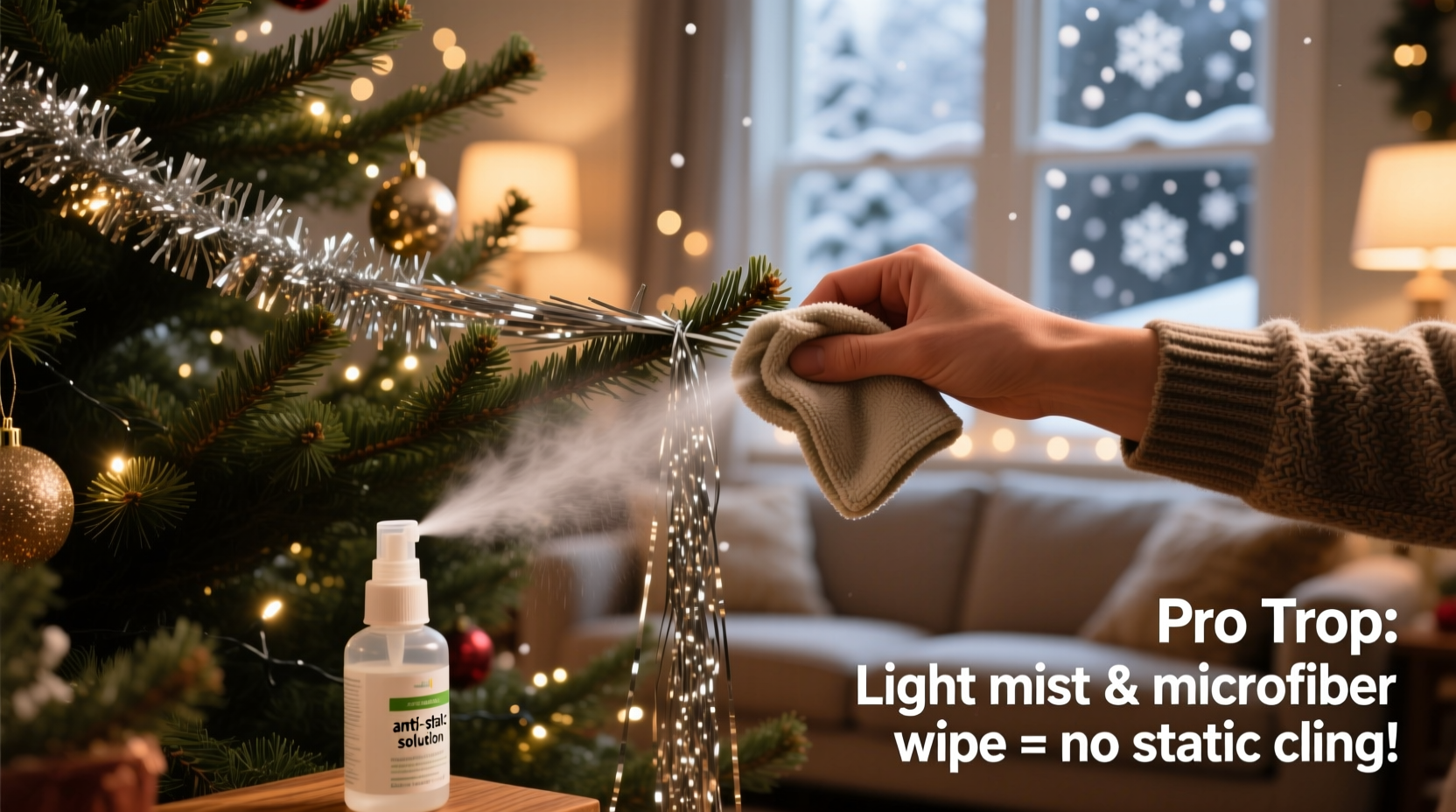
Unwrap tinsel and lay it loosely over a non-conductive surface like a wooden table. Mist it *very lightly* with water using a fine spray bottle. Alternatively, pass a damp (not wet) cloth over your hands and then gently run them along the tinsel strands. This adds trace moisture to the surface, reducing resistivity. - Use Anti-Static Tools
Wear cotton gloves if available. Hold tinsel with wooden clothespins or plastic tongs to reduce direct contact. You can also use a dryer sheet to lightly wipe the tinsel — the cationic surfactants in fabric softeners neutralize static charges. - Hanging Technique Matters
Apply tinsel in long, continuous drapes rather than short bursts. Work from the top down, allowing gravity to assist. Gently press each strand into place using the back of a plastic comb or ruler to avoid recharging through finger contact. - Final Settling Period
After hanging, leave the area undisturbed for at least 30 minutes. Avoid walking quickly nearby or creating air currents, which can re-agitate loose strands. If needed, lightly mist the air around (not directly on) the tinsel with water to help settle residual charges.
Do’s and Don’ts of Static Management During Decoration
| Action | Recommendation | Reason |
|---|---|---|
| Using a humidifier | Do | Increases ambient moisture, allowing charges to dissipate naturally. |
| Spraying tinsel directly with water | Don’t | Excess moisture can degrade metallic coatings and promote mold on trees. |
| Wearing rubber-soled slippers | Don’t | Insulates body charge, increasing static buildup. |
| Using unscented dryer sheets | Do | Lightly swiping tinsel with a sheet reduces surface resistance. |
| Handling tinsel after shuffling feet on carpet | Don’t | This generates thousands of volts — enough to make tinsel leap from your hands. |
| Storing tinsel in sealed plastic bags | Do | Protects from dust and retains slight humidity, reducing initial charge potential. |
Real Example: A Holiday Decorator’s Breakthrough
Maria K., a professional home stylist in Minneapolis, spent years battling unruly tinsel during December shoots. “I’d spend 45 minutes trying to drape a single garland,” she recalls. “The tinsel would stick to my sleeves, fly off the branches, or clump together like magnetic spaghetti.” Her turning point came when she borrowed a commercial-grade humidifier for a photoshoot in a newly constructed, tightly sealed home. With humidity raised from 28% to 46%, she noticed immediate improvement. “For the first time, the tinsel behaved. It draped smoothly, stayed put, and didn’t react to my movements. I now bring a portable humidifier to every winter job.”
Maria also began pre-treating tinsel with a diluted mix of water and a drop of fabric softener in a spray bottle (applied from 12 inches away), a method she credits with eliminating mid-air repulsion. While she avoids oversaturation, the micro-coating prevents electron buildup during handling.
Proven Tips to Reduce Static Long-Term
- Invest in a smart humidifier with automatic humidity adjustment. Models with built-in hygrometers maintain optimal levels without constant monitoring.
- Store tinsel with a damp paper towel in an airtight container — not soaked, just slightly moistened. Replace weekly. This maintains a microclimate that reduces initial static potential.
- Use anti-static sprays designed for electronics (like those used for vinyl records) on non-lighted decorations. Test on a small area first.
- Avoid plastic storage bins with tight seals if they promote static. Opt for canvas bags lined with cotton for tinsel and trimmings.
- Decorate after showering, when skin moisture is higher. Dry winter skin acts as an insulator; hydrated skin conducts charge more effectively, reducing personal voltage.
Checklist: Prepare for Static-Free Decorating
- ✅ Check room humidity with a hygrometer — aim for 40–50%
- ✅ Turn on humidifier 12–24 hours before decorating
- ✅ Choose cotton clothing and leather-soled shoes
- ✅ Wash hands and lightly moisturize (avoid heavy lotions)
- ✅ Ground yourself by touching metal plumbing or appliance
- ✅ Prepare tools: cotton gloves, plastic tongs, dryer sheet, fine mist spray bottle
- ✅ Lay out tinsel to acclimate for at least 30 minutes
- ✅ Keep pets and children away during application to reduce air disturbances
Frequently Asked Questions
Can I use hairspray to keep tinsel in place?
No. While hairspray might temporarily hold tinsel, it creates a sticky residue that attracts dust and can corrode metallic finishes over time. It also increases flammability risk near lights. Instead, focus on preventing static at the source through humidity and grounding.
Why does tinsel behave worse some years than others?
Variations in indoor humidity are the primary cause. Newer, energy-efficient homes are often more airtight, trapping dry air. Additionally, the type of heating system matters — forced-air furnaces dry air more aggressively than radiant systems. Year-to-year differences in weather patterns also affect baseline outdoor humidity.
Is there a difference between vintage and modern tinsel in terms of static?
Yes. Vintage tinsel made from actual lead or aluminum was heavier and less prone to airborne static effects, though it posed health risks. Modern mylar-based tinsel is lighter and more reflective but far more susceptible to electrostatic forces due to its low mass and high surface conductivity. However, modern materials respond better to anti-static treatments like fabric softener residues.
Expert Insight: What Professionals Know
“In high-end event design, we treat static like a lighting condition — something you must plan for. We schedule tinsel work for late morning when humidity peaks indoors, and always use ionizing fans set to low near the workspace. It’s not magic; it’s environmental engineering.” — Julian Reed, Lead Designer at Evergreen Event Co.
Professional decorators often use tools not commonly found in households. Ionizing air blowers, for example, emit balanced positive and negative ions that neutralize static charges on surfaces. While expensive for casual use, their principle informs simpler hacks: even opening a window briefly (if outdoor humidity is higher) can introduce balancing moisture. Similarly, running a hairdryer on cool/ionic mode near — but not on — tinsel can help stabilize strands during placement.
Conclusion: Enjoy Smooth, Elegant Holiday Decorating
Static cling doesn’t have to sabotage your holiday spirit. By understanding the role of dry air and material interactions, you gain control over what once seemed like random chaos. Simple changes — adjusting humidity, choosing the right attire, using grounded techniques, and preparing your materials — transform tinsel placement from a battle into a graceful process. The result is not only a better-looking tree or mantle but also a more peaceful, enjoyable decorating experience.
You don’t need professional gear to succeed. Start with one change — a humidifier, a dryer sheet, or simply grounding yourself before you begin — and build from there. Over time, these habits become second nature, ensuring your holiday displays remain pristine and stress-free year after year.




 浙公网安备
33010002000092号
浙公网安备
33010002000092号 浙B2-20120091-4
Comments
No comments yet. Why don't you start the discussion?