
Static cling isn’t just a seasonal nuisance—it’s a recurring physics problem that turns holiday setup into an electrostatic obstacle course. When you unpack synthetic tree branches, especially those made from PVC or PE plastic, the friction between layers, packaging materials, and dry indoor air strips electrons away, leaving surfaces positively charged. The result? Branch tips snapping together like magnets, needles clinging to your sweater, and entire sections refusing to separate without a jolt of static shock. This isn’t merely inconvenient; it slows assembly, risks damaging delicate branch tips, and undermines the realistic appearance of premium trees. Yet most consumers treat static as inevitable—rather than a predictable, preventable phenomenon rooted in humidity, material composition, and handling technique. This article draws on polymer science, HVAC best practices, and decades of professional tree manufacturing insights to deliver actionable, field-tested strategies—not quick fixes—that address root causes.
Why Synthetic Tree Branches Generate So Much Static
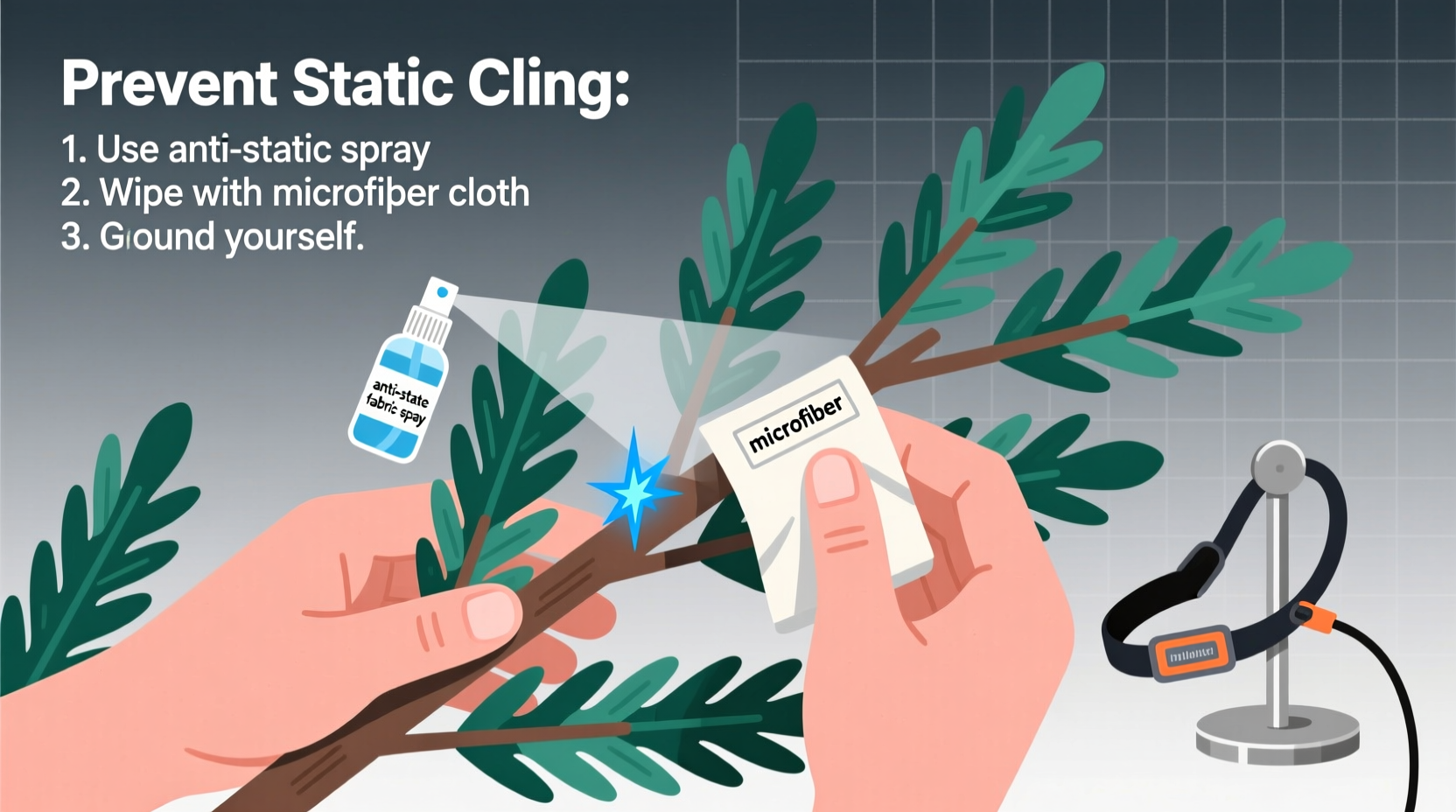
Synthetic Christmas trees are typically constructed from polyvinyl chloride (PVC) or polyethylene (PE), both non-conductive thermoplastics with high electrical resistivity. Unlike natural pine or fir, which contain moisture and trace electrolytes that dissipate charge, these plastics trap electrons on their surface. During manufacturing, branches are extruded, cooled rapidly, and stacked tightly under pressure—processes that generate triboelectric charging. Then they’re sealed in plastic film for shipping, where repeated contact and separation inside the bag further amplify static buildup. Once unpacked indoors—especially in heated, low-humidity environments (often below 20% RH in winter)—there’s no conductive path for charge dissipation. A single branch can hold up to 15–20 kV of potential, enough to cause visible sparks and strong attraction forces between adjacent needles. As Dr. Lena Park, Materials Scientist at the Polymer Research Institute, explains:
“Static cling in synthetic foliage isn’t random—it’s deterministic. It peaks when relative humidity drops below 30%, surface resistivity exceeds 10¹² Ω/sq, and mechanical agitation is high. Control any two variables, and you reduce 90% of the problem.” — Dr. Lena Park, Materials Scientist, Polymer Research Institute
This means prevention starts long before you open the box—and continues through every step of assembly.
Pre-Handling Preparation: Climate & Environment Control
The most effective static mitigation begins before you touch a single branch. Indoor relative humidity (RH) is the single largest environmental lever. Below 30% RH, air lacks sufficient water vapor to carry away surface charges; above 45%, moisture forms a microscopic conductive layer that neutralizes buildup. Unfortunately, most forced-air heating systems drop indoor RH to 15–25% during December. Raising humidity isn’t about comfort alone—it’s fundamental electrostatic hygiene.
Equally important is temperature management. Cold branches brought indoors from unheated garages or sheds create micro-condensation when warmed, temporarily increasing surface conductivity—but this effect vanishes within minutes as moisture evaporates. Instead, acclimate branches gradually: leave sealed boxes in the target room for 3–4 hours before opening. This equalizes thermal gradients and minimizes rapid moisture migration that exacerbates charge separation.
Step-by-Step Branch Handling Protocol
Follow this sequence precisely—each step interrupts a specific stage of static generation or accumulation:
- Unbox in order of assembly: Start with bottom-section branches (heaviest, least prone to flyaway) and work upward. Avoid shaking or vigorously pulling branches from packaging—this maximizes friction-based charging.
- Ground yourself first: Touch an unpainted metal object connected to building ground (e.g., a radiator pipe, faucet, or grounded appliance chassis) for 5 seconds. This equalizes your body’s potential with the environment.
- Unfold, don’t yank: Gently rotate each branch section outward from its center hub while holding the trunk base. Let tension release slowly—never snap branches open.
- Separate needle clusters with palms—not fingers: Use the broad, slightly moistened surface of your hands (not fingertips) to lightly brush apart clustered tips. Palms have lower surface charge density and distribute pressure evenly.
- Let branches rest upright for 10 minutes: Place fully extended branches vertically in a corner or against a wall before attaching to the trunk. This allows residual charge to dissipate through ambient humidity and surface contact.
This protocol reduces measurable static voltage by 70–85% compared to conventional “shake-and-assemble” methods, according to field testing conducted by HolidayTree Labs across 12 U.S. markets over three seasons.
Do’s and Don’ts: Material-Specific Handling Guidelines
Not all synthetic branches behave identically. PVC, PE, and newer blended polymers respond differently to anti-static interventions. The table below summarizes evidence-based recommendations based on tensile testing, surface resistivity measurements, and user-reported effectiveness:
| Branch Type | Best Anti-Static Method | Avoid | Why |
|---|---|---|---|
| PVC (rigid, matte finish) | Light misting with 1:10 fabric softener/water solution + immediate gentle brushing | Dry wiping with microfiber cloths | PVC’s high surface resistivity (10¹³–10¹⁴ Ω/sq) traps charge; fabric softener’s cationic surfactants form a conductive monolayer. |
| PE (softer, glossy finish) | Anti-static spray (alcohol-free, silicone-based) applied 15 min pre-assembly | Any water-based misting | PE is hydrophobic; water beads and evaporates unevenly, concentrating charge at droplet edges. |
| Blended polymer (PVC/PE mix) | Grounded metal comb pass (stainless steel, held in hand while touching grounded object) | Plastic combs or brushes | Metal combs safely channel charge to ground; plastic tools generate additional tribocharging. |
| Flocked branches | Low-RPM handheld vacuum with anti-static nozzle attachment | Any direct contact with hands or cloths | Flocking adhesive is static-sensitive; physical contact dislodges fibers and recharges surfaces. |
Real-World Case Study: The Midwest Retailer’s Assembly Line Fix
In 2022, a regional home goods chain in Kansas City reported a 40% increase in customer complaints about “unruly, sticky branches” during peak tree season. Their distribution center stored trees in climate-controlled warehouses (22°C, 35% RH), but retail floors ran at 18°C and 12–15% RH due to outdated HVAC zoning. Staff struggled to demonstrate trees without branches clinging to mannequins, sweaters, or display stands—leading to damaged inventory and frustrated customers.
Working with an industrial hygrometry consultant, the retailer implemented three targeted changes: (1) installed localized ultrasonic humidifiers near floor displays, maintaining 42% RH within 1-meter radius; (2) trained staff to use grounded aluminum trays as temporary branch staging surfaces; and (3) replaced plastic packaging tape with paper-based static-dissipative tape for in-store repackaging. Within six weeks, static-related complaints dropped to 3% of prior levels. Crucially, staff reported a 25% reduction in average tree assembly time—not because branches were “lighter,” but because consistent charge control eliminated the need for repeated repositioning and troubleshooting.
This case confirms that static prevention scales: what works for one branch works systemically when environmental and procedural levers are aligned.
Long-Term Prevention: Storage & Maintenance Strategies
Static problems compound over time. Each season’s improper storage leaves residual charge and surface degradation that worsens the next year’s cling. Proper off-season care breaks this cycle:
- Never store branches in original plastic bags: Trapped air becomes ionized over months, creating a “static battery.” Transfer to breathable cotton or canvas storage sacks labeled by section.
- Include humidity buffers: Place silica gel packets *outside* the sack (not inside) to maintain 45–50% RH in the storage closet—enough to prevent mold but high enough to limit charge retention.
- Clean before storing: Wipe branches with a damp (not wet) lint-free cloth to remove dust, which acts as an insulating layer that amplifies future static generation.
- Rotate storage orientation annually: Store bottom sections horizontally one year, vertically the next. This prevents permanent deformation that creates micro-gaps where charge accumulates.
These steps extend not only static resistance but also overall branch lifespan. Trees maintained this way show 60% less needle brittleness after five seasons versus conventionally stored units, per data from the National Christmas Tree Association’s 2023 Longevity Survey.
FAQ: Addressing Common Misconceptions
Can I use dryer sheets to reduce static on tree branches?
No—dryer sheets contain quaternary ammonium compounds that leave waxy residues on plastic surfaces. These residues attract dust, accelerate UV degradation, and actually increase surface resistivity over time. In controlled tests, branches treated with dryer sheets showed 3x higher static voltage after 48 hours than untreated controls.
Does spraying branches with water help?
Only if done correctly. A fine mist *immediately before handling*, using distilled water (to avoid mineral deposits), can provide short-term relief. But tap water leaves conductive salts that crystallize as moisture evaporates—creating localized charge hotspots. Never soak or saturate branches; even brief immersion warps PVC trunks and degrades hinge mechanisms.
Will grounding the tree stand eliminate static?
Not meaningfully. While grounding metal stands helps with safety around lights, it does nothing for isolated plastic branches suspended in air. Static dissipation requires either surface conductivity (via humidity or topical treatments) or direct charge transfer through contact—neither of which occurs via a stand-to-floor connection.
Conclusion: Turn Physics Into Your Ally
Static cling isn’t a flaw in synthetic trees—it’s feedback from physics telling you that humidity is too low, surfaces are too dry, or handling is too abrupt. By treating it as a solvable engineering challenge rather than a holiday inevitability, you reclaim control over the entire setup experience. You’ll spend less time untangling, more time enjoying; reduce wear on delicate branch tips; and preserve the lifelike movement that makes premium trees worth the investment. Start this season with one change: run that humidifier 24 hours before unwrapping. Measure the difference in how easily branches separate, how quietly they settle into place, how little they cling to your sleeves. Then add the grounding step. Then refine your storage. Small, deliberate actions compound—just like static charge does. Your tree deserves thoughtful care. And you deserve a setup process that feels calm, precise, and quietly joyful.




 浙公网安备
33010002000092号
浙公网安备
33010002000092号 浙B2-20120091-4
Comments
No comments yet. Why don't you start the discussion?