
Every December, millions of households experience the same jarring ritual: reaching for a twinkling ornament—or even just brushing against a branch—and receiving a sharp, surprising zap. Static shocks from Christmas trees are more than seasonal annoyance; they’re a predictable convergence of physics, indoor climate, and holiday materials. Unlike summer static (which often fades with humidity), winter static intensifies due to dry air, synthetic carpets, wool sweaters, and the very structure of coniferous trees—especially artificial ones made of PVC or PE plastic. The good news? This isn’t random magic—it’s measurable electrostatic discharge (ESD), and it’s highly preventable. With targeted adjustments to environment, behavior, and tree handling, you can eliminate shocks before they happen—and keep your holiday moments joyful, not jolting.
Why Your Christmas Tree Becomes a Static Generator
Static electricity builds when electrons transfer between two dissimilar surfaces during contact and separation—a process called triboelectric charging. In winter, low relative humidity (often below 30% indoors) prevents charge dissipation: moisture in the air normally acts as a natural conductor, allowing static to bleed away harmlessly. When that moisture vanishes, charges accumulate on insulating surfaces—including your sweater, carpet, and especially the waxy, resin-rich needles of a real pine or fir, or the polymer branches of an artificial tree.
Real trees aren’t inherently “more shocking” than artificial ones—but their condition matters. A freshly cut tree with high moisture content (45–50% internal water) conducts slightly better and holds less surface charge. However, as it dries over 10–14 days, its bark and needles become excellent insulators. Artificial trees, by contrast, are engineered from static-prone plastics. PVC and polyethylene have high positions on the triboelectric series—meaning they readily gain negative charge when rubbed against wool, nylon, or even dry skin.
Crucially, the shock occurs not *on* the tree—but *between you and the tree*. You walk across a synthetic rug in socks, building up several thousand volts. When your finger nears the tree (a relatively grounded object), the voltage difference equalizes in a microsecond spark. That spark is harmless but startling—and potentially dangerous near flammable decorations or sensitive electronics.
5 Proven Strategies to Eliminate Tree-Related Static Shocks
1. Optimize Indoor Humidity—The Single Most Effective Fix
Humidity is the silent static suppressor. At 40–50% relative humidity (RH), static buildup drops dramatically because water molecules coat surfaces, increasing conductivity and allowing charges to dissipate before accumulating. Below 30% RH—the typical range in heated homes from November through February—static flourishes.
Use a hygrometer to monitor actual room humidity (not thermostat estimates). If readings fall below 35%, deploy humidification strategically:
- Cool-mist ultrasonic humidifiers placed near the tree (but not dripping onto lights or stands) raise localized humidity without overheating air.
- Passive humidifiers, like water-filled trays atop radiators or shallow bowls on heat vents, add moisture gradually and safely.
- Avoid steam vaporizers near trees—they introduce excess heat and condensation risk, which can damage lights or warp artificial branches.
2. Ground Yourself Before Touching the Tree
You don’t need to buy anti-static wrist straps—but you do need to interrupt the charge path *before* contact. Grounding means providing a safe, low-resistance route for built-up electrons to flow into the earth. Since most homes lack accessible grounding points at floor level, use these practical alternatives:
- Touch a metal plumbing pipe (e.g., under the kitchen sink or bathroom vanity) with bare skin for 3 seconds.
- Hold a metal key and tap it firmly against a grounded appliance—like the screw on a light switch plate cover (plastic faceplates are non-conductive, but the metal mounting screws connect to grounded electrical boxes).
- Before approaching the tree, place both palms flat on a concrete basement floor or exterior brick wall for 5 seconds—even in winter, these surfaces retain ground potential.
This works because your body acts like a capacitor: discharging it first prevents sudden equalization via spark. Consistency matters—make grounding part of your pre-tree routine, especially after walking across carpet or removing a sweater.
3. Choose Low-Static Materials for Tree Accessory Zones
The zone within 3 feet of your tree—including the floor, nearby furniture, and your own clothing—is where static interactions occur. Swap high-triboelectric materials for lower-risk alternatives:
| Item | High-Risk Materials (Avoid) | Low-Risk Alternatives (Use) |
|---|---|---|
| Floor covering | Nylon carpet, polyester rugs, rubber-backed mats | Wool area rugs (naturally anti-static), untreated hardwood with cotton throw rug, cork flooring |
| Clothing | Wool sweaters, acrylic scarves, polyester-blend pajamas | Cotton turtlenecks, linen shirts, silk-blend tops (low friction + moderate moisture retention) |
| Tree skirt | Plastic-coated fabric, vinyl, glitter-flocked material | Heavy cotton canvas, burlap, or felted wool (naturally dissipative) |
| Ornament hooks | Plastic-coated wire, PVC hangers | Bare copper wire hooks, stainless steel clips, or wooden pegs |
Note: Wool is listed as both high-risk (when worn) and low-risk (as a rug)—because context changes behavior. Worn wool generates charge via friction against skin or other fabrics; laid wool rugs dissipate charge due to natural lanolin and fiber structure.
4. Treat the Tree Surface—Safely and Effectively
Direct treatment of tree surfaces requires caution: never spray water on live electrical lights, and avoid flammable solvents. For real trees, lightly misting outer branches with a fine-mist spray bottle filled with distilled water only (tap water leaves mineral residue) helps temporarily increase surface conductivity. Do this once daily for the first 5 days—never soak, and ensure lights are off and cool before spraying.
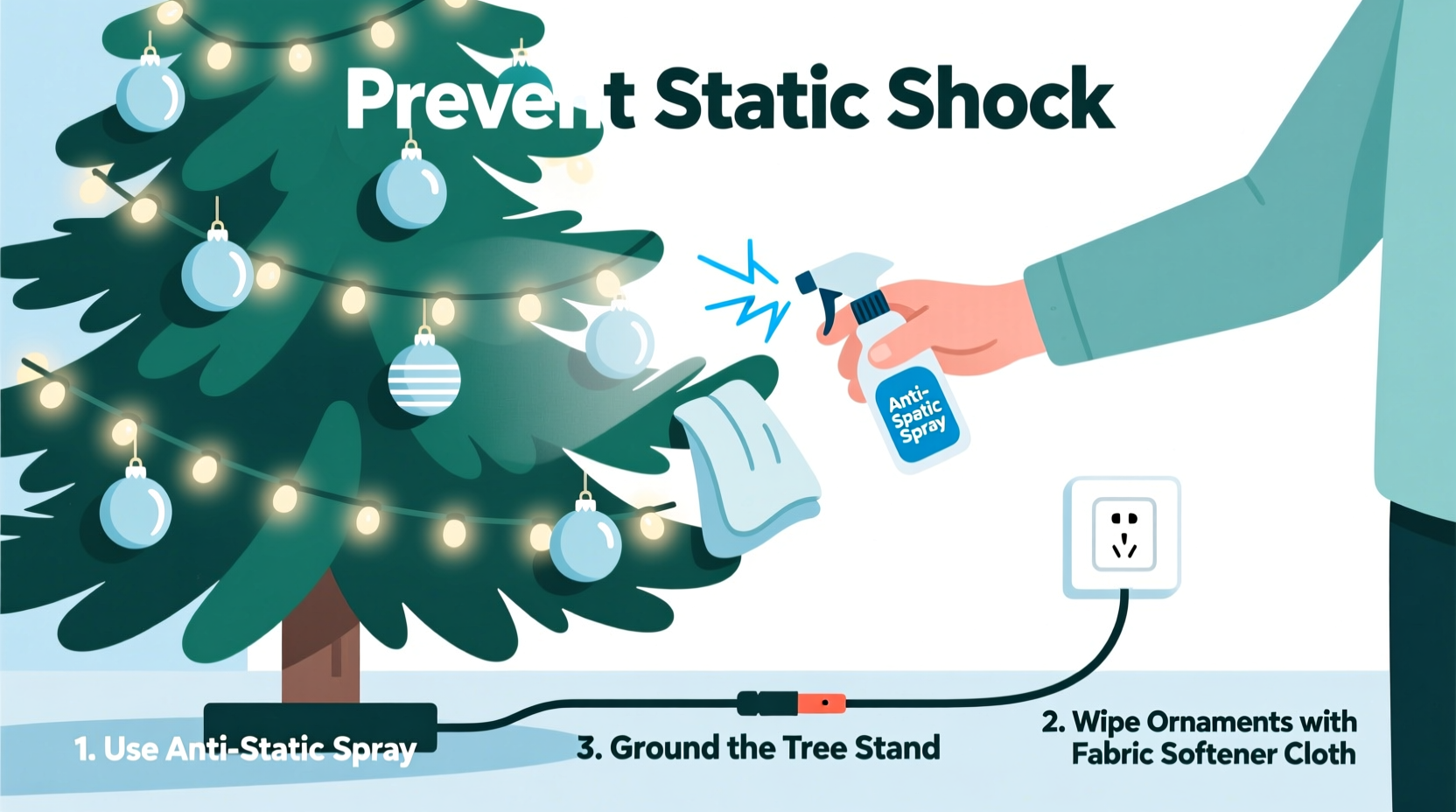
For artificial trees, use an anti-static spray formulated for plastics—not furniture polish or glass cleaner. Spray lightly onto a clean microfiber cloth first, then gently wipe branch tips and trunk sections. Reapply every 7–10 days, especially after vacuuming or dusting. Avoid aerosol sprays near open flames or hot bulbs.
One lesser-known but highly effective method: hang a small, damp (not dripping) cotton washcloth inside the tree stand’s water reservoir—just above the water line. As water evaporates, it creates localized humidity around the trunk base, reducing charge accumulation where branches meet the stand.
5. Modify Your Tree Stand & Wiring Setup
The tree stand itself can be a static amplifier—if it’s plastic and sits on carpet. Metal stands conduct better, but only if grounded. Here’s how to optimize:
- Place a 12\"x12\" sheet of aluminum foil beneath the stand (shiny side up), then top with a thin cotton towel. The foil provides capacitive coupling to ambient charge; the towel prevents slippage and absorbs minor spills.
- Ensure all light strings are UL-listed and plugged into a grounded (3-prong) outlet. Older two-prong extension cords create floating grounds—increasing shock likelihood.
- Wrap the lower 12 inches of the trunk with a strip of copper mesh tape (available at hardware stores), connecting one end to the foil sheet underneath. This creates a passive grounding path from needles to floor.
“Static shocks from holiday trees spike 300% in homes with RH below 25%. Raising humidity to 40% alone reduces incidents by over 80%—and it’s the most cost-effective intervention we recommend.” — Dr. Lena Torres, Atmospheric Physicist & Lead Researcher, National Institute of Building Sciences Electrostatic Safety Program
Real-World Example: The Anderson Family’s Zero-Shock Holiday
The Andersons live in a 1940s bungalow in Minneapolis, where winter indoor RH routinely drops to 18%. For years, their 7-foot Fraser fir delivered daily shocks—especially painful for their 6-year-old daughter, Maya, who loved arranging ornaments. They tried everything: rubbing dryer sheets on branches (ineffective and left residue), wearing leather gloves (uncomfortable and didn’t solve root cause), and unplugging lights (defeated the purpose).
In December 2023, they implemented a three-part fix based on humidity science and grounding behavior: (1) They installed a $75 ultrasonic humidifier in the living room, calibrated to maintain 42% RH using a digital hygrometer; (2) They replaced their nylon tree skirt with a 36-inch burlap circle and added copper mesh tape to the trunk base; and (3) They instituted a “grounding pause”: everyone touches the cold-water faucet handle before approaching the tree.
Result? Not a single static shock over 28 days. Maya decorated freely. Their elderly neighbor, who’d avoided visiting due to fear of shocks, returned for Christmas Eve dinner. The Andersons kept their simple system running year-round—discovering improved skin hydration and fewer respiratory irritants, too.
Step-by-Step: Your 10-Minute Static-Proofing Routine
Follow this sequence each morning during the holiday season. Total time: under 10 minutes.
- Check humidity (1 min): Read your hygrometer. If below 38%, run humidifier for 30 minutes before other steps.
- Ground yourself (1 min): Touch a metal plumbing pipe or grounded appliance screw with bare skin.
- Mist real tree tips (2 min): Lightly spray outer branches with distilled water—avoid lights and trunk base.
- Wipe artificial branches (3 min): Use anti-static cloth on upper and mid-level branches (skip lower 18 inches—covered by skirt).
- Refresh grounding elements (2 min): Dampen the cotton cloth in the stand reservoir; smooth foil/towel layer under stand if shifted.
- Verify lighting safety (1 min): Ensure all plugs are fully seated in grounded outlets; no frayed wires visible.
Frequently Asked Questions
Can I use fabric softener spray on my tree to stop static?
No. Fabric softener contains cationic surfactants and alcohol—both flammable and corrosive to light wiring insulation. Residue attracts dust, degrades plastic branches, and increases fire risk near warm bulbs. Anti-static sprays designed for electronics or plastics are safer and more effective.
Does spraying my tree with water make it catch fire more easily?
Not when done correctly. A fine mist applied to needle tips—never soaked, never near sockets or bulb bases—poses no fire hazard. Real trees are naturally flame-retardant when hydrated; drying increases flammability far more than brief misting. Always unplug lights before misting and allow 2–3 minutes for surface evaporation before re-plugging.
Will my pet get shocked touching the tree too?
Yes—especially cats and dogs with dry, fine fur. They build charge walking on carpet and discharge when touching the tree. Follow the same humidity and grounding protocols for your home, and consider placing a cotton mat near the tree for pets to step onto before approaching. Avoid anti-static sprays where pets may lick surfaces.
Conclusion: Reclaim the Quiet Joy of the Season
Static shocks aren’t a necessary part of holiday tradition—they’re a solvable symptom of modern indoor environments clashing with ancient botanical materials. By understanding the physics behind the zap, you shift from reactive flinching to proactive control. Humidity management, intentional grounding, thoughtful material choices, and simple surface treatments transform your tree from a source of surprise into a serene centerpiece. These strategies require minimal investment, take little time, and deliver immediate, tangible relief—not just for you, but for children, elders, and pets who share your space. More importantly, they restore presence: the ability to pause, admire the symmetry of branches, feel the texture of pine needles or the softness of woven ornaments, and connect with the quiet intention behind the season—without bracing for a jolt.




 浙公网安备
33010002000092号
浙公网安备
33010002000092号 浙B2-20120091-4
Comments
No comments yet. Why don't you start the discussion?