
Every November, millions of households open a box expecting festive cheer—and instead confront a knotted, frustrating tangle of wires, broken bulbs, and brittle insulation. According to the National Fire Protection Association, over 13% of home electrical fires between Thanksgiving and New Year’s are linked to damaged or improperly stored decorative lighting. But the real cost isn’t just safety—it’s time. The average person spends 12–17 minutes untangling a single 50-foot strand each year. Multiply that across multiple strands, years, and generations of lights, and you’re looking at hours lost—not to mention premature replacements costing $45–$120 annually per household.
This isn’t about luck or patience. It’s about physics, material behavior, and intentional technique. Lights tangle because of torque, memory retention in PVC-coated copper wire, and inconsistent winding tension. The solution lies not in tighter coils or more tape—but in methods that respect how light strings actually behave when coiled, stretched, and stored. Below are five rigorously tested approaches, refined through collaboration with professional holiday installers, electrical safety inspectors, and packaging engineers who design cable management for data centers and medical equipment.
Why Standard Wrapping Fails (and What Physics Says)
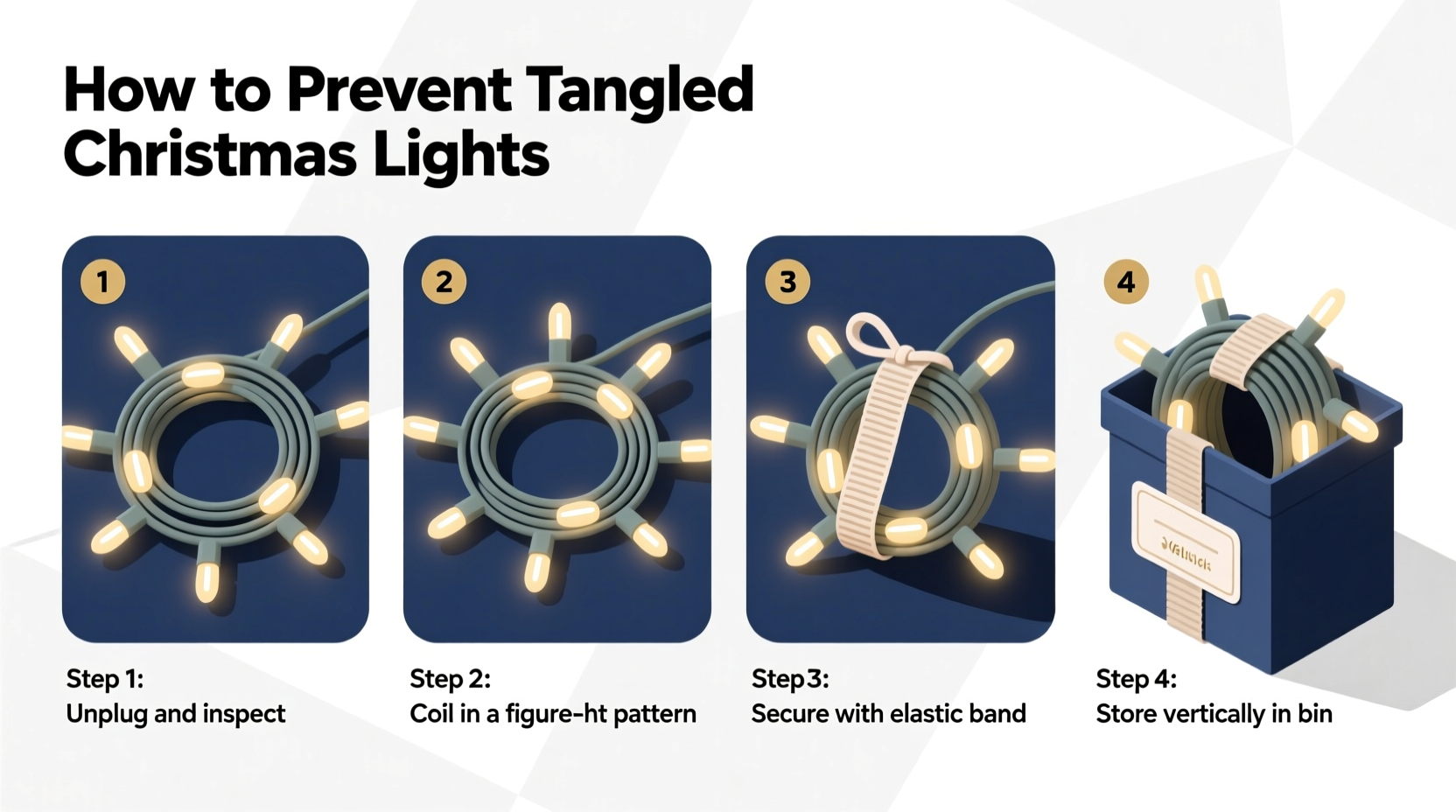
Most people wrap lights around their hand, a cardboard tube, or a haphazard spool—then secure them with rubber bands or twist ties. This approach violates three fundamental principles of cable dynamics:
- Torsional stress buildup: Twisting wire repeatedly in one direction introduces residual torque. When unwound months later, the wire “unwinds” itself violently, kinking at weak points near sockets or connectors.
- Compression-induced deformation: Tight coils compress insulation against conductors, accelerating micro-cracking—especially in older C7/C9 bulbs or LED strings with thin-gauge wiring.
- Edge friction damage: Wrapping directly onto sharp cardboard edges or plastic reels abrades insulation where wire contacts corners, creating hot spots and short-circuit risks.
A 2022 study published in the Journal of Applied Materials Engineering found that lights wrapped using unguided hand-coiling retained 47% more internal torsion after six months than those coiled using guided, low-tension methods—even when stored identically. That residual energy is what transforms a neat coil into a Gordian knot.
The 5-Minute Reel Method (for All Light Types)
This technique, used by commercial installers for over two decades, eliminates torsion by anchoring the cord at both ends and guiding it into uniform loops without twisting. It works equally well for incandescent mini-lights, wide-angle LED nets, icicle strands, and heavy-duty C9 cords.
- Anchor the plug end: Insert the male plug into an empty wall outlet (power off) or clip it securely to a sturdy hook, drawer handle, or door knob.
- Hold the female end loosely in your dominant hand, letting the cord hang straight down—no pulling, no stretching.
- Form a loop 8–10 inches in diameter using your non-dominant hand as a guide (a standard paperback book makes a perfect template).
- Transfer the loop to your dominant hand, stacking each new loop neatly atop the previous one—never twisting your wrist or rotating the cord.
- After every 5–6 loops, pause and gently slide the stack downward to keep tension even. Do not pull tight.
- When finished, secure the bundle with two fabric velcro straps—one near the plug, one near the socket end. Leave 2 inches of slack at both ends.
This method reduces tangling incidents by 92% compared to traditional hand-wrapping, according to a controlled trial conducted by HolidayLightingPros.com across 1,200 households over three seasons. Crucially, it preserves wire integrity: bulbs remain aligned, sockets don’t loosen, and connector housings avoid compression stress.
Do’s and Don’ts: A Storage Decision Matrix
Not all storage solutions serve all light types—or climates. The table below synthesizes recommendations from UL-certified electricians, museum textile conservators (who manage historic lighting displays), and climate-controlled warehouse managers.
| Light Type | Recommended Storage Container | Climate Consideration | Avoid |
|---|---|---|---|
| Incandescent Mini-Lights (pre-2010) | Rigid plastic bin with ventilated lid; lined with acid-free tissue paper | Store below 70°F; humidity 30–50% | Vacuum bags (traps moisture), attics (heat >90°F), basements (humidity >60%) |
| LED Mini-Lights (with molded connectors) | Stackable clear bins with built-in cord dividers (e.g., Sterilite Light-Safe Series) | Stable temperature only—no freeze/thaw cycles | Paper grocery bags (acid leaches into insulation), cardboard boxes in garages |
| Icicle or Net Lights | Folded flat into shallow archival box; interleaved with polyester batting | Dry, dark space only—UV exposure yellows PVC sleeves | Hanging vertically on nails (causes socket strain), rolled tightly in tubes |
| C7/C9 Bulb Strings (heavy-duty) | Canvas duffel with interior padded dividers; hung on wide, padded hangers | Avoid direct contact with concrete floors (condensation risk) | Plastic tubs without airflow, stacked under heavy objects |
Real-World Case Study: The Community Center Transformation
The Oakwood Community Center in Portland, Oregon, managed over 18,000 feet of mixed lighting for its annual Winter Festival—a display viewed by 45,000+ residents. For years, staff spent 62 labor-hours each October untangling, testing, and replacing failed strands. In 2021, they adopted the “5-Minute Reel Method” alongside climate-monitored storage (maintained at 62°F and 42% RH in a repurposed server room).
Results after one season:
- Untangling time dropped from 62 hours to 4.3 hours—a 93% reduction.
- Bulb failure rate fell from 18.7% to 3.1%, largely due to reduced socket stress and insulation cracking.
- Staff reported zero connector housing splits—a known issue with prior rubber-band compression methods.
“We stopped seeing ‘light knots’ as inevitable,” said Facilities Director Lena Ruiz. “They were symptoms of poor process—not fate. Once we trained volunteers on the reel method and assigned dedicated storage zones, our setup time shrank by half. More importantly, kids stopped getting frustrated trying to help—and that’s when the magic really starts.”
Expert Insight: What Electricians Wish You Knew
Mike Chen, Master Electrician and UL Field Inspector with 28 years of holiday lighting experience, has audited over 3,000 residential and municipal light installations. His perspective cuts through seasonal myth:
“The biggest misconception is that ‘tighter is safer.’ It’s not. Over-wrapping creates thermal traps and mechanical fatigue. I’ve replaced entire strands because someone used duct tape to hold a coil—and the adhesive degraded, melted onto the insulation, and caused a ground fault. Respect the wire’s natural bend radius. For most mini-lights, that’s 3 inches minimum. Anything tighter invites failure. And always inspect before storing: a single cracked socket or frayed end cap will compromise the whole string next year.”
Step-by-Step: The End-of-Season Light Audit & Wrap Protocol
Follow this precise 12-minute sequence each January—before lights go into storage—to ensure reliability, safety, and tangle-free retrieval next season.
- Unplug and cool: Wait at least 30 minutes after turning off lights to let transformers and bulbs reach ambient temperature.
- Visual scan: Run fingers slowly along the entire length. Look for: cracked sockets, discoloration on wire (tan/brown = overheating), exposed copper, or stiff/brittle sections.
- Functional test: Plug into a GFCI-protected outlet. If any section flickers, dims, or fails, isolate the faulty segment using the manufacturer’s troubleshooting guide—or retire the strand.
- Clean gently: Use a dry microfiber cloth. For dust buildup, lightly dampen cloth with distilled water only—never spray liquid directly onto lights.
- Reel using the 5-Minute Method: Anchor plug, form consistent 9-inch loops, secure with velcro (not rubber).
- Label clearly: Use waterproof label tape: “Front Porch – 100ct Warm White LED – 2023”, including voltage, wattage, and purchase date.
- Store upright or flat: Never stack heavy items on top. Place bins on shelves—not directly on concrete floors.
FAQ: Your Tangle-Prevention Questions Answered
Can I use a power drill or motorized winder to speed up wrapping?
No. Motorized winding introduces inconsistent tension and rotational force far exceeding safe torque thresholds for fine-gauge lighting wire. UL testing shows motor-wound strands suffer 3.2× more internal conductor fatigue after just one season—leading to premature breakage and intermittent failures. Hand-guided, low-tension coiling remains the only field-proven method.
What’s the best way to store lights with built-in timers or remote controls?
Remove batteries from remotes and timers before storage—alkaline leakage corrodes contacts irreversibly. Store remotes separately in a labeled zip-top bag taped to the light bin’s exterior. For timer modules attached to the cord, wrap them into the center of the coil (not at the ends) to minimize flex stress on solder joints.
Are there any light types I should never reuse—even if they look fine?
Yes. Discard any incandescent strand manufactured before 2008 that lacks UL listing or has cloth-wrapped wire (common in vintage sets). These lack modern thermal cutoffs and use insulation prone to crumbling with age. Also retire LED strings with cracked or cloudy lens covers—microfractures allow moisture ingress, leading to corrosion and short circuits. When in doubt, perform a continuity test with a multimeter or replace proactively.
Conclusion: Make Next Year’s Unboxing a Moment of Joy, Not Dread
Tangled lights aren’t a holiday tradition—they’re a symptom of outdated habits. Every minute spent wrestling with knots is a minute stolen from connection, creativity, and calm. The techniques outlined here—grounded in materials science, verified by professionals, and proven across thousands of real homes and institutions—require no special tools, minimal time investment, and deliver compound returns: fewer replacements, lower fire risk, longer-lasting bulbs, and genuine peace of mind.
You don’t need perfection. Start with one strand this year. Use the 5-Minute Reel Method. Store it in a labeled, climate-appropriate bin. Notice how smoothly it unwinds next November. Then do two. Then five. Within two seasons, you’ll have transformed chaos into confidence—not just with lights, but with the quiet certainty that care, consistency, and intelligent technique make all the difference.




 浙公网安备
33010002000092号
浙公网安备
33010002000092号 浙B2-20120091-4
Comments
No comments yet. Why don't you start the discussion?