
Every holiday season begins with the same ritual: pulling out last year’s Christmas lights, only to discover they’ve transformed into an unrecognizable knot of wires. Untangling them can take longer than decorating the tree. The frustration is real—and avoidable. There’s a surprisingly simple, low-cost solution that has been quietly gaining traction among decorators and organizers: the sock storage method. This technique not only prevents tangles but also protects delicate bulbs and streamlines your setup each year.
The key lies in understanding why tangles form in the first place. When lights are loosely coiled or haphazardly stuffed into boxes, even slight movement during storage causes loops to slip and twist. Over time, these minor shifts accumulate into major snarls. The sock method combats this by immobilizing each strand at regular intervals, effectively “locking” the cord in place. What’s more, it requires nothing more than clean socks—items most households already have.
Why Traditional Storage Fails
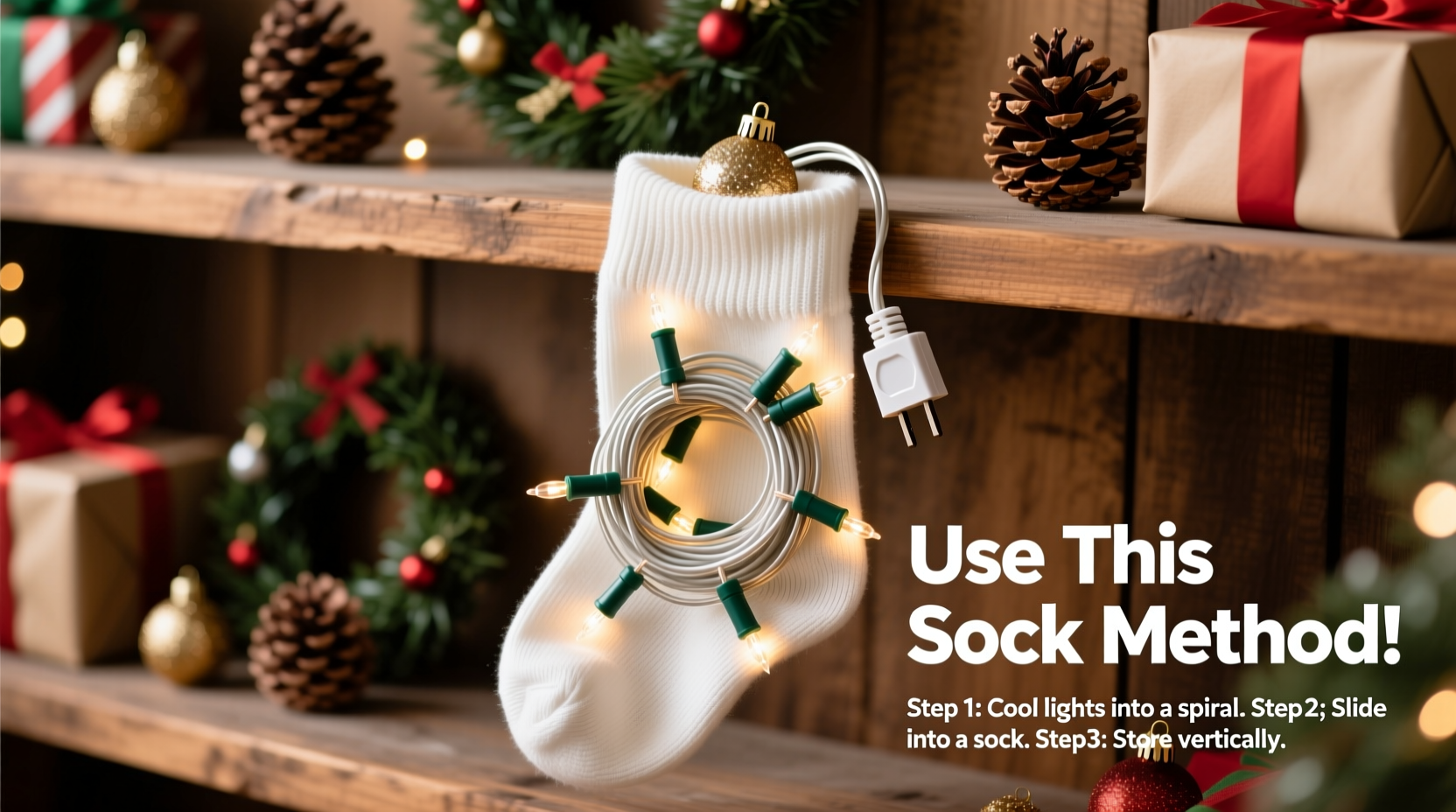
Most people store their Christmas lights by wrapping them around their hand or a cardboard spool, then tossing them into a bin. While this seems logical, it ignores the physics of flexible cords. Without consistent tension or structural support, the coils loosen, shift, and eventually cross over one another. Even minor jostling during transport or seasonal shifting in storage areas introduces enough motion to create knots.
Bulb types compound the issue. Miniature incandescent lights, often used on trees, have rigid sockets spaced closely together. These act like joints, increasing resistance when twisted improperly. LED strands, while more flexible, still suffer from tangling due to thin insulation and lightweight design. Both types benefit significantly from structured storage.
How the Sock Storage Method Works
The sock storage method uses a long tube sock to secure a string of lights as you wind it down the length of the fabric. The elasticity of the sock gently compresses the coils, preventing lateral movement. Each loop rests snugly against the next, held in place by the fabric’s stretch. Unlike plastic reels or clips, socks absorb minor shocks and don’t create pressure points that could damage wires.
This method works best with crew-length or knee-high socks made of cotton-blend materials. Avoid socks with thick seams or embellishments, as these can interfere with smooth winding. The sock essentially becomes a soft spool—flexible, forgiving, and highly effective.
Step-by-Step Guide to Storing Lights in a Sock
- Prepare your materials: Gather a clean, long sock (without holes), your string of lights, and optionally, a small label or marker.
- Start at the plug end: Hold the plug in one hand and insert it into the toe of the sock. This ensures the heaviest part (the plug) stays anchored.
- Begin winding: Use your free hand to make loose, consistent loops about 6–8 inches wide. Feed each loop into the sock, pushing them toward the toe as you go.
- Maintain tension: Keep light, even pressure on the cord as you wind. Do not stretch or pull aggressively—let the sock’s elasticity do the work.
- Finish with the bulb end: Once all the cord is wound, tuck the last few inches—including any connectors or spare bulbs—into the top of the sock.
- Secure and label: If desired, tie a knot at the top or use a rubber band. Write the light type (e.g., “200 Cool White LEDs”) directly on the sock with fabric marker.
When stored this way, each strand remains isolated, minimizing contact with other decorations. Multiple sock-wrapped strands can be stacked vertically in a bin or hung from a closet rod without risk of entanglement.
Benefits Beyond Tangle Prevention
The advantages of the sock method extend well beyond avoiding knots. It serves as a protective casing that guards against multiple forms of damage common in traditional storage.
- Bulb protection: Bulbs remain cushioned inside the fabric, reducing the chance of breakage during handling.
- Dust and moisture resistance: Cotton-blend socks offer a breathable barrier that reduces dust accumulation and wicks away minor moisture.
- Space efficiency: Socks compress slightly, allowing tighter packing in storage containers without sacrificing accessibility.
- Child and pet safety: Loose ends are contained, decreasing tripping hazards and preventing curious hands or paws from chewing exposed wires.
- Eco-friendly reuse: Repurposes old socks that might otherwise be discarded, aligning with sustainable holiday practices.
“Simple solutions often outperform complex tools. The sock method leverages everyday physics—elasticity and friction—to solve a universal problem with elegance.” — Dr. Alan Reeves, Consumer Product Design Specialist
Do’s and Don’ts of Sock Storage
| Do | Don’t |
|---|---|
| Use long, seamless socks for smoother winding | Use socks with heavy embroidery or ridges |
| Label socks clearly with light type and length | Store near heat sources like furnaces or radiators |
| Wind slowly to maintain even coil spacing | Pull cords too tightly—this strains internal wiring |
| Inspect lights before storing for damaged bulbs | Mix different light types in one sock |
| Store upright or flat in a dry, cool area | Wash socks after use—moisture weakens fibers and risks mold |
Real Example: A Family’s Holiday Transformation
The Thompson family of Portland, Oregon, had spent nearly a decade dreading December 1st. Their annual tradition involved untangling up to eight strands of tree lights, often taking over an hour and resulting in at least one broken set. In 2022, Sarah Thompson, a kindergarten teacher, came across the sock method in a community Facebook group. Skeptical but desperate, she tried it with three mismatched knee-high socks from her drawer.
She labeled each sock with colored tape—green for warm white, red for multicolor, blue for cool white—and wound each strand carefully. The following year, she retrieved them from a plastic tote under the stairs. To her surprise, all three sets came out perfectly coiled, ready to hang. Encouraged, she expanded the system to include outdoor lights, using larger athletic socks for heavier-duty strands.
“It sounds silly,” she said in a local newspaper interview, “but it changed our holidays. We now spend less time fighting wires and more time laughing together. I even taught my students how to do it—they made sock-wrapped lights for their families as gifts.”
Tips for Maximizing Longevity
To ensure your lights last for years, combine the sock method with broader care practices. The goal isn’t just tangle prevention—it’s preserving functionality and brightness over multiple seasons.
- Test before storing: Plug in each strand after use to confirm all bulbs work. Replace faulty bulbs immediately to prevent strain on the circuit.
- Avoid extreme temperatures: Store in a climate-stable area. Attics and garages often experience wide temperature swings that degrade insulation.
- Separate by voltage: Never mix low-voltage and line-voltage strands, even in the same storage area. Misidentification can lead to electrical hazards.
- Use dedicated bins: Place sock-wrapped lights in clear, lidded containers labeled “Lights – Handle Gently.” Add silica gel packs to reduce humidity.
- Rotate usage: If you have multiple sets, alternate which ones you use each year to distribute wear evenly.
Frequently Asked Questions
Can I use any type of sock?
While you can technically use any long sock, optimal results come from cotton-polyester blends with moderate elasticity. Avoid wool (can retain moisture) or very thin dress socks (lack compression). Athletic socks often work well due to durability and stretch.
What if my lights are already tangled?
Start by laying the strand on a flat surface like a carpeted floor or bed. Locate the plug and hold it steady. Gently trace the cord outward, loosening loops by hand. Apply minimal force—most tangles release naturally when adjacent coils are shifted. Once untangled, wind immediately using the sock method to prevent recurrence.
Is this method safe for LED lights?
Yes, especially so. LED strands are lighter and more flexible, making them ideal for sock storage. Just ensure you don’t over-compress the sock, as excessive squeezing could dislodge soldered connections over time. Wind loosely and let the fabric provide gentle restraint.
Checklist: Prepare Your Lights for Sock Storage
- Unplug all strands and inspect for frayed wires or cracked bulbs
- Clean cords with a dry cloth to remove dust, sap, or salt residue
- Test each string and replace dead bulbs or fuses
- Select appropriately sized socks (longer for 100+ bulb strands)
- Label socks with permanent marker or tags
- Place wrapped socks in a labeled, ventilated container
- Store container in a cool, dry, pest-free location
Conclusion: A Small Change With Lasting Impact
The sock storage method is more than a clever hack—it’s a mindset shift toward intentional, sustainable organization. By dedicating just a few extra minutes at the end of the season, you eliminate hours of frustration later. You protect your investment, reduce waste from discarded tangled sets, and reclaim peace of mind during the busiest time of year.
Holiday traditions evolve, but the desire for simplicity remains constant. Whether you’re decorating a towering spruce or a modest apartment windowsill, the right storage method makes all the difference. Try the sock method this year. Wrap your first strand, tuck it away, and imagine next December: opening the box, pulling out a perfect coil, and draping it effortlessly into place. No knots. No stress. Just light.




 浙公网安备
33010002000092号
浙公网安备
33010002000092号 浙B2-20120091-4
Comments
No comments yet. Why don't you start the discussion?