
Christmas trees and cats share an almost gravitational attraction: the shimmering lights, swaying branches, and dangling ornaments trigger deep-seated hunting instincts and playful curiosity. But what begins as harmless fascination often ends in toppled trees, shattered glass, chewed wires, and stressed pets—and owners. According to the American Veterinary Medical Association (AVMA), holiday-related pet injuries spike 37% between December 1st and January 5th, with tree-related incidents accounting for nearly 22% of those cases. Yet most solutions offered online—citrus sprays, aluminum foil barriers, or “just watch them closely”—fail because they ignore feline behavior science and environmental design principles. This article distills evidence-based strategies used by veterinary behaviorists, certified cat behavior consultants, and experienced multi-cat households. These aren’t theoretical tips; they’re field-tested interventions that address motivation, opportunity, and reinforcement—the three pillars of behavior change.
Why Cats Climb Trees (and Why ‘Just Saying No’ Doesn’t Work)
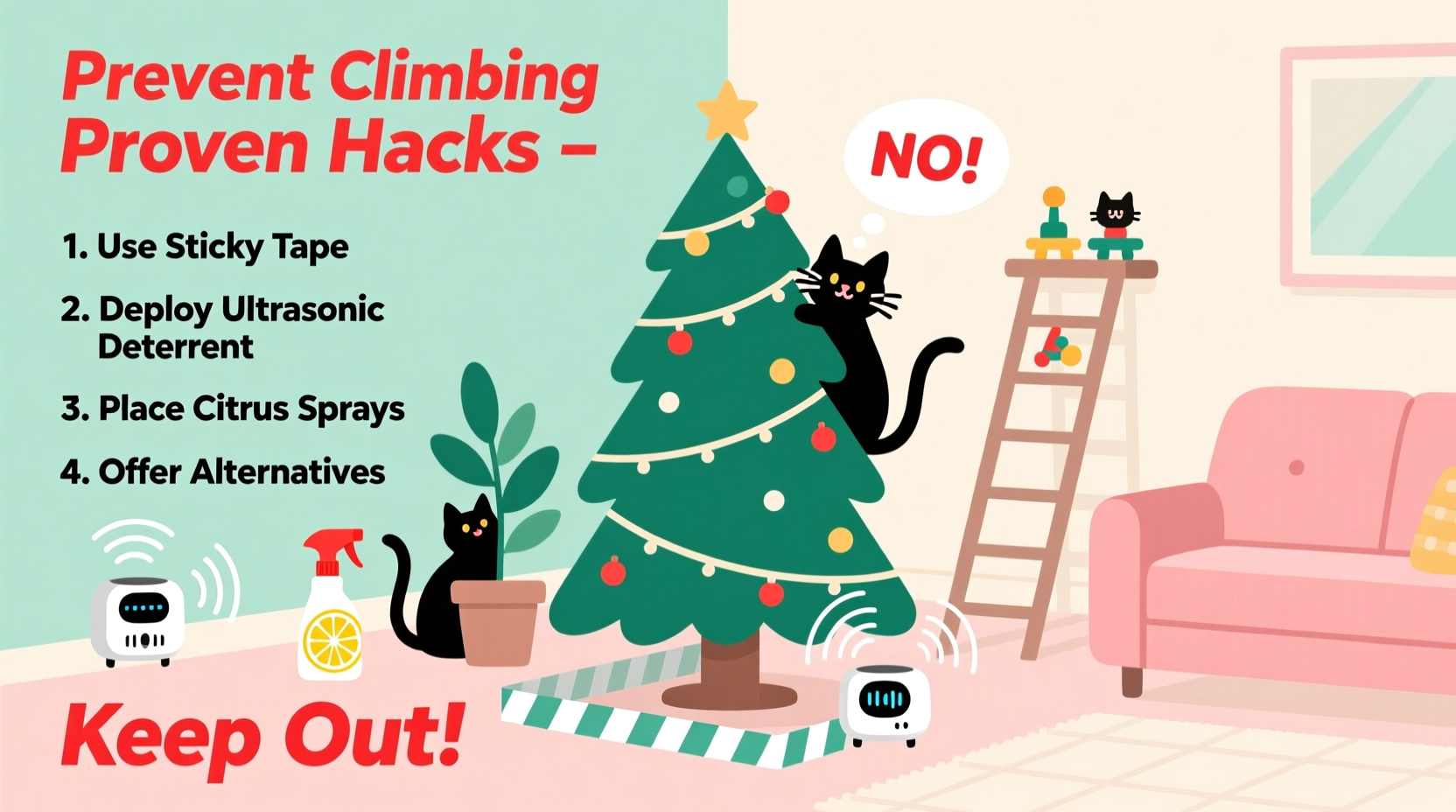
Cats don’t climb Christmas trees out of malice or defiance. They respond to specific environmental cues rooted in evolution and neurobiology. A live or realistic artificial tree mimics a vertical landscape—a natural vantage point for surveillance, play, and territorial assertion. The movement of tinsel, reflections off ornaments, and even the faint scent of pine resin activate dopamine pathways associated with exploration and reward-seeking. Critically, punishment-based responses (yelling, spraying water, clapping) do not teach alternative behaviors; instead, they erode trust and may increase anxiety-driven climbing. As Dr. Sarah Heath, a European Veterinary Specialist in Behavioural Medicine, explains:
“Cats learn through consequence and association—not moral instruction. If climbing the tree results in attention (even negative), treats dropped during a chase, or the thrill of knocking something down, the behavior is reinforced—even if you’re scolding. Effective prevention means removing reinforcement *and* offering better options.” — Dr. Sarah Heath, BVSc, DACVB, DECVBM-CA
This understanding shifts the focus from control to collaboration: redesign the environment, redirect energy, and respect the cat’s need for vertical space—not eliminate it.
Proven Physical Stabilization & Barrier Methods
A wobbly tree invites investigation. A stable, anchored tree removes the sensory feedback cats seek—the subtle sway, the rustle, the satisfying “give” under paw pressure. Stability isn’t just about preventing falls; it reduces the tree’s novelty as a moving object, lowering its appeal over time.
Barriers must be non-threatening, consistent, and impossible to bypass—not temporary deterrents that wear off or get ignored. The most effective physical systems combine anchoring with perimeter control:
- The Double-Ring Zone: Place a 36-inch-diameter ring of smooth, rigid plastic fencing (like garden edging) around the base, secured to the floor with double-sided carpet tape. Then place a second, slightly wider ring (42 inches) just outside it, filled with crinkly brown paper or shredded kraft paper. The outer layer provides auditory and tactile novelty; the inner barrier creates a visual and physical boundary cats instinctively hesitate to cross.
- Weighted Base Reinforcement: Fill the tree stand’s reservoir with sand or aquarium gravel *beneath* the water—not instead of it. A 5-gallon stand holds ~35 lbs of sand when layered correctly, raising the center of gravity and dampening vibration transmission.
- Branch-Level Deterrence (Non-Toxic): Wrap lower branches (up to 24 inches) with smooth, wide-gauge copper wire (14–16 AWG), twisted loosely around the trunk and secured with floral tape. Copper’s cool, unyielding texture and faint metallic scent are aversive to most cats—but safe, non-toxic, and invisible once decorated.
Crucially, avoid sticky paws pads, citrus oils near electrical cords, or motion-activated air sprays. These cause fear, damage trust, and may generalize to other areas of the home—undermining long-term harmony.
Behavioral Redirection: Meeting the Need, Not the Symptom
Climbing is rarely about the tree itself—it’s about unmet needs: vertical territory, predatory engagement, or mental stimulation. Redirecting requires offering superior alternatives *before* the tree becomes the default option.
| Need Addressed | High-Value Alternative | Why It Works |
|---|---|---|
| Vertical Space | Wall-mounted cat shelves arranged in a “staircase” pattern up a blank wall (minimum 3 shelves, spaced 12–16 inches apart, each ≥12\" deep) | Provides elevated observation points without instability; satisfies territorial instinct more reliably than a single tree. |
| Predatory Play | Daily 15-minute interactive sessions using wand toys with feather-and-fur combinations, ending with a food puzzle or treat-dispensing toy | Completes the prey sequence (stalk-chase-catch-kill-eat), reducing residual hunting drive directed at ornaments. |
| Mental Stimulation | Rotating “foraging zones”: shallow cardboard boxes filled with shredded paper and hidden kibble, placed in different rooms daily | Engages natural search behavior; prevents boredom-induced tree exploration. |
Timing matters. Initiate redirection *first thing in the morning* and *within 30 minutes of returning home*. These are peak arousal windows when cats are most likely to seek stimulation. Consistency for 10–14 days resets behavioral patterns—neuroplasticity research shows this is the minimum window for new habits to take root in feline cognition.
A Real Household Case Study: The Three-Cat Conundrum
In Portland, Oregon, Maya R., a veterinary technician and owner of three indoor cats (Luna, age 7; Jasper, age 4; and Pip, age 10 months), faced repeated tree collapses despite using commercial “cat-proof” stands and bitter apple spray. Her breakthrough came only after observing *when* and *how* each cat approached the tree:
- Luna (senior) circled slowly, then jumped directly to the third branch—motivated by vantage point.
- Jasper (middle-aged) batted at low-hanging ornaments—pure predatory play.
- Pip (kitten) chased light reflections on the wall *behind* the tree, then scaled it to investigate the source.
She implemented a tiered solution: installed wall shelves opposite the tree (for Luna), added a laser pointer mounted on a tripod to project moving dots *away* from the tree onto a blank wall (for Pip), and introduced a daily “ornament hunt” game—hiding soft, jingle-free plush ornaments in tunnels and boxes (for Jasper). Within nine days, all three cats ignored the tree entirely. The key wasn’t stopping behavior—it was solving the individual motivation behind it.
Step-by-Step Prevention Timeline (Start 10 Days Before Tree Setup)
- Days 10–7: Install and enrich alternative vertical spaces (shelves, towers). Introduce new foraging toys and rotate them daily. Begin twice-daily interactive play sessions.
- Day 6: Set up the tree stand in its final location—but leave the tree undecorated. Let cats explore the bare structure *without consequences*. This desensitizes novelty.
- Day 5: Anchor the tree securely. Add the Double-Ring Zone barrier. Place copper-wrapped lower branches.
- Days 4–2: Decorate *only* upper branches (above 36 inches). Keep lower 3 feet completely bare—no ornaments, no lights, no tinsel. This eliminates temptation while preserving aesthetics.
- Day 1 (Tree Day): Place a favorite blanket or cat bed *inside* the Double-Ring Zone, near the base but outside the barrier. Pair it with calming pheromone diffusers (Feliway Optimum) running 48 hours prior.
- Ongoing: Conduct one 15-minute play session within 30 minutes of turning on tree lights. Never allow unsupervised access until the cat consistently ignores the tree for 72+ hours.
FAQ
Will a fake tree really be safer than a real one?
Not inherently—unless you choose wisely. Avoid tall, lightweight flocked trees with narrow bases; their instability invites climbing. Opt for a pre-lit, weighted-base artificial tree with dense, stiff branches (PE plastic, not PVC) and a 4+ point anchoring system. Real trees have advantages too: their scent deters some cats, and their heavier weight adds stability—if properly anchored and watered daily to prevent needle drop (which creates litter cats love to dig in).
Can I use essential oils or citrus sprays safely?
No. Many essential oils—including orange, lemon, eucalyptus, and tea tree—are toxic to cats via inhalation, skin contact, or ingestion. Even diluted citrus sprays can cause oral ulceration or respiratory distress. Safer alternatives include a 1:4 vinegar-water mist (test on a small area first) or commercially formulated, veterinary-approved feline deterrents like PetSafe SSSCAT (a harmless, odorless aerosol triggered by motion).
My cat already climbs—will these methods still work?
Yes—but success depends on consistency and patience. If climbing has been reinforced for weeks or months, expect a 2–3 week adjustment period. Do not punish past behavior. Instead, interrupt *in the moment* with a calm “hey” and immediately redirect to a shelf or toy. Track progress: note how many times per day the cat approaches vs. climbs. A 50% reduction in approaches by Day 7 signals the plan is working.
Conclusion
Preventing your cat from climbing the Christmas tree isn’t about winning a battle—it’s about designing peace. It means honoring your cat’s nature while thoughtfully shaping the environment to support calm coexistence. The proven hacks outlined here—anchoring for stability, copper-wrapping for tactility, wall shelves for elevation, timed play for impulse control—work because they align with how cats think, learn, and thrive. They require planning, not perfection. Start early. Observe closely. Adjust based on your cat’s unique personality. And remember: the goal isn’t a perfectly still tree—it’s a joyful, stress-free holiday where both you and your cat feel safe, respected, and deeply at home.




 浙公网安备
33010002000092号
浙公网安备
33010002000092号 浙B2-20120091-4
Comments
No comments yet. Why don't you start the discussion?