
For many cat owners, the holiday season arrives with equal parts joy and quiet dread: the moment the first ornament is hung, the familiar thump-thump-thump of paws on carpet begins—and within hours, the tree is listing like a drunken sailor. It’s not mischief for mischief’s sake. Cats don’t knock over trees to spite us; they’re responding to instinct, curiosity, scent, movement, and unmet environmental needs. Understanding *why* your cat targets the tree—not just how to stop them—is the foundation of lasting success. This isn’t about punishment or exclusion. It’s about redesigning the interaction so both your feline companion and your festive centerpiece thrive.
Why Cats See the Tree as Prime Real Estate (and Why “No” Doesn’t Work)
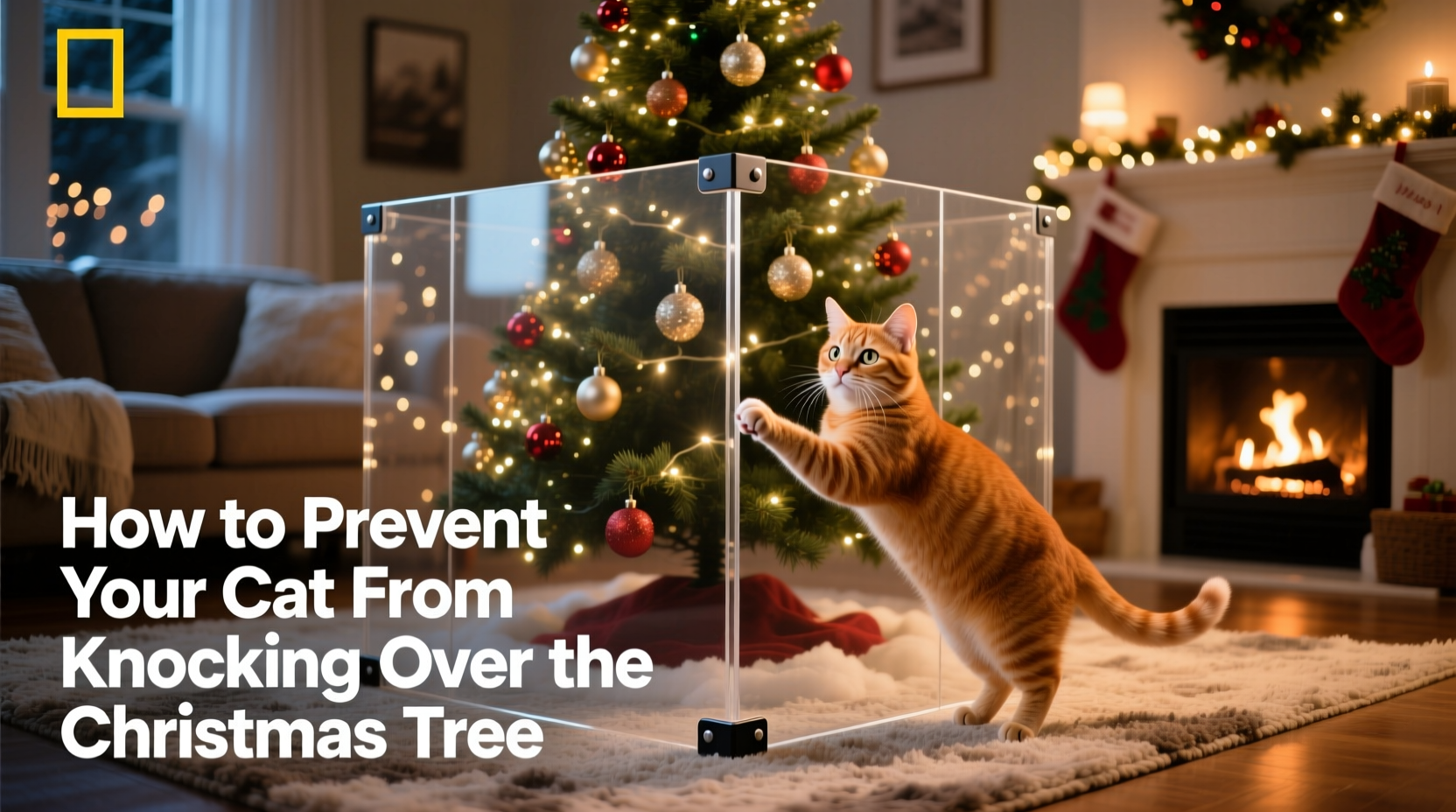
Cats are obligate climbers, natural hunters, and highly sensitive to novelty, texture, and motion. A Christmas tree delivers all three in abundance: vertical structure (ideal for surveying territory), dangling ornaments (mimicking prey movement), pine scent (novel and stimulating), and rustling branches (triggering chase reflexes). Scolding, spraying water, or yelling may suppress the behavior temporarily—but it doesn’t address the underlying drivers. Worse, it can erode trust and increase anxiety, sometimes escalating the very behavior you’re trying to curb.
Research from the University of Lincoln’s School of Life Sciences confirms that cats redirected from preferred activities without alternative outlets often intensify those behaviors later—or shift them to less obvious but equally problematic targets (e.g., knocking items off shelves at 3 a.m.). As Dr. Sarah Heath, a European Veterinary Specialist in Behavioural Medicine, explains:
“Cats aren’t ‘bad’ when they interact with the tree—they’re fulfilling biological imperatives. The goal isn’t to eliminate climbing or exploration, but to make the tree uninteresting *compared to better alternatives*. That requires environmental enrichment, not correction.” — Dr. Sarah Heath, FRCVS, Diplomate ECVBM-CA
This reframing shifts the solution set entirely—from barriers and deterrents alone, to proactive engagement, spatial design, and sensory substitution.
7 Proven, Cat-Safe Prevention Strategies (Backed by Feline Ethology)
Effective prevention combines physical security, behavioral redirection, and environmental management. These seven methods work best when layered—not deployed in isolation.
- Anchor the tree *beneath* the floor, not just at the base. Most tip-over incidents occur when cats push against the trunk mid-height or scramble up low branches, shifting the center of gravity. Use a heavy-duty, low-profile tree stand filled with sand or gravel (not just water) and secure it to a wall stud with aircraft-grade braided steel cable and rated eye bolts—not string or ribbon. Anchor points should be at least ⅔ up the trunk height to prevent leverage.
- Install a “no-climb” barrier using tension rods and mesh. Place two adjustable tension rods (rated for 30+ lbs) inside the tree skirt—one at ankle height, one at waist height. Drape lightweight, breathable nylon mesh (like garden netting) between them, forming a loose cylinder around the lower third of the tree. It’s visually unobtrusive, allows airflow, and disrupts the cat’s ability to gain traction on the trunk without feeling trapped.
- Redirect hunting energy with timed, high-value play sessions. Schedule two 15-minute interactive play sessions daily—at dawn and dusk—using wand toys that mimic birds or rodents. End each session with a meal (use puzzle feeders). This satisfies predatory drive *before* the tree becomes the default target and reduces nocturnal activity near the tree.
- Neutralize the scent lure. Pine, fir, and spruce resins contain terpenes that excite cats’ olfactory receptors. Wipe trunk and lower branches weekly with a damp cloth infused with diluted apple cider vinegar (1 tsp per cup of water)—a scent cats dislike but humans barely notice. Avoid citrus oils, which are toxic if licked.
- Create a superior vertical alternative *within sight* of the tree. Position a tall, stable cat tree or wall-mounted shelf system no more than 3 feet from the tree’s base—ideally at an angle that lets the cat observe the tree while perched higher. Cover it with sisal rope, fleece, or faux fur, and place a favorite toy or catnip pouch on the top platform.
- Remove visual triggers from ornaments. Hang breakable or shiny ornaments only above 4 feet. Use matte-finish wooden, felt, or fabric ornaments below that height—and avoid anything that swings, dangles, or reflects light erratically. Motionless, textured objects hold far less appeal than moving ones.
- Introduce “tree time” gradually with positive association. For 5 minutes twice daily, sit beside the tree with treats and gentle praise. Toss a treat *near* (not under) the tree, then gradually move the toss location closer over several days. Never force proximity. This builds neutral or positive associations instead of fear-based avoidance.
Do’s and Don’ts: What Actually Works (and What Makes It Worse)
| Category | Do | Don’t |
|---|---|---|
| Tree Setup | Use a weighted, wide-base stand; anchor to wall stud; choose a slim-profile artificial tree with tight branch spacing | Use a flimsy stand; rely solely on water weight; choose a full, bushy tree with low, springy branches |
| Ornament Strategy | Hang fragile items high; use soft, static ornaments below 4 ft; add subtle, non-reflective lights (warm white LED) | Hang glass balls or tinsel at cat height; use blinking or color-shifting lights; include bells or wind chimes nearby |
| Behavioral Support | Provide daily vertical play; rotate toys weekly; offer cardboard boxes near the tree as “observation posts” | Punish after the fact; use spray bottles; confine cat to another room during holidays |
| Scent Management | Wipe trunk weekly with diluted ACV; diffuse calming pheromones (Feliway Optimum) 3 ft from tree | Apply essential oils (peppermint, eucalyptus); use scented candles or potpourri near the tree; over-clean with strong disinfectants |
Real-World Success: How Maya Saved Her Fraser Fir (and Her Sanity)
Maya, a veterinary technician in Portland, faced annual tree disasters with her 3-year-old Maine Coon, Atlas. “He’d scale it like Spider-Man by Day 2—even with the stand filled with rocks,” she recalls. She tried everything: double-sided tape, lemon spray, even a motion-activated air canister (which terrified Atlas and made him hide for days).
After consulting with a certified feline behavior consultant, Maya implemented a three-tier approach over 10 days: First, she anchored her 7-foot Fraser fir to a wall stud using a 300-lb-rated cable kit and added the tension-rod/mesh barrier. Second, she installed a 6-foot wall-mounted shelf ladder 28 inches from the tree, covered in recycled denim and topped with a heated cat bed. Third, she began daily 12-minute play sessions ending in meals served in a slow-feeder ball placed *on the shelf*, not the floor.
By Day 5, Atlas was napping on the shelf, watching the tree. By Day 10, he ignored it entirely—except to occasionally bat a fallen pine needle off the shelf edge. “It wasn’t about stopping him,” Maya says. “It was about giving him something better to do, in a spot he already loved.” Her tree stood unscathed through New Year’s—and Atlas gained confidence, not stress.
Step-by-Step: Your 7-Day Tree-Proofing Timeline
Start this plan *before* you bring the tree indoors. Consistency matters more than speed.
- Day 1: Assess your space. Measure distance from wall to tree location. Purchase wall anchors, tension rods, and mesh. Buy or build a taller, more engaging cat perch.
- Day 2: Set up the perch within 3 feet of the planned tree spot. Introduce Atlas (or your cat) to it with treats and play—no pressure, just positive exposure.
- Day 3: Assemble and anchor the tree stand *before* adding the tree. Test stability with firm side pressure.
- Day 4: Bring the tree in. Install the tension-rod/mesh barrier. Wipe trunk with ACV solution. Hang only upper-level ornaments.
- Day 5: Begin scheduled play sessions—same time, same location, same routine. End each with food in the new perch.
- Day 6: Add one low-hanging, non-reflective ornament (e.g., a wool felt star). Observe calmly—do not intervene unless cat attempts to climb.
- Day 7: Gradually add remaining safe ornaments. Continue play, perch feeding, and light wiping. Monitor for relaxed body language (slow blinks, tail held high) near the tree.
FAQ: Addressing Common Concerns
What if my cat is already obsessed with the tree—can I reverse it?
Absolutely—but it requires consistency and patience. Stop reinforcing the behavior (don’t laugh, don’t chase, don’t give attention *during* climbing). Instead, immediately redirect to the perch with a treat or toy *before* they reach the trunk. Most cats reorient within 7–10 days if alternatives are consistently more rewarding.
Are artificial trees safer than real ones for cats?
Artificial trees eliminate pine needle ingestion risks and sap-related skin irritation—but many have PVC or lead-stabilized plastics that are toxic if chewed. Choose PE (polyethylene) or PP (polypropylene) trees labeled “non-toxic” and “lead-free.” Real trees require more scent management but pose fewer chemical risks if sourced organically and kept fresh.
Will a tree collar or skirt help—or just make it worse?
A rigid, weighted tree collar (not fabric) can stabilize the base—but avoid deep, enclosed skirts. Cats see them as hiding spots, increasing temptation to burrow underneath and destabilize the trunk. Opt for a low-profile, open-weave skirt or a simple circular rug that lies flat and doesn’t invite digging.
Conclusion: Safety, Respect, and Shared Joy
Preventing your cat from knocking over the Christmas tree isn’t about winning a battle—it’s about extending an invitation. An invitation to explore safely, to hunt meaningfully, to rest confidently, and to share your space without conflict. When we meet cats where they are—honoring their instincts while thoughtfully guiding their choices—we create homes where wonder isn’t sacrificed for order, and tradition isn’t built on stress.
The cleverest hack isn’t the most complex gadget or the strongest adhesive. It’s the willingness to pause, observe, and ask: *What does my cat need right now—and how can I help them get it, right here, right now?* That question transforms every holiday season from a countdown to catastrophe into a quiet celebration of mutual understanding.




 浙公网安备
33010002000092号
浙公网安备
33010002000092号 浙B2-20120091-4
Comments
No comments yet. Why don't you start the discussion?