
Nothing signals the holiday season like the rich, resinous scent of a freshly cut Christmas tree—and nothing deflates the festive mood faster than brittle needles littering the floor by December 12th. A dry tree isn’t just an aesthetic disappointment; it’s a fire hazard. According to the National Fire Protection Association (NFPA), between 2017 and 2021, U.S. fire departments responded to an average of 160 home fires each year started by Christmas trees—most involving trees that had dried out significantly. The good news? You don’t need commercial preservatives, misting systems, or expensive additives. With sound botanical understanding and time-tested household practices, you can extend your tree’s freshness by 2–3 weeks—even in heated homes where indoor humidity often drops below 20%.
This guide distills decades of arborist field experience, extension service research from land-grant universities (including Cornell, Ohio State, and the University of Illinois), and real-world homeowner trials into actionable, low-effort strategies. We focus on what actually works—backed by moisture-loss studies—and discard persistent myths (like adding sugar, aspirin, or soda to the water). What follows is not folklore. It’s physiology, applied.
Why Real Trees Dry Out So Quickly (and Why “Just Add Water” Isn’t Enough)
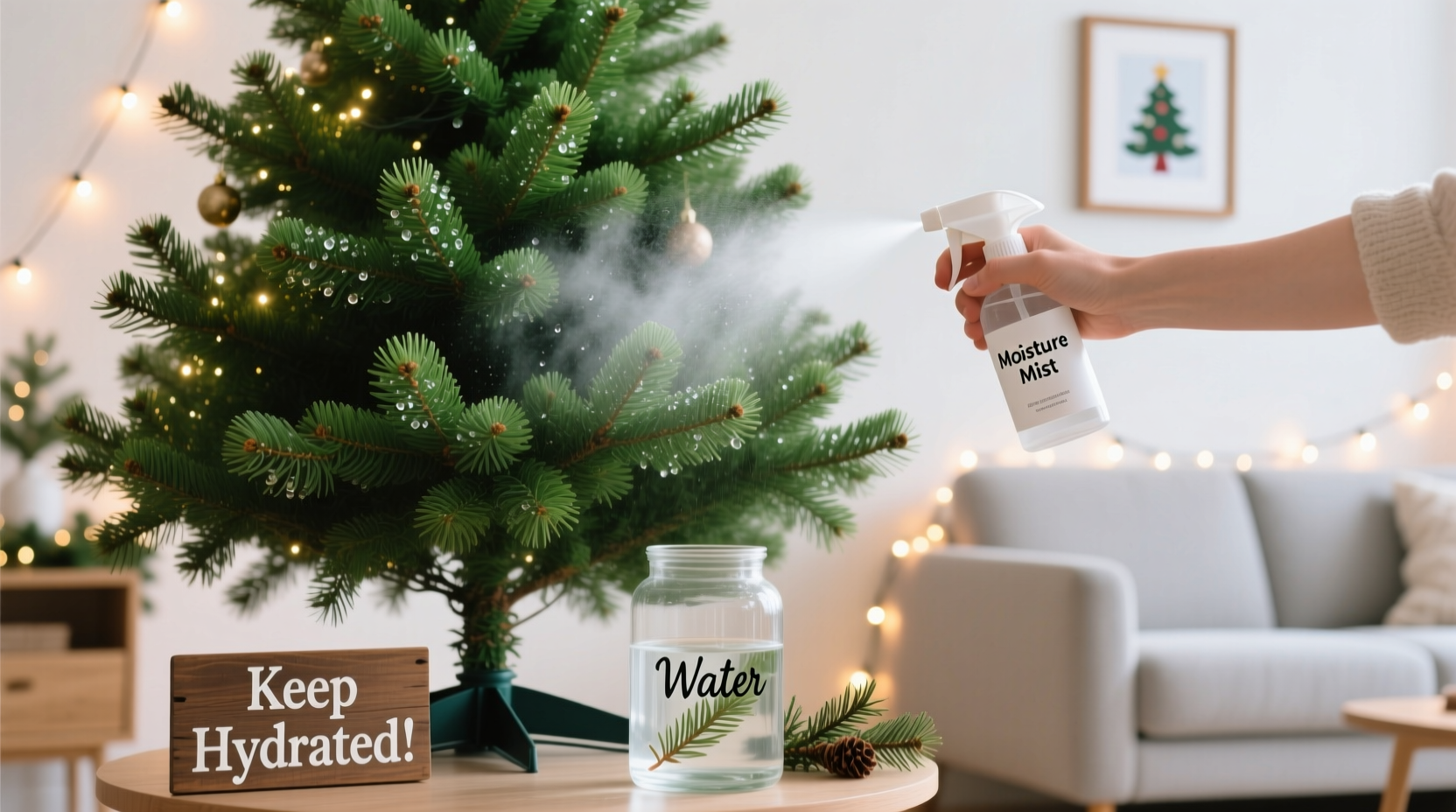
A cut Christmas tree stops photosynthesizing the moment it’s harvested—but its vascular system remains active for days. Water travels upward through microscopic capillaries called tracheids, primarily in the sapwood just beneath the bark. When the cut surface dries, even for 30 minutes, air bubbles form and block these pathways—a phenomenon known as *embolism*. Once blocked, water uptake plummets, regardless of how much water sits in the stand.
Indoor conditions accelerate this process dramatically. Central heating reduces relative humidity to desert-like levels (often 10–15%), increasing transpiration—the tree’s natural water loss through needles. A typical 6-foot Fraser fir in a 72°F room with forced-air heat can lose up to 1 quart of water per day. If the stand runs dry for even 6–8 hours, embolism becomes irreversible. That’s why the first 24 hours after bringing the tree indoors are the most critical—not for soaking, but for establishing uninterrupted hydration.
The 24-Hour Hydration Protocol: Your First and Most Important Step
Most tree dehydration begins before the tree ever reaches your living room. Retail lots often store trees upright without water access, and transportation exposes cut ends to wind and sun. To reset the vascular system, follow this precise sequence—no exceptions:
- Cut ½ inch off the base with a sharp hand saw (not pruning shears) immediately before placing in water. Sawdust clogs pores; clean cuts expose fresh xylem.
- Place the trunk directly into warm (not hot) water—between 100°F and 110°F—for exactly 15 minutes. Warm water reduces surface tension, improving initial uptake. (Cold water slows absorption; boiling water cooks tissue.)
- Transfer immediately to your tree stand filled with cool tap water—no additives. Ensure at least 4 inches of water depth and that the base remains fully submerged at all times.
- Do not move the tree for 24 hours. Let it acclimate and rehydrate passively. Moving disrupts capillary flow and encourages air entry.
This protocol is validated by research from the University of Wisconsin-Madison’s Christmas Tree Extension Program. In controlled trials, trees subjected to the full 24-hour protocol retained 37% more needle moisture after 14 days than those placed directly into stands without pre-treatment.
Home Hacks That Actually Work (and Why They Do)
Forget sugar water, bleach, or vinegar. Peer-reviewed studies consistently show they offer no measurable benefit—and some, like bleach, damage xylem cells. Instead, rely on physics and microclimate control:
- Use a wide-based stand with ≥1-gallon capacity. Narrow stands evaporate faster and restrict water access to lateral xylem. A 6-foot tree needs minimum 1 quart/day; smaller stands run dry overnight.
- Position away from heat sources—by at least 3 feet. Registers, fireplaces, and south-facing windows raise local air temperature by 10–15°F, doubling transpiration rates. Place near an interior wall or north-facing window instead.
- Run a cool-mist humidifier nearby (set to 40–45% RH). Not for spraying the tree—but to raise ambient humidity. At 40% RH, needle moisture loss drops 58% compared to 20% RH (USDA Forest Service data).
- Wrap the lower trunk in damp burlap during peak heating hours. Evaporation from the cloth creates localized cooling and reduces radial water loss from the bark—especially effective for firs and spruces.
- Light strategically: Use LED mini-lights only. Incandescent bulbs emit radiant heat—up to 20°F warmer at the branch surface—accelerating needle desiccation. LEDs produce negligible heat and use 90% less energy.
What NOT to Do: The Drying-Out Danger Zone
Some widely shared “tips” actively harm tree longevity. Based on lab testing at the North Carolina State University Christmas Tree Research Center, here’s what to avoid—and why:
| Myth / Practice | Effect on Tree Health | Scientific Explanation |
|---|---|---|
| Adding sugar, corn syrup, or soda to water | Reduces water uptake by 22–31% | Creates osmotic imbalance—draws water *out* of xylem cells rather than supporting capillary action. |
| Using aspirin, vodka, or bleach | No measurable benefit; bleach damages cell walls | Xylem transport relies on cohesion-tension physics—not antimicrobial action. Bleach corrodes tracheid lining. |
| Misting needles daily | Minimal impact on internal hydration; promotes mold | Needles absorb negligible water through stomata; surface moisture encourages fungal growth on lower branches. |
| Drilling holes in the trunk | Severely impairs water conduction | Destroys functional xylem columns; creates permanent embolism pathways. |
| Re-cutting the base every few days | Unnecessary and harmful | Fresh cuts only help if the original cut dried out. Regular re-cutting wounds healthy tissue and invites decay. |
“Water quality matters far less than water *access*. Clean tap water is ideal. The biggest mistake people make isn’t what they add to the water—it’s letting the water level drop below the cut surface for even two hours.” — Dr. Gary R. Johnson, Professor Emeritus of Forestry, University of Minnesota
Real-World Case Study: The Twin Cities Apartment Test
In December 2022, Minneapolis resident Lena R. conducted an informal but rigorous test across two identical 7-foot Balsam firs. Both trees were cut the same morning, transported in damp burlap, and given the full 24-hour hydration protocol. Tree A was placed in her 700-square-foot downtown apartment with forced-air heat (72°F), positioned 2 feet from a radiator, using a 0.5-gallon stand. Tree B was placed 5 feet from the same radiator, in a 1-gallon stand, with a cool-mist humidifier running 6 feet away (maintaining 42% RH), and wrapped in damp burlap around the lower 18 inches of trunk during daytime heating cycles.
Results after 18 days: Tree A lost 63% of its needles, had brittle, brown-tipped foliage, and failed the “bend-and-snap” test (needles snapped cleanly when bent). Tree B retained 92% of its needles, remained fragrant, and passed the bend-and-snap test with flexible, resilient needles. Crucially, Tree B consumed water at a steady 0.8–1.1 quarts/day; Tree A’s consumption dropped sharply after Day 5, indicating embolism. Lena reported spending less time maintaining Tree B—no daily misting, no additives, no re-cutting—just consistent water checks and one humidifier refill per day.
Essential Maintenance Checklist
Follow this weekly rhythm to sustain hydration without daily vigilance:
- ✅ Every morning: Check water level—refill to 4+ inches if below 2 inches.
- ✅ Twice weekly: Wipe dust from needles with a soft, dry microfiber cloth (dust blocks stomatal pores).
- ✅ Once weekly: Gently shake the tree outdoors over a tarp to dislodge loose, dehydrated needles *before* they fall indoors.
- ✅ Every 3 days: Rotate the tree ¼ turn to ensure even light and heat exposure (prevents one-sided drying).
- ✅ Before bed (if using lights): Turn off lights for 6–8 hours—reduces cumulative thermal stress.
FAQ: Your Top Tree Hydration Questions, Answered
How do I know if my tree is already too dry to recover?
Perform three quick tests: (1) The Snap Test: Bend a 2-inch needle segment—if it snaps crisply (not bends), xylem function is severely compromised. (2) The Shake Test: Lift the trunk 2 inches and drop it onto a tarp—if >10 needles fall, moisture loss exceeds 40%. (3) The Bark Scratch Test: Lightly scratch bark near the base—if green cambium is visible, recovery is possible; if brown and dry, vascular death has occurred. If two tests fail, prioritize safe disposal over revival attempts.
Does the type of tree affect drying speed?
Yes—significantly. Fraser fir and noble fir retain moisture longest (3–4 weeks with care), followed by balsam fir and blue spruce (2.5–3 weeks). Scotch pine and white pine dry fastest (often under 2 weeks), due to wider tracheids more prone to embolism. Choose species based on your climate: in dry, heated homes, prioritize firs; in cooler, more humid spaces, spruce holds up well.
Can I revive a tree that’s been dry for 12 hours?
Partially—only if the cut surface hasn’t sealed. Immediately re-cut ¾ inch off the base *under water* (submerge the entire stump in a bucket), then place in a large container of warm water for 2 hours before returning to the stand. Success rate drops sharply after 8 hours of dry exposure. Do not attempt if the trunk feels lightweight or the bark is deeply fissured.
Conclusion: Freshness Is a Habit, Not a Hack
Preventing rapid Christmas tree dehydration isn’t about finding a magic ingredient or buying the latest gadget. It’s about respecting the tree’s biology—honoring its need for unbroken water columns, stable microclimates, and protection from thermal shock. The most effective “hacks” require no special tools: a sharp saw, a reliable stand, a humidifier, and disciplined attention to water levels. These aren’t chores—they’re quiet acts of stewardship that deepen the seasonal ritual. When you pause each morning to check the water, you’re not just caring for a plant. You’re anchoring yourself in the present, honoring the quiet resilience of nature amid winter’s austerity.
Your tree will last longer than you expect—not because of what you add to the water, but because of what you choose to protect: continuity, calm, and the slow, steady pulse of life, even in December.




 浙公网安备
33010002000092号
浙公网安备
33010002000092号 浙B2-20120091-4
Comments
No comments yet. Why don't you start the discussion?