
The global popularity of Naruto has introduced millions to Japanese names, terms, and linguistic nuances. Yet, despite its widespread reach, many fans unknowingly mispronounce key character names—sometimes drastically altering how they sound in their original language. These errors stem from English-speaking habits, lack of exposure to Japanese phonetics, or reliance on fan-made pronunciations that never aligned with canon. Getting the pronunciation right isn’t just about accuracy; it deepens your appreciation for the culture behind the series and enhances discussions within the anime community.
Japanese pronunciation follows consistent rules distinct from English. Unlike English, where spelling often doesn’t match sound, Japanese is largely phonetic: each kana symbol corresponds to one syllable, and stress patterns are more even. This makes mastering correct pronunciation more accessible than it might first appear. With a few foundational principles and attention to detail, you can speak character names like a native speaker—or at least like someone who respects the source material.
Understanding Japanese Phonetics Basics
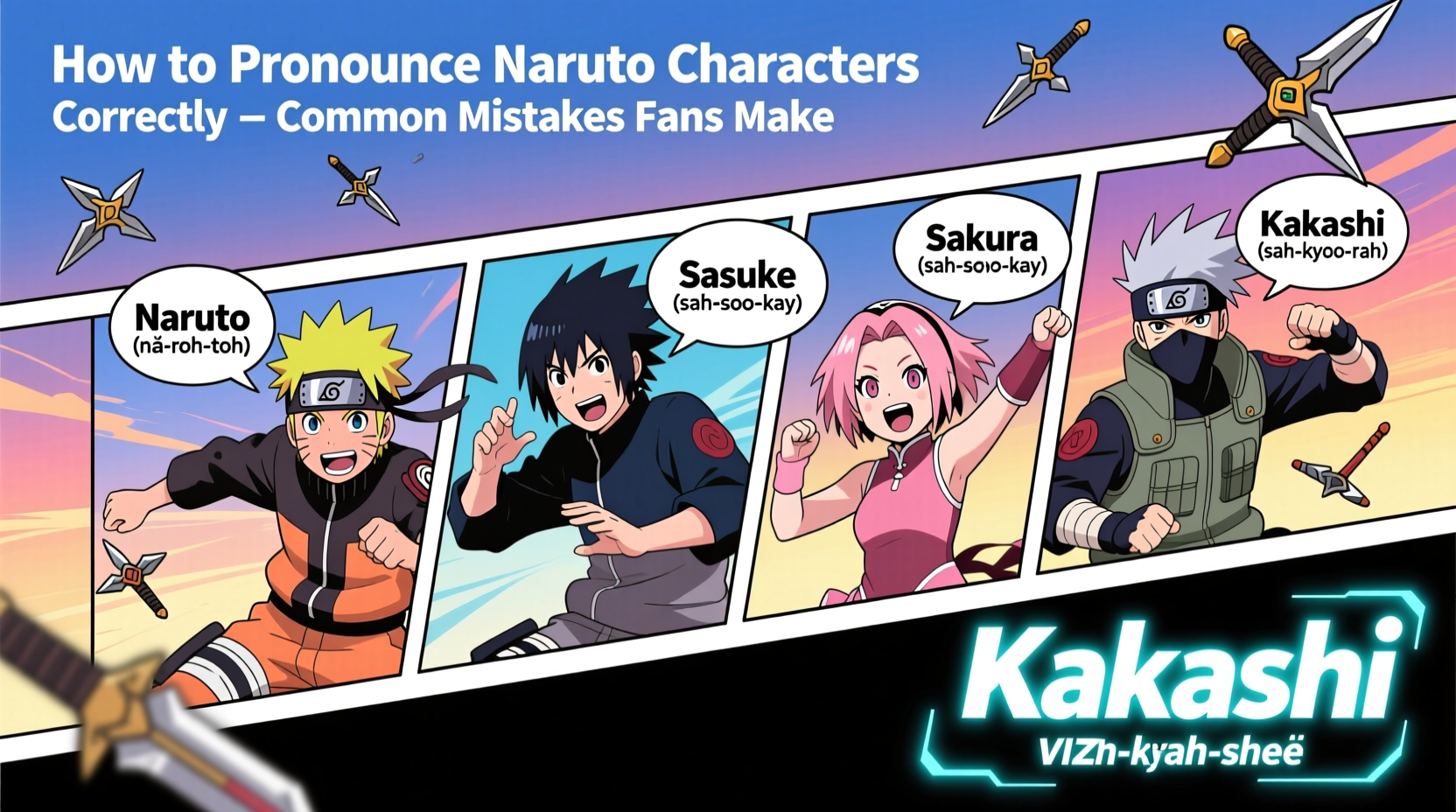
To pronounce Naruto characters correctly, start by understanding core elements of Japanese phonology. The language uses a relatively small set of sounds compared to English, which simplifies learning but requires precision.
One of the most important distinctions is between short and long vowels. In Japanese, vowel length changes meaning. For example, “saki” can mean “bloom” (咲) or “future” (先), depending on context—but elongating the “a” slightly shifts emphasis and clarity. Similarly, consonants like “r” are not rolled or pronounced like English “r.” Instead, the Japanese “r” is a quick tap of the tongue against the roof of the mouth—closer to a soft “d” or “l” sound, but uniquely its own.
- Vowels: Pronounced clearly and consistently: a (ah), i (ee), u (oo), e (eh), o (oh).
- Consonants: “R” is a single alveolar tap, not a hard English “r.”
- Doubled consonants: Indicate a slight pause before the sound (e.g., “Tsunade” → “Tsu-na-de,” not “Tsoon-a-day”).
- Long vowels: Marked by macrons (ō) or implied through spelling (e.g., “Naruto” ends with a long “o” sound).
Commonly Mispronounced Characters and Their Correct Forms
Even seasoned fans slip up on certain names. Below is a breakdown of frequently mispronounced characters, why the error occurs, and how to say them properly.
Naruto Uzumaki
Often said as “Nuh-roo-toh Yoo-zoo-mah-key,” this version adds extra syllables and stresses incorrectly. The correct pronunciation is Nah-ru-toh Oo-zoo-mah-kee. Note that “Uzumaki” begins with a clear “oo” sound, not “yoo,” and the “ma” is crisp, not drawn out.
Sasuke Uchiha
Frequently mispronounced as “Sass-uh-kee Oo-chee-ha,” when it should be Sah-soo-keh Oo-chee-hah. The “ke” in Sasuke rhymes with “eh,” not “key,” and “Uchiha” ends with a flat “hah,” not an aspirated “ha!”
Hinata Hyuga
Many say “Hi-nah-tah Hi-you-gah,” but the accurate form is Hee-na-tah Hyuu-gah. The “Hinata” starts with “hee,” not “hih,” and “Hyuga” features a prolonged “yu” sound—almost like “hyuu” with a glide.
Kakashi Hatake
Commonly butchered as “Kah-kash-ee Ha-tah-kay,” the proper way is Kah-kah-shee Ha-tah-keh. Each syllable is evenly spaced, and the “shi” is sharp, like “she,” not “shh.” The final “e” is “eh,” not “ay.”
Itachi Uchiha
Routinely said as “Ee-tack-eye,” but it’s actually It-tah-chee. The “It” is short and punchy, followed by a clean “tah” and ending with “chee” (like “tea”). No “k” sound appears—it’s “chi,” not “ki.”
“Pronunciation reflects respect—not just for the language, but for the creators who built this world.” — Dr. Akari Tanaka, Linguist & Anime Culture Researcher
Pronunciation Comparison Table: Common Errors vs. Correct Forms
| Character | Common Mispronunciation | Correct Pronunciation | Phonetic Guide |
|---|---|---|---|
| Naruto Uzumaki | Nuh-roo-toh Yoo-zoo-mah-key | Nah-ru-toh Oo-zoo-mah-kee | na-ru-toh oo-zu-ma-ki |
| Sasuke Uchiha | Sass-uh-kee Oo-chee-ha | Sah-soo-keh Oo-chee-hah | sa-su-ke oo-chi-ha |
| Hinata Hyuga | Hi-nah-tah Hi-you-gah | Hee-na-tah Hyuu-gah | hi-na-ta hyu-u-ga |
| Kakashi Hatake | Kah-kash-ee Ha-tah-kay | Kah-kah-shee Ha-tah-keh | ka-ka-shi ha-ta-ke |
| Itachi Uchiha | Ee-tack-eye | It-tah-chee | i-ta-chi |
| Gaara | Gay-rah | Gaa-rah | gaa-ra |
Step-by-Step Guide to Mastering Naruto Character Pronunciation
Improving your pronunciation doesn’t require fluency in Japanese. Follow this practical sequence to internalize correct forms:
- Break the name into syllables. Japanese names are typically divided into morae (sound units). For example, “Shikamaru” = Shi-ka-ma-ru (four beats).
- Identify long vowels. Look for double vowels (e.g., “Naruto” has a long “o”) or macrons if available. Hold these slightly longer than short vowels.
- Practice the “r” sound. Place the tip of your tongue lightly against the ridge behind your upper teeth and flick it once. It’s softer than English “r” and closer to the “tt” in “butter” in American English.
- Listen to native audio. Use official trailers, anime clips, or interviews with voice actors. Repeat phrases slowly, matching timing and tone.
- Record yourself. Compare your recording to the original. Adjust pitch, speed, and clarity until they align.
- Use mnemonic cues. Associate correct sounds with familiar words. For instance, “Hinata” sounds like “heena-tah,” not “hihn-ah-tah.”
- Speak aloud regularly. Practice during commutes or while watching scenes. Repetition builds muscle memory.
Real Example: A Fan’s Pronunciation Journey
Mark, a longtime Naruto fan from Texas, always pronounced “Sasuke” as “Sas-uh-kee.” He was confident in his version until attending a Japanese language meetup where participants watched anime together. When he said, “Sasuke betrayed Naruto,” others gently corrected him: “It’s Sah-soo-keh.” At first, it felt awkward. But after practicing with audio clips and slowing down his speech, Mark noticed a shift—not just in accuracy, but in how seriously other fans took his contributions in forums and conventions.
“I realized I wasn’t just saying a name,” he shared. “I was honoring the culture behind it. Now when I watch Shippuden, I hear the voices differently—clearer, more intentional.” His experience underscores how small linguistic adjustments can deepen fandom engagement and cultural awareness.
Checklist: Speak Naruto Names Like a Pro
- ✅ Break each name into individual syllables.
- ✅ Identify and elongate long vowels (e.g., “Naru—to”)
- ✅ Replace English “r” with a light tongue tap (alveolar flap).
- ✅ Avoid adding “y” before “u” (e.g., “Uchiha” ≠ “Yuchiha”)
- ✅ Never add extra syllables (e.g., “Nagato” is three syllables: Na-ga-to, not Nag-a-toe)
- ✅ Use official sources for reference (Crunchyroll dubs, Viz Media, or Toho releases)
- ✅ Record and compare your pronunciation weekly
Frequently Asked Questions
Is “Jiraiya” pronounced “Jih-rye-uh” or “Jee-rah-yah”?
The correct form is Jee-rah-yah (ji-ra-i-ya). Each syllable is distinct: “ji” (like “gee”), “ra,” “i,” and “ya.” The “j” is soft, similar to “jam,” not a hard “j” as in “jump.”
Why do some fans say “Chouji” like “Cho-gee”?
This mistake comes from misreading the “ji” sound. In Japanese, “ji” is pronounced like “jee” (as in “gene”), not “gee.” So “Chouji” is Cho-u-jee, with a long “o” and a soft “j.” Think “Chee-oh-jee” but blended smoothly.
How do you pronounce “Tsunade” without sounding like “Soon-ah-day”?
Start with “Tsu”—a clipped “ts” like in “cats”—followed by “na” (nah) and “de” (deh). It’s Tsu-na-deh, not “Soo-na-day.” The “u” in “tsu” is barely audible, almost swallowed.
Conclusion: Speak with Respect, Accuracy, and Confidence
Getting Naruto character names right isn’t about perfection—it’s about intention. Every time you say “Sah-soo-keh” instead of “Sasuke,” or “Hee-na-tah” instead of “Hi-nah-tah,” you connect more deeply with the world Kishimoto created. You also contribute to a more informed, respectful fan community.
Linguistic accuracy enhances conversations, enriches cosplay introductions, and shows appreciation for Japanese culture beyond surface-level aesthetics. Whether you’re discussing the Chunin Exams or debating Boruto’s legacy, speaking names correctly elevates your credibility and passion.




 浙公网安备
33010002000092号
浙公网安备
33010002000092号 浙B2-20120091-4
Comments
No comments yet. Why don't you start the discussion?