
Cutting an onion into a uniform dice is one of the most fundamental knife skills in cooking. Whether you're sautéing aromatics for a stew, building flavor in a sauce, or preparing a fresh salsa, the way you cut your onion affects both texture and taste. Uneven pieces cook at different rates—small bits burn while large chunks remain raw. A proper dice ensures even distribution of flavor and consistent doneness across dishes. Despite its simplicity, many home cooks struggle with technique, leading to tears, wasted time, and inconsistent results. Mastering this foundational skill improves efficiency, safety, and culinary outcomes in any kitchen.
Definition & Overview
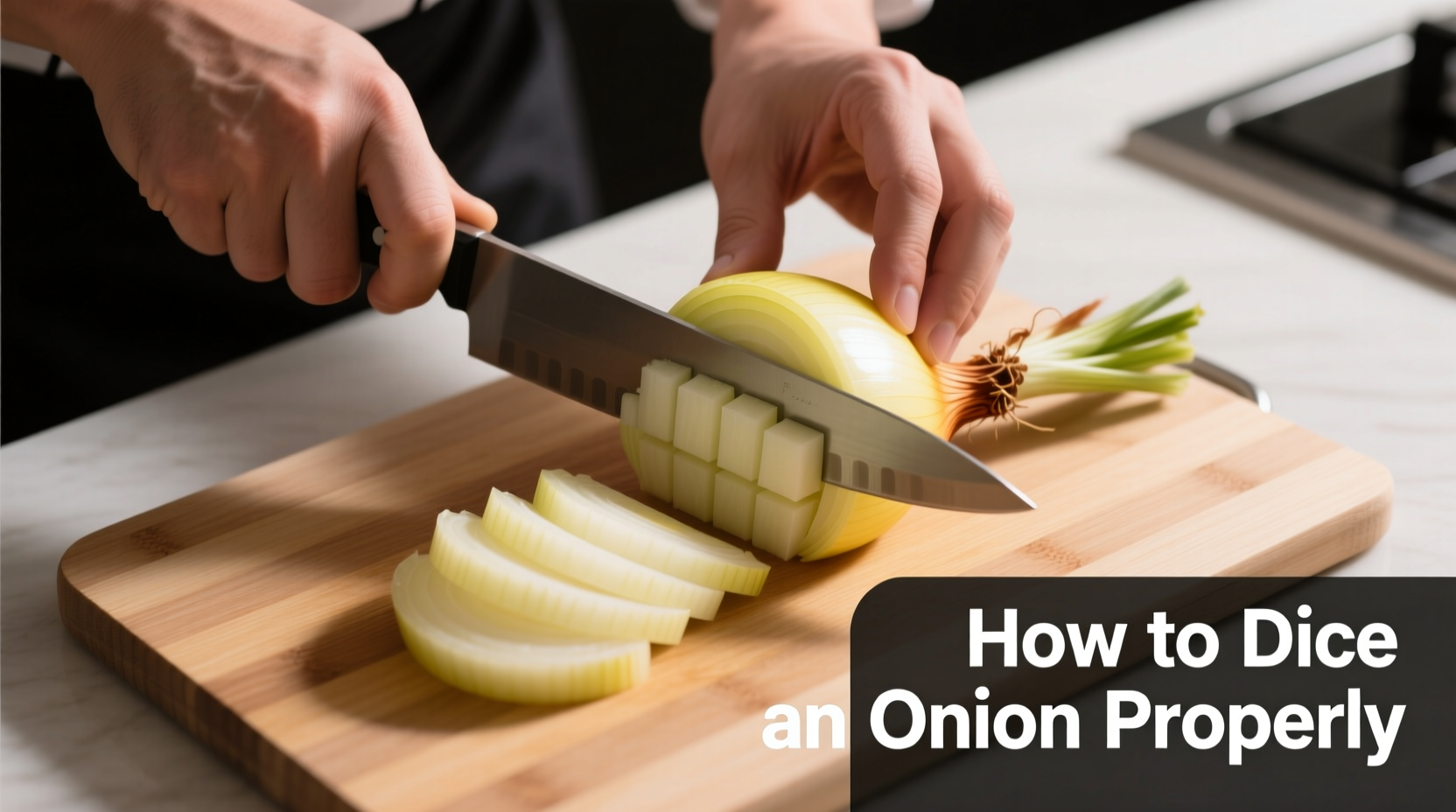
Dicing an onion refers to cutting it into small, uniform cubes—typically ranging from fine (about 1/8 inch) to medium (¼ inch) or large (½ inch). This method differs from slicing, which produces flat rounds, or chopping, which yields irregular fragments. The goal of dicing is precision: all pieces should be roughly the same size so they cook evenly and blend seamlessly into recipes.
The onion, a member of the *Allium* family, has been cultivated for over 5,000 years and is now a cornerstone of global cuisines—from French mirepoix to Indian tadka. Its layered structure makes it ideal for dicing, as each ring can be flattened and cross-cut into neat squares. While often associated with pungency and tear-inducing vapors, proper handling and sharp tools minimize discomfort and maximize control.
In professional kitchens, the term “brunoise” refers to the finest dice (1–3 mm), usually reserved for refined sauces or garnishes. For everyday cooking, a medium dice (¼ inch) strikes the best balance between surface area and structural integrity during cooking.
Key Characteristics of Onions
Understanding the onion’s composition helps inform cutting technique. Below are essential traits that influence how it behaves when diced:
| Characteristic | Description |
|---|---|
| Flavor Profile | Sharp, pungent when raw; sweetens dramatically when cooked due to caramelization of natural sugars. |
| Aroma | Pronounced sulfur compounds released when cells are ruptured—responsible for eye irritation. |
| Texture | Crisp and firm when raw; softens and breaks down with heat depending on cooking time. |
| Color/Form | Round bulb with concentric layers; common varieties include yellow, white, red, and sweet onions. |
| Culinary Function | Aromatic base in countless dishes; contributes depth, sweetness, and body. |
| Shelf Life | Whole onions last 1–2 months in cool, dry storage; once cut, refrigerate and use within 5–7 days. |
Step-by-Step Guide: How to Dice an Onion
Follow these steps to achieve clean, consistent onion dice safely and efficiently. This method applies primarily to globe onions (yellow, white, red)—the most commonly used type in Western cooking.
- Select a firm onion. Choose one with tight, papery skin and no soft spots. A heavier onion for its size indicates higher moisture content and freshness.
- Trim the ends. Place the onion on a stable cutting board. Using a sharp chef’s knife, slice off the stem end (top) about ¼ inch down—just enough to remove the dried tip. Leave the root end intact; keeping it attached helps hold layers together during cutting.
- Peel the onion. Remove the outer papery skin and any damaged outer layers. Rinse briefly if needed, but pat dry—wet surfaces make onions slippery and harder to cut precisely.
- Cut in half pole-to-pole. Position the onion vertically (from root to stem) and slice straight down through the center, creating two symmetrical halves. You’ll now see concentric rings radiating from the center.
- Create flat side down. Lay one half cut-side down on the board. This stabilizes the onion and prevents rolling during subsequent cuts.
- Make vertical cuts toward the root. Holding the knife parallel to the board, make even vertical slices from the top (stem end) down toward—but not through—the root. Spacing determines dice size:
- For fine dice: ⅛-inch intervals
- For medium dice: ¼-inch intervals
- For large dice: ½-inch intervals
- Cross-cut horizontally (optional). For smaller dice (especially brunoise), make one or two horizontal cuts parallel to the board, again stopping short of the root. This step adds dimensionality before the final chop.
- Slice across to create cubes. Rotate the onion 90 degrees. Now slice perpendicularly across the vertical cuts, moving from stem end toward the root. As you cut, small cubes will fall away cleanly. The root end remains as a small core—discard after dicing.
- Repeat with second half. Flip the remaining onion half and repeat the process.
Pro Tip: Always use a sharp knife. A dull blade crushes cells instead of slicing them, releasing more enzymes that cause tearing and making the onion mushier. A sharp knife glides cleanly, minimizing damage and vapor release.
Variants & Types of Onion Dices
Different culinary applications call for specific dice sizes. Understanding these variants allows better recipe execution and improved texture control.
- Fine Dice (Brunoise): ~1–3 mm cubes. Used in consommés, refined sauces, or as garnish where subtlety is key. Requires extra horizontal cuts and precise vertical spacing.
- Medium Dice: ¼ inch (6 mm). Ideal for soups, stews, stir-fries, and salsas. Balances flavor dispersion with visual presence.
- Large Dice: ½ inch (12 mm). Suitable for slow-cooked dishes like braises or roasted vegetable medleys where shrinkage occurs over time.
- Macedoine: Similar to brunoise but typically applied to mixed vegetables. Often used in salads or cold preparations.
Size selection depends not only on recipe requirements but also on desired mouthfeel and cooking duration. Fast-cooking dishes benefit from smaller dice for rapid integration, while long-simmered meals can accommodate larger pieces that retain shape.
Comparison with Similar Ingredients
Onions are frequently confused with other members of the allium family. While related, their structure and usage differ significantly when dicing.
| Ingredient | Dicing Suitability | Best Use Case | Key Difference |
|---|---|---|---|
| Shallot | Excellent—smaller layers allow fine, even dice | Vinaigrettes, delicate sauces | Sweeter, milder flavor; less water content |
| Garlic | Poor for traditional dicing; better minced or sliced | Aromatics, marinades | Individual cloves resist uniform cubing; stronger potency |
| Leek | Moderate—requires extensive cleaning; layered but fibrous | Creamed dishes, stocks | Only white and light green parts used; grit trapped between layers |
| Green Onion (Scallion) | Limited—best sliced into rounds or diagonals | Garnishes, quick stir-fries | Hollow tubes don’t cube well; used raw or lightly cooked |
Unlike garlic or leeks, the standard globe onion offers the optimal combination of size, layer consistency, and availability for reliable dicing. It forms the backbone of aromatic bases worldwide.
Practical Tips & FAQs
Why do onions make me cry, and how can I reduce it?
When onion cells are cut, they release sulfoxides that convert into sulfenic acid, then into a volatile gas called syn-propanethial-S-oxide. This irritates the eyes, triggering tears. To minimize exposure:
- Cut near a vent or under a range hood to draw fumes away.
- Chill the onion for 30 minutes before cutting—cold slows enzyme activity.
- Use a very sharp knife to reduce cell rupture.
- Cut quickly with good ventilation.
Can I dice onions ahead of time?
Yes, but store properly. Place diced onions in an airtight container in the refrigerator for up to 5 days. Exposure to air accelerates spoilage and intensifies odor. For longer storage, freeze diced onions (up to 6 months), though texture will soften upon thawing—best for cooked dishes, not raw applications.
What knife should I use?
A chef’s knife (8–10 inches) is ideal. Its weight and curve enable rocking motion for efficient, controlled cuts. Paring knives are too small for full dicing; serrated blades crush rather than slice.
Is there a difference between \"chopping\" and \"dicing\"?
Yes. Chopping implies speed and irregularity—pieces vary in size, acceptable for rustic dishes. Dicing demands uniformity for even cooking. In professional settings, “dice” means precision; “chop” suggests approximation.
Which onion variety is best for dicing?
Yellow onions are most versatile—robust flavor when cooked, balanced pungency when raw. White onions offer sharper bite and are common in Mexican cuisine. Red onions provide color and mild sweetness, excellent in salads. Sweet onions (like Vidalia or Walla Walla) caramelize beautifully but can be juicier and harder to dice finely without slipping.
How do I prevent my diced onions from turning brown?
Browning occurs due to oxidation. To delay it:
- Minimize air exposure by covering or sealing.
- Add a splash of lemon juice or vinegar (acid slows enzymatic browning).
- Use promptly in cooking.
“The way you handle an onion reveals your respect for the craft. Precision isn’t just about looks—it’s about how flavors build, layer by layer.” — Chef Elena Martinez, Culinary Instructor, Institute of Classical Cooking
Professional Applications & Culinary Pairings
In restaurant kitchens, consistent onion dicing enables reproducible results across hundreds of servings. Sous chefs often set up mise en place stations where onions are pre-diced to exact specifications based on menu needs.
Common pairings include:
- Carrots and Celery (Mirepoix): Classic French trio in equal parts (2:1:1 ratio onion:celery:carrot), forming the base of stocks, soups, and braises.
- Garlic and Tomato (Soffritto): Italian variation, often sweated in olive oil before adding liquids.
- Bell Peppers (Holy Trinity): Cajun and Creole staple, combining onion, celery, and green pepper in gumbo and jambalaya.
- Oil & Butter: Onions sweat best in fat, which conducts heat gently and enhances flavor development.
When building flavor foundations, always start with onions before adding garlic or spices. Their higher water content allows gradual softening without burning. Aim for translucency—not browning—unless caramelization is intended.
Efficiency Hack: When preparing multiple onions, batch the tasks: peel all first, then halve all, then dice one at a time. This reduces repetitive motions and speeds up prep time significantly.
Summary & Key Takeaways
Dicing an onion properly is more than a basic task—it's a gateway to better cooking. Uniformity ensures even cooking, maximizes flavor integration, and reflects attention to detail. By mastering this technique, cooks gain confidence, efficiency, and consistency in both simple weeknight meals and complex dishes.
Core principles to remember:
- Always keep the root end intact until the final cut—it holds the onion together.
- Use a sharp chef’s knife for cleaner cuts and reduced tearing.
- Adjust dice size according to cooking method and recipe needs.
- Refrigerate or freeze pre-diced onions appropriately for future use.
- Understand the role of onions in flavor layering—they are rarely the star, but always essential.
Like any skill, repetition builds mastery. Practice with different onion types and sizes to develop muscle memory and adaptability. Over time, dicing becomes instinctive—a seamless part of the cooking rhythm that elevates everything from scrambled eggs to coq au vin.




 浙公网安备
33010002000092号
浙公网安备
33010002000092号 浙B2-20120091-4
Comments
No comments yet. Why don't you start the discussion?