
Slicing an onion may seem like a basic kitchen task, but mastering the technique is foundational to successful cooking. A poorly sliced onion can lead to uneven cooking, inconsistent texture, and imbalanced flavor distribution in dishes ranging from soups and stews to salsas and stir-fries. Conversely, a well-sliced onion ensures uniformity, enhances layering of flavors, and contributes to both the aesthetic and functional integrity of a recipe. Despite its ubiquity, many home cooks approach the onion with hesitation—often due to eye irritation or uncertainty about knife angles and grain direction. This guide provides a comprehensive, step-by-step approach to slicing an onion correctly, covering tool selection, anatomical understanding, cutting methods, and practical applications used by professional chefs worldwide.
Definition & Overview
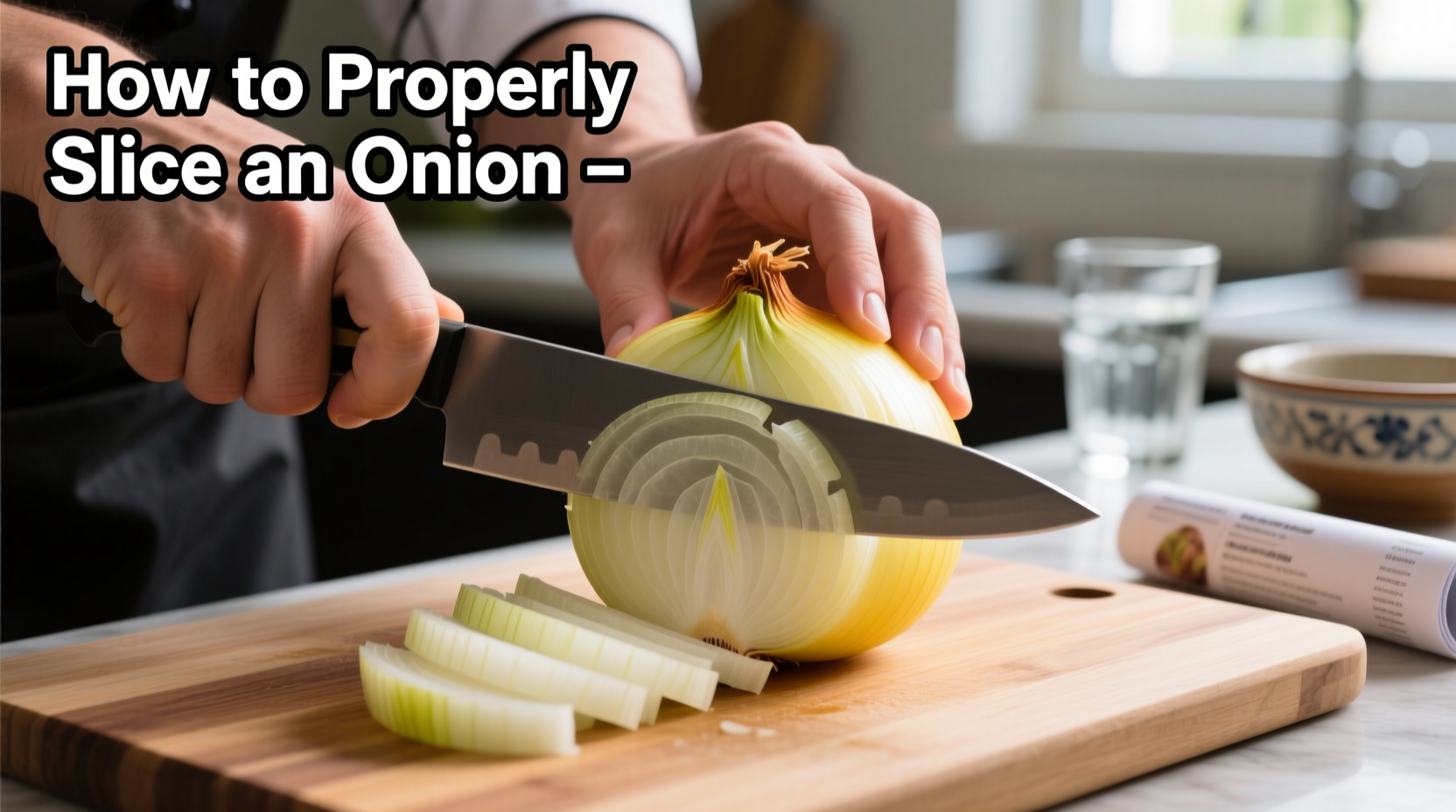
An onion (Allium cepa) is a biennial vegetable belonging to the Alliaceae family, which includes garlic, leeks, scallions, and chives. It grows as a bulb composed of layered, fleshy scales that store nutrients and develop pungent sulfuric compounds responsible for its sharp aroma and tear-inducing properties. Onions are cultivated globally and serve as a culinary cornerstone across cuisines—from French mirepoix and Spanish sofrito to Indian tadka and Caribbean seasoning blends.
In cooking, onions function as an aromatic base, providing depth, sweetness (when caramelized), and savory complexity. They are rarely eaten raw in large quantities due to their bite, but when cooked, their natural sugars undergo Maillard reactions and caramelization, transforming into rich, umami-laden components essential to sauces, braises, roasts, and more. The way an onion is sliced directly affects how it cooks, releases moisture, and interacts with other ingredients.
Key Characteristics
Understanding the onion’s physical and chemical makeup informs proper slicing technique:
| Characteristic | Description |
|---|---|
| Flavor Profile | Sharp, pungent when raw; sweet, mellow, and complex when cooked. |
| Aroma | Pronounced sulfuric scent released upon cell disruption (cutting). |
| Color/Form | Bulbous shape with concentric layers; common varieties include yellow, white, red/purple, and sweet (e.g., Vidalia). |
| Heat Level | Mild to hot depending on variety and preparation; raw red onions are sharper than sweet onions. |
| Culinary Function | Aromatic base, textural component, flavor enhancer, coloring agent. |
| Shelf Life | Whole: 1–3 months in cool, dry storage; cut: 7–10 days refrigerated in airtight container. |
Practical Usage: How to Slice an Onion Correctly
The goal of slicing an onion is consistency—uniform thickness ensures even cooking, prevents some pieces from burning while others remain raw, and improves mouthfeel. The following method applies to most culinary contexts and uses a standard chef’s knife (8–10 inches recommended).
- Prepare Your Tools and Workspace
Use a stable cutting board (wood or composite). Ensure your knife is sharp—a dull blade crushes cells, releasing more irritants and making clean cuts difficult. - Trim the Ends
Place the onion on the board. Cut off the stem end (top), removing about 1/4 inch. Leave the root end intact initially—it helps hold the onion together during slicing. - Peel the Onion
Remove the papery outer skin and any damaged outer layers. Rinse briefly if needed, then pat dry. - Halve Root-to-Stem
Stand the onion upright and slice down through the equator, dividing it into two equal halves from root to stem. This preserves the structural integrity of each half. - Lay Flat and Make Vertical Cuts
Take one half and place it flat-side down. Make vertical cuts from the top toward—but not through—the root end. Spacing determines thickness: 1/8 inch for fine dicing, 1/4 inch for medium slices, wider for rings. - Cross-Cut for Dice (Optional)
After vertical cuts, angle the knife horizontally across the onion to create dice. For slices, skip this step. - Final Slice Through the Root
Once cross-hatched, slice completely through the root end to release individual pieces.
Pro Tip: Keep the root intact until the final cut. It acts as a hinge, minimizing hand exposure to volatile compounds and improving control. Only remove the root tip after slicing if desired.
This technique yields consistent, manageable pieces ideal for sautéing, roasting, grilling, or eating raw. For ring-style cuts (used in onion burgers or blooming), stand the whole onion on its root end and slice crosswise into 1/2-inch rounds, then separate the rings manually.
Why Grain Direction Matters
Like meat, onions have a “grain” defined by the alignment of their concentric layers. Cutting with the grain (from pole to pole) produces longer, firmer strips that hold up better in high-heat applications. Cutting against the grain (equatorially) results in flatter, more delicate rings suited for quick pickling or frying. For maximum tenderness when caramelizing, slice pole-to-pole; for faster breakdown in stews, go equatorial.
Variants & Types of Onions and Their Slicing Needs
Not all onions are interchangeable. Each type has distinct water content, sugar levels, and pungency, influencing how they should be sliced and used.
- Yellow Onions: Most common in cooking. High sulfur, strong flavor when raw, sweetens dramatically when cooked. Best sliced thin for sautéing or medium-thick for roasting.
- White Onions: Crisper and slightly more acidic. Common in Mexican cuisine. Ideal for salsas and grilled dishes. Slice finely for raw use; they break down quickly when heated.
- Red (Purple) Onions: Vibrant color, moderately spicy when raw, mild when cooked. Often sliced paper-thin for salads, sandwiches, or pickling. Retain color best when marinated in acid.
- Sweet Onions (Vidalia, Walla Walla, Maui): Low sulfur, high water and sugar content. Prone to mushiness if overcooked. Slice thicker to preserve structure. Excellent for grilling or eating raw.
- Shallots: Botanically distinct but used similarly. More delicate, garlicky flavor. Usually minced rather than sliced, but can be halved or thinly sliced for vinaigrettes or pan sauces.
| Onion Type | Best Slicing Method | Recommended Use |
|---|---|---|
| Yellow | Thin to medium, pole-to-pole | Sautéing, soups, stews, caramelizing |
| White | Medium, equatorial or pole-to-pole | Salsas, tacos, frying, boiling |
| Red | Very thin, often equatorial | Salads, pickling, garnishes |
| Sweet (Vidalia, etc.) | Thicker slices, pole-to-pole | Grilling, roasting, sandwiches |
| Shallots | Halved, sliced, or minced | Vinaigrettes, sauces, deglazing |
Comparison with Similar Ingredients
Onions are frequently confused with related alliums. While they can sometimes substitute for one another, their textures and flavor profiles differ significantly.
| Ingredient | Differences from Onion | When to Use Instead |
|---|---|---|
| Garlic | Smaller cloves, much stronger, spicier, less sweet. Used in smaller quantities. | For pungent flavor accent, not bulk aromatics. |
| Leeks | Milder, grassier, requires thorough cleaning. Bulbless, cylindrical. | In soups, delicate sauces, where subtlety is key. |
| Scallions (Green Onions) | No developed bulb; both green and white parts edible. Milder, crisp texture. | Raw garnishes, stir-fries, quick-cook dishes. |
| Chives | Herb-like, tubular leaves. Very mild onion flavor. | Finishing touch on potatoes, eggs, soups. |
| Shallots | Sweeter, more nuanced, less harsh. Higher price point. | In refined sauces, dressings, French cuisine. |
“The way you cut an onion isn’t just about size—it’s about controlling moisture release, surface area for browning, and how it integrates into the dish.” — Chef Elena Martinez, Culinary Instructor, Institute of American Cooking
Practical Tips & FAQs
How do I reduce tearing when slicing onions?
The lachrymatory effect comes from syn-propanethial-S-oxide, a gas released when enzymes react after cell damage. To minimize tears:
- Chill the onion for 30 minutes before cutting—cold slows enzyme activity.
- Cut near running water or under a vent hood to disperse gases.
- Use a sharp knife to reduce cellular trauma.
- Cut quickly and efficiently—less time exposed means fewer tears.
Can I use a food processor to slice onions?
Yes, for large batches. A slicing disc produces uniform cuts, but pulse carefully to avoid turning onions into mush. Hand slicing offers more control over thickness and grain direction.
What’s the difference between slicing and dicing?
Slicing creates flat, two-dimensional pieces (like half-moons). Dicing involves further cutting slices into cubes. Slicing is faster and ideal for even cooking surfaces; dicing ensures complete integration into mixed dishes.
How should I store sliced onions?
Place in an airtight container and refrigerate. Use within 7–10 days. Pre-sliced onions lose crispness and develop off-flavors over time. For long-term storage, freeze—but expect texture loss upon thawing, suitable only for cooked dishes.
Are onion slices healthy?
Yes. Onions are low in calories and rich in vitamin C, B6, folate, potassium, and antioxidants like quercetin. Raw onions have higher flavonoid content, though cooking preserves many beneficial compounds.
Can I slice onions ahead of time?
Yes, but with caveats. Sliced yellow and white onions oxidize and soften after a few hours. Red onions retain color better in acidic marinades. Sweet onions degrade fastest. For best results, prep no more than 24 hours in advance and store properly.
Storage Checklist:
✅ Cool, dark, dry place for whole onions (never refrigerate unless peeled)
✅ Airtight glass or plastic container for cut onions
✅ Label with date—use within one week
❌ Avoid storing near potatoes—they emit moisture and ethylene gas, speeding spoilage
Substitutions in Recipes
If out of onions, consider:
- Shallots: 1:1 ratio for raw or sautéed use, but flavor is more delicate.
- Leeks: Use white and light green parts only; requires washing. Substitute 1.5x volume due to milder taste.
- Scallions: Best in uncooked or lightly cooked dishes. Use 3–4 scallions per medium onion.
- Onion Powder: 1 teaspoon ≈ 1/4 cup chopped onion. Lacks texture but useful for dry rubs or soups.
Summary & Key Takeaways
Slicing an onion properly is more than a kitchen chore—it’s a skill that impacts the outcome of countless dishes. Mastery begins with selecting the right onion for the task, using a sharp knife, and understanding how cut direction influences texture and cooking behavior. Whether preparing a mirepoix for a French stew or assembling a fresh pico de gallo, precision in slicing ensures balanced flavor development and visual appeal.
Key points to remember:
- Always trim and peel before slicing, preserving the root end for stability.
- Cut pole-to-pole for firmer slices; equatorially for quicker-cooking rings.
- Adjust slice thickness based on cooking method: thinner for sautéing, thicker for grilling.
- Refrigerate cut onions promptly and use within a week.
- Minimize tears by chilling onions and working efficiently.
- Know the differences between onion types—each has optimal uses and slicing needs.
Put it into practice: Next time you cook, take an extra minute to slice your onion with intention. Notice how uniform pieces brown evenly and integrate seamlessly into your dish. Small details make exceptional meals.




 浙公网安备
33010002000092号
浙公网安备
33010002000092号 浙B2-20120091-4
Comments
No comments yet. Why don't you start the discussion?