
Vintage vinyl records are more than just music—they’re artifacts of culture, craftsmanship, and personal history. Whether inherited from a relative or collected over decades, preserving their condition is essential to maintaining both sound quality and value. Two of the most common threats to vinyl longevity are warping and dust accumulation. Warping distorts playback and can render a record unplayable, while dust degrades audio fidelity and accelerates wear on styluses. The good news is that both issues are largely preventable with proper storage techniques. This guide outlines practical, science-informed strategies to keep your collection in pristine condition for years to come.
Understanding the Enemies: Heat, Humidity, and Gravity
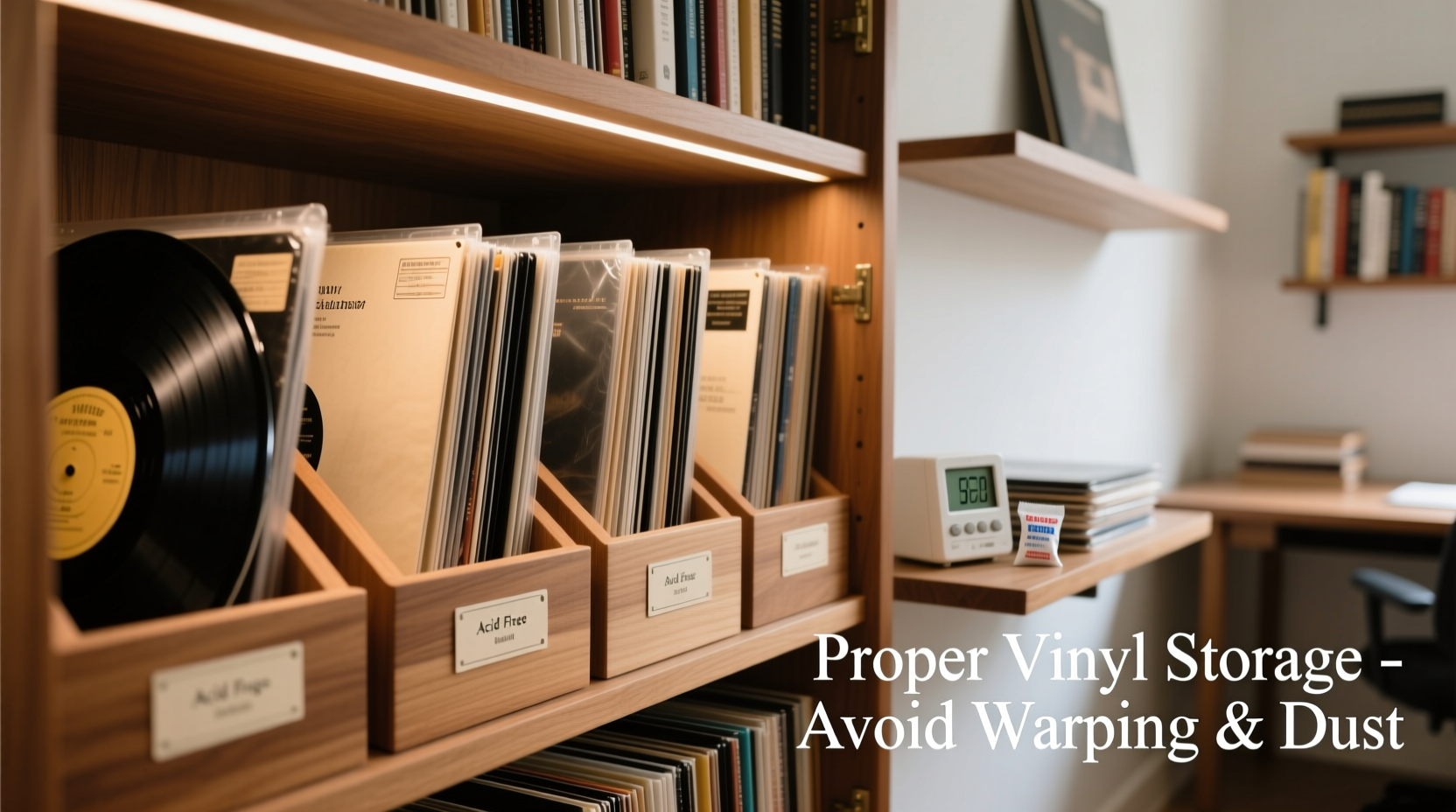
Vinyl records are made from polyvinyl chloride (PVC), a thermoplastic material sensitive to environmental changes. When exposed to heat, especially above 100°F (38°C), PVC softens and can permanently deform under its own weight. Even moderate heat over time—like that near a radiator or in an attic—can lead to subtle warping that affects tracking and tonearm stability.
Humidity is another silent threat. High moisture levels encourage mold growth, particularly on paper sleeves and labels, and can degrade adhesives used in original packaging. Conversely, extremely dry environments may make older cardboard sleeves brittle and prone to shedding fibers that become embedded in grooves.
Gravity plays a role too. Storing records horizontally stacked, especially in tall piles, applies continuous pressure to lower discs. Over months or years, this compression can cause slight concave or convex deformation—often imperceptible to the eye but detectable during playback as pitch wobble or skipping.
“Vinyl doesn’t age poorly when treated well. It’s not the passage of time that ruins records—it’s poor storage.” — David McLean, Archival Audio Specialist, National Sound Preservation Society
Step-by-Step Guide to Proper Vinyl Storage
Preserving vintage vinyl requires consistency and attention to detail. Follow these steps to ensure optimal storage conditions:
- Inspect each record upon acquisition. Check for existing warps by placing the disc on a flat surface and observing for gaps between the record and table. Also look for visible dust, mold, or label damage.
- Clean before storing. Use a carbon fiber brush or a dedicated record cleaning kit to remove loose particles. For deeper cleaning, consider wet vacuum systems, but never use household cleaners or alcohol-based solutions.
- Replace damaged or non-archival inner sleeves. Original paper sleeves often contain lignin, which breaks down over time and releases acids. Replace them with anti-static polyethylene-lined sleeves or rice paper alternatives.
- Use outer protective sleeves. Clear polypropylene sleeves shield against dust and minor scuffs without trapping moisture. Avoid PVC sleeves, as they can off-gas chemicals that degrade vinyl.
- Store vertically, not flat. Always place records upright on shelves designed for LPs. This distributes weight evenly and prevents edge stress.
- Maintain spacing between records. Overcrowding causes friction and sleeve abrasion. Allow slight gaps so records can be removed without tilting or forcing adjacent ones.
- Control the environment. Keep temperature between 65–70°F (18–21°C) and relative humidity around 45–50%. Avoid basements, garages, and attics unless climate-controlled.
Do’s and Don’ts of Vinyl Storage
| Do’s | Don’ts |
|---|---|
| Store records vertically in sturdy bins or shelves | Stack records horizontally like pancakes |
| Use archival-quality inner and outer sleeves | Keep records in original paper sleeves long-term |
| Keep storage area cool, dry, and dark | Store near radiators, windows, or damp walls |
| Handle records by edges and label only | Touch the playing surface with bare fingers |
| Rotate collection occasionally to check condition | Forget about records once shelved |
A Real Example: The Basement Collection Rescue
In 2019, Sarah Thompson inherited her father’s 1960s jazz collection—a trove of rare Blue Note pressings stored in a basement corner for nearly 30 years. Though the jackets were intact, many records had developed a slight warp and were coated in fine dust. After consulting a local audiophile group, she moved the entire set to a climate-controlled closet upstairs, replacing all inner sleeves with rice paper and adding outer polypropylene covers. She installed a low-humidity shelf unit and began using a carbon fiber brush before each play.
Within six months, playback improved noticeably: less surface noise, no skipping, and truer tonal balance. More importantly, further degradation halted. “I thought some were beyond saving,” she said. “But once I corrected the storage, even slightly warped ones stabilized and became enjoyable again.” Her experience underscores that even neglected collections can recover with proper intervention.
Essential Checklist for Long-Term Vinyl Preservation
- ✅ Store records upright in dedicated shelving
- ✅ Use acid-free, anti-static inner sleeves
- ✅ Protect with clear outer polypropylene sleeves
- ✅ Maintain stable temperature (65–70°F / 18–21°C)
- ✅ Control humidity between 45% and 50%
- ✅ Clean records before storage with safe tools
- ✅ Avoid direct sunlight and heat sources
- ✅ Handle only by edges and center label
- ✅ Inspect collection every 6–12 months
- ✅ Keep shelves away from concrete walls (common in basements) to reduce moisture transfer
Frequently Asked Questions
Can a warped record be fixed?
Minor warps—those where the record still lies mostly flat—can sometimes be corrected using controlled heat methods, such as oven baking at low temperatures (around 150°F / 65°C) with weighted glass. However, this process is risky and may introduce new distortions or damage labels. For valuable vintage records, professional restoration services are recommended over DIY fixes.
Is it okay to store vinyl in wooden cabinets?
Yes, provided the wood is sealed and the cabinet is in a climate-stable room. Unsealed wood can emit volatile organic compounds (VOCs) and absorb or release moisture, affecting humidity levels around records. Choose furniture with ventilation slats and avoid airtight enclosures that trap stagnant air.
How often should I clean my vintage records?
For records in long-term storage, cleaning once before initial storage is usually sufficient if kept in clean sleeves. If played regularly, clean every 3–5 plays using a carbon fiber brush or a wet cleaning system. Dust builds up gradually, and frequent deep cleaning can increase risk of micro-scratches if done improperly.
Advanced Tips for Collectors and Archivists
For serious collectors, additional precautions enhance preservation. Consider investing in a hygrometer to monitor humidity in your storage room. Digital models with data logging help identify fluctuations over time. Pair this with a small dehumidifier or humidifier as needed to maintain equilibrium.
Some collectors use interleaving tissue paper between album jackets to prevent ink transfer, especially with older pressings that used unstable dyes. However, ensure the paper is acid-free and removed before playing to avoid accidental playback with debris.
For rare or high-value records, consider creating digital backups. While not a substitute for physical preservation, digitization safeguards the music against future loss due to damage. Use a high-quality turntable and analog-to-digital converter, capturing at 24-bit/96kHz resolution for archival-grade files.
“The best archive is one you forget about because nothing ever goes wrong. That’s the power of correct storage.” — Lena Ruiz, Conservator at the Pacific Audio Archive
Conclusion: Preserve the Past, One Record at a Time
Storing vintage vinyl properly isn’t about perfectionism—it’s about respect for the medium and foresight for the future. Simple habits like upright positioning, using quality sleeves, and avoiding heat can dramatically extend the life of your records. Dust and warping are not inevitable; they are consequences of oversight, not time. By implementing these practices today, you ensure that the crackle before the first note remains nostalgic, not destructive.




 浙公网安备
33010002000092号
浙公网安备
33010002000092号 浙B2-20120091-4
Comments
No comments yet. Why don't you start the discussion?