
Losing your bookmarks in Google Chrome can feel like losing a personal roadmap to the web. Whether you rely on them for work, research, or daily browsing, their sudden disappearance after a browser crash or system failure is more than inconvenient—it’s disruptive. The good news is that Chrome maintains multiple layers of backup and synchronization that, if accessed correctly, can restore your bookmarks completely. Unlike temporary cache or history, bookmarks are often preserved in hidden files, cloud services, or automatic snapshots—even when they seem gone for good.
This guide walks through practical, tested strategies to recover lost bookmarks after a Chrome crash. From checking synced accounts to restoring from local backup files and leveraging third-party tools, each method is designed to help you regain access to your saved links—fast and without technical complexity.
Check Your Google Account Sync First
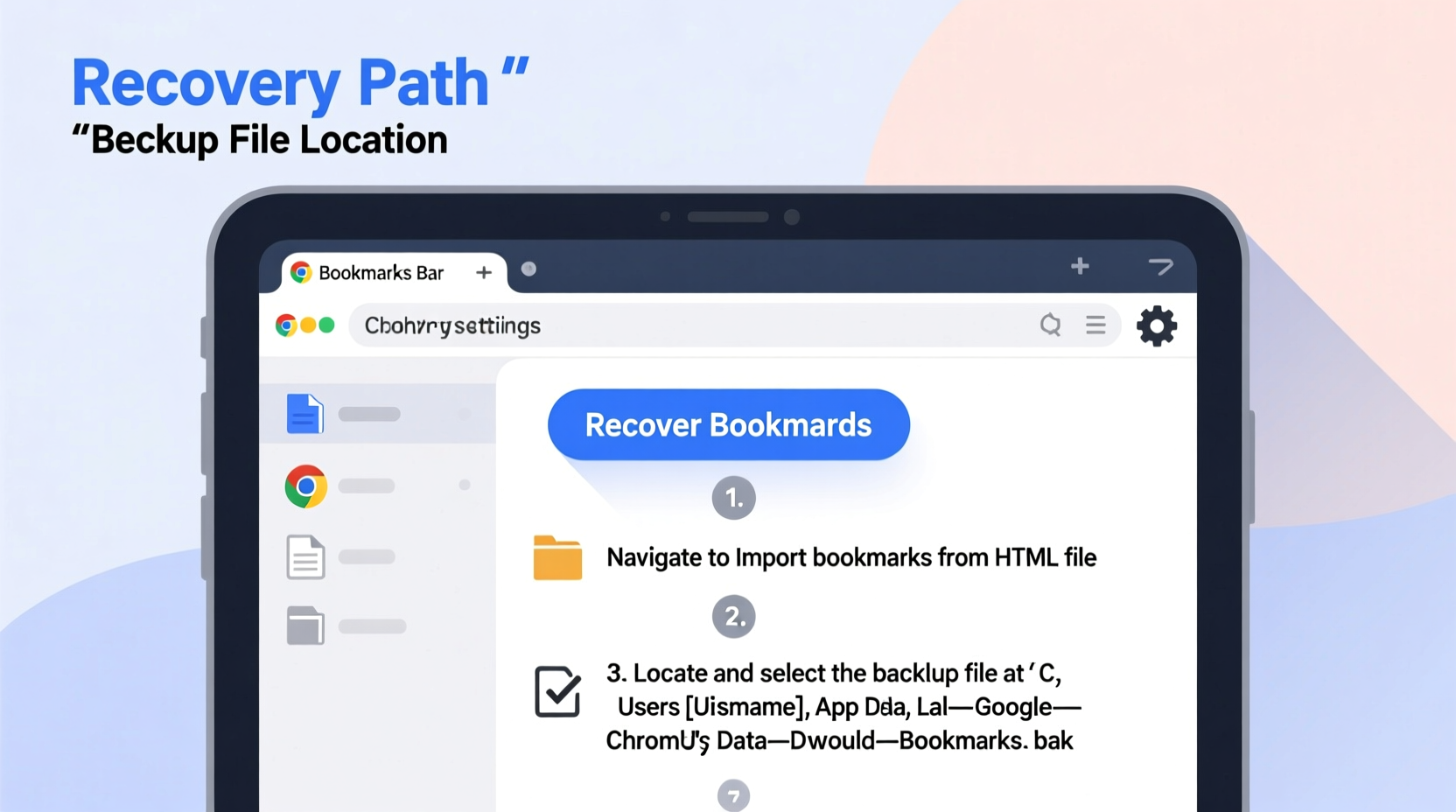
The fastest way to recover lost bookmarks is often the most overlooked: your Google Account sync. If you’ve ever signed into Chrome with your Google account and enabled sync, your bookmarks are likely stored securely in the cloud. A crash may have disrupted local data, but the cloud copy remains intact.
To verify:
- Open Chrome and click the profile icon in the top-right corner.
- Ensure you're signed in with the correct Google account.
- Click “Turn on sync” if it’s disabled, or check that “Bookmarks” is selected under sync settings.
- Wait a few moments for Chrome to pull data from the cloud.
If sync was active before the crash, your bookmarks should reappear automatically. This process typically takes less than a minute. In some cases, you may need to manually trigger a sync by visiting chrome://settings/syncSetup and clicking “Sync now.”
Restore from Local Bookmark Backup Files
Even without sync, Chrome automatically creates local backups of your bookmarks in JSON format. These files are stored on your computer and can be restored manually. The location varies slightly depending on your operating system, but the structure remains consistent.
Here’s where to find them:
| Operating System | Default Path to Bookmarks Backup |
|---|---|
| Windows | C:\\Users\\[Username]\\AppData\\Local\\Google\\Chrome\\User Data\\Default\\BookmarkBackup |
| macOS | /Users/[Username]/Library/Application Support/Google/Chrome/Default/BookmarkBackup |
| Linux | /home/[Username]/.config/google-chrome/Default/BookmarkBackup |
Navigate to the appropriate folder and look for files named bookmarks_YYYY-MM-DD_HH-MM-SS. These are timestamped backups created periodically by Chrome. Choose the most recent one before the crash occurred.
To restore:
- Close Chrome completely (check Task Manager or Activity Monitor).
- Copy the selected JSON backup file.
- Navigate to the main bookmarks file directory: same path, but without “/BookmarkBackup” — just
Default. - Rename the existing
Bookmarksfile toBookmarks_oldas a safety measure. - Paste your backup file and rename it to
Bookmarks(no extension). - Restart Chrome. Your bookmarks should now be restored.
Note: If the BookmarkBackup folder is empty, Chrome may not have created automatic backups. However, another local file—the “Bookmarks.bak”—might still exist in the same Default folder. This is a failsafe copy made during routine operations and worth checking.
Recover from the Main Bookmarks File
If no dedicated backup folder exists, Chrome still keeps a primary bookmarks file that can be rolled back to an earlier state. This file, simply named Bookmarks, is updated every time you add or remove a bookmark. But crucially, Chrome also maintains a shadow copy called Bookmarks.bak, which reflects the previous version.
Follow these steps to use it:
- Close Chrome entirely.
- Go to your Chrome profile folder:
- Windows:
C:\\Users\\[Username]\\AppData\\Local\\Google\\Chrome\\User Data\\Default\\ - macOS:
~/Library/Application Support/Google/Chrome/Default/ - Linux:
~/.config/google-chrome/Default/
- Windows:
- Locate both
BookmarksandBookmarks.bak. - Rename
BookmarkstoBookmarks.corrupt. - Rename
Bookmarks.baktoBookmarks. - Reopen Chrome. Your previous bookmarks should now be visible.
This method works best if the crash happened shortly after a change. The .bak file only holds one prior version, so it won’t help if multiple updates occurred before the crash.
“Many users don’t realize Chrome generates silent backups. Accessing these local files can save hours of manual re-saving.” — David Lin, Browser Forensics Analyst at CyberTrace Labs
Use Third-Party Recovery Tools (When All Else Fails)
If both sync and local files fail to yield results, consider specialized recovery software. These tools scan your hard drive for deleted or corrupted Chrome data, including bookmarks, even after accidental deletion or disk errors.
Recommended tools include:
- Recuva (Windows): Scans deep into file systems to recover deleted JSON and user data files.
- Disk Drill (Cross-platform): Offers intuitive interface and supports Chrome profile recovery.
- PhotoRec (Free, advanced): Open-source tool capable of recovering raw data fragments from damaged drives.
Process overview:
- Download and install the recovery tool.
- Select the drive where Chrome stores user data (usually C: on Windows).
- Scan for deleted files, filtering by type (.json, .bak, or folder name “Chrome”).
- Preview found files and restore any matching bookmark backups.
- Manually replace the current
Bookmarksfile as described earlier.
Success depends on whether the original data sectors were overwritten. Act quickly—delaying recovery increases the risk of permanent data loss.
Real Example: Recovering After a Forced Restart
Sophie, a freelance researcher, experienced a sudden power outage while working on a tight deadline. Her laptop shut down mid-session, and upon reboot, Chrome launched with no bookmarks visible. Panic set in—she had over 300 curated links for client projects.
She first checked her Google Account sync. It was active, but bookmarks hadn’t reappeared. Then she navigated to her Chrome profile folder and found the BookmarkBackup directory empty. Discouraged, she almost gave up—until she noticed a Bookmarks.bak file in the main Default folder.
Following the rollback procedure, she renamed the files and restarted Chrome. To her relief, all bookmarks were restored. Later, she discovered that sync had been paused due to a network glitch during startup. The local .bak file was her only lifeline.
Sophie now keeps monthly manual exports of her bookmarks and uses a cloud-synced note app as a secondary reference list.
Prevent Future Loss: Proactive Bookmark Management
Recovery is valuable, but prevention is better. Implementing a few habits can eliminate future stress:
✅ Bookmark Maintenance Checklist
- Enable Chrome sync and confirm bookmarks are included.
- Verify sync status weekly via chrome://sync-internals.
- Export bookmarks manually every month: Menu → Bookmarks → Bookmark manager → Three-dot menu → Export bookmarks.
- Store exported HTML files in cloud storage (Google Drive, Dropbox).
- Avoid using multiple browsers without cross-sync tools.
- Keep Chrome updated to reduce crash risks.
Storing an exported HTML file gives you a universal fallback. You can import it into any browser, even if switching devices or platforms. Think of it as insurance: quick to create, invaluable when needed.
Frequently Asked Questions
Can I recover bookmarks if I never used sync?
Yes, as long as Chrome created local backup files or the Bookmarks.bak file wasn’t overwritten. Recovery relies on accessing these files before they’re lost to disk activity.
Why didn’t my bookmarks sync after the crash?
Sync may fail temporarily due to poor internet, sign-in issues, or Chrome bugs. Check your connection, sign out and back in, or force a sync at chrome://settings/syncSetup. Also ensure “Bookmarks” is toggled on under sync options.
Is there a way to automate bookmark backups?
Chrome doesn’t offer built-in automation, but third-party tools like “Bookmark Backup” (Chrome extension) can auto-export your bookmarks to Google Drive or Dropbox at scheduled intervals.
Conclusion: Don’t Let a Crash Erase Your Digital Footprint
Losing bookmarks doesn’t have to mean starting over. With Chrome’s layered architecture—cloud sync, automatic backups, and local failsafes—recovery is often possible, even when data appears vanished. The key is acting promptly and knowing where to look. Whether you restore from a .bak file, pull from your Google Account, or use recovery software, the tools exist to bring your digital shortcuts back.
Take control today: enable sync, export a backup, and store it safely. A five-minute habit could save you hours of frustration tomorrow. Your future self will thank you when the next crash comes—and it will.




 浙公网安备
33010002000092号
浙公网安备
33010002000092号 浙B2-20120091-4
Comments
No comments yet. Why don't you start the discussion?