
Every January, millions of households across North America face the same quiet ritual: untangling strands of holiday lights, inspecting for burnt-out bulbs, and deciding what to do with the ones that no longer work—or simply haven’t been used in years. While tossing them in the trash feels easiest, it’s also the least responsible choice. Christmas lights contain copper wiring, PVC insulation, glass or plastic bulbs, and sometimes even small amounts of lead or brominated flame retardants. When landfilled, those materials leach into soil and groundwater; when incinerated, they release toxic fumes. Fortunately, robust recycling infrastructure exists—but it’s not always obvious where to go or how to participate. This guide cuts through the confusion with verified, up-to-date options, logistical insights, and real-world strategies tested by municipal coordinators, e-waste processors, and sustainability advocates.
Why Recycling Christmas Lights Matters More Than You Think
Christmas lights may seem trivial in weight—most strands weigh under 0.5 pounds—but their collective environmental impact is substantial. The U.S. Environmental Protection Agency estimates that Americans discard over 150 million pounds of holiday lighting annually. That’s equivalent to the weight of 300 fully loaded school buses. Copper alone makes up roughly 15–20% of a standard incandescent strand’s mass—and even LED strings contain 3–7% copper in their internal wiring and circuit boards. Recovering that copper reduces demand for virgin mining, which consumes vast quantities of water and energy and generates significant carbon emissions. Equally important is the PVC jacketing: when improperly disposed of, it can release dioxins during incineration and microplastics as it degrades in landfills. Recycling diverts both metals and plastics into closed-loop supply chains—copper gets refined for new electronics, while recovered polymers are repurposed into industrial-grade pellets for non-consumer applications like cable conduits or traffic cones.
“Light recycling is one of the highest-return e-waste streams we handle—not because the volume is massive, but because the copper recovery rate exceeds 92%, and the labor cost per pound is among the lowest. It’s low-hanging fruit for community sustainability.” — Dr. Lena Torres, Director of Materials Recovery, Midwest Recycling Consortium
Local Drop-Off Options: What’s Available Near You (and How to Find It)
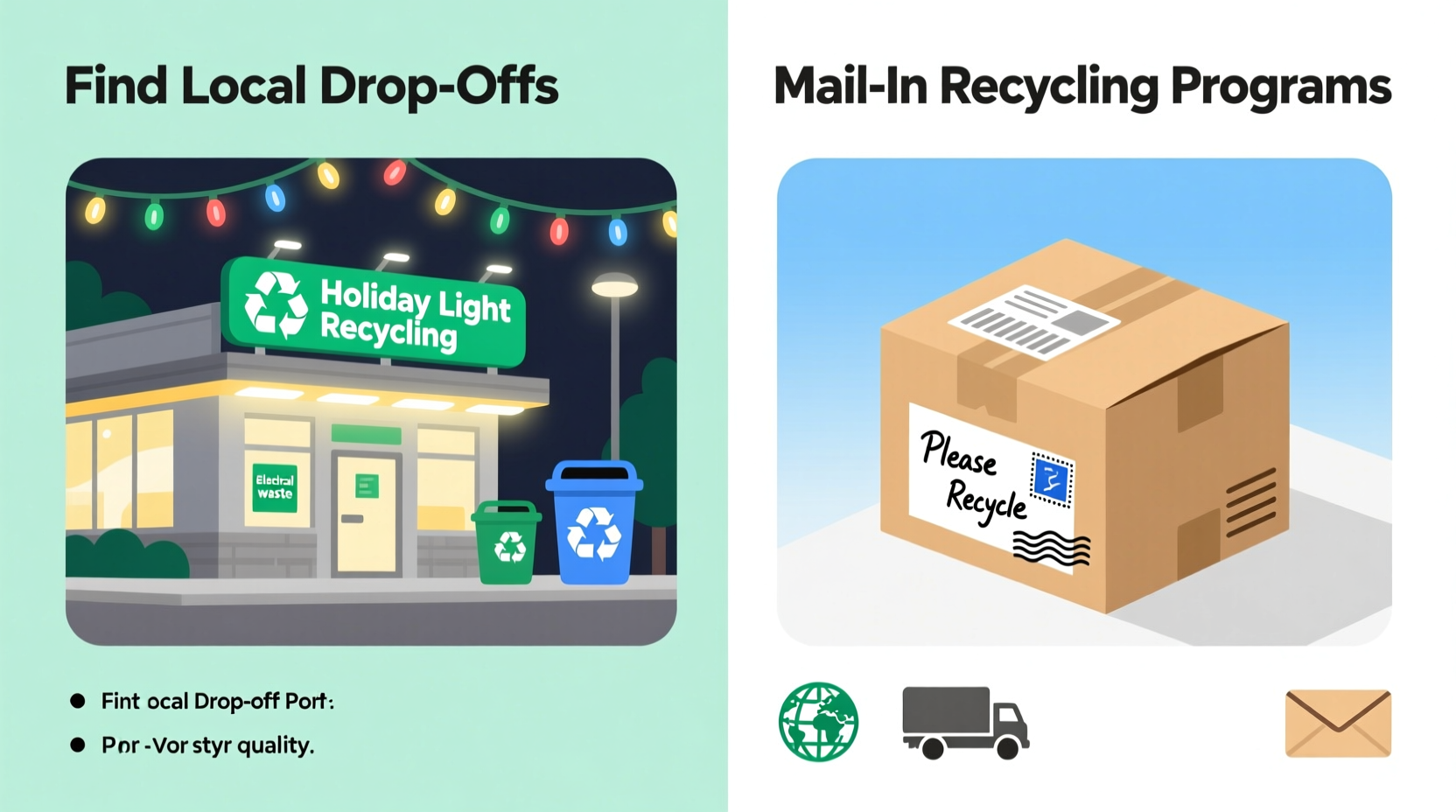
Most municipalities don’t accept Christmas lights at standard curbside recycling bins—wires tangle sorting machinery, and mixed-material construction violates single-stream protocols. Instead, look to three proven local channels:
- Municipal Household Hazardous Waste (HHW) Facilities: Many cities operate seasonal or year-round HHW collection sites that accept lights as part of their broader e-waste program. These are often free for residents and located at transfer stations or public works yards. To locate one, search “[Your City] HHW collection site” or use the EPA’s HHW Directory.
- Retained Retailer Programs: Home Depot, Lowe’s, and Ace Hardware have historically offered in-store light recycling, though participation varies by region and season. As of 2024, Home Depot maintains active drop-off bins at over 1,200 U.S. stores from mid-November through mid-January. No receipt or purchase is required. Call ahead: some locations limit acceptance to incandescent and LED strings only (not novelty or battery-operated lights).
- Community E-Waste Events: Libraries, churches, and environmental nonprofits host one-day collection drives—especially in December and January. These are often partnered with certified recyclers like ERI or Sustainable Electronics Recycling International (SERI). Check your county’s solid waste department calendar or platforms like Earth911.org.
Mail-In Recycling Programs: When Local Options Aren’t Accessible
If you live in a rural area, lack nearby retail partners, or have a large volume (e.g., 50+ strands), mail-in services offer reliable alternatives. Unlike donation-based models, these are professionally managed logistics networks with traceable outcomes. Below is a comparison of leading U.S.-based programs, all verified as active in Q2 2024:
| Program | Cost to User | Max Weight per Box | Certifications | Processing Partner |
|---|---|---|---|---|
| Christmas Light Source Recycle Program | $14.95 flat fee (includes prepaid box & shipping) | 25 lbs | R2v3, NAID AAA | ERI (Electronic Recyclers International) |
| ReTech Solutions Holiday Light Drive | Free box + prepaid label (minimum 10 lbs) | 30 lbs | SERI RIOS, ISO 14001 | ReTech (Chicago-based, specializes in wire recovery) |
| GreenCitizen “Bright Future” Kit | $19.99 (includes eco-box + tracking) | 20 lbs | e-Stewards, R2v3 | GreenCitizen (Bay Area, operates own smelting line for copper) |
| Goodwill Industries E-Waste Partnerships | Free (drop at participating Goodwill centers) | N/A (in-person only) | NAID AAA (data destruction for smart lights) | Multiple regional recyclers, audited annually |
All four programs accept both incandescent and LED strings—including mini-lights, C7/C9 bulbs, icicle lights, and net lights. They explicitly exclude extension cords, power adapters, damaged transformers with exposed wiring, and lights with non-removable batteries (e.g., integrated solar units). Each service provides online tracking and issues a Certificate of Recycling upon processing—valuable for businesses or schools seeking sustainability reporting documentation.
A Step-by-Step Guide to Preparing and Shipping Your Lights
Proper preparation ensures your shipment is accepted, processed efficiently, and contributes meaningfully to material recovery. Follow this sequence:
- Sort by type: Separate incandescent, LED, and novelty strands (e.g., fiber optic, rope lights). While most recyclers accept mixed types, separating speeds sorting and avoids contamination from non-recyclable components.
- Remove non-light elements: Cut off and discard plastic hangers, metal hooks, zip ties, and adhesive backing. These are not recoverable and clog processing lines.
- Coil neatly: Wind each strand around a rigid cardboard spool (like an empty paper towel tube) or use a reusable light-reel tool. Avoid tight knots or rubber bands—these damage insulation and complicate automated wire stripping.
- Bag securely: Place coiled strands in the provided box or a sturdy corrugated box lined with kraft paper (no plastic bags or bubble wrap). Fill voids with shredded paper—not styrofoam peanuts—to prevent shifting during transit.
- Label and ship: Affix the prepaid label exactly as instructed. Drop at any USPS, UPS, or FedEx location. Do not use third-party shipping services unless explicitly approved by the program.
Note: If using a retailer drop-off, skip steps 3–4—just bring clean, dry, uncoiled strands in a reusable bag or box. Staff will handle bundling and labeling onsite.
Mini Case Study: A Small-Town Library’s Successful Light Drive
In 2023, the Cedar Hollow Public Library in rural Iowa launched its first “Twinkle & Toss” light recycling drive. With no nearby Home Depot or HHW facility, staff partnered with ReTech Solutions to secure free collection boxes and educational posters. They promoted the drive via local radio, school newsletters, and a Facebook group titled “Cedar Hollow Green.” Over six weeks, residents dropped off 1,247 strands—weighing 1,892 pounds total. The library tracked participation by zip code and discovered that 68% came from households over age 65, many of whom had stored lights since the 1990s. Post-drive analysis showed 82% were incandescent (reflecting generational usage patterns), and nearly half contained intact copper cores despite visible bulb burnout. ReTech reported a 94.3% copper recovery rate and returned a $217 rebate to the library—funded by metal resale—which was used to purchase LED replacement lights for the town hall. The initiative has now become an annual event, supported by the county’s Office of Sustainability.
What Happens After You Drop Off or Ship Your Lights?
Understanding the downstream process builds confidence in the system. Once received, lights undergo a standardized, multi-stage recovery workflow:
- Manual pre-sorting: Workers remove plugs, controllers, timers, and non-wire components. Plugs are sent to metal recyclers; controllers are routed to circuit board specialists.
- Shredding and separation: Strands pass through granulators that break insulation from copper. Air classifiers then separate lightweight PVC from dense copper wire.
- Copper refining: Wire fragments enter electrolytic refining or flash smelting—producing 99.99% pure copper cathodes ready for industrial reuse.
- PVC repurposing: Recovered insulation is pelletized and sold to manufacturers of traffic cones, garden edging, or industrial flooring—never reprocessed into food-grade or medical products.
No reputable recycler landfill or incinerate functional components. Certified programs provide full chain-of-custody documentation, including weight logs, processing dates, and end-market verification. If a provider refuses to share this information—or charges “processing fees” without transparency—opt for a SERI- or R2-certified alternative.
Frequently Asked Questions
Can I recycle broken or tangled Christmas lights?
Yes—broken bulbs and tangled wires are acceptable and expected. In fact, tangles pose no issue for industrial shredders. Just ensure strands are dry and free of excessive dirt, grease, or mold (which can contaminate copper). Severely corroded plugs or frayed ends with exposed bare wire should be cut off before drop-off.
Do LED lights really need recycling? Aren’t they more eco-friendly?
LEDs use far less energy during operation, but they contain complex circuitry—including semiconductors, capacitors, and sometimes rare-earth phosphors—that require specialized recovery. Their smaller size also means more units per pound, increasing cumulative heavy metal load in landfills. Recycling ensures gallium, indium, and other trace elements are reclaimed—not lost.
What about vintage or handmade lights—like 1950s bubble lights or ceramic socket sets?
These are accepted by most certified programs, though they’re handled manually due to unique materials (e.g., methylene chloride in vintage bubble lights requires special ventilation). ReTech and GreenCitizen report processing over 12,000 vintage units annually—many sourced from antique dealers and estate sales. If unsure, email a photo to the recycler’s support team before shipping.
Conclusion: Turn One Small Act Into Lasting Impact
Recycling old Christmas lights isn’t about perfection—it’s about intentionality. You don’t need to audit every strand in your attic or ship 200 pounds overnight. Start with what’s already unplugged and unwound. Choose one drop-off location within five miles or order a single mail-in kit. That single act recovers copper equivalent to a 3-foot electrical conduit, prevents half a pound of PVC from entering the waste stream, and supports skilled jobs in domestic recycling facilities. More importantly, it signals to retailers, municipalities, and policymakers that circular holiday habits matter. When neighbors see your reusable tote filled with coiled lights heading to the library drive—or spot the ReTech box on your porch—they’re more likely to ask, “Where’d you get that?” That question sparks conversation, shifts norms, and builds momentum for systemic change. Don’t wait for next December. Pull out that box in the garage today. Unplug one strand. Coil it. And send it forward—not as waste, but as raw material for what comes next.




 浙公网安备
33010002000092号
浙公网安备
33010002000092号 浙B2-20120091-4
Comments
No comments yet. Why don't you start the discussion?