
For many people, remembering a new acquaintance’s name feels like an impossible task. You smile, shake hands, exchange pleasantries—and by the time you turn away, their name has vanished from memory. This common struggle isn’t a sign of poor intelligence or lack of interest; it’s often the result of how our brains process information during social interactions. The good news? Remembering names is not an innate talent—it’s a skill that can be improved with deliberate practice and effective strategies. With focused attention and the right techniques, anyone can become significantly better at recalling names, building stronger relationships, and making more meaningful connections.
The Science Behind Name Forgetting
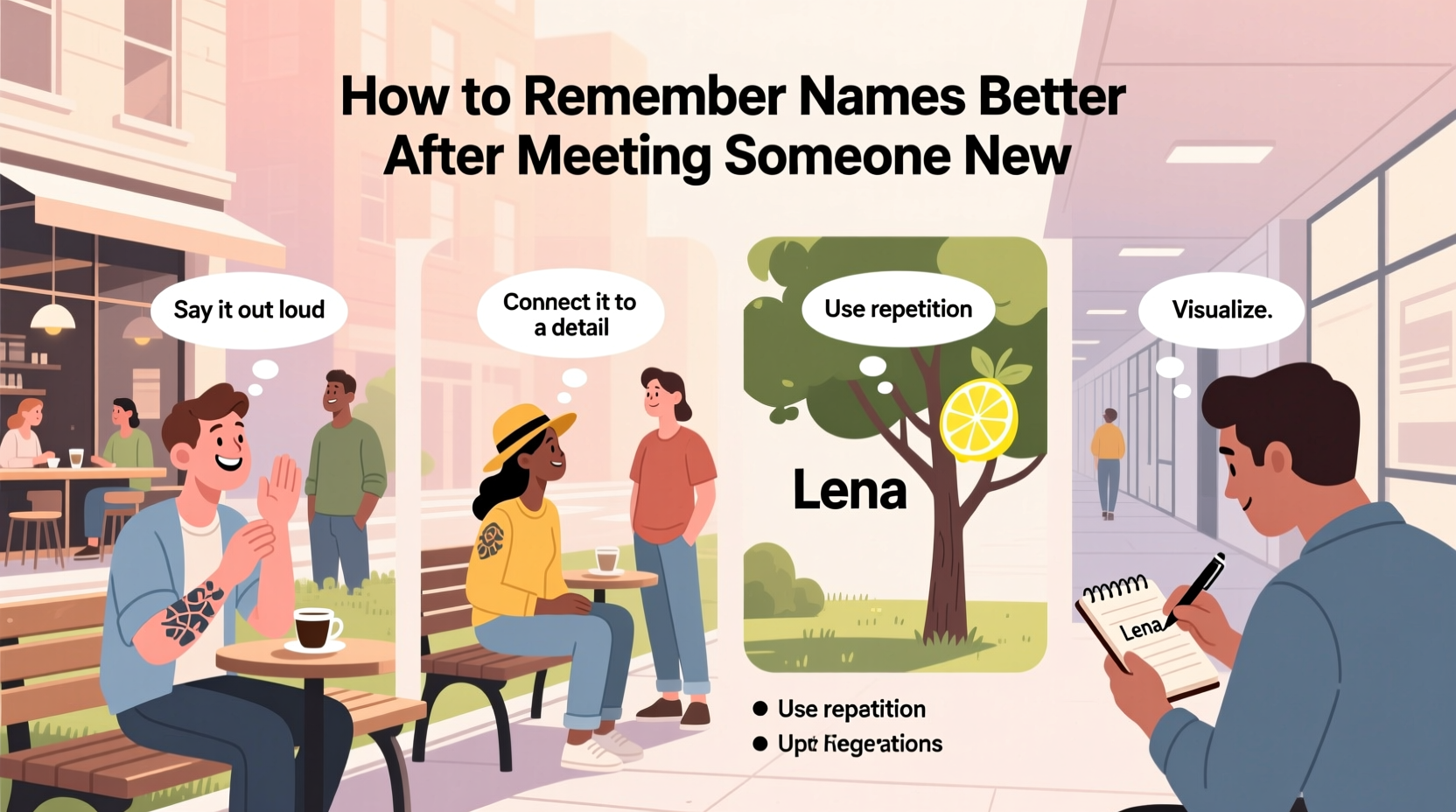
Names are among the hardest pieces of information to retain because they are arbitrary labels with little inherent meaning. Unlike faces, which the brain processes holistically using specialized regions, names are abstract and disconnected from visual or emotional cues—unless we actively create those links. Research in cognitive psychology shows that most forgetting happens within seconds of hearing something, especially if attention is divided. In a typical introduction, your mind may be occupied with how you appear, what to say next, or scanning the room, leaving minimal mental bandwidth for encoding the person’s name.
Dr. Elizabeth Loftus, a renowned cognitive psychologist, explains:
“Memory is not like a video recorder. It’s reconstructive. If we don’t pay attention at the moment of learning, there’s nothing solid to retrieve later.” — Dr. Elizabeth Loftus, Cognitive Psychologist
This means that the key to remembering names lies not in having a ‘good memory,’ but in improving the initial encoding process—how you capture and store the information when you first hear it.
Step-by-Step Guide to Remembering Names
Improving name recall doesn’t require memorization tricks alone. It starts the moment you meet someone. Follow this five-step process to dramatically increase your chances of remembering their name:
- Pay Full Attention: When introduced, pause mentally. Make eye contact, stop scanning the room, and focus entirely on the person. Say their name silently in your head as soon as you hear it.
- Repeat It Immediately: Use their name in conversation right away. “Nice to meet you, Sarah,” or “So, James, what brings you here?” This repetition strengthens neural pathways.
- Visualize the Spelling: Mentally picture how the name is spelled. Is it “Kristen” or “Christine”? Visualizing letters creates a second memory trace.
- Create a Mental Link: Connect the name to something familiar—a celebrity, a place, or a physical feature. For example, “Nina reminds me of Nina Dobrev,” or “Mark has a strong jaw like a hammer (Mark/Hammer).”
- Review Within 60 Seconds: After moving away, quickly repeat the name and association in your mind. Think: “Sarah—red scarf, loves hiking.” This brief rehearsal locks it in short-term memory.
Effective Memory Techniques to Apply
Beyond immediate repetition, several proven memory techniques can transform your ability to retain names over time.
The Association Method
Your brain remembers things better when they’re connected to existing knowledge. When you hear a name, link it to someone or something you already know. For instance, meeting someone named “Greg” who wears glasses might trigger the thought: “Greg like my old neighbor Greg who was a librarian.” The more vivid and personal the image, the stronger the memory.
The Rhyme and Alliteration Trick
Rhyming or alliterative phrases are easier to recall. If you meet a man named Tony who owns a bakery, think: “Tony the baker.” Or for Laura with long hair: “Laura with the flair.” These catchy phrases act as mental hooks.
The Loci Method (Memory Palace)
Used by ancient Greeks and modern memory champions, this technique involves placing names in a familiar mental space, like your home. Imagine walking through your front door and seeing each new person standing in a specific room. Assign them a spot based on the order you met them. Recalling the sequence becomes as easy as mentally walking through your house.
Engage Multiple Senses
The more senses involved in learning, the stronger the memory. As you hear the name, visualize it spelled out, say it aloud, and even imagine writing it with your finger on your palm. This multisensory approach deepens encoding.
Common Mistakes That Sabotage Name Recall
Even well-intentioned efforts fail when these habits go unchecked. Avoid these pitfalls to improve retention:
| Mistake | Why It Hurts Memory | Better Approach |
|---|---|---|
| Assuming you’ll remember automatically | No active encoding occurs without intention | Decide in the moment to remember |
| Using nicknames too soon | Weakens the link to the real name | Use full name initially, then nickname |
| Focusing only on the face | Ignores the verbal component of identity | Link name + face + voice + context |
| Not reviewing after the conversation | Allows memory to fade within minutes | Recap names during bathroom breaks or quiet moments |
| Apologizing excessively for forgetting | Reinforces self-doubt and anxiety | Politely re-ask and refocus on remembering |
Real-Life Example: From Forgetful to Unforgettable
Consider Mark, a sales executive who struggled to remember client names during networking events. He’d feel embarrassed when introduced a second time to someone he’d met weeks earlier. After learning about active listening and association techniques, he began implementing small changes. At his next conference, he made it a point to repeat each person’s name twice during conversation and linked it to a distinctive feature—like “Julie with the turquoise earrings” or “David who works in renewable energy.” He also paused briefly after each interaction to mentally review three names. By the end of the day, he could recall 90% of the people he’d met. A week later, he followed up with personalized emails referencing their conversation. The response rate doubled compared to previous events. His confidence grew, and so did his network.
This wasn’t magic—it was method. Mark shifted from passive hearing to active remembering.
Checklist: How to Remember Names Like a Pro
Use this checklist every time you meet someone new to build a reliable habit:
- ✅ Make strong eye contact during introductions
- ✅ Listen carefully and ask for clarification if needed
- ✅ Repeat the name aloud within the first 10 seconds
- ✅ Visualize the spelling of the name in your mind
- ✅ Find a connection: celebrity, sound-alike word, or physical trait
- ✅ Use the name naturally two or three times in conversation
- ✅ Mentally review the name and association after parting
- ✅ Write it down later if appropriate (e.g., business card notes)
- ✅ Test yourself later: “Who did I meet at the event yesterday?”
- ✅ Practice daily—even with strangers in line at coffee shops
FAQ: Common Questions About Remembering Names
What if I forget a name immediately after hearing it?
It happens to everyone. The best approach is to acknowledge it gently: “I’m so glad to meet you—I just want to double-check your name so I remember it correctly.” Most people appreciate the effort. Then, apply the techniques immediately: repeat, associate, and visualize.
Are some names harder to remember than others?
Yes. Unfamiliar names, especially those from cultures different from your own, can be harder due to lack of exposure. This isn’t bias—it’s cognitive fluency. The solution is extra attention. Break the name into syllables, ask about pronunciation, and find a meaningful association. Showing genuine interest often makes the other person feel respected and valued.
Can memory training really help with names?
Absolutely. Studies show that even short-term memory training programs improve name-face recall. Techniques like spaced repetition, mindfulness, and chunking strengthen working memory. Apps and courses designed for memory improvement often include name-recall exercises. But you don’t need software—consistent application of the methods above yields results in days, not months.
Conclusion: Turn Forgetting into a Thing of the Past
Remembering names isn’t about having a photographic memory—it’s about being present, intentional, and strategic. Every time you meet someone, you have a choice: passively absorb their name and risk forgetting it, or actively engage with it and create a lasting impression. The techniques outlined here—repetition, visualization, association, and review—are simple, but their impact compounds over time. People feel seen, respected, and valued when you use their name correctly. In professional settings, it builds trust. In personal ones, it deepens connection.
You don’t need to remember every name perfectly. But with consistent practice, you’ll notice a dramatic shift—from awkward pauses to confident greetings, from forgotten faces to meaningful follow-ups. Start today. The next person you meet deserves to be remembered.




 浙公网安备
33010002000092号
浙公网安备
33010002000092号 浙B2-20120091-4
Comments
No comments yet. Why don't you start the discussion?