
Every holiday season, millions of homes fill with the scent of pine, the glow of lights, and the quiet hum of shared memory. For gamers who grew up with the tactile *click* of a Nintendo Entertainment System cartridge sliding into place—or the satisfying heft of a Sega Genesis game—those plastic shells hold more than nostalgia. They hold identity. Yet many sit forgotten in dusty drawers or donated bins, their circuits silent, their artwork faded. Repurposing them as tree decor isn’t just crafty recycling—it’s storytelling made tangible. This isn’t about slapping glue on plastic and calling it done. It’s about honoring design history, respecting material integrity, and creating heirloom-quality ornaments that spark conversation, not just curiosity.
Why Cartridges Make Exceptional Tree Ornaments
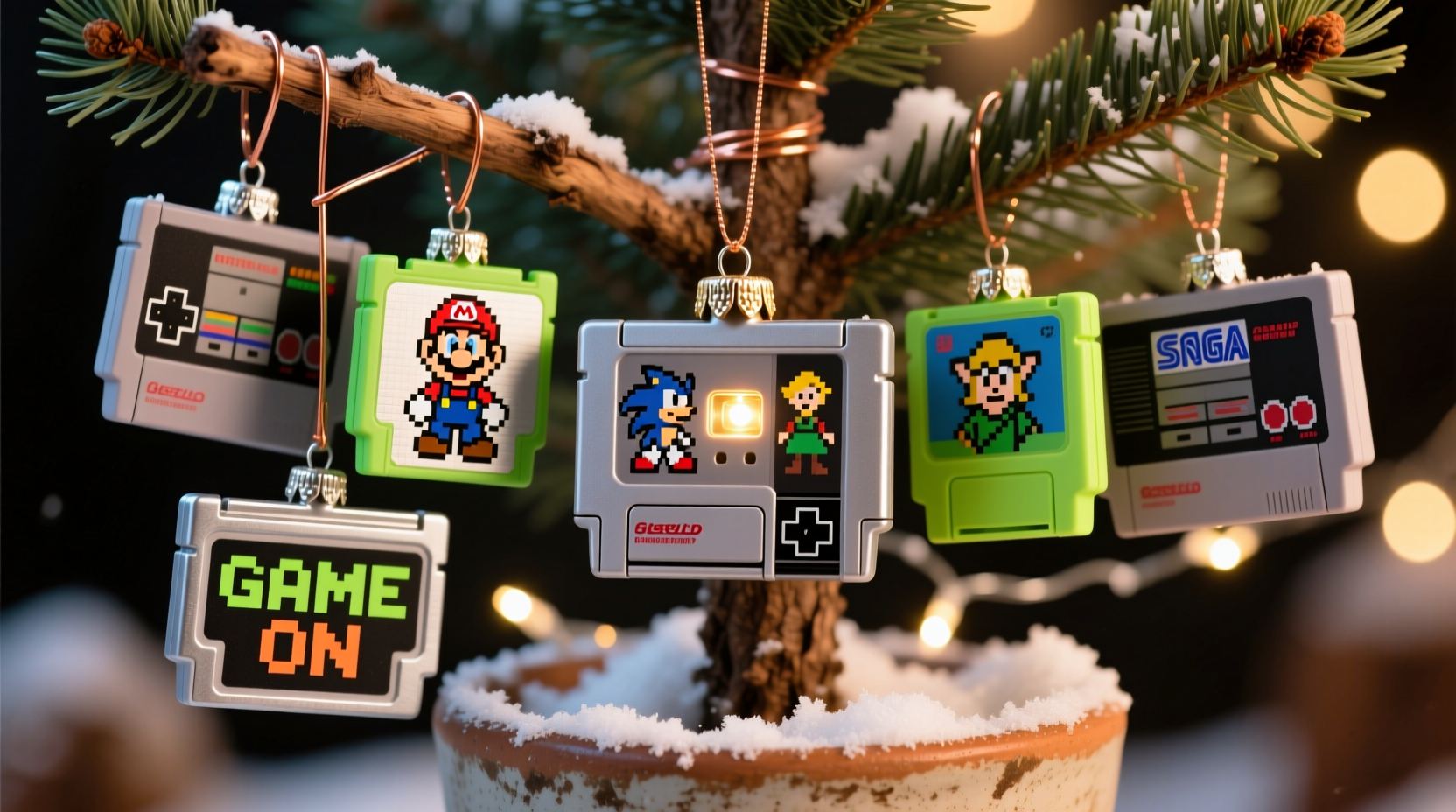
Unlike mass-produced plastic baubles, authentic video game cartridges possess built-in advantages for decorative reuse. Their rigid ABS or polycarbonate shells resist warping and cracking under indoor temperature fluctuations. Their standardized dimensions—NES (5.25\" × 4.75\"), SNES (5.5\" × 4.75\"), Genesis (5.0\" × 4.5\"), Game Boy (4.75\" × 3.0\")—allow for predictable hanging and balanced visual weight. Most importantly, their original artwork was engineered for shelf appeal: bold typography, saturated palettes, and iconic character renderings designed to catch the eye in crowded retail displays. When hung on a tree, these elements translate seamlessly into miniature works of pop-art ornamentation.
Conservation-minded crafters also appreciate that cartridge reuse avoids the environmental cost of new plastic production. A single NES cartridge weighs approximately 85 grams—mostly durable thermoplastic. Recycling facilities rarely accept mixed-plastic electronics casings due to sorting complexity and low yield value. Repurposing bypasses landfill disposal while preserving cultural artifacts. As Dr. Lena Torres, curator of the Digital Material Archive at MIT, observes:
“Cartridges are physical anchors to digital history. When we treat them as disposable, we erase the labor, aesthetics, and engineering embedded in their form. Thoughtful reuse—especially in domestic, celebratory contexts—reasserts their cultural weight.” — Dr. Lena Torres, Digital Material Archive, MIT
Preparation: Safety, Sourcing & Sanitization
Before any crafting begins, responsible preparation is non-negotiable. Vintage cartridges may harbor dust mites, mold spores, or residual cleaning solvents from decades-old store refurbishments. Never assume “clean-looking” means safe for indoor decoration.
Sourcing guidelines:
- Avoid cartridges with cracked, warped, or brittle shells. Polycarbonate degrades over time when exposed to UV light or ozone; compromised structural integrity increases breakage risk during drilling or hanging.
- Steer clear of water-damaged units. Swollen labels, white residue inside the shell, or musty odors indicate internal corrosion—even if the circuit board appears intact. Moisture compromises long-term stability.
- Prefer cartridges with intact, unpeeled labels. Original printed art retains higher visual fidelity than photocopied replacements or fan-made stickers.
Sanitization protocol (for non-electronic display only):
- Wipe exterior with dry, lint-free microfiber cloth to remove loose dust.
- Use compressed air (not canned air with propellants) to clear crevices around the edge seam and label perimeter.
- For stubborn grime: lightly dampen a cotton swab with distilled water only—never submerge. Gently roll along label edges and cartridge ridges. Air-dry vertically for 48 hours in low-humidity, indirect-light conditions.
- Never use bleach, ammonia, acetone, or abrasive cleaners—they degrade plasticizers and cause yellowing.
Five Proven Hanging Methods (Ranked by Durability & Aesthetics)
How you hang determines longevity, safety, and visual cohesion. Below is a comparative analysis of five field-tested techniques, evaluated across three criteria: structural security (resistance to snapping or slipping), visual neutrality (minimal interference with original design), and material compatibility (no chemical reaction with plastic).
| Hanging Method | Structural Security | Visual Neutrality | Material Compatibility | Best For |
|---|---|---|---|---|
| Drilled top-edge hole + stainless steel jump ring | ★★★★★ | ★★★★☆ | ★★★★★ | NES, SNES, Genesis—thick-shell cartridges with ample top margin |
| Clear acrylic adhesive hook (3M Command™ Outdoor) | ★★★☆☆ | ★★★★★ | ★★★☆☆ | Lightweight Game Boy, Game Gear—only on undamaged, non-glossy labels |
| Heat-formed plastic loop (using low-temp heat gun) | ★★★★☆ | ★★★☆☆ | ★★★☆☆ | Experienced crafters; requires precise temp control to avoid warping |
| Reinforced label tab (glue + folded cardstock backing) | ★★☆☆☆ | ★★☆☆☆ | ★★★★★ | Delicate or historically significant units where drilling is prohibited |
| Magnetic clip (neodymium + thin steel washer) | ★★★☆☆ | ★★★☆☆ | ★★★★★ | Display-only setups (not for active trees with pets/kids); requires interior washer placement |
The drilled-hole method remains the gold standard for permanent, secure display. Use a 1/16\" titanium-coated drill bit at low speed (under 500 RPM) with light, consistent pressure. Drill perpendicular to the top edge—not angled—and stop immediately upon breaking through the inner shell wall. Deburr the entry/exit points with a fine-grit sanding sponge (400+ grit) to prevent snagging ribbon or wire.
Step-by-Step: Creating a Balanced, Thematic Ornament Set
A cohesive collection elevates individual pieces into intentional design. Follow this timeline to build a harmonized set of 12 ornaments—ideal for a standard 6–7 foot tree.
- Week 1: Curation & Sorting
Group cartridges by era (8-bit, 16-bit, handheld), color family (primary reds/blues, earth tones, metallics), and gameplay genre (platformers, RPGs, sports). Discard duplicates unless visually distinct (e.g., US vs. Japanese box art variants). - Week 2: Surface Refinement
Using 0000 steel wool and mineral oil, gently buff matte-finish shells (like early NES carts) to restore subtle luster—never on glossy labels. Wipe clean with lint-free cloth. For scuffed labels, apply archival-quality matte varnish (Golden MSA Varnish) with soft brush—only on fully cured, dust-free surfaces. - Week 3: Hardware Integration
Drill all selected cartridges using identical technique. Attach nickel-plated stainless steel jump rings (5mm inner diameter). Thread with 1.2mm satin-finish black nylon cord—knot with surgeon’s knot and seal ends with clear nail hardener. - Week 4: Thematic Grouping
Create trios: e.g., Zelda (blue), Super Mario Bros. (red), Metroid (purple) for “Nintendo Trinity”; or Streets of Rage, Golden Axe, Altered Beast for “Sega Beat ’Em Up Trio.” Each trio shares a unified cord length (8\", 10\", 12\") to create rhythmic depth on the tree. - Week 5: Final Assembly & Placement Map
Photograph your tree and overlay a grid. Assign ornament groups to zones: high branches (lightest pieces), mid-canopy (thematic trios), lower boughs (largest/heaviest like SNES carts). Reserve one “anchor piece”—a pristine, iconic title like Chrono Trigger—for the tree topper base.
Mini Case Study: The Retro Revival Tree in Portland, OR
In December 2023, graphic designer Maya Chen transformed her family’s Douglas fir into a widely shared “Retro Revival Tree” using 47 repurposed cartridges. She began with a strict curation rule: no duplicate publishers (so only one Nintendo, one Sega, one Atari per branch quadrant) and mandatory inclusion of at least three titles from underrepresented developers—including EarthBound (Ape Inc.), Loom (LucasArts), and Maniac Mansion (Lucasfilm Games). To solve hanging inconsistencies, she custom-machined 47 aluminum cradles—each sized precisely to a cartridge’s footprint—that clipped onto brass hooks. The cradles held the cartridges at a 15-degree forward tilt, maximizing label visibility without compromising stability. Visitors reported spending an average of 7 minutes examining the tree—not just admiring, but identifying titles, debating release years, and sharing childhood memories tied to specific games. Local news coverage credited the project with sparking renewed interest in the Oregon Video Game History Society’s preservation workshops.
FAQ: Practical Concerns Addressed
Can I safely drill into cartridges containing working circuit boards?
Yes—if the board is fully removed first. Never drill near exposed contacts or solder joints. Extract the PCB using a small Phillips #00 screwdriver (most NES/SNES carts use two screws beneath the label). Store boards separately in anti-static bags; they retain collector value and historical significance even without shells.
Will the plastic yellow over time on my tree?
Potential yellowing comes from UV exposure and oxidation—not tree lights. Incandescent bulbs emit negligible UV; modern LEDs emit none. Keep your tree away from south-facing windows and use curtains at peak daylight hours. If yellowing occurs, restoration is possible: submerge in hydrogen peroxide (3%) + OxiClean powder + UV lamp for 4–6 hours—a process known as “retrobrighting.” But prevention is simpler and safer.
How do I explain this to skeptical relatives who think it’s “just junk”?
Lead with shared memory: “This Castlevania cart? That’s the one we took turns playing during power outages in ’92.” Then pivot to craftsmanship: “Each one took 20 minutes of careful prep—more time than most store-bought ornaments.” Finally, cite precedent: museums like The Strong National Museum of Play display cartridges as cultural artifacts alongside toys and books. Value isn’t inherent in function alone—it resides in resonance.
Conclusion: Hang More Than Ornaments—Hang Meaning
Repurposing video game cartridges as tree decor transcends seasonal craft. It’s an act of material empathy—recognizing that plastic, once dismissed as ephemeral, can carry decades of human connection. It’s a quiet resistance to disposability culture, where every drilled hole, every knotted cord, affirms intention over impulse. And it’s deeply personal: whether you’re honoring your first console, commemorating a sibling’s favorite RPG, or paying tribute to a developer whose work shaped your creative voice, these ornaments become conduits—not just for nostalgia, but for intergenerational dialogue. Your child may not know how to insert a cartridge into an NES, but they’ll remember the story behind the Final Fantasy VI ornament—the one with the dragon crest—and ask why it matters. That question is where legacy begins.




 浙公网安备
33010002000092号
浙公网安备
33010002000092号 浙B2-20120091-4
Comments
No comments yet. Why don't you start the discussion?