
Sleeping in on weekends might feel like a reward after a long workweek, but it often comes at a cost: a misaligned circadian rhythm. When Monday morning arrives, you may find yourself groggy, unfocused, and struggling to wake up—symptoms of what’s commonly known as “social jet lag.” This condition occurs when your weekend sleep schedule drifts significantly from your weekday routine, disrupting your body’s internal clock. The good news is that your circadian rhythm is adaptable. With intentional habits and consistency, you can recalibrate your internal clock and restore healthy sleep patterns—even after the most indulgent weekend.
The Science Behind Your Internal Clock
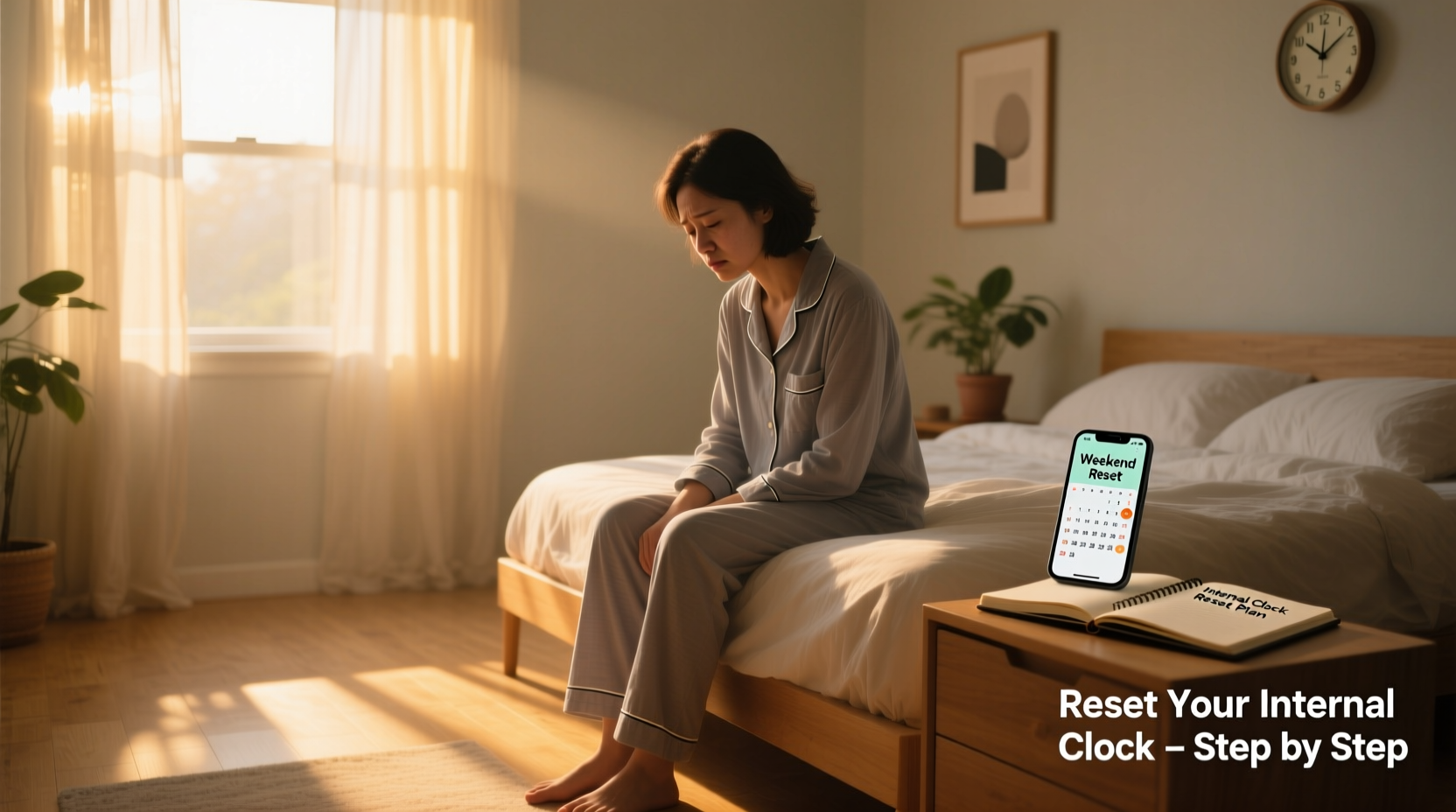
Your internal clock, or circadian rhythm, is a 24-hour biological cycle regulated by the suprachiasmatic nucleus (SCN) in your brain. It responds primarily to light and darkness, influencing not only sleep but also hormone release, body temperature, digestion, and cognitive performance. When you alter your sleep schedule dramatically over the weekend—say, staying up two hours later and waking three hours later—you send conflicting signals to your SCN. This disrupts melatonin production, delays your natural sleep onset, and reduces sleep quality.
According to Dr. Matthew Walker, neuroscientist and author of *Why We Sleep*, “Even a one- to two-hour shift in sleep timing can impair alertness and metabolic health. The brain doesn’t adapt quickly to abrupt changes in sleep-wake cycles.” This explains why many people feel worse after a late Sunday sleep-in than they would after a shorter night of consistent sleep.
“Even a one- to two-hour shift in sleep timing can impair alertness and metabolic health.” — Dr. Matthew Walker, Neuroscientist and Sleep Researcher
Resetting your internal clock isn't about forcing yourself to fall asleep instantly on Sunday night. It's about gradually realigning your biological rhythms through environmental cues, behavior, and timing.
Step-by-Step Guide to Resetting Your Circadian Rhythm
Recovery from weekend sleep disruptions doesn’t require drastic measures. Instead, follow this structured, four-day plan to smoothly transition back into your weekday rhythm without excessive fatigue or irritability.
- Saturday Night: Begin winding down 30 minutes earlier than usual. Avoid screens after 9 PM and dim indoor lights. If you typically stay up until midnight, aim for 11:30 PM.
- Sunday Morning: Wake up no more than 60–90 minutes later than your weekday wake time. Resist the urge to sleep past 9 AM if you usually rise at 7:30. Exposure to morning sunlight within 30 minutes of waking helps signal daytime to your brain.
- Sunday Afternoon: Avoid long naps. If you’re tired, limit rest to a 20-minute power nap before 3 PM. Later naps interfere with nighttime sleep drive.
- Sunday Evening: Follow your weekday bedtime routine. Be in bed with lights out by your target sleep time. Use a warm-toned reading light if needed, but avoid blue light from phones or TVs.
- Monday and Beyond: Maintain consistent wake times—even on weekends. Allow no more than a 30–60 minute variation between weekend and weekday schedules.
Key Habits That Support Circadian Realignment
While timing is crucial, your daily behaviors also influence how quickly your body adjusts. Incorporate these evidence-based practices to accelerate recovery and improve long-term sleep stability.
Maximize Morning Light Exposure
Natural light is the strongest cue for resetting your internal clock. Within 30 minutes of waking, spend 15–30 minutes outside (or near a bright window). This suppresses melatonin and advances your circadian phase, making you feel alert earlier and sleepy earlier the next night.
Maintain Consistent Meal Times
Your digestive system follows circadian rhythms too. Eating breakfast within an hour of waking reinforces your body’s internal day-night signal. Avoid heavy meals within three hours of bedtime, as digestion can delay sleep onset.
Limit Caffeine and Alcohol
Caffeine has a half-life of 5–6 hours, meaning a 3 PM coffee can still affect sleep at 9 PM. Alcohol may make you drowsy initially but fragments sleep later in the night. Avoid both after mid-afternoon, especially during recovery days.
Use Temperature Strategically
Your core body temperature drops slightly before sleep. A cool bedroom (60–67°F or 15–19°C) supports this process. Taking a warm bath 1–2 hours before bed can also help, as the post-bath cooldown mimics natural temperature decline.
Do’s and Don’ts: A Quick Reference Table
| Action | Do | Don’t |
|---|---|---|
| Weekend wake time | Stay within 60 minutes of weekday wake time | Sleep in more than 90 minutes past usual time |
| Evening routine | Dim lights, read, meditate | Watch intense TV, scroll social media |
| Light exposure | Get 15+ minutes of morning sunlight | Sleep with blackout curtains indefinitely |
| Napping | Limit to 20 minutes before 3 PM | Take long or late afternoon naps |
| Diet | Eat breakfast early; avoid late dinners | Consume caffeine after 2 PM or alcohol before bed |
Real-Life Example: Recovering from a Weekend of Disruption
Consider Sarah, a 34-year-old marketing manager who typically wakes at 6:30 AM on weekdays. Last weekend, she stayed up until 1:00 AM Saturday and Sunday, watching shows and socializing. She slept until 9:00 AM both mornings. By Sunday night, she felt anxious about the week ahead and lay awake until 12:30 AM, despite being exhausted.
Instead of panicking, Sarah applied a reset strategy. On Sunday, she woke at 8:00 AM (within 90 minutes of her weekday time), drank water, and walked outside for 20 minutes in the morning sun. She skipped her usual afternoon latte and took a 15-minute nap at 2:00 PM. That evening, she turned off her phone at 9:00 PM, read a book under soft lighting, and was in bed by 10:30 PM. Though she didn’t fall asleep immediately, she woke feeling more refreshed than expected on Monday. By Tuesday, her rhythm had normalized.
Sarah’s experience illustrates that even after significant disruption, small, deliberate actions can mitigate the effects of social jet lag.
Checklist: How to Reset Your Internal Clock in 24–72 Hours
- ✅ Wake up within 60–90 minutes of your weekday wake time on Sunday
- ✅ Get 15–30 minutes of natural light within 30 minutes of waking
- ✅ Avoid naps longer than 20 minutes or after 3 PM
- ✅ Stop caffeine intake by 2 PM
- ✅ Begin a wind-down routine by 9 PM (dim lights, no screens)
- ✅ Eat dinner at least three hours before bedtime
- ✅ Keep your bedroom cool, dark, and quiet
- ✅ Go to bed at your target time—even if you don’t fall asleep right away
- ✅ Stick to your weekday wake time on Monday, regardless of sleep quality the night before
- ✅ Repeat consistent habits for at least three days to stabilize your rhythm
FAQ: Common Questions About Circadian Reset
Can I fix my sleep schedule in just one night?
While you can make meaningful progress in one night, full circadian realignment typically takes 2–3 days of consistency. The key is not perfection but direction—each aligned day moves you closer to balance.
Is it better to go to bed early or wake up early?
Waking up at a consistent time is more important than bedtime. Your wake time anchors your circadian rhythm. Even if you go to bed later than planned, rising at your target time helps your body adjust faster.
What if I can’t fall asleep at my desired bedtime?
If you’re not sleepy by 10 PM, don’t force it. Stay up until you feel drowsy, but remain in low-light mode. Avoid stimulating activities. Over time, consistent wake times will naturally shift your sleepiness earlier.
Long-Term Prevention: Building Resilience Against Weekend Drift
Preventing disruption is easier than correcting it. Consider adopting a “flexible consistency” approach: allow minor variations on weekends while respecting your biological limits. For example, sleeping in 30–60 minutes is acceptable. Staying up an extra hour occasionally is fine. But avoid extremes—sleeping five hours less one night and nine hours more the next creates a net deficit and phase delay that’s hard to recover from.
Think of your circadian rhythm like a musical instrument: it needs regular tuning. Daily habits such as morning light, consistent mealtimes, and a stable wake-up anchor keep it in harmony. Occasional deviations are normal, but frequent disruptions lead to chronic misalignment, increasing risks for mood disorders, metabolic issues, and reduced cognitive performance.
“The most powerful sleep aid isn’t a supplement—it’s consistency. Your body thrives on predictability.” — Dr. Rebecca Robbins, Sleep Scientist, Harvard Medical School
Conclusion: Reclaim Your Rhythm, Reclaim Your Energy
Weekend sleep disruptions are common, but they don’t have to derail your week. By understanding your circadian biology and applying targeted strategies, you can reset your internal clock efficiently and sustainably. Start with small adjustments—morning light, a consistent wake time, and a screen-free evening—and build from there. Your energy, focus, and mood will reflect the change.




 浙公网安备
33010002000092号
浙公网安备
33010002000092号 浙B2-20120091-4
Comments
No comments yet. Why don't you start the discussion?