
Vintage ornaments—glass baubles from 1920s Czechoslovakia, hand-blown mercury glass from the 1940s, cast-iron figural pieces, or porcelain Santas with delicate painted details—are more than decorations. They’re tactile history: fragile, weighted, and often surprisingly dense. Rotating them seasonally or repositioning them for display isn’t just aesthetic maintenance—it’s curatorial stewardship. Yet many collectors and decorators overlook a critical reality: lifting, twisting, and stabilizing these pieces frequently triggers acute lower back strain. The average vintage glass ornament weighs 300–800 grams; larger figural pieces (e.g., 8-inch porcelain angels or brass candleholders) can exceed 3.5 kg. When combined with repetitive bending, asymmetrical loading, or sudden rotational torque—especially after prolonged sitting or poor warm-up—the lumbar spine bears disproportionate force. This article distills evidence-based movement science, occupational therapy principles, and decades of hands-on experience from museum registrars and heritage conservators into a precise, actionable protocol. No gimmicks. No “just lift with your knees” oversimplifications. Just biomechanically intelligent methods that protect your back *and* your collection.
Why Lower Back Strain Is So Common—and Preventable
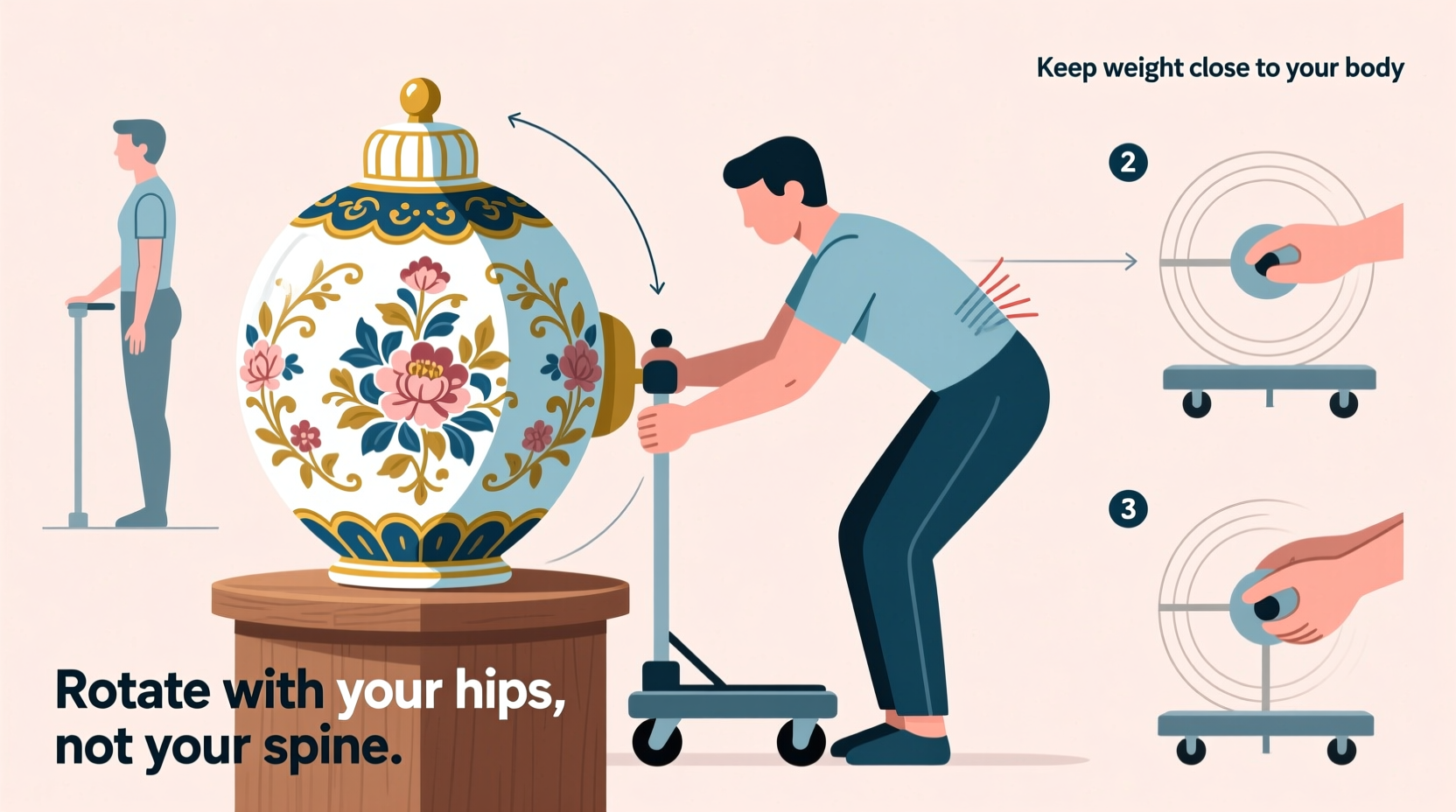
Lower back injury during ornament handling rarely stems from a single heavy lift. It’s almost always the result of cumulative micro-stress: repeated flexion (bending forward), rotation under load, or sustained postural compromise—like hunching over a mantelpiece or reaching across a ladder step. The lumbar spine’s intervertebral discs are especially vulnerable when compressed *and* twisted simultaneously—a motion required when turning a heavy ornament on its hook or adjusting its angle mid-air. A 2022 study in the Journal of Occupational Rehabilitation found that 68% of reported back injuries among seasonal decorators involved rotational movement during object placement—not static lifting alone. Crucially, the same study noted that 91% of those injuries occurred in individuals who had *not* performed targeted core activation before handling objects heavier than 1.5 kg. That’s not anecdotal—it’s physiological. Your transversus abdominis and multifidus muscles act as natural corsets, stabilizing vertebrae during dynamic tasks. Without their pre-engagement, even a 2.2 kg brass star becomes a lever arm stressing L4–L5.
The 5-Step Rotation Protocol: Safe, Controlled, Repeatable
This sequence is designed for rotating ornaments *in situ*—repositioning them on existing hooks, branches, or stands—without full removal, lifting, or carrying. It minimizes spinal load by eliminating unnecessary elevation, lateral reach, and torsion. Practice it slowly first with lighter pieces.
- Assess & Anchor: Stand squarely facing the ornament. Feet hip-width apart, knees slightly bent—not locked. Place one hand flat against a stable surface near the ornament (e.g., mantel edge, shelf bracket, or wall-mounted anchor point). This creates a fixed reference point and prevents accidental trunk rotation.
- Neutral Grip Initiation: With your free hand, grasp the ornament at its *center of mass*—not the top or base. For spherical glass balls, this is the equator. For asymmetrical pieces (e.g., a kneeling angel), locate the visual midpoint between head and base. Use a full-palm grip—not fingertips—to distribute pressure and prevent slippage.
- Micro-Rotation Only: Rotate *only your forearm and wrist*, keeping your upper arm glued to your torso and your spine absolutely vertical. Imagine your elbow is pinned to your ribcage. Turn no more than 15–20 degrees per adjustment. If greater rotation is needed, re-anchor your hand and repeat.
- Weight Redistribution Check: After each micro-turn, pause. Gently shift your weight side-to-side over your feet. Does the ornament feel balanced? Does your lower back remain relaxed—not braced or arched? If not, stop. Reposition your stance or anchoring hand before continuing.
- Final Lock & Release: Once oriented, secure the ornament using its original mounting method (e.g., twist the wire loop snugly, tighten a screw cap, or nest it fully into a socket). Then, release your anchoring hand *last*, maintaining upright posture until both hands are free.
Do’s and Don’ts: A Comparative Guide
| Action | Do | Don’t |
|---|---|---|
| Lifting an ornament off its display | Use a padded tray or shallow wooden box lined with archival tissue. Lift the *entire tray*—not the ornament alone—with elbows bent at 90°, shoulders down, spine neutral. | Bend at the waist while holding the ornament in one hand. Never lift with arms fully extended or twist while holding. |
| Reaching overhead | Use a stable step stool with a handrail. Step *up*, then position yourself directly beneath the ornament before lifting. Keep the piece within the “power zone”: between mid-thigh and shoulder height. | Stretch upward while standing on tiptoes or balancing on unstable furniture. Never reach across your body to grab something above chest level. |
| Storing between seasons | Place ornaments in rigid, compartmentalized boxes (e.g., archival photo storage boxes with fitted inserts). Label orientation (“Top ↑”) and weight class (“Heavy: >1.2 kg”). Store boxes on waist-high shelves—not floor or attic rafters. | Stack loose ornaments in plastic bins or hang them from nails in garage walls. Avoid cardboard boxes without internal support—they collapse under weight and encourage awkward lifting. |
| Using tools | Employ soft-jawed, spring-loaded hemostats for gripping slippery glass or tight wire loops. Use a lightweight, telescoping magnetic wand (with adjustable strength) to retrieve fallen metal ornaments from tight spaces—no crawling required. | Use pliers with metal jaws, duct tape, or rubber bands for grip assistance. These create uneven pressure points and increase risk of breakage or sudden slip. |
A Real-World Scenario: The 1937 Czech Glass Star Collection
Maria, a third-generation collector in Portland, inherited 42 hand-cut Czech glass stars—each 12 cm in diameter, weighing 580–620 g, with intricate silvered interiors. For years, she rotated them manually on her 12-foot fir tree each November, climbing a wobbly aluminum ladder, twisting her torso to adjust angles, and lifting multiple stars at once to “save time.” By age 54, she developed chronic L5-S1 discogenic pain, confirmed by MRI. Her physical therapist identified three root causes: habitual lumbar rotation during placement, lack of pre-lift core engagement, and storing stars in a heavy cardboard box on the basement floor—requiring deep squatting to retrieve. Over eight weeks, Maria implemented the 5-Step Rotation Protocol, switched to a padded tray system, and installed a wall-mounted display rack at optimal height (110 cm from floor). She now rotates all 42 stars in under 45 minutes—without pain, without assistance, and without compromising a single piece. “The biggest shift wasn’t strength,” she notes. “It was learning that precision beats power every time.”
Expert Insight: Movement Science Meets Heritage Conservation
“Museums don’t move heavy artifacts based on ‘how strong you are.’ They move them based on ‘how little torque we can apply to the joints.’ Your lumbar spine is not structurally different from a 19th-century bronze hinge—it degrades fastest under repetitive shear forces. Rotating a 2.5 kg ornament with a 30-degree twist applies nearly 40% more compressive load to the disc than rotating it with a 5-degree twist—even if the weight is identical. Control the arc, not the effort.” — Dr. Lena Torres, PT, DPT, former Senior Conservator at the Winterthur Museum and author of Movement Ethics in Object Stewardship
Essential Prep: Your Pre-Rotation Checklist
- ✅ Clear the immediate workspace of tripping hazards (cords, rugs, pet toys)
- ✅ Wear low-heeled, non-slip footwear (no socks, slippers, or high heels)
- ✅ Hydrate well 30 minutes prior—dehydration reduces disc hydration and shock absorption
- ✅ Perform 2 minutes of dynamic prep: cat-cow stretches, seated pelvic tilts, and gentle glute bridges
- ✅ Identify and test your anchoring points (mantel, shelf bracket, wall mount) for stability *before* handling ornaments
- ✅ Set up your padded tray or compartmentalized box within arm’s reach—never across the room
FAQ: Addressing Common Concerns
What if I need to rotate ornaments on a tall tree or high shelf—and can’t avoid overhead work?
Use a stable, height-adjustable platform—not a ladder. OSHA-certified step stools with handrails and non-slip treads (e.g., Little Giant’s “Flip-N-Lock” series) allow you to work at eye level with minimal reaching. Position the stool so your dominant hand is always within 12 inches of your sternum when grasping the ornament. If the piece requires more than 15 degrees of rotation, lower it to your tray first, rotate it safely at waist height, then reinstall.
Can strengthening exercises really make a difference—or is it just about technique?
Technique is primary—but targeted strength is essential for sustainability. Focus on endurance, not bulk: 3 sets of 20-second dead bugs (lying on back, alternating arm/leg extensions while maintaining lumbar contact), 2× daily; and 3 sets of 30-second farmer’s carries (holding two equal-weight books at your sides, walking slowly with upright posture). These build the specific muscular stamina needed for multi-hour rotation sessions. Avoid sit-ups, toe touches, or heavy squats—they reinforce harmful movement patterns.
My partner insists on “helping” by lifting heavy pieces for me—but they have no back issues. Should I let them?
No—unless they’ve been trained in this exact protocol. Untrained assistance often increases risk: well-meaning helpers instinctively twist, over-grip, or lift with extended arms, creating unpredictable load vectors. Instead, assign them low-risk, high-value tasks: organizing trays, labeling boxes, documenting rotations with photos, or managing lighting. True collaboration means dividing labor by *skill*, not just strength.
Conclusion: Honor the Object, Protect the Body
Vintage ornaments endure because generations chose care over convenience. They survived wars, moves, and decades of changing tastes—not through indestructibility, but because someone paused, assessed, and acted with intention. Your lower back deserves that same reverence. Rotating these pieces isn’t a chore to rush through before the holidays arrive. It’s a ritual of continuity: connecting your hands to craftsmanship from another century, while honoring the physical vessel that makes that connection possible. Every time you anchor your hand before rotating, every time you choose the padded tray over the dangling grip, every time you pause to breathe before lifting—you’re not just preventing injury. You’re practicing embodied respect. Start small: apply the 5-Step Protocol to just three ornaments this season. Notice the difference in your energy, your focus, your comfort. Then expand. Share this method with a fellow collector. Tag a friend who lifts heavy heirlooms without thinking. Because sustainable stewardship isn’t measured in years of display—it’s measured in decades of pain-free, joyful engagement with beauty that lasts longer than we do.




 浙公网安备
33010002000092号
浙公网安备
33010002000092号 浙B2-20120091-4
Comments
No comments yet. Why don't you start the discussion?