
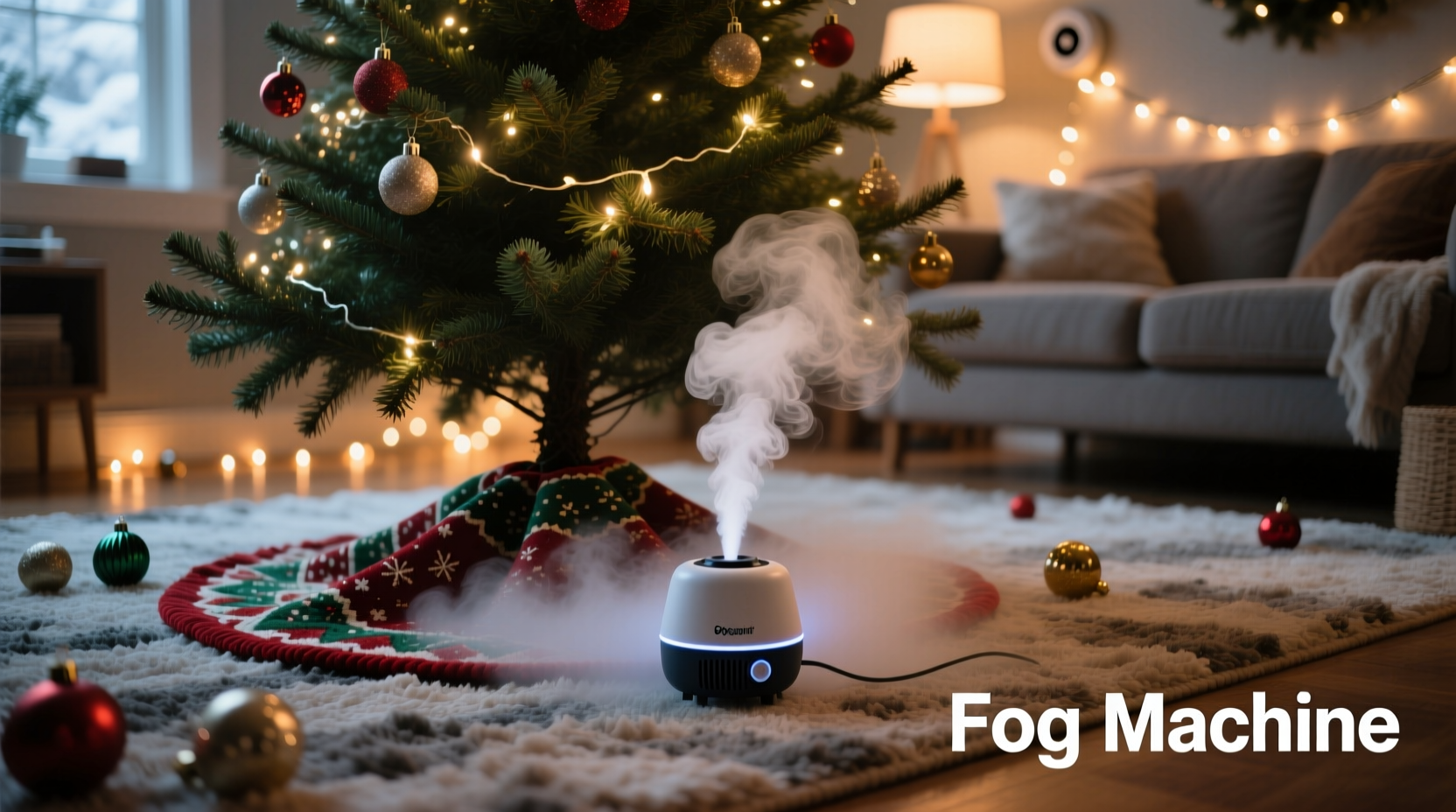
That ethereal, softly swirling mist beneath your Christmas tree—evoking enchanted forests or frost-laced mountain valleys—has become a quietly coveted holiday upgrade. But many enthusiasts abandon the idea after one false alarm: the piercing shriek of a smoke detector mid-celebration, followed by frantic fan-waving and a deflated mood. The truth is not that fog machines are inherently unsafe near trees, but that most attempts fail due to overlooked physics, detector sensitivity types, and installation missteps—not equipment flaws. With thoughtful planning, the right hardware, and deliberate environmental control, you can achieve a captivating, low-lying fog effect that stays precisely where it belongs: nestled in the hush beneath the skirt, never rising toward ceiling-mounted sensors.
Why Smoke Detectors React (and Why It’s Not Always About “Smoke”)
Modern residential smoke detectors fall into two primary categories: photoelectric and ionization. Photoelectric units detect larger particles—like those in smoldering fires—and are highly responsive to visible aerosols, including theatrical fog. Ionization detectors respond faster to smaller, invisible combustion particles but can still activate when dense fog clouds pass through their chambers. Crucially, neither type distinguishes between hazardous smoke and non-toxic glycol-based fog fluid vapor. What triggers them is particle density, dwell time, and airflow direction—not chemical danger.
Fog machines produce an aerosol mist composed of heated glycol-water mixtures (typically propylene glycol or triethylene glycol). When cooled rapidly upon exiting the nozzle, these vapors condense into microscopic droplets—5–10 microns in diameter—dense enough to scatter light and trigger photoelectric sensors if they accumulate in the detection chamber. Most false alarms occur not because the fog is “too much,” but because it’s allowed to rise, pool near ceilings, or linger undisturbed in stagnant air.
Selecting the Right Fog Machine and Fluid
Not all mini fog machines are created equal for this application. Compact units marketed as “party foggers” often prioritize volume over control—producing hot, buoyant plumes that rise instantly. For tree skirt use, prioritize devices engineered for cold, dense, ground-hugging output. Key features to verify:
- Cold fog capability: Look for units with built-in chillers or “low-lying fog” modes (often using dry ice or Peltier cooling). Avoid models that rely solely on heat-induced vaporization without post-cooling.
- Adjustable output duration and interval: You need precise control—e.g., 3-second bursts every 90 seconds—not continuous flow. Models with programmable timers prevent oversaturation.
- Fluid compatibility: Use only manufacturer-recommended, water-based, food-grade propylene glycol fog fluid. Avoid mineral oil– or glycerin-heavy fluids; they leave residue, increase particle size, and linger longer in air.
- Low-noise operation: Units emitting >45 dB can disrupt quiet moments under the tree. Check decibel ratings at 1-meter distance.
Avoid ultrasonic “foggers” sold for reptile tanks or humidifiers. These generate fine water mist—not theatrical fog—and lack the particle density for visual impact. They also introduce excess moisture near electrical tree lights and dry pine needles, increasing fire risk.
Strategic Placement and Environmental Control
The location of your fog machine relative to the tree, skirt, detectors, and room airflow determines success more than any single device spec. Follow these spatial principles:
- Position at floor level, centered under the skirt: Mount the unit directly on the floor—not on a table or box—inside a stable, ventilated enclosure (e.g., a plastic storage bin with 2-inch holes drilled in the *side*, not top). This directs output horizontally, not upward.
- Use directional baffling: Place a small, rigid cardboard or acrylic shield (4” x 6”) angled 30° downward just in front of the nozzle. This deflects initial momentum downward, encouraging immediate settling.
- Maintain minimum clearance from tree base: Keep the fog outlet ≥12 inches from the trunk and any light cords. Heat buildup near wiring—even from low-wattage foggers—can degrade insulation over hours of operation.
- Control ambient temperature: Fog sinks best in cooler air. Run HVAC at 64–68°F (18–20°C) for 30 minutes before activation. Warmer rooms cause rapid buoyancy.
- Neutralize cross-drafts: Close windows, turn off ceiling fans, and avoid placing the tree near HVAC vents or doorways. Even subtle air movement lifts fog.
Crucially: never place the fogger *inside* the skirt fabric unless the material is fully breathable (e.g., burlap or open-weave linen). Polyester or vinyl skirts trap fog, creating localized high-density pockets that easily breach upward. Instead, position the unit *under* the skirt’s edge, allowing fog to seep outward and settle naturally across the floor.
Safety-First Testing Protocol (Before Guests Arrive)
Assume no detector is immune—even “hush” or “interconnected” models may activate if fog concentration exceeds design thresholds. A rigorous pre-event test isn’t optional; it’s your only reliable safeguard. Follow this 7-step verification process:
- Ensure all smoke detectors are within manufacturer-recommended replacement window (typically 10 years).
- Confirm battery levels (replace if <1 year old or showing low-battery chirps).
- Disable any smart-home integrations that auto-alert phones or security systems during testing.
- Run the fog machine at its *lowest* output setting for 60 seconds. Wait 5 minutes. Observe: no alarm? Proceed.
- Increase to medium output for 90 seconds. Wait 5 minutes. Still silent? Continue.
- At full output, run three 5-second bursts spaced 2 minutes apart. Monitor detectors continuously for 15 minutes post-final burst.
- If *any* alarm sounds, stop immediately. Identify the culprit detector, note its model number, and consult its manual for “aerosol immunity” specs. Many units list acceptable fog concentration limits (e.g., “safe up to 0.5% obscuration per meter”).
This protocol mimics real-world usage while isolating variables. Skipping step 7—or relying on “it didn’t go off last year”—ignores detector drift, seasonal humidity shifts, and cumulative dust buildup inside sensor chambers, all of which lower activation thresholds.
Do’s and Don’ts: A Critical Safety Table
| Action | Do | Don’t |
|---|---|---|
| Fog Fluid | Use only UL-listed, water-based propylene glycol fluid labeled “low toxicity” and “indoor-safe.” | Mix DIY fluids, reuse expired fluid, or substitute essential oils or rubbing alcohol. |
| Tree Proximity | Keep fog outlet ≥12 inches from trunk, lights, and skirt seams. Use flame-retardant skirt fabric. | Place fogger inside skirt folds, against light cords, or within 6 inches of dry pine branches. |
| Detector Management | Test detectors monthly. Replace units older than 10 years. Consider photoelectric-only models (less fog-sensitive) in living areas. | Cover detectors with tape, remove batteries, or disable interconnected alarms—even temporarily. |
| Operation Time | Limit total daily runtime to ≤2 hours. Use timer-controlled bursts (max 5 sec/burst). | Run continuously overnight or during unattended periods (e.g., while sleeping). |
| Post-Use | Wipe nozzle and reservoir with distilled water after each use. Store fluid in cool, dark place. | Leave fluid in tank between uses or store machine near heat sources (radiators, fireplaces). |
Real-World Example: The Henderson Family’s Two-Year Success
The Hendersons in Portland, Oregon, lost their first holiday party to a cascading alarm event: a $40 fogger, set atop a gift box under a polyester skirt, flooded their open-concept living room with warm fog. All four interconnected detectors screamed—waking toddlers, alarming neighbors, and shutting down their smart-home system. Undeterred, they consulted their local fire department’s non-emergency line. Fire Marshal Lena Ruiz reviewed their setup and recommended three changes: switching to a chiller-equipped cold-fog unit, installing a breathable jute skirt, and relocating the machine inside a ventilated bin placed flush against the baseboard (away from the tree’s center mass). They also added a standalone photoelectric detector in the hallway—outside the main fog zone—as a dedicated “control sensor.” For two consecutive seasons, their tree has exhaled soft, slow-drifting mist from dusk until midnight, with zero alarms. “It’s not magic,” Ruiz told them. “It’s physics, patience, and respecting the detector’s job.”
“Detectors are designed to save lives—not spoil parties. When fog sets them off, it’s rarely a flaw in the device. It’s a signal that aerosol concentration exceeded safe thresholds in the breathing zone. Treat that as diagnostic data, not a nuisance.” — Fire Marshal Lena Ruiz, Portland Bureau of Emergency Management
Frequently Asked Questions
Can I use dry ice instead of a fog machine?
Dry ice produces true low-lying fog (CO₂ gas + condensed water vapor) and avoids glycol residues—but introduces serious risks. CO₂ displaces oxygen in confined spaces; even brief exposure near a seated child or pet can cause dizziness or shortness of breath. Dry ice also requires insulated handling gloves and cannot be sealed under skirts (pressure buildup risk). For home use, certified cold-fog machines are safer, more controllable, and code-compliant.
Will my “smart” detector learn to ignore fog over time?
No. AI-powered detectors do not “learn” household patterns for aerosol events. Their algorithms filter transient interference (like steam from showers), but theatrical fog’s particle density and spectral signature mimic real smoke too closely. Relying on “machine learning immunity” is dangerously misleading. Physical mitigation—placement, timing, and ventilation—is the only proven method.
Is fog fluid toxic to pets or children if inhaled briefly?
Propylene glycol fog fluid is classified as GRAS (“Generally Recognized As Safe”) by the FDA for food contact and inhalation at theatrical concentrations. However, prolonged exposure (>2 hours) in poorly ventilated spaces may irritate airways in sensitive individuals (asthmatics, infants, elderly). Always operate in well-ventilated rooms and limit session length. Never allow direct inhalation from the nozzle.
Conclusion: Elevate Your Holiday Magic—Responsibly
A perfectly executed fog effect under your tree skirt does more than impress guests—it transforms the space into a moment of tangible wonder. That gentle, slow-rising mist doesn’t just look magical; it signals care, attention to detail, and deep respect for the safety systems that protect your home. You don’t need to choose between atmosphere and assurance. With the right equipment, precise placement, disciplined testing, and adherence to fundamental airflow principles, you can create a signature holiday experience that’s both breathtaking and beyond reproach. Start now: check your detector ages, measure your tree’s clearance, select a cold-fog unit, and run your first timed test this weekend. Your future self—calmly sipping cocoa while mist curls silently around the trunk—will thank you.




 浙公网安备
33010002000092号
浙公网安备
33010002000092号 浙B2-20120091-4
Comments
No comments yet. Why don't you start the discussion?