
Every holiday season, homes come alive with the warm glow of Christmas lights. But few things disrupt the festive mood faster than a sudden blackout caused by a tripped circuit breaker. While it’s tempting to drape every roofline, tree, and shrub in twinkling strings, overloading circuits is both dangerous and inconvenient. The good news: with proper planning and electrical awareness, you can create a dazzling display that stays lit—without taxing your home’s power system.
Tripped breakers occur when too much current flows through a circuit, triggering the safety mechanism designed to prevent overheating and fire. Outdoor lighting setups are especially prone to this issue because people often plug multiple strands into one outlet or power strip, unaware of cumulative wattage. This guide walks through the science behind circuit loads, practical wiring strategies, and real-world techniques used by professional decorators—all aimed at helping you enjoy a bright, safe, and uninterrupted holiday light show.
Understanding Your Home’s Electrical Capacity
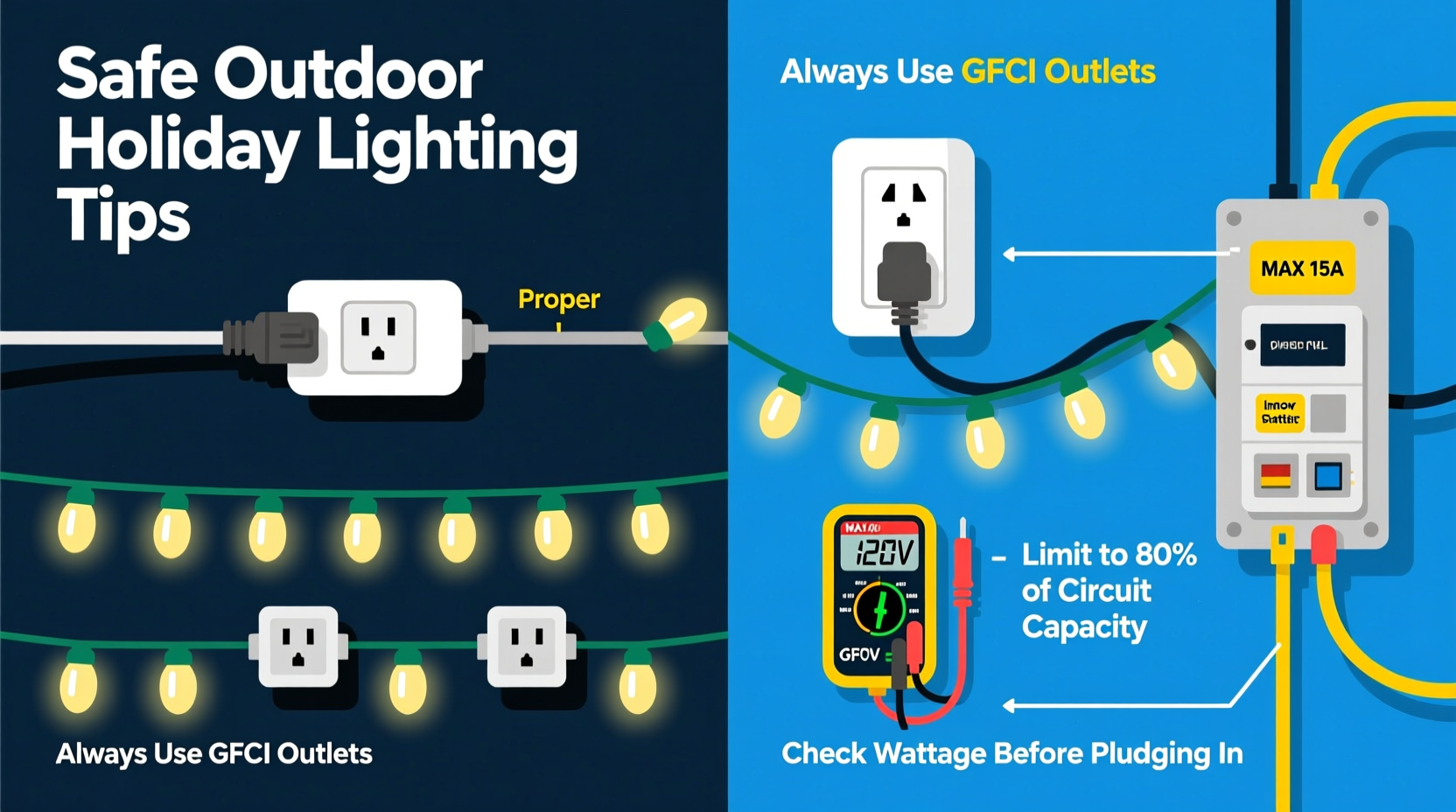
To avoid tripping breakers, start by understanding how electricity works in your home. Most residential circuits in North America operate on 15 or 20 amps at 120 volts. A simple formula determines how much power each circuit can handle:
Wattage = Volts × Amps
For a standard 15-amp circuit: 120V × 15A = 1,800 watts maximum capacity
However, electrical codes recommend using only 80% of a circuit’s capacity for continuous loads (those running three hours or more)—which includes holiday lights. That means your safe operating limit is:
1,800 × 0.8 = 1,440 watts per 15-amp circuit
A 20-amp circuit allows up to 1,920 watts (with an 80% safe load of 1,536 watts). Knowing these numbers is essential before connecting even a single strand of lights.
Calculate Total Light Load Before You Plug In
Not all Christmas lights consume the same amount of energy. The key to staying within limits is calculating the total wattage of your planned setup. Start by checking the specifications of your light strands—usually printed on the packaging or molded into the wire.
Here’s a quick reference table showing average wattage for common types of outdoor Christmas lights:
| Light Type | Wattage per Strand (Avg) | Lights per Strand | Max Strands Daisy-Chained |
|---|---|---|---|
| Mini Incandescent (Traditional) | 40–48 watts | 50–100 | 3–4 |
| LED Mini Lights | 4–7 watts | 50–100 | 20–25 |
| C7 Incandescent | 5–7 watts per bulb | 25 bulbs = ~125–175 watts | 1–2 max |
| C9 Incandescent | 7–10 watts per bulb | 25 bulbs = ~175–250 watts | 1 max |
| C9 LED | 0.5–1 watt per bulb | 25 bulbs = ~12–25 watts | 10–12 |
For example, if you’re using five strands of traditional mini incandescent lights (48 watts each), your total draw is 240 watts—well under the 1,440-watt threshold. But add a set of C7 lights (150 watts) and two larger inflatables (each drawing 200 watts), and you're already at 690 watts. That may still be safe—but only if nothing else shares the circuit.
“Most homeowners don’t realize that porch lights, garage outlets, and even indoor lamps can share a circuit with outdoor receptacles. Always map out what’s connected before adding decorative lighting.” — Daniel Reeves, Licensed Electrician & Holiday Lighting Contractor
Step-by-Step Guide to Safe Light Installation
Follow this proven sequence to install outdoor Christmas lights safely and efficiently, minimizing strain on your electrical system.
- Map Your Circuits: Use a circuit tester to identify which outdoor outlets are on the same breaker. Turn off the breaker and check which outlets lose power. Label them accordingly.
- Choose LED Lights Whenever Possible: LEDs use up to 90% less energy than incandescent bulbs and generate far less heat, reducing fire risk and allowing longer runs.
- Distribute Loads Across Multiple Circuits: Don’t plug everything into one outdoor outlet. Spread your displays across different circuits to balance the load.
- Use Heavy-Duty Extension Cords Rated for Outdoor Use: Look for cords labeled “SJTW” or “W-A” and ensure they’re grounded (three-prong). Avoid daisy-chaining extension cords.
- Plug Into GFCI-Protected Outlets: Ground Fault Circuit Interrupter (GFCI) outlets shut off power instantly if they detect current leakage—critical for outdoor safety, especially in wet conditions.
- Power Large Displays Through Timers or Smart Plugs: Use programmable timers to run lights only during evening hours (e.g., 5 PM to 11 PM). This reduces runtime and heat buildup.
- Test One Section at a Time: After connecting each segment, turn on the power and monitor the breaker. If it trips immediately, disconnect and reassess the load.
Real Example: How a Family Avoided Constant Breaker Trips
The Thompson family in suburban Chicago loved going all-out for Christmas. Their home featured roofline lights, lit reindeer, a motorized sleigh, two inflatable snow globes, and a giant illuminated tree in the front yard. Each year, their display grew—but so did the frustration of frequent power outages.
In 2022, they experienced nightly breaker trips around 7:30 PM. After calling an electrician, they discovered that all their outdoor decorations were running off a single 15-amp circuit that also powered their garage door opener and motion-sensor lights. The combined load exceeded 1,900 watts—far above the 1,440-watt safe limit.
The solution? The electrician installed a new 20-amp dedicated circuit for outdoor holiday use, relocated some lights to existing interior circuits (via attic access), and replaced all incandescent strings with LED equivalents. They also added smart plugs to stagger startup times—preventing surge overload when everything turned on simultaneously.
Result: A brighter, safer display that stayed on all night, every night, without a single trip.
Do’s and Don’ts of Outdoor Light Wiring
Even small mistakes can lead to big problems. Refer to this checklist to stay safe and efficient.
| Do | Don't |
|---|---|
| Use LED lights to reduce wattage and heat | Use indoor-rated lights outdoors |
| Check manufacturer ratings for max daisy-chaining | Daisy-chain more than recommended strands |
| Plug into GFCI outlets or use GFCI extension cords | Bypass grounding pins or use two-prong adapters |
| Inspect cords for cracks or fraying before use | Run cords under snow, ice, or heavy foot traffic |
| Use conduit or cord covers on walkways | Overload power strips or multi-plug adapters |
Essential Checklist for a Breaker-Safe Display
Before turning on your lights, go through this final checklist:
- ☑ All light strands are rated for outdoor use
- ☑ Total wattage per circuit is below 80% capacity
- ☑ Extension cords are outdoor-rated and properly grounded
- ☑ GFCI protection is active on all outdoor circuits
- ☑ No daisy-chaining beyond manufacturer limits
- ☑ Timers or smart plugs are set to control runtime
- ☑ Cords are elevated or covered where pedestrians walk
- ☑ Spare fuses or reset procedure is known in case of trip
Frequently Asked Questions
Can I use multiple power strips for my Christmas lights?
You can, but only if they’re plugged into outlets on separate circuits. Never plug multiple high-draw strips into the same outlet or daisy-chain power strips together—they aren’t designed for that and can overheat quickly.
Why do my lights work fine for hours and then trip the breaker?
This often happens with older incandescent lights that generate heat over time. As the temperature rises, resistance changes and current draw increases slightly. Combined with continuous load, this thermal creep can push the circuit past its limit after several hours. Switching to cooler-running LEDs usually resolves this issue.
Is it safe to leave Christmas lights on overnight?
If installed correctly—with proper wattage management, GFCI protection, and weatherproof connections—it is generally safe to leave LED Christmas lights on overnight. However, using a timer to turn them off after midnight reduces fire risk, energy use, and light pollution. Never leave damaged cords or malfunctioning lights unattended.
Final Tips from Seasoned Decorators
Professional installers have seen every mistake—and mastered the solutions. Here are a few advanced strategies worth adopting:
- Stagger Startup Times: Use smart plugs to turn on different sections of your display a few minutes apart. This prevents a massive inrush current when dozens of lights activate simultaneously.
- Upgrade to Dedicated Circuits: If you decorate heavily every year, consider having an electrician install a dedicated outdoor circuit. It pays for itself in reliability and peace of mind.
- Monitor with Smart Panels: Devices like the Emporia Vue or Square D Energy Monitor let you track real-time power usage per circuit. You’ll see exactly how much your lights are drawing—and get alerts if something’s amiss.
- Unplug During Storms: Even with GFCI protection, lightning and heavy rain increase electrical risks. Unplug non-essential lights during severe weather.
“The most beautiful displays aren’t the brightest—they’re the ones that stay on. Safety isn’t limiting creativity; it’s enabling it.” — Maria Lopez, Founder of Evergreen Holiday Lighting Co.
Conclusion: Shine Bright, Stay Safe
A stunning Christmas light display doesn’t have to come at the cost of electrical safety or constant breaker resets. By understanding your home’s limits, choosing efficient lighting, and distributing loads wisely, you can create a memorable holiday showcase that runs smoothly from December 1st to New Year’s Eve.
Start planning early, calculate your wattage, and test your setup before the big reveal. Whether you’re draping a single evergreen or transforming your entire property into a winter wonderland, smart electrical practices ensure your lights stay on—where they belong.




 浙公网安备
33010002000092号
浙公网安备
33010002000092号 浙B2-20120091-4
Comments
No comments yet. Why don't you start the discussion?