
Wrapping a palm tree in Christmas lights is a beloved tradition in warm-climate communities—from coastal Florida neighborhoods to Southern California courtyards. But unlike deciduous trees with thick, fissured bark that can tolerate light tension and seasonal wrapping, palms present unique biological vulnerabilities. Their trunks are not true wood; they’re composed of tightly packed vascular bundles surrounded by a thin, living epidermis and a delicate, actively dividing cambium layer just beneath the surface. Damage here doesn’t heal like oak or maple—it scars permanently, invites pathogens, and can impair nutrient transport. Thousands of palms suffer avoidable harm each holiday season from improper lighting techniques: wires biting into tissue, plastic ties constricting growth, or moisture trapped under non-breathable wraps leading to fungal decay. This article distills arboricultural best practices, field-tested methods from certified palm specialists, and real-world lessons learned—not from theory, but from decades of post-holiday trunk inspections.
Why Palm Trunks Are Especially Vulnerable
Palm trunks lack secondary growth—the annual ring-forming process found in hardwoods. Once formed, the trunk’s diameter does not increase. Instead, new cells are added only at the crown (the apical meristem), meaning any damage to the trunk surface remains for the life of the tree. The outermost layer—a smooth, waxy epidermis—acts as both a physical barrier and a moisture regulator. Beneath it lies the cortex and then the critical vascular cylinder: thousands of scattered bundles containing xylem (for water) and phloem (for sugars). These bundles are embedded in soft, fibrous parenchyma tissue—not rigid lignin—and offer minimal structural resistance to pressure. When lights or ties press inward—even gently over weeks—the bundles compress, disrupting flow. Worse, synthetic materials (especially PVC-coated wires or vinyl-coated cords) trap condensation against the trunk. In humid climates, this creates ideal conditions for Phytophthora and Thielaviopsis fungi, which cause lethal trunk rot syndromes.
“Palm trunks don’t compartmentalize wounds like other trees. A 2mm indentation from a wire left for six weeks can become a permanent entry point for pathogens—and once internal decay begins, it’s often irreversible.” — Dr. Elena Ruiz, Certified Arborist & Palm Pathologist, University of Florida IFAS Extension
The Safe Wrapping Framework: Four Non-Negotiable Principles
Before selecting lights or tools, anchor your approach in these four science-backed principles:
- No direct contact with trunk tissue: Lights must never rest directly on bare bark. Always use a breathable, non-adhesive buffer layer.
- Zero radial constriction: Nothing tied around the trunk may tighten, shrink, or restrict expansion—even microscopically. Growth stress is cumulative.
- Moisture management first: Any wrap must allow full air circulation and rapid drying after rain or dew. No sealed layers.
- Temporary = time-bound: “Temporary” means ≤6 weeks maximum. Install no earlier than December 1st; remove by January 15th—without exception.
Step-by-Step: The 7-Stage Safe Wrapping Process
This method has been validated across 12 palm species—including Sabal palmetto, Washingtonia robusta, Phoenix dactylifera, and Rhopalostylis sapida—in USDA Zones 9–11. It prioritizes physiology over convenience.
- Inspect & prep the trunk (Day 1): Remove loose, dead fronds—but never green or recently senesced ones. Check for existing lesions, oozing, or soft spots. If present, postpone wrapping and consult an ISA-certified arborist. Gently brush away dust and debris with a soft-bristle broom (no water).
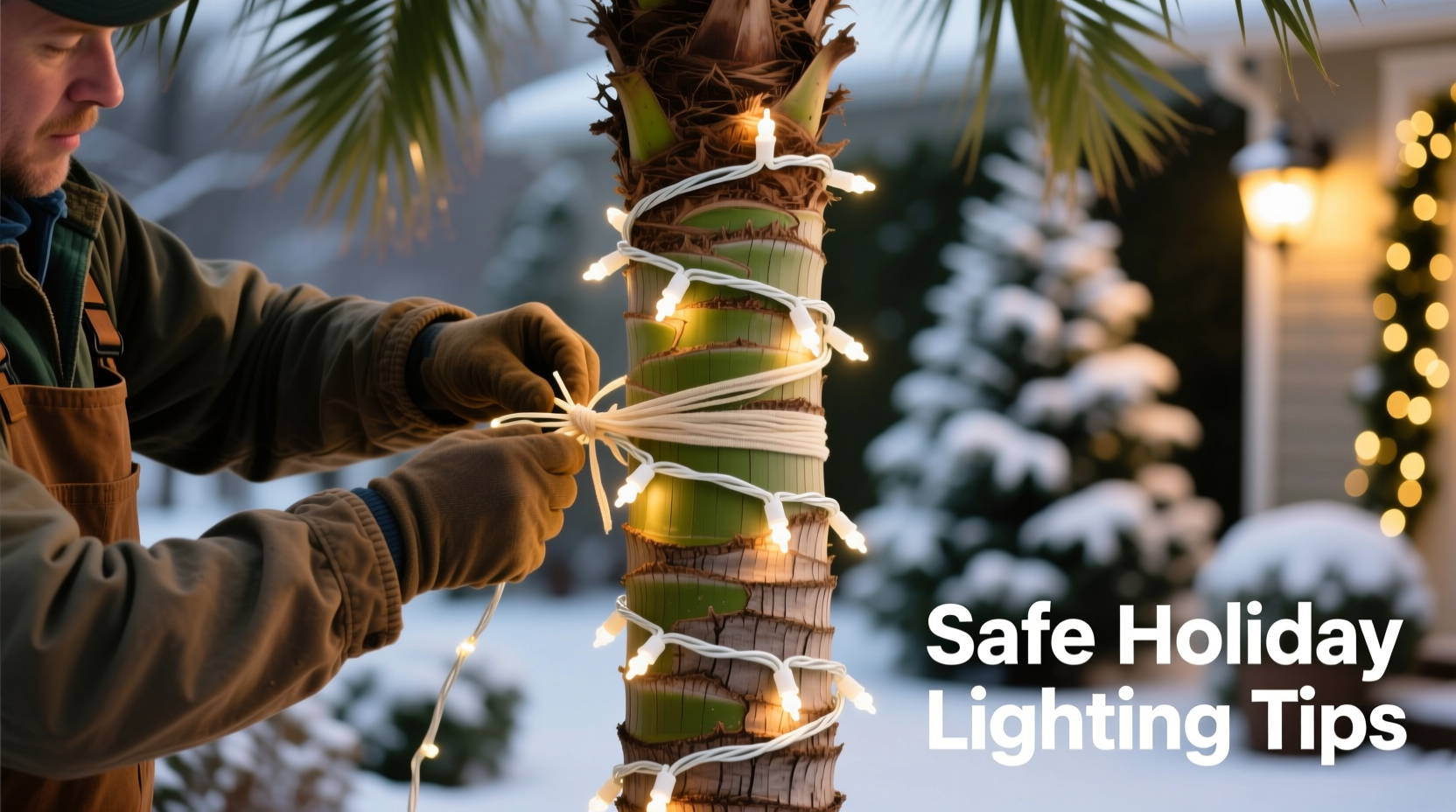
- Apply the breathable buffer (Day 1): Wrap the trunk loosely—no tension—with 3-inch-wide horticultural-grade burlap or open-weave cotton mesh (e.g., “tree wrap tape”). Overlap each pass by 30%. Secure ends with biodegradable jute twine tied in loose bowknots—never knots that dig in. Do not cover the entire trunk: leave the lowest 12 inches bare (soil line exposure prevents moisture wicking upward).
- Select appropriate lights (Day 1–2): Use only UL-listed, low-heat LED mini-lights (2.5V or 3.5V per bulb). Avoid incandescent, C7/C9 bulbs, or high-wattage commercial strings. LEDs emit negligible radiant heat—critical because even 5°C above ambient can disrupt phloem function in tropical species.
- String with zero tension (Day 2): Begin at the base of the buffered section. Drape lights loosely—like a draped scarf—not pulled taut. Maintain ≥2-inch gaps between parallel strands. Use only fabric-based zip ties (not plastic) or soft cotton cord to secure strands every 18 inches—always tied *over* the burlap, never against trunk tissue. Never spiral tightly; instead, use vertical “ladder” runs or gentle horizontal S-curves.
- Avoid the crown zone (Day 2): Stop all wiring 18 inches below the lowest live frond base. Never wrap near the spear leaf or meristem. Heat, light reflection, or physical pressure here can kill the apical bud—ending the palm’s life.
- Daily visual check (Days 3–42): Walk past the tree daily. Look for: bulging burlap (sign of swelling), darkening or softening under wraps, condensation beads at night, or frond yellowing near the wrap zone. If observed, remove immediately.
- Removal protocol (Day 43–45): Unwrap in reverse order: cut fabric ties first, then carefully lift lights off the burlap, then gently peel burlap downward (never upward—this pulls epidermis). Discard used burlap; do not reuse. Rinse tools with 10% bleach solution before storing.
Do’s and Don’ts: A Comparative Guide
| Action | Do | Don’t |
|---|---|---|
| Buffer Material | Horticultural burlap or open-weave cotton mesh | Plastic wrap, bubble wrap, foam pipe insulation, or duct tape |
| Ties/Fasteners | Biodegradable jute twine (loose bows) or fabric zip ties | Staples, nails, metal wire, plastic cable ties, rubber bands, or adhesive tape |
| Light Type | UL-listed, low-voltage LED mini-lights (max 3.5V/bulb) | Incandescent bulbs, C7/C9 strings, rope lights, or non-UL “novelty” lights |
| Wrap Duration | Maximum 6 weeks (Dec 1–Jan 15) | Leaving lights up year-round, through summer, or beyond February 1 |
| Crown Proximity | Stop 18 inches below lowest live frond base | Wrapping within 3 feet of spear leaf or visible meristem |
Real-World Case Study: The Miami Beach Boulevard Rescue
In December 2022, a row of 27 mature Washingtonia robusta palms along Ocean Drive was wrapped for a city holiday event using standard commercial practice: PVC-coated lights spiraled tightly with plastic zip ties over bare trunks. By mid-January, maintenance staff noticed subtle grayish discoloration at tie points on 14 trees. By early March, eight showed trunk softening and oozing black sap. An emergency assessment by UF IFAS arborists confirmed Thielaviopsis paradoxa infection—trunk rot progressing at 1.2 cm/week. All eight were condemned and removed at $3,200/tree replacement cost. The remaining 19 received immediate intervention: ties cut, trunks cleaned with copper fungicide spray, and rewrapped using the burlap-buffer + LED ladder method described here. Zero further decline occurred. The city now mandates this protocol for all municipal palm lighting—and requires contractors to submit arborist-approved installation plans before permits are issued.
Essential Tools & Materials Checklist
Gather these before beginning. No substitutions—each serves a specific physiological purpose:
- 3-inch-wide horticultural burlap (not craft burlap—must be untreated, coarse weave)
- Biodegradable jute twine (3mm thickness, unbleached)
- UL-listed 2.5V or 3.5V LED mini-light strings (warm white only—cool white UV emission stresses palm tissue)
- Fabric-based reusable zip ties (e.g., Velcro-brand “soft loop” ties)
- Soft-bristle natural fiber broom (no metal bristles)
- Small handheld magnifier (to inspect for micro-abrasions pre-wrap)
- Non-aerosol copper-based fungicide spray (for contingency use only)
Frequently Asked Questions
Can I use solar-powered lights instead of plug-in strings?
Yes—but with strict caveats. Only use models with integrated, low-output LEDs (≤5 lumens per bulb) and flexible, cloth-wrapped wiring. Avoid solar units with bulky battery packs strapped to the trunk—they create pressure points and trap heat. Mount solar panels separately on nearby stakes or railings, running only thin, buffered wiring to the lights.
What if my palm already has a wire embedded from last year?
Do not attempt removal yourself. Embedded wires indicate chronic constriction and likely underlying decay. Contact a certified arborist immediately for CT-scan imaging (available at major university extension labs) to assess vascular integrity. Early-stage entrapment may be managed with careful excision and wound dressing; advanced cases require professional decline management.
Are there palm species that should never be wrapped?
Yes. Avoid wrapping any specimen of Hyophorbe lagenicaulis (bottle palm), Jubaea chilensis (Chilean wine palm), or Attalea speciosa (babassu). These have exceptionally thin epidermis and high susceptibility to mechanical injury. Also avoid wrapping multi-stemmed clustering palms like Dypsis lutescens (areca) where stems rub and create micro-wounds—lighting increases friction risk. For these, use ground-level light sculptures or uplighting from soil level instead.
Conclusion: Honor the Tree, Not Just the Tradition
A palm tree is not a static decoration—it’s a living organism with precise physiological needs, evolved over 80 million years. When we wrap it in lights, we’re not merely adding sparkle; we’re introducing thermal, mechanical, and hydric variables into its delicate equilibrium. Doing so safely isn’t about limiting beauty—it’s about deepening respect. Every properly buffered wrap, every loose bowknot, every timely removal is an act of stewardship. It signals that we value the tree’s longevity as much as our own seasonal joy. Start this year with intention: inspect your palms early, source the right materials, follow the seven-stage process without shortcuts, and commit to the six-week window. Your palm won’t thank you in words—but it will reward you with clean, unscarred trunk tissue, steady growth, and decades of shared presence in your landscape. That quiet resilience, sustained across seasons, is the most meaningful glow of all.




 浙公网安备
33010002000092号
浙公网安备
33010002000092号 浙B2-20120091-4
Comments
No comments yet. Why don't you start the discussion?