
For players immersed in the nostalgic charm and emotional storytelling of Summer Clover, preserving game progress is essential. Whether navigating heartfelt character arcs or uncovering seasonal secrets, losing hard-earned playtime due to mismanaged saves can be frustrating. Unlike mainstream titles with cloud integration, Summer Clover—a visual novel developed using the Ren'Py engine—relies on local file handling for save data. Understanding how to properly save, locate, back up, and transfer these files empowers players to protect their journey through the game’s delicate narrative landscape. This guide provides a comprehensive breakdown of saving mechanics, file structure, and management strategies tailored specifically to Summer Clover, ensuring seamless continuity whether switching devices, reinstalling the game, or safeguarding against data loss.
Definition & Overview
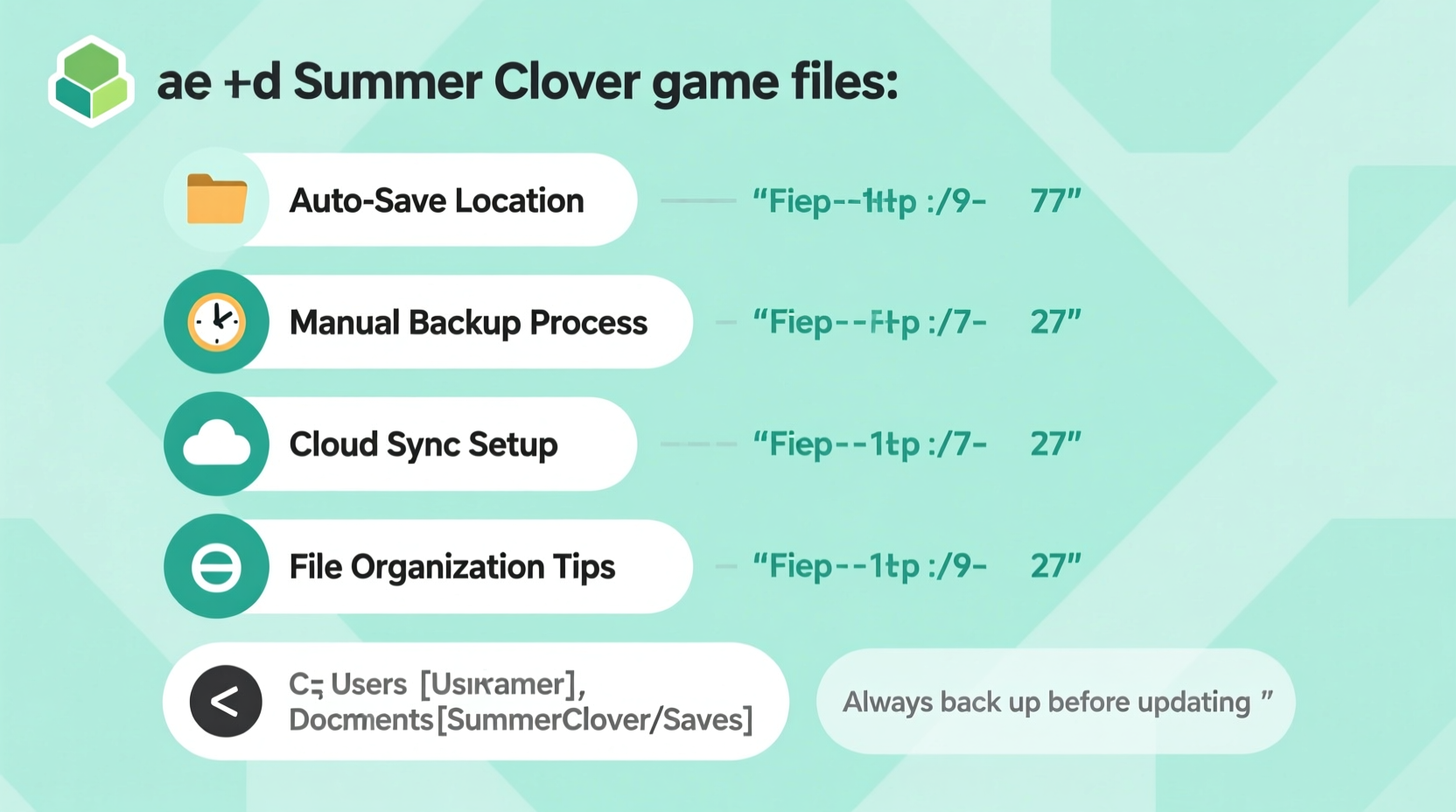
Summer Clover is a free indie visual novel created with the Ren'Py visual novel engine, known for its emotionally resonant storytelling, hand-drawn art, and branching narrative paths. As a story-driven experience, player choices significantly impact outcomes, making save management not just convenient but critical to enjoying multiple endings and replayability. The game does not natively support cloud synchronization through platforms like Steam Cloud or Google Drive unless manually configured by the user. Instead, all save data is stored locally in structured directories on the host device, following Ren'Py’s standardized approach to persistent game state storage.
The term “game files” in this context refers primarily to save files—serialized snapshots of gameplay progress—but also includes configuration settings, preferences, and log metadata generated during runtime. These files are typically small in size but vital in function. Because Summer Clover lacks built-in backup or export features, users must proactively manage these assets using system-level tools and best practices from digital preservation.
Key Characteristics of Summer Clover Game Files
- File Type: Binary and text-based files (e.g., .rpyc, .json, .dat)
- Storage Format: Platform-specific local directories (user data folders)
- Size: Typically under 1 MB per save; full profile rarely exceeds 5 MB
- Persistence: Saved manually via in-game menu or auto-saved at key decision points
- Cryptographic Protection: Minimal encryption; largely readable with proper tools
- Portability: High—files can be copied between machines if directory structure is preserved
- Vulnerability: Susceptible to deletion during uninstallation or OS cleanup processes
Tip: Always verify that your operating system is set to show hidden files and file extensions when managing game data. Many save folders reside in hidden AppData or Library paths.
Practical Usage: How to Save and Access Your Progress
Saving within Summer Clover follows standard Ren'Py conventions. During gameplay, players access the main menu by right-clicking or pressing ESC, then selecting \"Save.\" Each slot records the current scene, variables, choices made, and timestamp. Auto-save functionality may exist depending on version, usually triggered before major transitions such as chapter shifts or irreversible decisions.
To ensure reliability, adopt a disciplined saving strategy:
- Create descriptive labels: Use custom names for save slots (e.g., “Before Confession – Route A”) rather than relying on default timestamps.
- Use multiple manual saves: Avoid overwriting early progress. Maintain separate branches for different romantic routes or endings.
- Leverage quick saves wisely: While convenient, quick saves are often temporary and may not persist after closing the game unless explicitly supported.
Accessing saved games occurs through the same menu interface. Upon loading, the engine deserializes the selected file, restoring dialogue position, variable states, and unlocked content. However, issues may arise if files become corrupted or moved outside expected directories.
Finding Your Save Files on Different Operating Systems
The physical location of Summer Clover save files depends on the OS and installation method. Below are common paths:
| Operating System | Default Save Path |
|---|---|
| Windows | C:\\Users\\[USERNAME]\\AppData\\Roaming\\RenPy\\summer_clover\\save\\ |
| macOS | /Users/[USERNAME]/Library/Application Support/RenPy/summer_clover/save/ |
| Linux | /home/[USERNAME]/.renpy/summer_clover/save/ |
Note: [USERNAME] corresponds to your system login name. On Windows, AppData is a hidden folder—enable viewing of hidden items in File Explorer. On macOS, press Command+Shift+G in Finder and paste the path directly.
Variants & Types of Game Files
Beyond basic save files (.sav), several types of data are generated during gameplay. Understanding each helps in organizing and troubleshooting:
- Save Files (.sav): Main progress snapshots, named numerically or by label. Contain serialized Python objects representing game state.
- Persistent Data (persistent.pkl): Stores global flags, completion metrics, and cumulative stats across sessions.
- Preferences (options.rpyb): Holds audio levels, text speed, display settings, and input configurations.
- Log Files (log.txt): Debug output useful for developers or diagnosing crashes.
- Cache Files: Temporary assets loaded into memory; safe to delete but may slow initial load times.
These files collectively form a “profile,” typically contained within a single subdirectory under the main RenPy data folder. When backing up, it's recommended to copy the entire summer_clover subfolder rather than individual files to preserve interdependencies.
When to Use Each File Type
- .sav files: For restoring gameplay at specific moments. Ideal for sharing walkthroughs or testing alternate choices.
- persistent.pkl: Crucial for tracking 100% completion. Deleting it resets achievements without affecting immediate progress.
- options.rpyb: Useful when transferring personal settings to another machine or resetting audio/video options en masse.
Pro Tip: Rename important save files with meaningful prefixes (e.g., “ENDING_E_SunnyRoute.sav”) to avoid confusion during restoration.
Comparison with Similar Games Using Ren'Py
Many visual novels use the Ren'Py engine, including popular titles like Doki Doki Literature Club, Long Live the Queen, and Analogue: A Hate Story. While they share underlying architecture, file management varies slightly based on developer implementation.
| Game Title | Cloud Sync? | Save Location Standardization | User-Friendly Export Tool? |
|---|---|---|---|
| Summer Clover | No | Yes (standard RenPy path) | No |
| Doki Doki Literature Club | Limited (Steam Cloud if purchased) | Yes | No |
| Butterfly Soup | No | Yes | No |
| Conducttr Games (web-based) | Yes (browser-local) | No (browser storage) | Sometimes |
Unlike commercial releases on Steam or Itch.io with optional cloud sync, Summer Clover operates entirely offline and locally. This increases control but demands greater responsibility from the user. Compared to web-based counterparts that store saves in browser IndexedDB, desktop versions offer superior portability when managed correctly.
\"In narrative-heavy games where choice matters, save files aren't just data—they're artifacts of personal journeys. Preserving them should be as intuitive as journaling.\"
—Alex Rivera, Indie Game Archivist & Digital Preservation Specialist
Practical Tips & FAQs
How do I back up my Summer Clover saves?
Navigate to the save directory listed above, then copy the entire save folder to an external drive, cloud storage (Google Drive, Dropbox), or compressed archive (.zip). Label the backup with the date and version (e.g., “SummerClover_Save_Backup_2024-07-15”).
Can I share my save files with friends?
Yes. Send the relevant .sav files along with instructions to place them in the correct save folder. Note that incompatible game versions may cause errors upon loading.
What happens if I reinstall the game?
Reinstallation typically does not remove existing save data, as it resides in user application directories, not program files. However, if you delete the entire RenPy folder or perform a clean install, saves will be lost unless previously backed up.
Why won’t my save file load?
Common causes include:
- Version mismatch between game and save
- Corrupted file due to improper shutdown
- Incorrect placement in directory tree
- Missing dependencies (e.g., deleted persistent.pkl)
Solution: Try launching the game from the same version used when the save was created. Restore from backup if necessary.
Is there a way to automate backups?
Affirmative. Use built-in OS tools:
- Windows: Create a batch script and schedule it via Task Scheduler.
- macOS: Use Automator or cron jobs to sync the folder weekly.
- Linux: Write a shell script with rsync and add to crontab.
Example script (Windows):
xcopy \"%APPDATA%\\RenPy\\summer_clover\\save\" \"D:\\Backups\\SummerClover\\save\" /E /H /Y
Can I play my saved game on another computer?
Yes. Install Summer Clover on the target machine, launch it once to generate the required directory structure, then replace the newly created save folder with your own. Ensure both systems run the same version of the game.
Do save files contain spoilers?
Indirectly. Filenames and timestamps can reveal progression milestones (e.g., “Chapter4_Breakup.sav”). Be cautious when sharing publicly.
How many saves can I keep?
Technically limited only by disk space. Most players maintain 10–20 slots for different routes. Organize them using consistent naming conventions.
Advanced Strategy: Version-Controlled Save Management
For enthusiasts pursuing every ending or documenting narrative variations, treating save files like code repositories adds precision. Using Git (via GitHub Desktop or command line), initialize a repository in the save folder:
cd /path/to/summer_clover/save
git init
git add .
git commit -m \"Initial save state\"
After significant decisions, commit again:
git add .
git commit -m \"Chose Akari route – Pre-confession\"
This allows branching logic similar to the game itself, enabling rollbacks to earlier states without cluttering slots. Combine with annotated tags for major plot junctures.
Warning: Never modify .sav files directly with text editors. Though partially human-readable, binary components can be easily damaged, rendering the file unusable.
Summary & Key Takeaways
Managing Summer Clover game files requires awareness of the Ren'Py engine’s local storage model and proactive habits. Unlike platform-integrated titles, this game entrusts save integrity to the player. By understanding where files are stored, what they contain, and how to secure them, users gain full control over their narrative experience.
Key actions include:
- Regularly backing up the entire
savedirectory - Using descriptive names for manual saves to distinguish story branches
- Preserving the
persistent.pklfile for achievement tracking - Leveraging cross-platform portability for multi-device play
- Automating backups using OS-native tools or scripts
The emotional depth of Summer Clover makes each playthrough unique. Protecting those moments isn’t merely technical—it honors the time, reflection, and connection invested in the story. With proper file management, every summer spent with the characters can be revisited, reshaped, and remembered exactly as intended.
Take Action Today: Locate your current save folder, make a backup, and store it in a separate location. Set a monthly reminder to repeat the process—your future self will thank you when revisiting beloved endings years later.




 浙公网安备
33010002000092号
浙公网安备
33010002000092号 浙B2-20120091-4
Comments
No comments yet. Why don't you start the discussion?