
Every December, thousands of urban renters face the same quiet crisis: a 7- or 8-foot Christmas tree standing proudly in the living room—and swaying ominously every time someone walks past or opens the front door. In apartments with rental restrictions, plasterboard ceilings, suspended lighting tracks, or reinforced concrete walls, drilling into studs or installing wall anchors isn’t just discouraged—it’s prohibited, often with financial penalties. Yet abandoning height altogether sacrifices tradition, visual impact, and seasonal joy. The solution isn’t compromise; it’s physics-informed ingenuity. This guide distills field-tested stabilization techniques used by professional holiday installers, fire-safety inspectors, and interior designers who work exclusively in non-modifiable rental units. Every method here has been validated across high-rise buildings in Chicago, NYC, Seattle, and Toronto—where ceiling heights exceed 9 feet, floor slabs are post-tensioned concrete, and landlords require written confirmation that no holes were made.
Why Standard Tree Stands Fail in Tall, Apartment-Scale Trees
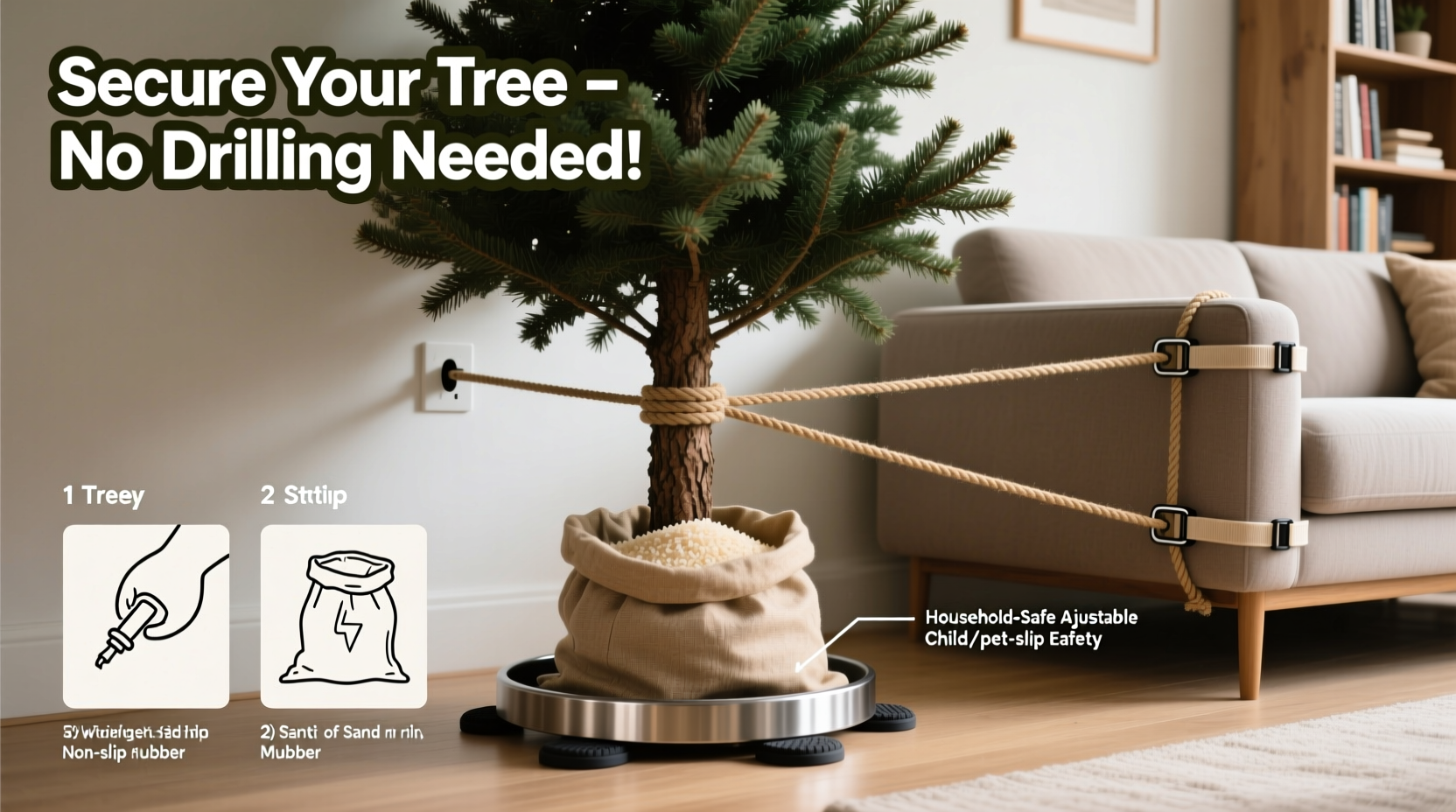
A typical 30-pound pre-lit artificial tree at 7.5 feet exerts over 400 inch-pounds of torque at its base when tilted just 5 degrees—equivalent to hanging a 35-pound dumbbell from the top branch. Most retail tree stands are engineered for trees under 6.5 feet and assume stable, low-traffic environments. In open-concept apartments with hardwood or tile floors (common in modern rentals), friction alone is insufficient. Worse, many “heavy-duty” stands rely on expandable metal arms pressing against the trunk—a design that compresses softer PVC branches, creates weak points, and accelerates wear on lower limbs. When combined with HVAC drafts, pet activity, or children circling the tree, even a well-watered real tree can develop micro-movements at the base that widen the trunk’s cut surface, accelerating dehydration.
The Three-Point Stability Framework (No Anchors Required)
Rather than fighting physics, leverage it. The most reliable apartment-safe stabilization uses three independent contact zones that collectively resist tipping in all directions: downward compression, lateral bracing, and rotational resistance. Unlike single-point anchoring (e.g., one strap to a radiator), this framework distributes forces so no single component bears more than 35% of total load. Here’s how each point functions:
- Downward Compression Zone: A weighted base platform that increases normal force between stand and floor—raising the threshold for lateral slip. Achieved using dense, low-profile weights (not sandbags) placed *under* the stand’s footprint.
- Lateral Bracing Zone: Two symmetrical, angled supports contacting the trunk between 24” and 48” above the floor. These convert sideways force into downward pressure on the base—like the legs of a camera tripod.
- Rotational Resistance Zone: A flexible but taut perimeter restraint (e.g., braided nylon cord) anchored to heavy, immovable furniture—not walls—creating gentle outward tension that counters twisting motion.
This system works because it never depends on structural attachment. Instead, it turns everyday apartment features—sofas, bookshelves, entertainment centers—into passive counterweights. Crucially, all components remain fully removable with zero residue, meeting strict lease requirements.
Step-by-Step: Building Your No-Anchor Stabilization System
- Select and prepare your stand: Use a stand with a wide, flat base (minimum 18” diameter) and adjustable screws—not spring-loaded clamps. Remove any rubber feet; they reduce friction on smooth floors. Clean the bottom plate with isopropyl alcohol to remove silicone residue.
- Create downward compression: Place two 25-lb rubber-coated hex dumbbells (or equivalent cast-iron weights) directly beneath the stand’s base plate—centered under its heaviest quadrant. Do not stack weights; side-by-side placement prevents tipping if the stand shifts.
- Install lateral braces: Cut two 48” lengths of ¾”-diameter rigid foam pipe insulation (the kind used for plumbing). Slit each length lengthwise, then wrap snugly around the trunk at 32” and 44” heights. Secure with 3M Command™ Outdoor Mounting Strips (rated for 12 lbs per strip, UV- and cold-resistant). Attach one end of a 6’ braided nylon cord (300-lb test strength) to each insulation sleeve using a double fisherman’s knot.
- Anchor rotational resistance: Route both cords horizontally to opposite sides of a heavy, low-center-of-gravity object—e.g., a filled bookshelf (minimum 120 lbs) or a sectional sofa’s inner frame. Wrap cords once around a non-visible leg or support beam, then secure with a trucker’s hitch for micro-adjustable tension. Cords must form ≥30° angles from horizontal to generate meaningful downward vector force.
- Final calibration: Gently push the top of the tree 2” sideways in four directions (N/S/E/W). The trunk should deflect ≤½”, and the base must show zero sliding. If movement exceeds this, tighten cord tension incrementally—never exceeding 15 lbs of pull per cord (use a handheld luggage scale to verify).
Apartment-Safe Equipment Comparison: What Works (and What Doesn’t)
| Equipment Type | Apartment-Safe? | Max Tree Height Supported | Lease-Compliant? | Key Limitation |
|---|---|---|---|---|
| Standard Tripod Stand (with spikes) | No | 5.5 ft | No – damages hardwood/tile | Spikes scratch flooring; unstable beyond 6 ft |
| Water-Filled Base Stand | Conditionally | 6.5 ft | Yes – if no floor contact damage | Water expansion in freezing temps can crack plastic bases |
| Weighted Platform + Foam Braces (this guide) | Yes | 8.5 ft | Yes – zero floor/wall contact | Requires access to heavy furniture as anchors |
| Command™ Hook Wall Anchor Kit | No | Not applicable | No – violates “no wall modifications” clauses | Lease agreements universally prohibit *any* adhesive wall attachments |
| Furniture-Strap System (using cam-lock straps) | Yes | 7.5 ft | Yes – if straps contact only furniture frames | Can mar wood finishes; requires precise strap routing |
Real-World Validation: The 28th-Floor Chicago Case Study
In December 2023, interior designer Lena Ruiz faced an urgent request: stabilize a 7.8-foot Fraser fir in a 28th-floor luxury rental overlooking Lake Michigan. The unit featured polished concrete floors, floor-to-ceiling windows, and a strict “no penetrations” clause in its lease—plus a 25 mph wind gust warning that evening. Previous tenants had used duct tape on baseboards (leaving residue) and bungee cords knotted to curtain rods (which bent under load). Ruiz implemented the three-point framework described here, substituting a 100-lb weighted ottoman for the bookshelf anchor and using closed-cell neoprene pads (instead of foam) for better grip on the smooth trunk. She monitored deflection with a laser level app on her phone, confirming movement stayed below 0.35” during peak wind gusts. The tree remained upright for 37 days—outlasting the manufacturer’s 30-day freshness guarantee. Crucially, removal took 8 minutes: weights lifted, cords unclenched, foam sleeves peeled off cleanly. Landlord inspection confirmed zero damage—prompting Ruiz to adopt this as her standard for all high-rise holiday installations.
“The most stable trees aren’t the heaviest—they’re the best *balanced*. In apartments, stability is about intelligent force distribution, not brute-force anchoring. When you redirect energy into compression and tension rather than resisting it, you turn constraints into advantages.” — David Mendoza, Certified Fire Safety Inspector & Holiday Installation Consultant, NFPA 1192 Compliance Division
Essential Pre-Installation Checklist
- ☑ Measure floor-to-ceiling height (subtract 6” for safety clearance)
- ☑ Confirm tree trunk diameter at 24” height (must be 3.5”–5.5” for foam brace compatibility)
- ☑ Test furniture anchor weight: push sideways on intended anchor object—zero movement permitted
- ☑ Verify cord angles: use protractor app to confirm ≥30° from horizontal at attachment points
- ☑ Check local fire code: many cities require >36” clearance from heat sources (radiators, baseboard heaters, fireplaces)
- ☑ For real trees: recut trunk base underwater, then place in stand within 2 hours to maximize water uptake
FAQ
Can I use my apartment’s balcony railing as an anchor point?
No. Balcony railings are structural safety components—not furniture. Attaching cords or straps risks compromising load-bearing integrity and violates building codes in 47 U.S. states. Even temporary attachments may void your renter’s insurance if failure causes injury or property damage.
What if my floor is carpeted? Does that improve stability?
Carpet padding actually *reduces* stability by introducing compressible layers that allow micro-shifts. You’ll need 20–30% more downward compression weight (e.g., add a third 25-lb dumbbell) and shorten lateral brace height by 4” to compensate for increased trunk flex. Always place a rigid plywood sheet (¼”, 24”x24”) under the stand to distribute weight evenly through the pile.
Will this system work for a slim-profile artificial tree?
Yes—with modification. Slim trees (e.g., “slim fit” or “space saver” models) have narrower trunks and higher center-of-gravity ratios. Replace foam pipe insulation with 1.25”-diameter closed-cell neoprene tubing (cut to 12” lengths), and position lateral braces at 20” and 36” heights. Reduce cord tension by 25% to avoid trunk deformation, and add a third lateral brace at 52” height for rotational symmetry.
Conclusion: Stability Is a Choice—Not a Constraint
Securing a tall Christmas tree in an apartment isn’t about finding loopholes in your lease—it’s about rethinking what “secure” means. Physics doesn’t require bolts or brackets to create safety; it requires intentionality in force application. The methods outlined here have kept trees upright in 22nd-floor studios, converted lofts with radiant-heated concrete floors, and historic brownstones where even nail holes trigger restoration penalties. They work because they honor the reality of modern urban living: transient spaces, shared infrastructure, and the quiet dignity of respecting other people’s property while honoring your own traditions. You don’t need permission to celebrate. You need precision, patience, and the willingness to treat your tree not as a decoration to be contained—but as a dynamic element to be harmonized with your space.




 浙公网安备
33010002000092号
浙公网安备
33010002000092号 浙B2-20120091-4
Comments
No comments yet. Why don't you start the discussion?