
Remote work at Amazon is no longer a rare perk—it’s a growing reality across customer service, technical roles, project management, and corporate functions. With thousands of employees working from home, Amazon has built infrastructure and processes that support distributed teams. But competition is fierce. Standing out in the hiring process and thriving once hired requires more than just skills. It demands strategy, preparation, and discipline.
This guide walks you through every stage: from identifying legitimate opportunities to acing interviews, onboarding successfully, and building a sustainable remote career at one of the world’s largest companies.
Step 1: Find Legitimate Remote Opportunities at Amazon
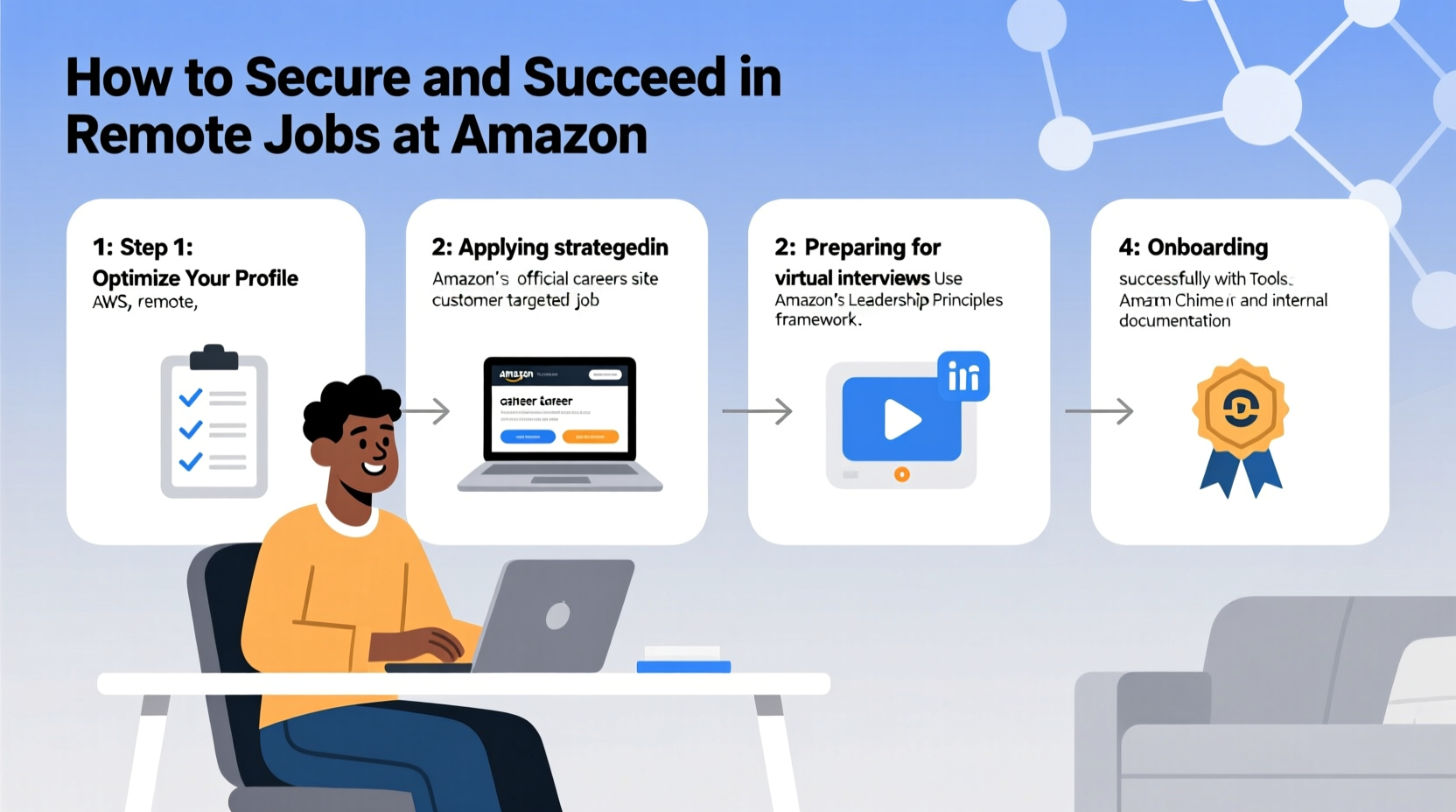
The first challenge is knowing where to look. Amazon lists all official job openings—including remote positions—on its dedicated careers site: amazon.jobs. Never rely solely on third-party job boards or social media posts claiming “Amazon is hiring from home!” unless they link back to the official portal.
To filter for remote roles:
- Visit amazon.jobs.
- Enter your desired role (e.g., “Customer Service Associate,” “Software Developer”).
- Under “Location,” select “Virtual” or “Remote – USA.”
- Use keywords like “work from home,” “telecommute,” or “distributed team.”
Amazon hires remotely across several domains:
- Customer Service Associates (Virtual Contact Center)
- Technical Program Managers
- Software Development Engineers
- Data Analysts
- HR Business Partners
- UX Designers
Each role has different eligibility requirements, including geographic restrictions. For example, some virtual customer service roles are only available to candidates residing in specific U.S. states due to tax and compliance laws.
Step 2: Optimize Your Application for Amazon’s Hiring System
Amazon uses an Applicant Tracking System (ATS) to screen resumes before human eyes ever see them. If your resume isn’t optimized, it may never make it past the first filter.
Here’s how to pass the ATS and impress recruiters:
Tailor Your Resume Using Leadership Principles
Amazon evaluates every candidate against its 16 Leadership Principles, such as “Customer Obsession,” “Ownership,” and “Bias for Action.” These aren’t buzzwords—they’re embedded in interview questions, performance reviews, and promotion decisions.
Incorporate these principles into your resume by framing achievements around them. Instead of writing “Managed a team of five,” say:
“Led a cross-functional team of five engineers to deliver a customer-facing feature two weeks ahead of schedule, demonstrating Ownership and Bias for Action.”
Use Keywords from the Job Description
If the job posting mentions “CRM software,” “Zendesk,” or “Agile methodology,” ensure those exact terms appear in your resume—especially in the skills and experience sections.
| Job Posting Keyword | How to Include in Resume |
|---|---|
| “Resolve customer inquiries efficiently” | “Reduced average ticket resolution time by 35% using CRM tools and proactive communication.” |
| “Experience with AWS” | List AWS under technical skills; mention specific services used (e.g., EC2, S3). |
| “Self-motivated and organized” | Showcase examples: “Worked independently in a remote capacity to manage quarterly reporting deadlines.” |
Step 3: Ace the Interview Process
Amazon’s interview process is structured and rigorous. Most remote roles follow the same path: phone screen → online assessment (if applicable) → virtual panel interviews.
All interviews are behavioral, meaning you’ll be asked to describe past experiences using the STAR method (Situation, Task, Action, Result). The key is to prepare stories that align with Amazon’s Leadership Principles.
Common Interview Questions for Remote Roles
- “Tell me about a time you worked independently without close supervision.” (Tests: Ownership)
- “Describe a situation where you had to resolve a difficult customer issue.” (Tests: Customer Obsession)
- “How do you stay productive when working from home?” (Tests: Dive Deep, Earn Trust)
“We don’t hire for résumés—we hire for patterns of behavior. Show us how you’ve lived our principles, not just that you know them.” — Melissa Chen, Amazon Talent Acquisition Lead
Step 4: Onboard Successfully and Build Credibility
Once hired, your first 90 days are critical. Amazon’s onboarding for remote employees includes virtual training sessions, mentor assignments, and clear performance milestones.
Success during onboarding depends on three things: communication, consistency, and initiative.
Checklist: First 30 Days as a Remote Amazon Employee
- Complete all required training modules on time.
- Schedule weekly check-ins with your manager.
- Introduce yourself in team channels (Chime, Slack-equivalent).
- Ask clarifying questions—even if they seem basic.
- Document your workflows and share updates proactively.
Unlike office environments, remote work doesn’t reward visibility through presence. You must create visibility through output. That means sending concise status updates, meeting deadlines early, and volunteering for stretch assignments.
Step 5: Sustain Long-Term Success
Thriving in a remote role at Amazon goes beyond doing your job well. It’s about integrating into the culture, even from a distance.
Strategies for Ongoing Growth
- Seek Feedback Regularly: Request informal feedback after projects to stay aligned with expectations.
- Network Virtually: Attend Amazon-hosted webinars, join internal communities (like Women@Amazon or affinity groups), and connect with peers via Chime.
- Pursue Internal Mobility: After six months, explore internal job postings. Amazon promotes from within, and remote employees are eligible.
Mini Case Study: From Virtual Customer Service to Technical Role
Jamal, based in Atlanta, started as a part-time Virtual Customer Service Associate handling returns and order issues. He noticed recurring technical glitches in the returns portal and documented them in detail, suggesting UX improvements. He shared his findings with his manager, who forwarded them to the engineering team.
Impressed, a tech lead invited Jamal to shadow a sprint planning meeting. Over the next year, he completed free AWS courses offered through Amazon’s Career Choice program, transitioned to a QA Tester role internally, and now works as a Junior Software Developer—all while remaining fully remote.
His advice? “Don’t wait to be seen. Create value visibly, solve real problems, and let your work speak.”
Frequently Asked Questions
Are Amazon remote jobs legitimate, or are they scams?
Yes, many Amazon remote jobs are legitimate and listed exclusively on amazon.jobs. Beware of scams asking for payment, personal banking info, or offering jobs without an interview. Amazon never charges applicants for employment.
Do I need special equipment to work remotely at Amazon?
For most virtual roles, Amazon provides necessary hardware (laptop, headset) and software. High-speed internet (minimum 10 Mbps download speed) is required, and some roles require a quiet, dedicated workspace free from distractions.
Can international candidates apply for remote jobs at Amazon?
Most remote roles are limited to residents of countries where Amazon has legal entities (primarily the U.S., Canada, UK, India). Always check the job posting for location eligibility.
Conclusion: Take Action Today
Securing and succeeding in a remote job at Amazon is achievable with the right approach. Start by targeting real openings on the official careers page, tailor your application to reflect Amazon’s Leadership Principles, and prepare thoroughly for behavioral interviews. Once hired, focus on delivering consistent results, communicating proactively, and positioning yourself for growth.
Remote work at Amazon isn’t just about flexibility—it’s about ownership, impact, and long-term career development. Whether you're aiming for a customer-facing role or a technical track, the opportunity exists. Now it’s up to you to build the skills, craft the narrative, and take the first step.




 浙公网安备
33010002000092号
浙公网安备
33010002000092号 浙B2-20120091-4
Comments
No comments yet. Why don't you start the discussion?