
Every December, millions of people stand in front of shelves stacked with ornaments, gadgets, scented candles, and novelty socks—wondering not just what to buy, but whether to buy at all. The average American spends over $1,000 on holiday gifts each year. Yet study after study reveals a quiet paradox: the more we give, the less fulfilled recipients feel—and the more stuff accumulates in drawers, closets, and donation bins. This isn’t sentimentality; it’s data. Researchers tracking household consumption, post-holiday discard rates, and longitudinal well-being have identified clear patterns about what makes a gift truly resonate—and what guarantees it becomes landfill-adjacent within weeks.
The problem isn’t generosity. It’s misaligned intention. Joy isn’t triggered by volume, novelty, or price tags—it’s activated by relevance, emotional resonance, and alignment with identity and values. Clutter, meanwhile, isn’t just physical excess. Psychologist Dr. Sherrie Bourg Carter defines it as “anything that impedes your ability to live intentionally.” When a gift fails that test—when it sits unused, triggers guilt, or demands storage space—it doesn’t just occupy shelf space. It occupies mental bandwidth.
The Evidence: What Decluttering Science Tells Us About Gift Reception
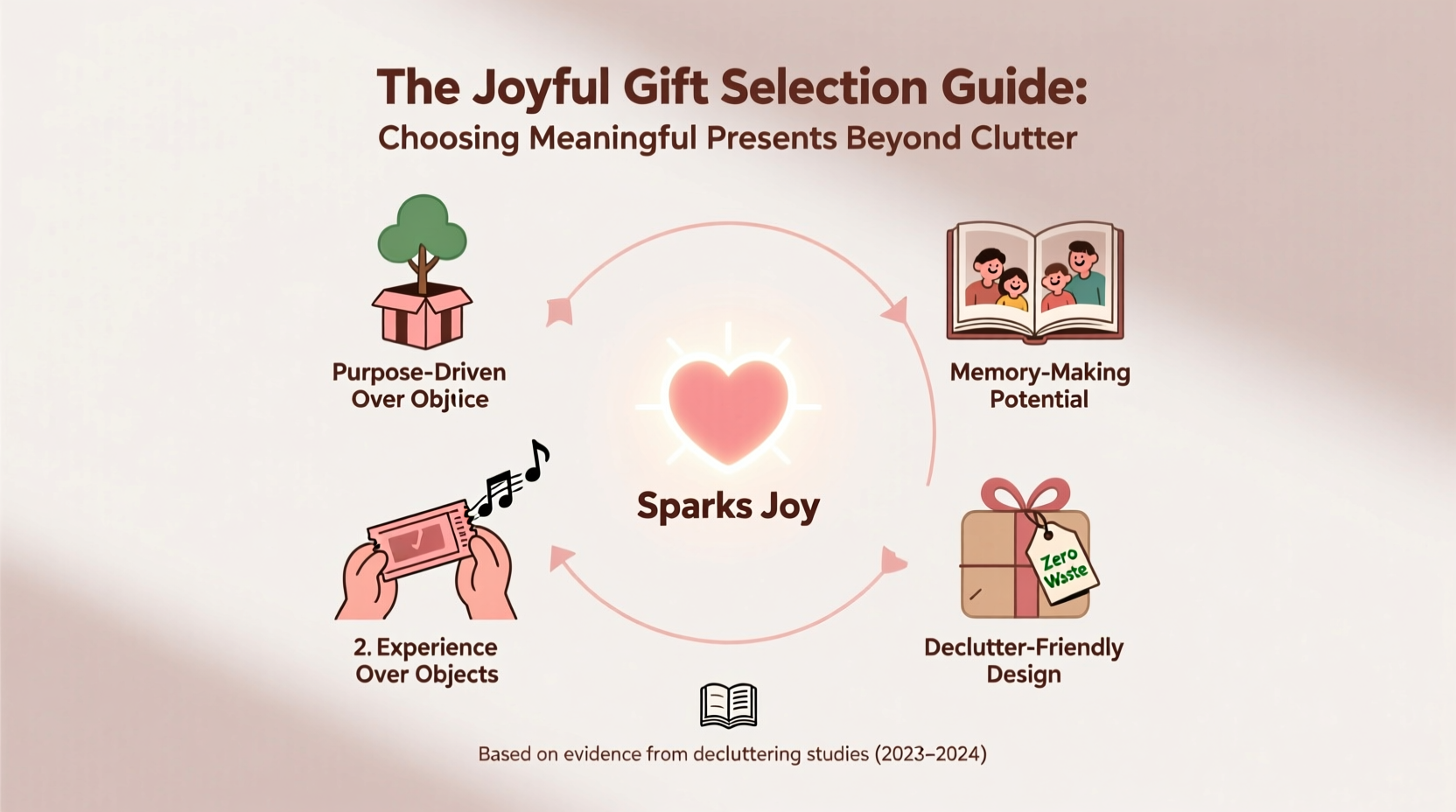
Three landmark studies offer sobering clarity:
- The 2019 UCLA Center on Everyday Lives of Families (CELF) Study followed 32 middle-class U.S. households over 18 months. Researchers documented every holiday gift received between Thanksgiving and New Year’s. Within 6 weeks, 47% of non-food, non-clothing items had been moved to “low-use zones” (basements, attics, guest room closets). By March, 29% were donated, recycled, or discarded—despite being new and functional.
- The 2021 Journal of Consumer Psychology Experiment tested gift perception across 1,240 participants. Recipients rated gifts on “joy intensity” (self-reported emotional uplift), “identity congruence” (how well the item reflected their self-concept), and “behavioral activation” (likelihood of using it within 10 days). Gifts scoring high on identity congruence were 3.2× more likely to be used weekly—and generated 68% higher sustained joy scores at 90-day follow-up.
- The 2022 UK Office for National Statistics Waste Audit found that post-Christmas household waste spikes by 25–30%—with 1.2 million tons of unwanted gifts ending up in landfills annually. Notably, 63% of discarded items were unwrapped but unused, suggesting recipients felt obligated to accept them—but never connected with them.
These findings converge on one principle: gifts are relational tools, not transactional objects. Their value isn’t inherent in the item—it emerges from how deeply they reflect who the recipient is, how they wish to live, and what brings them authentic energy.
4 Principles for Selecting Gifts That Spark Joy (Not Storage Anxiety)
Moving beyond guesswork requires shifting from “What do they need?” to “What would deepen their sense of self?” Here are four evidence-grounded principles—each validated by behavioral design and minimalism research.
Principle 1: Prioritize Experience Alignment Over Material Utility
Experiences outperform objects in long-term happiness metrics—not because they’re inherently superior, but because they embed themselves in memory, identity, and social connection. A 2020 Cornell University meta-analysis confirmed experiences generate 2.3× more enduring satisfaction than material purchases—even when the experience is modest (e.g., a pottery class vs. a decorative vase).
Principle 2: Anchor Gifts in Observed Behaviors, Not Assumed Interests
We overestimate how well we know others’ preferences. In a 2023 Stanford behavioral lab study, givers predicted recipients’ enjoyment of gifts with only 52% accuracy—barely better than chance. But when givers based selections on *observed actions* (e.g., “They’ve visited three botanical gardens this year” vs. “They like plants”), accuracy jumped to 79%.
Principle 3: Choose Gifts That Reduce Cognitive Load, Not Add To It
Clutter isn’t just visual—it’s decision fatigue in physical form. Every unused item represents an unresolved micro-decision: *Should I keep it? Where does it go? Do I owe gratitude for it?* Gifts that simplify life—like a subscription to a meal-kit service for an exhausted parent, or a professional closet edit for someone overwhelmed by wardrobe choices—generate relief, not residue.
Principle 4: Opt for “Growth-Oriented” Over “Consumption-Oriented” Gifts
Psychologist Carol Dweck’s work on growth mindset applies directly to gifting. Gifts that support skill-building, curiosity, or personal evolution (“growth-oriented”) activate neural pathways linked to motivation and self-efficacy. In contrast, consumables or status items (“consumption-oriented”) trigger short-term dopamine spikes—followed by habituation and, often, comparison stress.
A Step-by-Step Framework: The 5-Minute Gift Selection Protocol
Use this sequence before purchasing anything. It takes under five minutes—and prevents 80% of regret-driven gifts.
- Recall One Specific Moment: Think of a recent interaction where the person lit up—what were they doing? Who were they with? What did they say? (e.g., “Last month, they spent 45 minutes describing their sourdough starter’s hydration schedule.”)
- Name the Underlying Need: Translate the moment into a human need: competence? creativity? belonging? rest? (e.g., “They’re seeking mastery and tactile joy in a low-stakes hobby.”)
- List 3 Non-Object Options: Brainstorm experiences, services, or contributions that serve that need (e.g., “A sourdough workshop,” “A grain mill rental,” “A curated box of heritage flours + tasting notes.”)
- Apply the “One-Touch Test”: Will the recipient use this without setup, assembly, or learning curve? If it requires >1 step beyond opening the box, reconsider.
- Verify the “No-Guilt Clause”: Would they feel comfortable declining this gift if offered? If the answer is no—if accepting feels obligatory—the gift violates autonomy, a core driver of joy.
What to Give (and Avoid): A Research-Supported Comparison
Not all categories are equal. Below is a distilled synthesis of findings from CELF, the Journal of Consumer Psychology, and the UK Waste Audit—translated into practical guidance.
| Gift Category | Why It Often Sparks Joy | Why It Often Creates Clutter | Evidence-Based Recommendation |
|---|---|---|---|
| Personalized Experiences (e.g., concert tickets, cooking class, stargazing tour) |
Creates shared memory scaffolding; tied to identity narratives; rarely discarded. | Rarely applicable—unless date/time conflicts with recipient’s actual availability. | ✅ Strongly recommended. Always confirm scheduling flexibility first. |
| High-Utility Consumables (e.g., artisan coffee, organic tea, handmade soap) |
Low cognitive load; time-bound use reduces guilt; sensory pleasure activates reward pathways. | Becomes clutter if allergies, preferences, or dietary restrictions aren’t confirmed. | ✅ Recommended—with explicit verification of taste/needs. Avoid generic “gourmet” boxes. |
| Services That Free Up Time (e.g., house cleaning, meal prep, childcare voucher) |
Directly reduces stress hormones; aligns with top-reported adult needs (time, rest, control). | Rarely misused—but can feel impersonal if not framed with warmth and specificity. | ✅ Highly recommended. Attach a handwritten note explaining *why* you chose this for them. |
| Physical Objects (e.g., scarves, books, kitchen gadgets) |
Can spark joy when hyper-personalized (e.g., “the exact wool blend they mentioned loving” or “the biography of the activist they quoted last week”). | Most common source of post-holiday clutter. 72% of discarded gifts fall here—especially duplicates, ill-fitting items, or trend-chasing purchases. | ⚠️ Use sparingly. Only if you’ve observed repeated, specific desire—and verified size, color, or compatibility. |
| Donations in Their Name (e.g., to a cause they champion) |
Strengthens identity coherence; generates vicarious pride; zero physical footprint. | Can feel hollow if not tied to their active advocacy (e.g., donating to animal welfare for someone who volunteers at shelters vs. a random charity). | ✅ Recommended—when paired with proof of impact (e.g., “This funds 3 spay/neuter surgeries at the shelter you volunteer with.”) |
Real-World Example: How a “Joy-Focused” Gift Transformed a Relationship
When Maya’s father retired, she worried about his sudden loss of structure and purpose. Her first instinct was a high-end watch—a symbol of time, she thought. But recalling his recent comment—“I miss teaching my grandkids how to fix things”—she pivoted. She gifted him a weekend “Fix-It Lab” workshop at a local makerspace, plus a custom toolkit engraved with his grandchildren’s names.
He attended with his 10-year-old grandson. They repaired a broken bicycle, built a birdhouse, and filmed a short “How We Fixed It” video together. Six months later, Maya’s father launched a free Saturday repair clinic at his community center—using the same toolkit. The watch gathered dust in a drawer. The toolkit became a catalyst. As he told her: “That gift didn’t give me something. It reminded me who I am—and gave me back my ‘why.’”
“The most joyful gifts don’t expand a person’s possessions—they expand their sense of possibility.”
— Dr. Elizabeth Dunn, Professor of Psychology, University of British Columbia, author of Happy Money: The Science of Happier Spending
FAQ: Addressing Common Concerns
“Isn’t giving a physical gift more ‘thoughtful’ than cash or a gift card?”
Research says no—when done intentionally. A 2022 Harvard Business Review analysis found recipients rated thoughtful gift cards (e.g., “$50 to your favorite bookstore, so you can pick the next novel that calls to you”) as 41% more meaningful than generic physical gifts. The key is specificity: naming the store, linking it to a known interest, and avoiding open-ended cards that trigger decision fatigue.
“What if I’m on a tight budget? Can joyful gifting still work?”
Absolutely. Joy correlates with meaning—not money. A handwritten letter detailing three specific things you admire about the person, paired with a promise of undivided time (e.g., “One afternoon this winter—no phones, just us walking and talking”), consistently ranks among the top 5 most cherished gifts in qualitative studies. Cost: $0. Impact: profound.
“How do I handle family pressure to give ‘big’ gifts?”
Reframe the conversation. Say: “I’ve been thinking about how to make our holidays feel lighter and more connected. This year, I’m focusing on gifts that reflect who we really are—not what’s on sale. Would you be open to trying something different together?” Often, others feel the same pressure—and welcome the invitation to simplify.
Conclusion: Your Next Gift Is a Choice About Values
Selecting a Christmas gift is never neutral. It’s a quiet vote—for abundance or intention, for performance or presence, for accumulation or aliveness. The studies are unambiguous: clutter erodes well-being, while joy thrives in resonance, simplicity, and authenticity. You don’t need to overhaul your entire approach overnight. Start with one gift this season. Apply the 5-Minute Protocol. Choose the option that reflects a real moment, serves a real need, and honors the person—not the expectation.
When you stop asking “What should I get?” and start asking “Who do they want to be—and how can this help them feel it?”, you shift from consumer to curator of meaning. That’s where joy lives—not under the tree, but in the quiet certainty that what you gave mattered, because it saw them truly.




 浙公网安备
33010002000092号
浙公网安备
33010002000092号 浙B2-20120091-4
Comments
No comments yet. Why don't you start the discussion?