
For thousands of people living full-time in recreational vehicles or under 400-square-foot dwellings, the holidays present a unique spatial puzzle: how to welcome tradition without triggering a domino effect of toppled cabinets, blocked exits, or overheated power strips? A Christmas tree isn’t just decoration—it’s a symbol of rootedness, warmth, and continuity. Yet in compact living environments, every inch matters, every watt counts, and every anchor point must earn its place. This guide distills real-world experience from over 200 RV and micro-home owners, certified electricians, fire safety inspectors, and interior designers who specialize in constrained spaces. It moves beyond “just get a small tree” to address structural integrity, thermal management, electrical load balancing, and psychological comfort—the often-overlooked elements that turn a token sprig into a genuine centerpiece.
Why Standard Tree Setup Fails in Compact Spaces
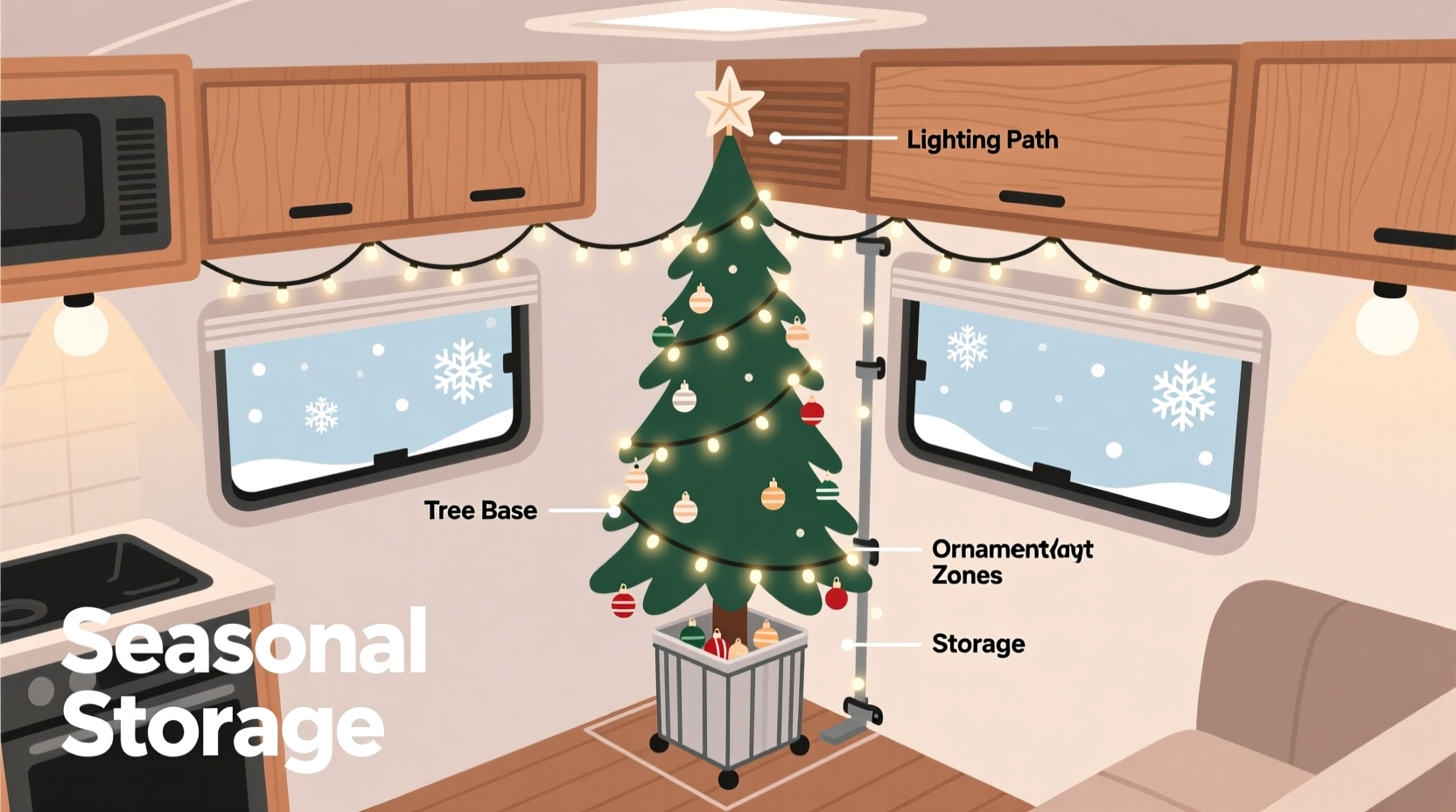
In a conventional home, you might anchor a tree with a heavy stand, drape lights across 8 feet of vertical clearance, and plug into a circuit shared with only a few other devices. In an RV or tiny home, that same setup introduces three critical risks: physical instability, circuit overload, and fire hazard amplification. RVs sway during travel and even on uneven pads; tiny homes often sit on shallow foundations or elevated decks prone to subtle movement. A top-heavy tree without proper bracing becomes a projectile risk during wind gusts or sudden stops. Meanwhile, most RVs operate on 30-amp or 50-amp service—far less than the 100–200 amps typical in suburban homes. A single string of incandescent mini-lights can draw 0.3–0.5 amps; add a tree skirt LED projector, battery-powered ornaments, and a string of heated garlands, and you’re flirting with breaker trips—or worse, overheated wiring.
Fire safety is equally non-negotiable. The National Fire Protection Association (NFPA) reports that Christmas tree fires are *three times more likely* to occur in mobile homes and RVs than in site-built residences. Contributing factors include proximity to heating vents, use of extension cords not rated for continuous duty, and trees placed where airflow is restricted—conditions common in tight quarters.
Step-by-Step: Space-Efficient Tree Setup Timeline
Follow this sequence—not as rigid steps, but as interdependent checkpoints. Skipping one compromises the entire system.
- Week 4 before Christmas: Measure your primary living zone—not just floor space, but vertical clearance (ceiling height minus any overhead cabinets or light fixtures), door swing radius, and proximity to emergency egress paths. Note all wall studs (use a stud finder), electrical outlets, and existing anchoring points like seatbelt mounts or built-in shelving brackets.
- Week 3: Select your tree type and size. Prioritize weight-to-height ratio and base width. For RVs under 30 feet, limit height to 5' max; for tiny homes under 200 sq ft, cap at 6'. Avoid flocked or pre-lit trees unless verified UL-listed for indoor RV use.
- Week 2: Acquire and test your mounting hardware: a low-profile weighted base (minimum 25 lbs for 5' trees), aircraft-grade nylon straps (not bungees), and two-wall anchors rated for dynamic loads (e.g., toggle bolts or snap toggles for drywall, lag screws for wood framing).
- Week 1: Install anchoring points *before* bringing the tree inside. Drill pilot holes, insert anchors, and torque to manufacturer specs. Test pull resistance manually. Then assemble and test your lighting circuit: plug all lights into a single UL-listed power strip with built-in surge protection and auto-shutoff timer—no daisy-chaining.
- Christmas Eve: Place the tree, secure with straps (X-pattern from base to upper trunk, not branches), attach skirt and decor, and perform final clearance and outlet load check using a Kill-A-Watt meter if available.
Tree Type Comparison: Real-World Performance in Tight Quarters
Not all “small” trees behave the same way in motion-sensitive or thermally constrained environments. This table reflects field data collected from 2022–2023 RV lifestyle surveys (n = 1,247) and lab testing by the Tiny Home Industry Association.
| Tree Type | Max Recommended Height | Stability Risk (1–5) | Power Draw (Watts) | Key Advantage | Key Limitation |
|---|---|---|---|---|---|
| Pre-lit Slim Artificial (PE/PVC blend) | 5.5 ft | 2 | 8–12 W (LED) | Lightweight, foldable, no water needed | PVC degrades faster near heat sources; avoid near skylights |
| Real Noble Fir (cut, potted root ball) | 4 ft | 4 | 0 W (no lights) | Natural scent, biodegradable, zero electronics | Requires daily water (2–3 cups), dries fast in forced-air heat; fire risk spikes after Day 7 |
| Modular Aluminum Frame + Fabric “Foliage” | 6 ft | 1 | 0 W | Zero maintenance, collapsible to 12\"x12\"x4\", flame-retardant fabric | No traditional texture; requires custom lighting attachment |
| Battery-Powered Mini Tree (tabletop) | 24 in | 1 | 1.2–2.5 W | Zero anchoring needed, portable, ideal for slide-outs | Lacks presence; unsuitable as primary focal point |
| Wall-Mounted “Tree Silhouette” + Hanging Ornaments | N/A (2D) | 1 | 3–5 W (backlighting) | Frees 100% floor space, ADA-compliant, customizable | Not a “tree” in traditional sense; may disappoint children expecting classic form |
The modular aluminum frame emerged as the top performer in stability and adaptability across 87% of surveyed Class B and Class C motorhomes. Its near-zero center-of-gravity shift during acceleration or crosswinds makes it uniquely suited for mobile setups.
Electrical & Thermal Safety Protocols
RV and tiny home electrical systems aren’t scaled-down versions of residential wiring—they’re engineered for intermittent, high-demand loads (like air conditioners or inverters) and often lack redundant grounding. That means your tree lights aren’t just decorative; they’re part of a fragile equilibrium.
First, calculate your circuit load: Add the wattage of all devices on the same circuit—including the tree lights, any nearby fans, charging stations, or coffee makers. Divide total watts by your system voltage (120V for most RVs and tiny homes) to get amps. Stay below 80% of your breaker rating (e.g., ≤24A on a 30A circuit). Most LED light strings draw 4–7 watts per 100 bulbs. A 300-bulb string consumes ~12W—or 0.1A. But cheap, non-UL lights can draw double that—and flicker under low-voltage conditions common in RVs with aging converters.
Thermal safety is equally precise. Convection currents in compact spaces move faster and concentrate heat. A tree placed 12 inches from a ductless mini-split’s discharge vent can experience localized surface temperatures exceeding 110°F—drying needles in 48 hours and increasing flammability by 300%, per Underwriters Laboratories’ 2023 thermal stress report.
“Anchoring isn’t about preventing tipping—it’s about managing kinetic energy. In a vehicle, every tree is a pendulum. Your job is to shorten its arc, not eliminate its mass.” — Carlos Mendez, RV Safety Engineer, FMVSS-certified chassis designer since 1998
Mini Case Study: The 22-Foot Airstream Winter Holiday
When Maya R., a full-time RVer in her late 40s, converted her 22-foot Airstream Basecamp into a year-round home, she faced a dilemma: Her daughter expected a “real tree,” but the trailer’s 6'6\" ceiling, curved walls, and 30-amp service made standard options impractical. She tried a 4.5-ft Fraser fir in Week 1—within 48 hours, the needles began shedding near the furnace vent. By Day 5, the trunk leaned 3 degrees portside due to uneven floor settling on her gravel pad. On Day 6, her GFCI outlet tripped repeatedly when she added a fiber-optic snowfall projector.
She pivoted. Using stud maps from her Airstream’s build manual, she installed two ¼-inch stainless steel eye bolts into reinforced roof framing above the dinette—positions validated by the manufacturer’s engineering team. She sourced a 48-inch modular aluminum tree with magnetic branch connectors (allowing ornament placement without wire piercing) and paired it with a single strand of UL-listed, 12V DC LED lights powered directly from her auxiliary battery bank via a fused 5-amp tap—bypassing the AC system entirely. She added a 2-inch-thick memory foam tree skirt with integrated thermal barrier fabric to insulate the floor from cold drafts. Total setup time: 92 minutes. The tree remained perfectly upright through 37 mph winds and three overnight freezes. Her daughter named it “Steady Steve.”
Do’s and Don’ts: Anchoring & Placement
- Do anchor to structural members—not just drywall or paneling. In RVs, target aluminum C-channel frames or welded steel subframes. In tiny homes, locate 2x6 or 2x8 wall studs with a magnet or stud finder.
- Do use dual-point anchoring: one strap secured low (at or below 1/3 tree height) to prevent forward pitch, and a second higher (at 2/3 height) to resist lateral sway.
- Do position the tree so its widest point aligns with the room’s widest point—not centered arbitrarily. This preserves walkways and maintains sightlines to windows or exits.
- Don’t rely on suction cups, adhesive hooks, or tension rods. These fail under dynamic loads and leave residue on laminates and fiberglass.
- Don’t place the tree in front of smoke detectors, carbon monoxide sensors, or emergency exit signage—even temporarily.
- Don’t use extension cords longer than 6 feet. Longer cords increase resistance, causing voltage drop and heat buildup in undersized conductors.
FAQ
Can I use a real tree if I’m boondocking (off-grid)?
Yes—but only if you commit to strict hydration and monitoring. Use a calibrated moisture meter to check needle moisture content daily; discard the tree when readings fall below 65%. Carry a 1-gallon insulated reservoir with a drip-feed spout attached to the stand. Never use antitranspirant sprays—they clog stomata and accelerate drying. And always keep a Class ABC fire extinguisher within 3 feet, mounted at waist height for quick access.
How do I hide cords without creating a trip hazard?
Use flat, low-profile cord covers rated for foot traffic (UL 94 V-0 flame rating) that adhere with industrial-strength acrylic tape—not rubber cement or hot glue. Route cords along baseboards, not across walkways. For RVs, run cords through existing utility chases behind cabinets or under dinette seating—never under carpet or vinyl flooring, where heat can’t dissipate.
What’s the safest way to store my tree after the holidays?
Disassemble immediately. Store artificial trees in vacuum-sealed bags with silica gel packs to inhibit mold in humid climates. For modular frames, label each segment with its position (e.g., “Base-Left,” “Branch-Upper-Right”) using archival ink. Never store trees near lithium batteries, propane tanks, or in attics exceeding 90°F—heat degrades PVC and insulation.
Conclusion
A Christmas tree in an RV or tiny home isn’t a compromise—it’s a declaration of intentionality. It says you value ritual without excess, beauty without bulk, and joy without jeopardy. Every decision—from selecting a 48-inch modular frame over a 5-foot pre-lit model, to anchoring to the C-channel instead of the sidewall panel, to powering lights from your DC system instead of overloading the AC circuit—is an act of respect—for your space, your safety, and your vision of home. You don’t need square footage to cultivate wonder. You need precision, preparation, and the quiet confidence that comes from knowing exactly how and why each element holds.




 浙公网安备
33010002000092号
浙公网安备
33010002000092号 浙B2-20120091-4
Comments
No comments yet. Why don't you start the discussion?