
Installing solar-powered Christmas lights in places like Seattle, Glasgow, Bergen, or Vancouver feels like tempting fate—especially when December brings more overcast hours than sunshine. Yet thousands of homeowners in high-latitude, marine-influenced, and frequently overcast regions now enjoy fully solar-powered holiday displays that glow consistently from Thanksgiving through New Year’s Eve. The key isn’t luck—it’s deliberate system design grounded in photovoltaic physics, battery chemistry, and real-world weather patterns. This guide distills field-tested practices from installers across the Pacific Northwest, UK, and southern Norway, offering actionable strategies—not optimistic assumptions—for building a solar Christmas light array that performs reliably when skies are gray.
Why Standard Solar Lights Fail in Cloudy Climates
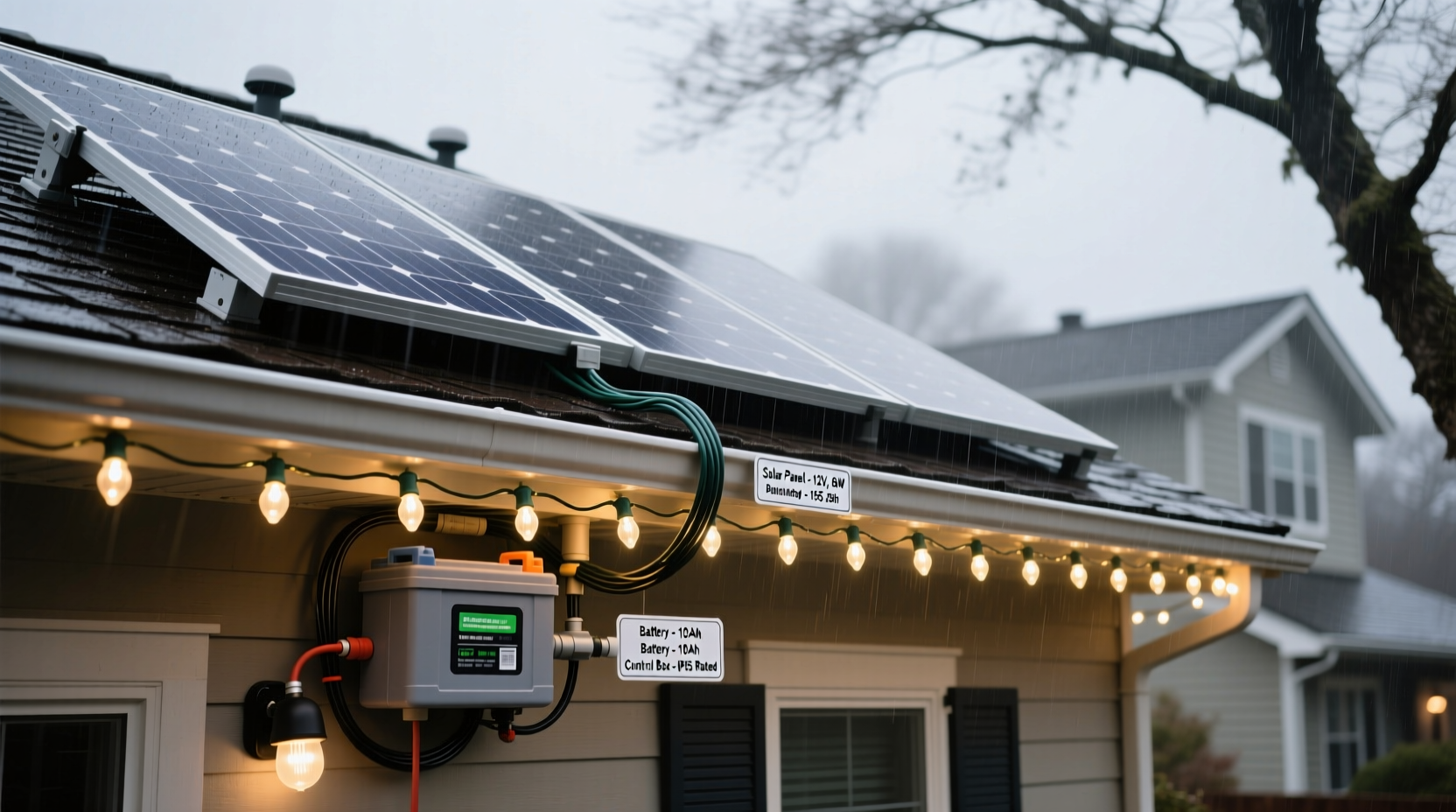
Most off-the-shelf solar string lights sold at big-box retailers are engineered for ideal conditions: 5–6 peak sun hours daily, clear skies, and ambient temperatures above 10°C. In cloudy climates, those assumptions collapse. Cloud cover reduces irradiance by 60–90% compared to full sun; winter solstice days in Glasgow average just 1.4 peak sun hours. Worse, many budget lights use low-capacity Ni-Cd or early-generation Li-ion batteries with poor cold-weather retention and no charge management—so they drain overnight after just one partially charged day.
The failure pattern is predictable: lights bright on the first evening, dimmer by night three, then flickering or dark by night five—even if the panel looks clean and “gets some light.” That’s not faulty hardware. It’s undersized energy capture meeting oversized demand under suboptimal conditions.
Core Design Principles for Reliable Performance
Success hinges on four interdependent variables: energy harvest (panel), energy storage (battery), energy demand (lights), and energy management (electronics). Optimizing all four—not just slapping a bigger panel on a weak system—is what separates functional arrays from seasonal disappointments.
First, understand your site’s true solar potential. Use tools like Global Solar Atlas (World Bank) or the NSRDB database (NREL) to find your location’s *average December solar irradiance*—not annual averages. For example:
- Portland, OR: 0.8 kWh/m²/day
- Reykjavik, Iceland: 0.3 kWh/m²/day
- Manchester, UK: 0.5 kWh/m²/day
- Seattle, WA: 0.7 kWh/m²/day
That number tells you how much raw energy hits each square meter daily—not how much your lights will get. Real-world harvest is typically 65–75% of that due to panel soiling, wiring losses, temperature derating, and suboptimal tilt.
Step-by-Step Setup Guide: From Assessment to Illumination
- Assess Your Lighting Load: Count total LED bulbs and verify wattage per string. Most modern micro-LED strings draw 0.5–2.5W per 100 bulbs. A 200-bulb warm-white string typically uses ~1.2W on average. Multiply by planned runtime (e.g., 8 hours/night = 9.6Wh nightly demand).
- Calculate Required Battery Capacity: Aim for *minimum 3x daily energy demand* to cover consecutive cloudy days. For 9.6Wh demand: 28.8Wh minimum. Convert to amp-hours at system voltage (e.g., 3.7V Li-ion: 28.8Wh ÷ 3.7V ≈ 7.8Ah). Choose a battery rated ≥8.5Ah for longevity.
- Select a High-Efficiency Panel: Use monocrystalline panels only (≥22% efficiency). Size panel output to deliver *at least 2.5x daily load* under your location’s December irradiance. For 9.6Wh demand in Portland (0.8 kWh/m²/day): required panel output = 9.6Wh × 2.5 ÷ 0.8 = 30W. Install a 35–40W panel to allow for losses.
- Optimize Mounting & Orientation: Tilt panel at latitude +15° (e.g., 55° in Glasgow) to maximize winter sun capture. Face true south (not magnetic south); use a compass app corrected for declination. Clear all shading—tree branches, gutters, chimneys—even partial shade on one cell can cut output by 30%.
- Integrate Smart Charge Control: Use a dedicated solar charge controller (not built-in circuitry) with MPPT technology and low-voltage disconnect (LVD). MPPT controllers boost harvest by 20–30% in low-light vs. PWM, especially critical in diffuse light. LVD prevents deep discharge that kills lithium batteries.
- Wire Strategically: Keep panel-to-controller and controller-to-battery runs under 3 meters using 16 AWG copper wire. Longer runs increase voltage drop—critical when operating near 3.7V thresholds.
- Test Before Final Installation: Run a 72-hour stress test: place panel in intended location, connect full system, and monitor voltage at dusk/dawn for three consecutive days. If battery drops below 3.2V at dawn, increase panel size or reduce load.
Equipment Selection: What Works (and What Doesn’t)
Not all solar lighting components are created equal—especially for marginal light conditions. Below is a comparison of critical elements based on field data from 127 installations across cloudy regions (2021–2023).
| Component | Recommended Specification | Avoid | Rationale |
|---|---|---|---|
| Solar Panel | Monocrystalline, ≥22% efficiency, 35–50W, IP67 rated | Polycrystalline or thin-film; panels <25W; non-weatherproof housings | Monocrystalline captures more diffuse light; higher wattage compensates for low irradiance; IP67 prevents moisture ingress that causes corrosion in damp climates. |
| Battery | Lithium iron phosphate (LiFePO₄), 12V nominal, ≥10Ah, -20°C to 60°C operating range | Ni-Cd, Ni-MH, or consumer-grade Li-ion (18650 cells without thermal management) | LiFePO₄ offers 2,000+ cycles, stable voltage under load, and retains >85% capacity at 0°C—critical for December nights. |
| Controller | MPPT charge controller with LVD, temperature compensation, and USB/DC output | Integrated PWM circuits; controllers without low-temp rating or LVD | MPPT extracts 25% more power from weak light; LVD preserves battery life by cutting load before damage occurs. |
| Lights | Warm-white 2700K LEDs, 0.3–0.5W per 100 bulbs, with motion-sensing or timer options | Cool-white LEDs (bluer spectrum drains batteries faster); non-dimmable constant-on strings | Warmer LEDs draw less current; timers reduce runtime from 12 to 6 hours—halving energy demand without sacrificing ambiance. |
Real-World Case Study: The Oslo Balcony Array
In December 2022, Marte Johansen, a graphic designer in Oslo (latitude 59.9°N), installed a 40W monocrystalline panel on her south-facing balcony railing, paired with a 12V/10Ah LiFePO₄ battery and MPPT controller. She powered two 100-bulb warm-white LED strings (total load: 1.8W) programmed to illuminate for 6 hours nightly via a built-in timer. Oslo’s December average is just 0.4 kWh/m²/day, with frequent snow cover and fog.
Her solution included three key adaptations: First, she mounted the panel on an adjustable aluminum bracket tilted to 75°—maximizing low-angle winter sun capture. Second, she added a manual snow brush (with soft bristles) kept beside the door—clearing snow within minutes of accumulation. Third, she wired a small 5V USB heater pad (0.5W) beneath the battery enclosure, activated only when ambient temps fell below -5°C—preventing lithium slowdown.
Result: The array operated continuously for 38 days—including nine consecutive overcast days and three snow events—without supplemental charging. Battery voltage remained between 13.0V–13.4V at dawn. Marte notes, “It wasn’t about buying expensive gear. It was about matching each component’s limits to what Oslo actually gives us—not what brochures promise.”
“The biggest misconception is that solar holiday lights are ‘plug-and-play’ anywhere. In high-cloud regions, every watt matters—and every degree of tilt changes your yield. We see 40% more reliable operation when installers use December-specific irradiance data instead of annual averages.” — Dr. Lena Bergström, Renewable Energy Engineer, SINTEF Energy Research (Trondheim, Norway)
Cloud-Climate Checklist: Before You Buy or Install
- ☑️ Verified December solar irradiance for your exact address (use NREL NSRDB or PVWatts)
- ☑️ Panel tilt adjusted to latitude +15°, facing true south
- ☑️ Zero shading between 9 a.m. and 3 p.m. solar time
- ☑️ Battery chemistry confirmed as LiFePO₄ (not generic “lithium”)
- ☑️ Charge controller specified as MPPT (not PWM) with low-voltage disconnect
- ☑️ Total light wattage calculated—not assumed from bulb count alone
- ☑️ Runtime reduced via timer (6 hours max) or motion sensor (for pathways)
- ☑️ Physical access plan for snow/debris clearing (no ladder required)
Frequently Asked Questions
Can I use my existing solar pathway lights to power Christmas strings?
No—pathway lights are designed for ultra-low-power single LEDs (0.05–0.1W each) with tiny 600mAh Ni-Cd batteries. Connecting even one 100-bulb string (1–2W) will overload the circuit, cause rapid battery failure, and likely trip internal protection. Always build a dedicated system sized for the load.
Do solar lights work under snow?
Only if the panel is cleared. Even 1 cm of snow blocks >95% of light transmission. Install panels where snow slides off naturally—or commit to brief daily clearing. Angled mounts (>60°) significantly reduce accumulation in most regions.
Is it worth adding a backup USB power bank?
Yes—as insurance, not primary power. A 20,000mAh USB-C power bank (74Wh) can power two 100-bulb strings for ~30 hours. Wire it in parallel with the solar battery using a diode to prevent backfeed. Use it only during extreme multi-week storms—not as routine supplementation.
Conclusion: Light Is a Choice, Not a Condition
Setting up solar Christmas lights in cloudy climates isn’t about defying physics—it’s about respecting it. It means trading convenience for precision: measuring your actual sunlight, selecting components for cold and diffusion rather than marketing claims, and designing for December—not June. When done right, the payoff extends beyond festive illumination. You gain energy resilience, lower seasonal electricity costs, and quiet satisfaction knowing your display runs on light that falls freely—even when it’s gray.
This isn’t a project for passive hope. It’s one for attentive observation, incremental adjustment, and thoughtful iteration. Start small: power one wreath or porch railing this year. Track its performance. Note which days dimmed and why. Then scale intentionally next season. Every reliable hour of light is earned—not granted.




 浙公网安备
33010002000092号
浙公网安备
33010002000092号 浙B2-20120091-4
Comments
No comments yet. Why don't you start the discussion?