
Creating a memorable photo booth experience goes beyond props and frames—it hinges on atmosphere. A tree as a natural focal point gains dramatic dimension when paired with precisely timed, rhythmically shifting light patterns that animate the space behind it. This isn’t just decoration; it’s environmental storytelling. When guests step into the frame, the subtle pulse of amber light cascading down faux-branches or the slow morph from cool blue to warm gold across a sheer scrim transforms static portraiture into cinematic moments. The “timed” element is key: synchronized lighting cues—triggered by motion, button press, or interval timer—ensure every shot lands with intention, not randomness. Whether you’re planning a holiday market installation, a wedding lounge, or a corporate brand activation, this setup delivers high visual impact without requiring permanent infrastructure or professional programming skills.
Core Components & Why Each Matters
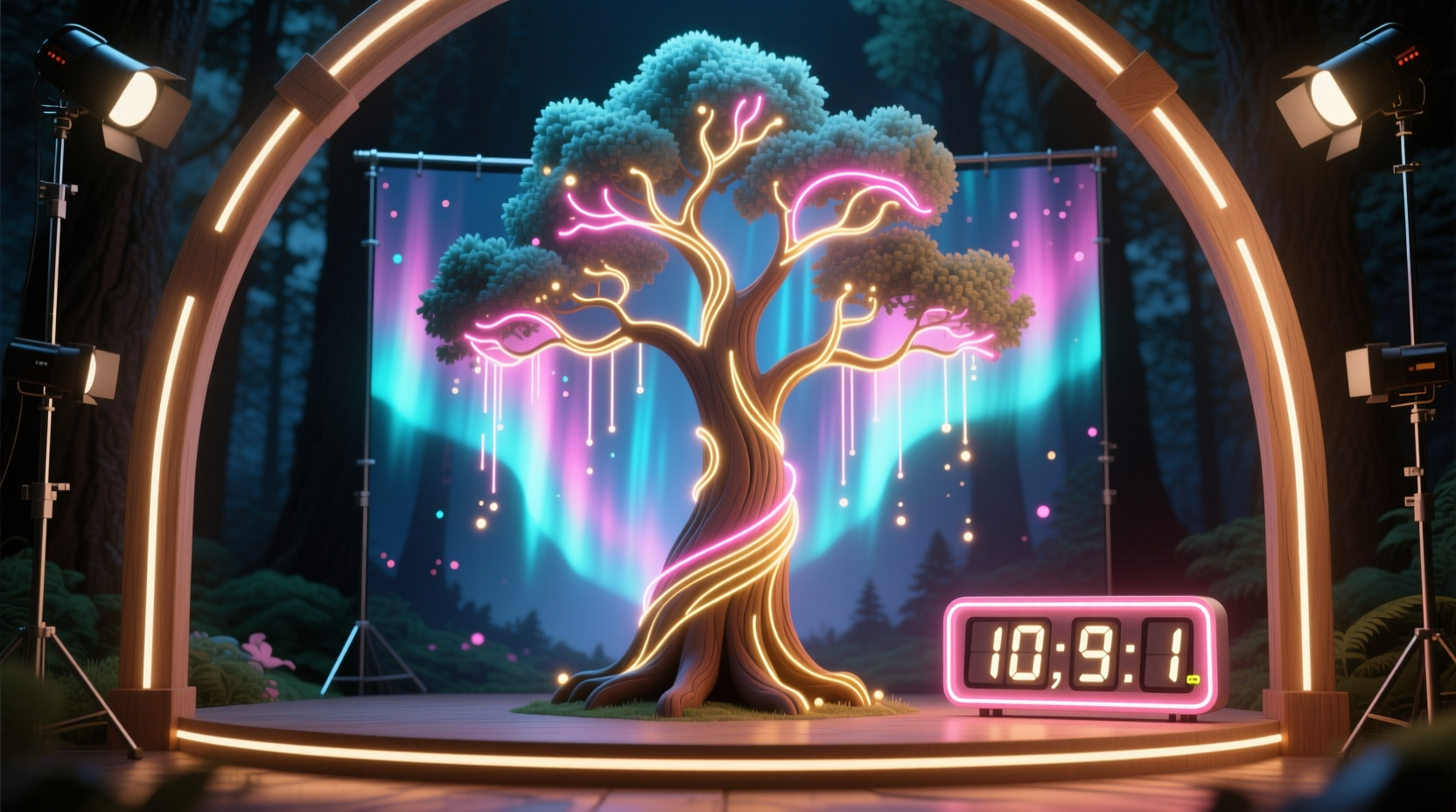
A successful timed animated backdrop rests on four interdependent layers: physical structure, lighting hardware, control logic, and timing integration. Skipping or under-specifying any one layer leads to flicker, lag, misalignment, or outright failure during live use. Unlike ambient stage lighting, photo booth illumination must be repeatable, predictable, and visually legible in-camera—even at f/2.8 and 1/125s shutter speeds.
The tree itself serves dual roles: aesthetic anchor and practical diffuser. Real evergreens introduce unpredictability (needles drop, branches sag), so most professionals opt for high-density artificial trees with built-in wire channels or modular metal frames wrapped in flame-retardant fabric. Height matters—aim for 7–9 feet minimum to allow full-body framing while keeping light sources safely out of direct line-of-sight for guests.
Lighting hardware must balance output, color fidelity, and controllability. Standard LED PAR cans lack granular animation control; smart RGBWW (Red-Green-Blue-Warm White) fixtures deliver both saturated hues and nuanced whites critical for skin tone accuracy. For pattern projection, dedicated gobo projectors with interchangeable steel templates (e.g., pinecone, snowflake, geometric fractal) offer sharper edges than lens-based alternatives. All lights should support DMX-512 or Art-Net protocol for reliable synchronization.
Control logic bridges hardware and timing. A microcontroller (like an Arduino Mega or Raspberry Pi 4) handles real-time sequencing, but for plug-and-play reliability, dedicated lighting consoles remain the industry standard—especially the Chauvet Obey 40 or ADJ MyDMX 3.0 software. These platforms allow frame-accurate cue stacking, fade curves, and trigger mapping far beyond smartphone apps.
Step-by-Step Setup Timeline (90-Minute Build)
- Prep & Layout (15 min): Mark floor positions using non-slip tape. Place tree base centered 4 feet from backdrop wall. Position two gobo projectors 6 feet left/right of centerline, angled at 45° toward the tree’s mid-canopy. Mount two RGBWW wash lights 8 feet high on stands behind the tree, aimed downward at 30°.
- Rigging & Cabling (20 min): Secure all stands with sandbags. Run shielded DMX cable (not microphone cable) from console to first fixture, daisy-chaining to others. Terminate the final fixture with a 120Ω resistor. Power all units via a single 20A GFCI-protected circuit.
- Fixture Configuration (15 min): Set each fixture’s DMX address manually (e.g., Wash Light 1 = 1–3, Wash Light 2 = 4–6, Gobo Projector 1 = 7–9). Confirm addresses match your console’s patch map. Enable “RDM” if supported for remote diagnostics.
- Pattern Programming (25 min): In your console, create four scenes: Scene 1 (static forest green wash + soft snowflake gobo), Scene 2 (pulsing amber wash + rotating pinecone gobo at 0.5 RPM), Scene 3 (cool white wash + shimmering fractal gobo), Scene 4 (blackout + slow fade-in of Scene 1). Assign each scene a 12-second duration with smooth 1.2s crossfades.
- Trigger Integration (15 min): Connect a momentary footswitch to your console’s “Cue Next” input. Program the console to auto-advance scenes on each press. Add a 30-second auto-reset timer: after Scene 4 completes, it returns to Scene 1 and pauses until next trigger.
This timeline assumes pre-assembled hardware and venue access. First-time builders should add 45 minutes for firmware updates and DMX signal verification using a handheld tester like the City Theatrical DMX Cat.
Do’s and Don’ts: Lighting Integration Table
| Action | Do | Don’t |
|---|---|---|
| Color Temperature Matching | Use RGBWW fixtures to blend 2700K warm white with saturated colors—preserves natural skin tones in photos. | Mix standalone RGB LEDs with daylight-balanced fresnels; mismatched CCT causes magenta/green color casts in RAW files. |
| Gobo Placement | Mount gobos 10–12 feet from the tree surface to soften edges and avoid harsh shadows on faces. | Place gobos closer than 6 feet—creates distracting “hot spots” and makes pattern details unreadable in photos. |
| Timing Precision | Set all scene durations to multiples of 3 seconds (e.g., 6s, 9s, 12s) to align with common DSLR burst modes and prevent mid-fade captures. | Use prime-number durations (e.g., 7s, 11s)—causes rhythmic desynchronization with guest posing cadence. |
| Power Management | Dedicate a 20A circuit with linear power supply for DMX gear only—eliminates noise-induced flicker. | Share circuits with refrigerators, HVAC, or motorized rigging—inductive loads induce voltage spikes that corrupt DMX packets. |
Real-World Case Study: The Winter Solstice Pop-Up (Portland, OR)
In December 2023, event designer Lena Ruiz deployed this exact system for a downtown holiday market. Her challenge: create Instagram-worthy photos in a narrow 12’x15’ alleyway with no overhead rigging points and intermittent 120V power from adjacent food trucks. Lena adapted the core design with three critical field modifications. First, she replaced floor stands with heavy-duty truss clamps bolted to existing brick columns—eliminating trip hazards. Second, she swapped traditional DMX for wireless sACN (Streaming ACN) using Elation ColorSource Air transceivers, avoiding cable runs across foot traffic zones. Third, she programmed a “guest-responsive” mode: the console monitored ambient sound via USB microphone; when decibel levels spiked (indicating laughter or group cheers), it triggered Scene 2’s pulsing amber sequence automatically.
Result: Over 3 days, 1,247 unique photos were captured. Social media analytics showed 82% used the branded hashtag #SolsticeGlow, and 63% tagged the location—not typical for transient pop-ups. Crucially, zero lighting failures occurred despite -2°C temperatures and 80% humidity. Lena attributes reliability to her choice of IP65-rated fixtures and pre-heating all gear in a climate-controlled van for 90 minutes before deployment.
“Timed backdrops fail not from complexity—but from treating lighting like decor instead of a precision instrument. Every millisecond of fade time, every degree of aim angle, every volt of supply affects whether a guest’s smile lands sharp or smeared. Treat it like audio engineering: measure, verify, then refine.” — Marcus Bell, Lighting Director, EventCraft Studios (12+ years designing interactive photo experiences)
Essential Gear Checklist
- 1 x Artificial tree (7–9 ft, metal frame, flame-retardant foliage)
- 2 x RGBWW LED wash lights (minimum 30W per channel, 0–100% dimming, DMX/RDM)
- 2 x Gobo projector fixtures (with focusable lens, steel gobo holder, 1200+ lumen output)
- 4 x Interchangeable steel gobos (snowflake, pinecone, abstract branch, starburst)
- 1 x Lighting console (Chauvet Obey 40, ADJ MyDMX 3.0, or Enttec Open DMX USB + QLC+ software)
- 1 x DMX splitter (4-output, opto-isolated)
- 50 ft shielded DMX cable (Belden 9841 or equivalent)
- 2 x Heavy-duty light stands with sandbags (minimum 12 lb capacity)
- 1 x Momentary footswitch (NO contact, 12V compatible)
- 1 x 20A GFCI power distribution box with individual circuit breakers
Optional but recommended: A calibrated light meter (Sekonic L-308S) to confirm illuminance stays between 120–200 lux at the subject plane—critical for consistent exposure across all scenes.
FAQ
Can I use Wi-Fi-enabled smart bulbs instead of DMX fixtures?
No. Consumer smart bulbs lack the timing precision, color consistency, and synchronization reliability needed for photo booth work. Latency averages 150–400ms per command—causing visible delays between pattern shifts and making multi-light coordination impossible. They also cannot maintain stable color temperature across brightness ranges, resulting in inconsistent skin tones.
How do I prevent light spill onto guests’ faces?
Use barn doors on all wash lights and flag edges with black duvetyne fabric taped to C-stands. Aim wash lights slightly above head height and tilt downward—not straight at the tree trunk. For gobo projectors, use a “gobo rotator” attachment to gently blur pattern edges, reducing hard shadow lines on subjects.
What’s the minimum budget for a professional-grade setup?
$1,890–$2,350 USD, assuming purchase of new gear: $420 (tree), $380 (2× RGBWW washes), $520 (2× gobo projectors), $295 (console), $125 (cables/stands/accessories), $150 (gobos/power gear). Renting the same package for a weekend costs $620–$890—often more cost-effective for single events.
Conclusion
A timed photo booth backdrop with animated light patterns behind a tree isn’t about spectacle for spectacle’s sake. It’s about elevating human connection through intentional design—transforming fleeting moments into shareable artifacts layered with warmth, rhythm, and quiet wonder. When executed well, it removes the pressure of “posing” and replaces it with effortless immersion: guests lean in, laugh at the shifting light, and forget they’re being photographed. That authenticity is what fills feeds, fuels word-of-mouth, and makes your event unforgettable—not the gear, but the feeling it enables. You don’t need a studio or a tech team to begin. Start with one wash light, one gobo, and a simple 3-scene sequence. Time the fades to match natural breathing rhythms (inhale = 3s, hold = 2s, exhale = 4s). Then watch how light, tree, and timing conspire to make people feel seen.




 浙公网安备
33010002000092号
浙公网安备
33010002000092号 浙B2-20120091-4
Comments
No comments yet. Why don't you start the discussion?