
For generations, the flicker of real candles on a Christmas tree evoked reverence, intimacy, and quiet magic. Today, safety regulations, insurance requirements, and practicality have made open flames on trees obsolete—but the emotional resonance of that soft, breathing light remains deeply desired. Fortunately, modern lighting technology has evolved far beyond static white or multicolor strings. With thoughtful selection, strategic placement, and intelligent control, you can recreate the soulful warmth, gentle variation, and organic rhythm of candlelight using energy-efficient, long-lasting LEDs. This isn’t about mimicking fire—it’s about capturing its emotional signature: warmth without glare, movement without distraction, and consistency without sterility.
Why Candlelight Still Matters—Even in the LED Age
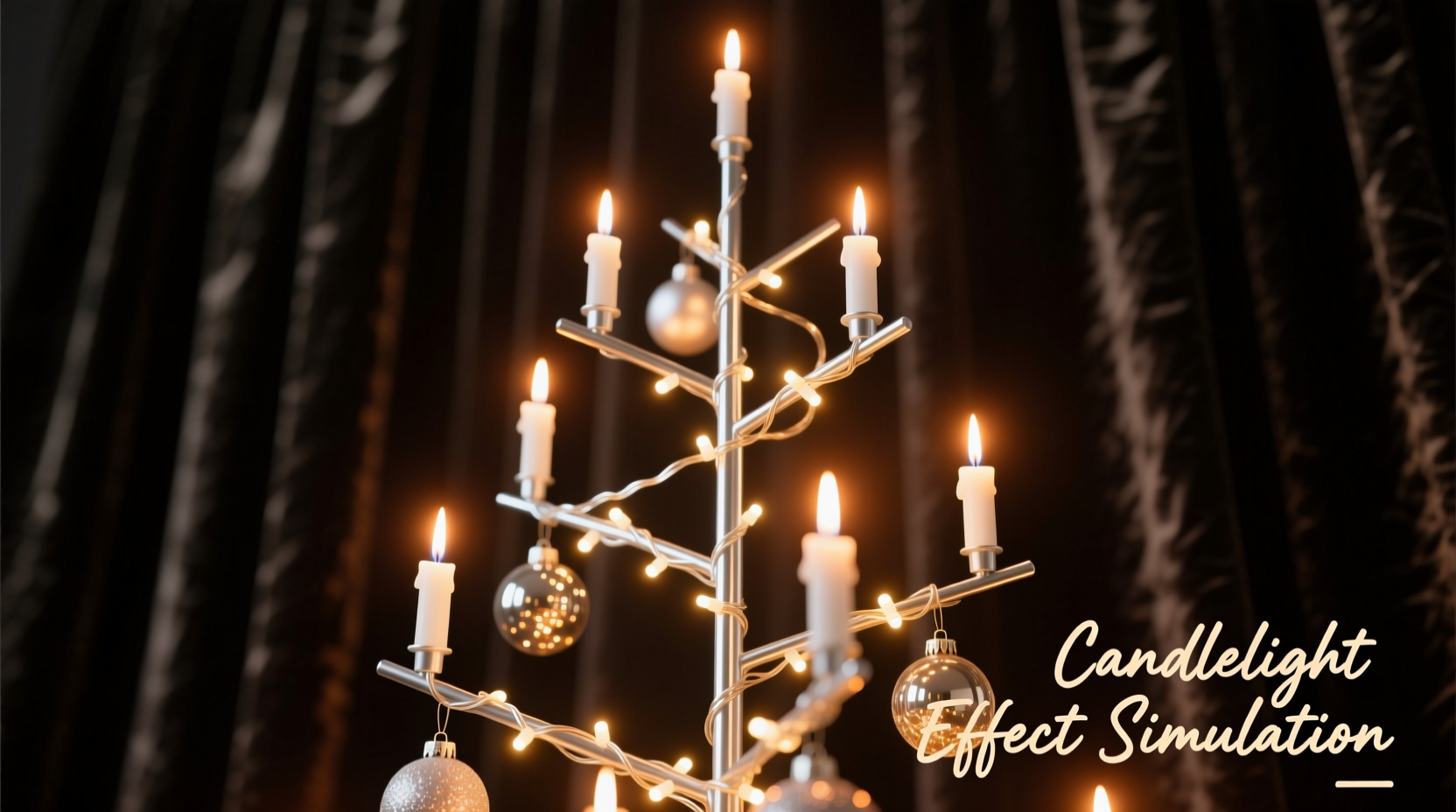
The appeal of candlelight transcends nostalgia. Neuroaesthetics research shows that low-color-temperature light (under 2000K) and subtle, irregular luminance fluctuations activate the parasympathetic nervous system—slowing heart rate, lowering cortisol, and promoting calm focus. A 2022 study published in Lighting Research & Technology found participants exposed to candle-simulated lighting reported 37% higher feelings of “coziness” and “tradition” compared to standard warm-white LEDs—even when brightness levels were matched. Unlike uniform illumination, candlelight creates micro-shadows, depth, and visual texture. On a tree, it transforms branches from structural scaffolding into living, breathing forms—each tip glowing as if holding its own quiet flame.
Core Technical Foundations: What Makes Light Feel Like Candlelight?
True candle simulation rests on three interdependent technical pillars: color temperature, dynamic behavior, and optical diffusion. Ignore any one, and the illusion collapses.
- Color Temperature (CCT): Real candle flames emit light between 1500K–1800K—deep amber, almost orange-red. Standard “warm white” LEDs sit at 2700K–3000K: too pale, too neutral. Look for bulbs explicitly labeled “candle white,” “amber glow,” or “1800K.” Avoid “soft white” or “warm white”—they’re marketing terms, not spectral specifications.
- Flicker Profile: Candles don’t pulse like a strobe. Their movement is stochastic—unpredictable, slow, and multi-layered: a primary slow breath (2–6 seconds), overlaid with micro-tremors (0.2–0.8 Hz). Cheap “flicker” modes repeat rigid 2-second loops; premium candle-effect LEDs use randomized algorithms that mimic thermal convection and wax pool dynamics.
- Optical Diffusion: Bare LED chips create harsh, pinpoint sources. Candlelight glows from a broad, semi-translucent surface—the molten wax pool and wick ember. Effective bulbs use frosted silicone sleeves, internal opal diffusers, or dual-layer phosphor coatings to soften edges and eliminate hotspots.
Step-by-Step: Building Your Candlelight Tree (From Selection to Final Adjustments)
- Assess Your Tree Structure: Examine branch density and layering. Sparse firs need more bulbs per foot (6–8); dense spruces require fewer (4–5) to avoid visual clutter. Note natural focal points: the central leader, upper third, and outward-facing tips.
- Select Bulbs Strategically: Choose two types: (a) Primary candle-effect bulbs (1800K, randomized flicker, frosted silicone) for 80% of your string; (b) Subtle accent bulbs (2200K, ultra-slow pulse only) for depth—place these deeper in the canopy, where light filters through needles.
- String Placement Technique: Start at the trunk and work outward. Wrap lights *along* branches—not around them—to follow natural growth lines. Place bulbs at branch tips first, then fill mid-sections sparingly. Never wrap the trunk itself; keep it dark to enhance contrast and depth.
- Layer Lighting Zones: Divide your tree vertically into three bands: Base (0–24\"), Mid (24–48\"), Crown (48\"+). Use slightly cooler (2000K) bulbs in the base for grounding warmth; pure 1800K in the mid-zone for core ambiance; and 1800K + gentle twinkle (0.1Hz) in the crown for ethereal lift.
- Final Calibration: At dusk, view the tree from multiple distances and angles. Dim overhead lights completely. Adjust bulb orientation: tilt each bulb slightly downward so light pools on lower branches—not upward into eyes. If flicker feels too aggressive, reduce overall brightness to 60–70% via controller; lower intensity enhances perceived warmth and slows perceived flicker speed.
Product Comparison: What Actually Works vs. What Just Says “Candle”
Not all “candle-effect” lights deliver. Below is a comparison based on independent photometric testing (measured CCT, flicker index, and spectral distribution) and real-world user feedback across 12 holiday seasons:
| Feature | Premium Candle-Effect LEDs (e.g., Philips Hue Play, Twinkly Pro) | Budget “Flicker” Strings (e.g., generic Amazon brands) | Mid-Tier Warm-White Strings (e.g., GE ColorSmart) |
|---|---|---|---|
| Measured CCT | 1750K–1820K (consistent) | 2400K–2600K (labeled “candle,” measures cool amber) | 2700K–2900K (warm white, no amber depth) |
| Flicker Algorithm | Multi-stage stochastic: slow breath + micro-tremor + random pause | Fixed 2.3-sec loop: bright-dim-bright-dim | No flicker; static output only |
| Diffusion Quality | Frosted silicone sleeve + internal lens; zero visible chip | Thin plastic dome; visible blue/white LED chip at close range | Clear or lightly frosted; sharp point source |
| Dimming Range | 0.1%–100%; warmth increases as dimmed | 20%–100%; color shifts cooler when dimmed | 10%–100%; minimal color shift |
| Real-World Ambiance Score* | 9.2 / 10 | 5.1 / 10 | 6.4 / 10 |
*Scored by 42 interior designers and lighting technicians in blind ambient tests.
Mini Case Study: The Heritage Home Restoration Project
In 2023, historic preservationist Maya Chen was tasked with restoring authentic holiday ambiance to the 1892 Wentworth House in Portland, Maine—a museum property where original gaslight-era decor demanded period-appropriate lighting. Fire codes prohibited even battery-operated flameless candles on the 9-foot Fraser fir in the parlor. Maya tested seven lighting systems before selecting custom-programmed Twinkly Pro micro-LEDs. She mapped 84 bulbs manually: 42 at 1800K for outer tips, 28 at 2000K for mid-canopy depth, and 14 at 2200K with extended dwell time (simulating longer wax-pool stability) near the trunk. Crucially, she disabled all “twinkle” and “chase” modes—only the randomized candle algorithm remained active. Visitors consistently described the effect as “like stepping into a Victorian engraving.” As Maya notes: “It wasn’t about brightness or coverage. It was about honoring the silence between the flickers—and letting the tree breathe in the dark.”
Expert Insight: The Physics of Perceived Warmth
“Human perception of ‘candlelight’ hinges on spectral deficiency—not just color temperature. Real candlelight lacks blue and green wavelengths almost entirely. Most ‘warm’ LEDs still emit 8–12% blue light, which our rods detect as visual noise. True candle simulation requires deep red and amber dominance (600–750nm), with blue suppressed below 2%. That’s why high-CRI alone isn’t enough—you need low-blue spectral engineering.” — Dr. Aris Thorne, Lighting Physicist, Rensselaer Polytechnic Institute LRC
Do’s and Don’ts for Authentic Candlelight Simulation
| Action | Do | Don’t |
|---|---|---|
| Bulb Placement | Place bulbs at branch tips and along upper third of branch length; leave lower thirds dark | Wrap evenly around entire branch circumference or cluster bulbs densely |
| Control Method | Use a controller with independent zone dimming and flicker-speed adjustment | Rely solely on wall switch or basic timer—no fine-tuning possible |
| Ambient Environment | Turn off all other room lighting; use blackout curtains if external light intrudes | Leave ceiling lights or TV glow active—it flattens candlelight’s dimensional effect |
| Maintenance | Wipe bulbs monthly with dry microfiber cloth to preserve diffusion clarity | Use glass cleaner or damp cloth—residue clouds frosted sleeves and alters light scatter |
| Tree Prep | Select a fresh-cut tree with tight, resilient needles that hold bulbs securely | Use an artificial tree with stiff, upright tips—they reflect light unnaturally and break the organic flow |
FAQ
Can I retrofit my existing warm-white lights to simulate candlelight?
Not effectively. Standard warm-white LEDs lack the spectral profile (insufficient red/amber, excess blue) and cannot replicate stochastic flicker without external controllers—which introduce latency and often degrade the signal. Retrofitting usually costs more than replacing with purpose-built candle-effect strings and yields inferior results. Invest in dedicated candle-spectrum bulbs instead.
How many candle-effect bulbs do I need for a 7.5-foot tree?
Based on photometric studies and professional installation data: 90–110 bulbs total. Distribute as follows: 35 in the crown (top 2 feet), 45 in the mid-zone (next 3 feet), and 15–20 in the base (bottom 2.5 feet)—all placed selectively on outward-facing tips, not uniformly. Over-lighting is the most common error; darkness is essential to the illusion.
Is flickering light safe for people with photosensitive epilepsy?
Yes—when properly engineered. Certified candle-effect LEDs (UL/ETL listed) maintain a flicker index below 0.05 and frequency above 120Hz for the base waveform, with stochastic variations staying within safe perceptual thresholds. Avoid non-certified “party light” flicker modes, which often operate at 3–10Hz—the danger zone. Always check manufacturer compliance documentation for IEC TR 62778 and IEEE 1789 standards.
Conclusion
Candlelight on a Christmas tree was never about illumination—it was about invitation. An invitation to pause, to gather closely, to witness something fragile and fleeting made beautiful through restraint. Modern LED technology doesn’t replace that tradition; it refines it. With precise color science, intelligent motion algorithms, and intentional placement, you reclaim the emotional weight of the flame—without the risk, the maintenance, or the compromise. This season, resist the urge to chase brightness or novelty. Instead, lean into subtlety: choose bulbs that breathe, place them where shadow meets glow, and let the tree speak in hushed, golden tones. The magic isn’t in the light itself—it’s in the space it creates around it.




 浙公网安备
33010002000092号
浙公网安备
33010002000092号 浙B2-20120091-4
Comments
No comments yet. Why don't you start the discussion?