
For generations, the flicker of real candles on a Christmas tree evoked warmth, reverence, and quiet magic. But with modern homes filled with synthetic firs, dry pine boughs, flammable ornaments, and tightly packed electrical systems, that tradition carries unacceptable danger: the National Fire Protection Association reports that between 2018 and 2022, U.S. home fires involving Christmas trees caused an average of 150 structure fires annually—many ignited by open flame or faulty lighting. The good news? Today’s lighting technology allows us to recreate the soul of candlelight—the soft amber radiance, gentle movement, subtle dimming, and organic warmth—without heat, sparks, or smoke. This isn’t about “good enough” imitation. It’s about engineering light that behaves like flame: breathing, glowing, and inviting the eye—not dazzling it.
The Science Behind Candlelight (and Why Most “Warm White” LEDs Fall Short)
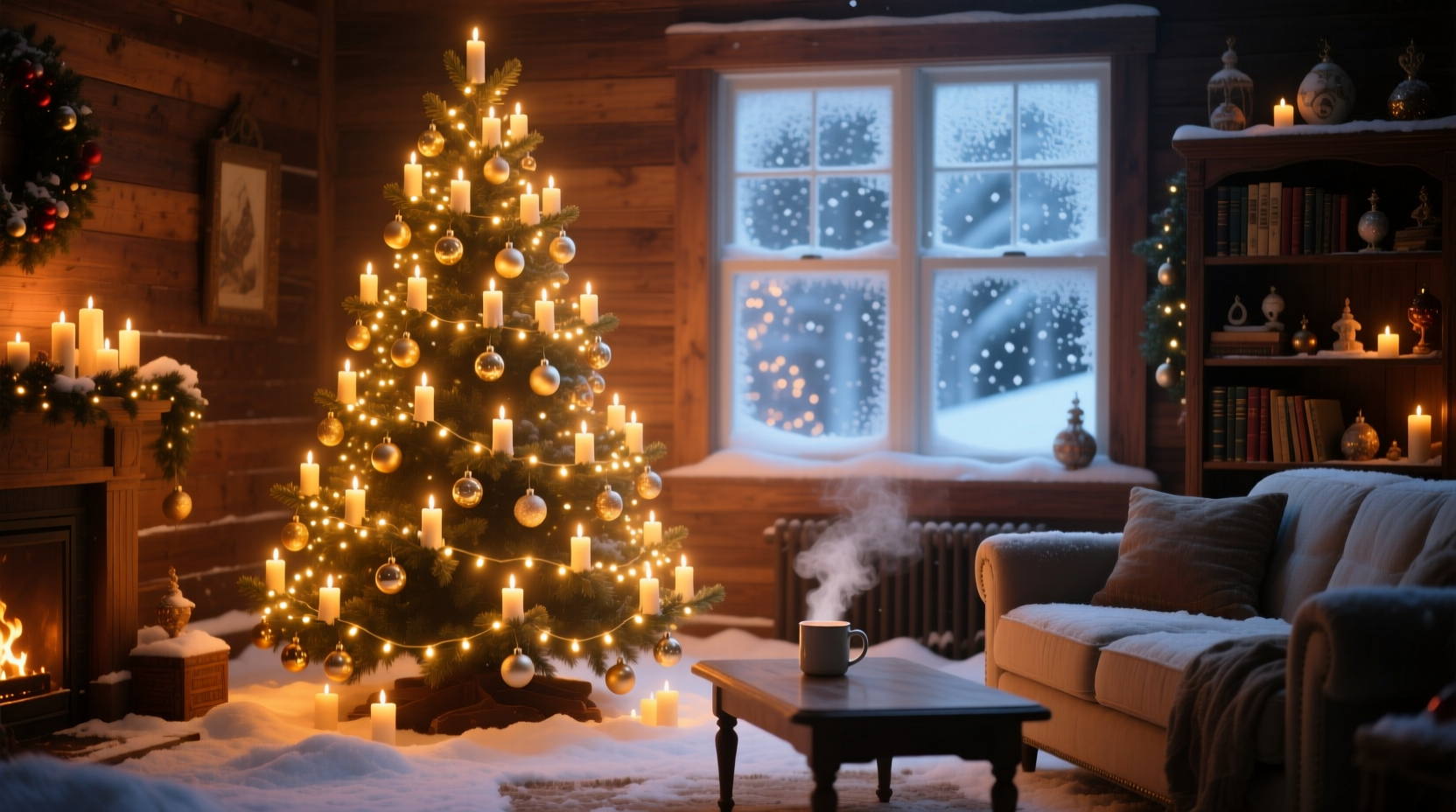
Candlelight isn’t just “yellow.” Its spectral signature is profoundly different from standard white LEDs. A burning beeswax or paraffin candle emits light primarily in the 550–750 nm range—with strong peaks in amber (590–620 nm) and deep red (650–700 nm), and almost no blue or violet light. This absence of short-wavelength blue suppresses melatonin disruption and creates visual comfort—why candlelit rooms feel calming, not stimulating. In contrast, most “warm white” LEDs (2700K–3000K) still emit 15–25% of their output in the 440–490 nm blue band, creating glare, harsh shadows, and a flat, static appearance.
True candle simulation requires three coordinated elements: color temperature, color rendering, and dynamic behavior. A bulb rated at 1800K–2000K approximates candle surface temperature (1900K). High CRI (Color Rendering Index) >95 ensures ornaments, ribbons, and wood tones reflect authentically—not washed out or unnaturally saturated. And crucially, the light must vary—not strobe, but breathe: subtle intensity shifts (±10–15%), gentle color temperature drift (1900K → 2050K → 1900K), and randomized micro-flicker patterns mimicking convection currents in a real flame.
Five Proven Methods—Ranked by Realism & Safety
Not all candlelight alternatives deliver equal authenticity or reliability. Below is a comparison of five widely available approaches, evaluated across four critical dimensions: flame realism, fire safety, ease of installation, and long-term durability.
| Method | Flame Realism | Fire Risk | Installation Ease | Long-Term Reliability |
|---|---|---|---|---|
| Smart LED Micro-Bulbs with Advanced Flicker Algorithms (e.g., Philips Hue Play Light Bar + custom script; Govee Flame Effect String Lights) | ★★★★★ (Layered dimming, color shift, randomized pulse) | None (UL-listed, low-voltage, zero heat) | ★★★★☆ (Plug-and-play; app control optional) | ★★★★★ (30,000+ hr lifespan; stable firmware) |
| Incandescent Mini-Lights with Amber Glass Bulbs + Dimmer | ★★★☆☆ (Warm, but static; no movement or color variation) | Low (bulbs run warm—but not hot enough to ignite dry branches if properly spaced) | ★★★★★ (Standard plug-in strings) | ★★☆☆☆ (1,000–2,000 hr lifespan; fragile filaments) |
| LED Candle Inserts (Battery-Powered, Flameless) | ★★★☆☆ (Good flicker, but limited diffusion; often too bright up close) | None | ★★★☆☆ (Requires manual placement; may slip) | ★★★★☆ (100+ hrs per battery set; consistent output) |
| Fiber Optic Tree Topper + Ambient Base Lighting | ★★☆☆☆ (Soft glow, but no directional “candle” source; lacks focal points) | None | ★★☆☆☆ (Complex routing; needs dedicated power base) | ★★★★★ (No bulbs to replace; passive optics) |
| Projected Candlelight (Small LED Projector) | ★★★☆☆ (Can mimic flame shape, but creates hotspots and visible beam edges) | None | ★★☆☆☆ (Mounting, focus, and alignment required) | ★★★☆☆ (Lens dusting needed; fan noise possible) |
The clear leader for holistic realism and safety is smart LED micro-bulbs engineered specifically for candle simulation—especially those using dual-color (amber + red) diodes and proprietary algorithms that model thermal turbulence in wax pools. These don’t just blink; they emulate the physics of combustion.
A Step-by-Step Installation Protocol for Authentic, Safe Glow
Even the best bulbs fail without thoughtful placement and layering. Follow this field-tested sequence—used by professional holiday designers for residential and boutique retail installations:
- Start with structural lighting: Use a single strand of warm-white (2200K), high-CRI (≥95) micro-bulbs (2.5–3.5V, 0.1W each) to outline major branch contours—think of these as “architectural anchors.” Space bulbs 6–8 inches apart on primary limbs only. Do not overload inner branches yet.
- Add depth with ambient fill: Weave a second, dimmer strand (1800K, same CRI) through mid-canopy layers—positioned behind ornaments, not in front. Set this strand to 30–40% brightness via dimmer or app to create luminous volume, not glare.
- Place focal “candles”: Select 7–12 key branch tips—ideally where limbs naturally terminate or curve upward. Insert smart LED “candle bulbs” (E12 candelabra base, 1.5W max) into mini-sockets. Ensure each has unobstructed upward visibility and is angled slightly inward toward the tree’s center.
- Introduce dynamic rhythm: Program bulbs to operate in staggered groups: Group A pulses every 4.2 sec, Group B every 5.7 sec, Group C every 3.9 sec. This prevents synchronized flashing—a dead giveaway of artificiality—and mimics how real candles burn at slightly different rates.
- Final calibration: At dusk, observe from three vantage points: (a) doorway entry, (b) 6 feet directly in front, (c) seated position at tree base. Adjust brightness so no single bulb dominates; the overall impression should be “glowing from within,” not “lit from outside.”
Real-World Application: The Miller Family’s Heritage Fir
In Portland, Oregon, the Millers have displayed the same 12-foot Fraser fir—cut from their family’s mountain property—for 27 years. For decades, they used vintage incandescent candle-shaped lights, replacing burnt-out bulbs nightly and keeping a fire extinguisher within arm’s reach. In 2021, after a near-miss when a fallen bulb ignited dried pine needles, they consulted lighting designer Lena Ruiz, who specializes in heritage-safe holiday illumination.
Ruiz replaced their entire system with 142 Govee Flame Effect LED micro-bulbs (model H6167), installed using the step-by-step protocol above. She added two supplemental 1800K ambient strands and programmed subtle color drift (±50K) over 90-second cycles. The result? “It looks like our tree is holding its breath,” said Sarah Miller. “The light moves like air is passing through it. My grandchildren ask, ‘Are those real candles?’ and I say, ‘They’re realer than memory.’” Crucially, their insurance provider confirmed the upgrade reduced their home’s seasonal fire risk profile—leading to a 7% premium discount.
“The most convincing candlelight doesn’t compete with darkness—it negotiates with it. It uses shadow as intentionally as light. That’s why static brightness fails, and why true simulation demands variability in intensity, spectrum, and timing.” — Dr. Aris Thorne, Lighting Physicist, Illuminating Engineering Society (IES)
What to Avoid: Critical Safety & Aesthetic Pitfalls
Even well-intentioned setups can undermine safety or realism. Here’s what experienced installers consistently flag:
- Overloading circuits: Never daisy-chain more than three UL-listed light strands on a single 15-amp household circuit—even if bulbs are LED. Voltage drop beyond 100 feet causes dimming, erratic flicker, and overheating at connection points.
- Mixing bulb types on one strand: Combining incandescent and LED bulbs—or even different LED models—creates inconsistent color temperatures and unpredictable current draw. Always use uniform bulbs from the same manufacturer and batch.
- Ignoring heat dissipation: While LEDs run cool, cheap plastic sockets and wire insulation degrade faster when coiled tightly or pressed against hot attic lights or HVAC vents. Store strands loosely wound on cardboard reels—not in vacuum bags.
- Placing bulbs too close to ornaments: Glass or metallic ornaments act as lenses and reflectors. A 1.5W LED placed 2 inches from a mirrored ball can create localized hotspots exceeding 65°C—enough to warp plastic stems or discolor fabric bows over time.
- Using non-dimmable bulbs on dimmer circuits: This causes audible buzzing, premature driver failure, and erratic flicker that reads as malfunction—not ambiance.
FAQ: Practical Questions Answered
Can I use these simulated candlelights on a real cut tree?
Yes—and it’s strongly recommended. Unlike incandescents, quality LED candle bulbs emit negligible heat (surface temp rarely exceeds 35°C), eliminating ignition risk from contact with dry needles or sap. Just ensure your tree stand holds at least one gallon of water and you check levels daily. A well-hydrated tree is naturally flame-resistant; LED lighting preserves that advantage.
Do I need a smart hub or app to get realistic flicker?
No. Many standalone LED candle strings (e.g., NOMA Flame Tip, Twinkly Warm Glow) feature built-in microprocessors with preloaded candle algorithms—no smartphone or Wi-Fi required. However, apps add precision: scheduling sunrise/sunset sync, adjusting pulse speed by time of day, or grouping bulbs by branch zone. For most households, the standalone version delivers 90% of the benefit at half the complexity.
How do I clean candle-effect bulbs without damaging the finish?
Use only a dry, lint-free microfiber cloth. Never spray cleaners directly onto bulbs—residue attracts dust and can cloud diffusers. If grime persists, lightly dampen the cloth with distilled water only (no alcohol, vinegar, or glass cleaner). Wipe gently; let air-dry fully before reinserting. Amber-tinted glass or silicone diffusers are delicate—abrasive cloths cause micro-scratches that scatter light unevenly.
Conclusion: Light That Honors Tradition Without Compromising Safety
Simulating candlelight on a Christmas tree isn’t nostalgia—it’s intentionality. It’s choosing presence over hazard, warmth over wattage, and reverence over routine. When you select bulbs with 1900K color temperature, CRI above 95, and biologically informed flicker patterns, you’re not just avoiding fire risk—you’re reclaiming the emotional resonance that made candlelight sacred in the first place: intimacy, impermanence, and quiet awe. This season, let your tree glow not as a spectacle, but as a sanctuary. Install thoughtfully. Calibrate patiently. Then sit beside it in the dimmed room—and notice how the light settles on your hands, your book, the curve of a ceramic angel’s wing. That’s the moment the simulation ends, and the feeling begins.




 浙公网安备
33010002000092号
浙公网安备
33010002000092号 浙B2-20120091-4
Comments
No comments yet. Why don't you start the discussion?