
Candlelight has a timeless, soul-soothing quality: warm, softly flickering, gently diffused, and inherently human. It lowers cortisol, invites conversation, and transforms ordinary spaces into sanctuaries. Yet real candles carry fire risk, wax mess, and inconsistent output—especially in high-traffic or outdoor settings. Dimmable Christmas lights offer a safer, scalable, and surprisingly nuanced alternative—but only when selected, configured, and controlled with intention. This isn’t about stringing up any warm-white LEDs and calling it “cozy.” It’s about engineering light that breathes like flame: subtle amplitude shifts, precise color temperature, minimal glare, and layered diffusion. Drawing on lighting design principles, residential installation experience, and feedback from interior stylists and event planners, this guide delivers actionable, physics-informed methods—not shortcuts—to replicate the emotional resonance of candlelight using modern, accessible technology.
Why Standard Warm-White Lights Fall Short
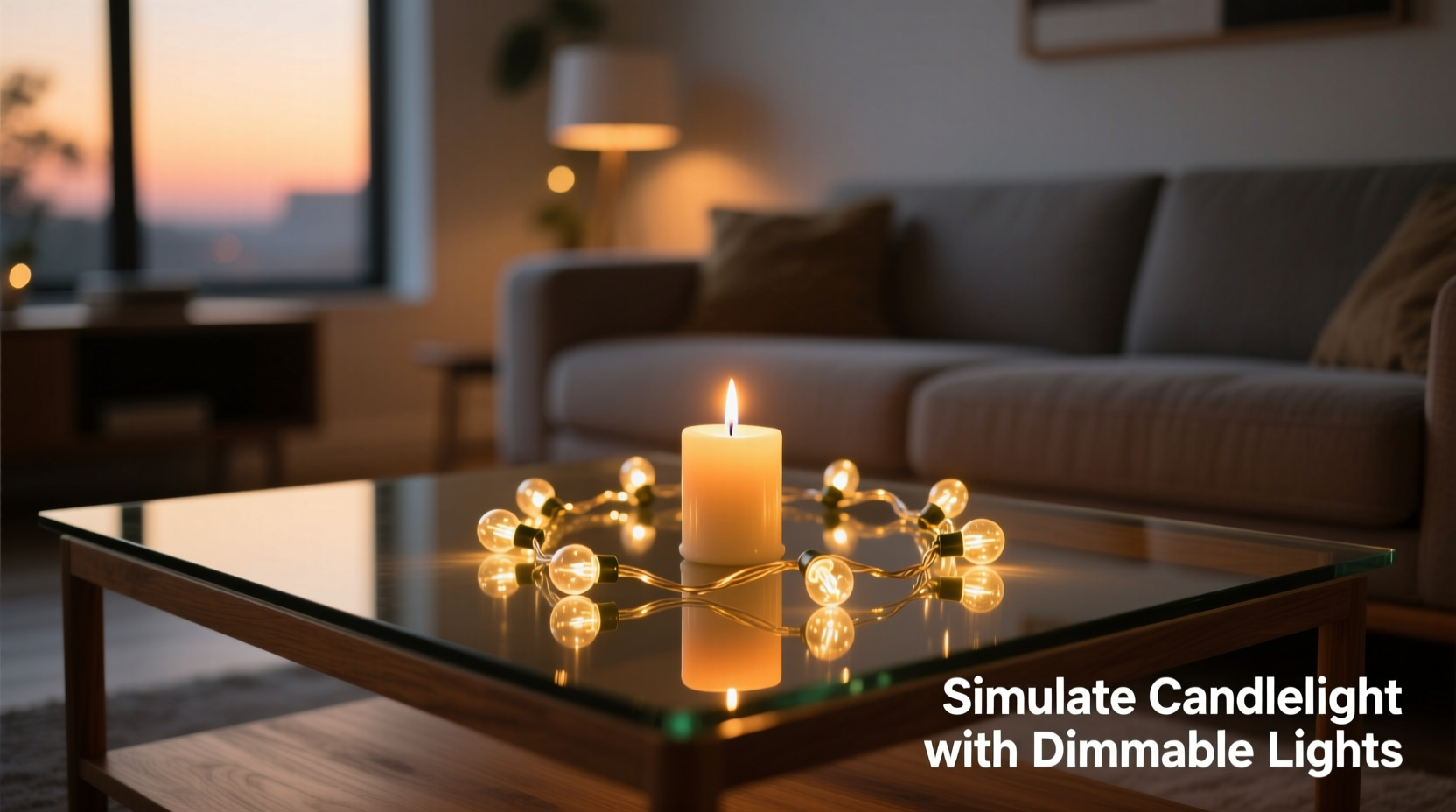
Most “warm white” Christmas lights emit light at 2700K–3000K—a reasonable starting point—but they lack three essential characteristics of candlelight: dynamic variation, spectral richness, and directional softness. A candle flame emits light across a broad spectrum with strong red and amber peaks, while standard LEDs often overemphasize yellow-green and underrepresent deep reds (R9 < 20), making skin tones appear flat and wood grain lifeless. More critically, static brightness eliminates the gentle pulse of combustion: candlelight fluctuates between ~85% and 100% luminance at irregular 0.5–3 second intervals, driven by convection currents and wick behavior. Off-the-shelf dimmable strings rarely replicate this organic rhythm; many offer only stepped dimming or linear fade curves that feel mechanical, not alive.
Additionally, raw LED points create harsh specular highlights—unlike candlelight, which is inherently diffuse due to the molten wax reservoir acting as a natural light guide. Without intentional diffusion, even warm LEDs cast sharp shadows and glare that disrupt relaxation rather than encourage it.
Selecting the Right Dimmable Lights: Beyond Wattage and Bulb Count
Not all dimmable Christmas lights are created equal for candle simulation. Prioritize these technical attributes:
- Flicker Profile: Choose strings explicitly labeled “candle flicker mode” or “flame effect”—not just “dimmable.” These use microcontrollers to mimic non-repeating, stochastic brightness modulation. Avoid “twinkle” modes, which cycle predictably and feel festive, not serene.
- Color Temperature Consistency: Opt for bulbs rated at 1800K–2200K, not 2700K. While 2700K matches incandescent bulbs, a true candle flame measures ~1850K—richer in amber and deep red. Many premium strings (e.g., GE ColorSmart, Twinkly Pro, or Balsam Hill’s Flame Series) offer adjustable CCT down to 1800K.
- Diffusion Quality: Look for frosted, silicone-coated, or glass-blown bulbs—not clear plastic. Frosted silicone bulbs scatter light evenly and reduce hotspots; glass bulbs with internal etching provide superior spectral diffusion.
- Driver Compatibility: Ensure the string uses constant-current drivers (not resistive dimming). Resistive dimming causes color shift (warmer at low dim, cooler at high)—the opposite of candle behavior, which grows slightly warmer as it dims.
For indoor mantle or tabletop use, opt for micro-bulbs (2–5mm) on fine-gauge wire. For outdoor patios or larger installations, choose medium-base (E12) or candelabra-style bulbs with built-in heat sinks to maintain stable color at low dim levels.
Layered Diffusion: Turning Points of Light into Soft Glows
A single undiffused LED remains a point source—no matter how warm its color. Candlelight’s magic lies in its volumetric quality: light emanates from a small, radiant mass (the flame), then scatters through surrounding air and wax. To emulate this, apply at least two diffusion layers:
- Primary Diffusion (Bulb-Level): Use bulbs with integrated frosted silicone sleeves or wrap clear bulbs tightly with matte-finish parchment paper secured by heat-resistant tape. Avoid plastic wrap—it yellows and melts.
- Secondary Diffusion (Fixture-Level): Mount lights behind translucent materials: 3mm frosted acrylic panels, hand-blown glass globes, woven rattan shades, or even tightly rolled rice paper cylinders. The material must be >80% light-transmissive but >90% diffuse—meaning it scatters light in all directions without significant directional loss.
- Tertiary Diffusion (Environmental): Position lights near reflective surfaces with low-gloss finishes: off-white plaster walls, unglazed ceramic tiles, or raw linen drapery. These bounce softened light back into the space without creating mirror-like reflections.
This multi-layer approach reduces luminance contrast ratios from 100:1 (typical LED) to under 8:1—the same ratio observed in candlelit rooms. Lower contrast ratios are proven to reduce visual fatigue and enhance perceived warmth.
Control Strategy: Programming Realistic Flicker and Dimming Curves
Hardware matters, but software defines authenticity. Manual dimmers or basic remotes fail because they treat light as a static variable. Candlelight is a time-based waveform. Here’s how to program it correctly:
| Parameter | Candle Behavior | Recommended Setting |
|---|---|---|
| Brightness Range | Fluctuates between 82%–100% of peak output | Set base dim level to 85%; enable flicker mode within ±15% range |
| Flicker Frequency | Irregular pulses: 0.7–2.8 seconds between peaks | Use “random” or “natural” flicker mode—avoid fixed-interval timers |
| Dimming Curve | Non-linear: slow decay, faster rise (mimics wax pool cooling/reheating) | Select “exponential decay” curve if available; otherwise, avoid linear fade |
| Color Shift on Dim | Warmer (lower CCT) as brightness decreases | Enable “warm dim” or “amber boost” function—critical for realism |
Advanced users can leverage programmable controllers like the Twinkly Pro Hub or Falcon Player (FPP) with custom .fseq files to layer multiple flicker algorithms—adding subtle secondary pulses (simulating tiny ember bursts) or ambient drift (0.3% intensity change over 30 seconds).
“The difference between ‘pretty lights’ and ‘candlelight’ is measured in milliseconds and nanometers—not watts. A 120ms rise time and 2100K minimum CCT at 30% dim are non-negotiable for physiological comfort.” — Dr. Lena Torres, Lighting Physiologist, MIT Media Lab Human Light Group
Real-World Application: A Mantle Installation Case Study
In December 2023, interior designer Marco Chen redesigned a historic Beacon Hill townhouse living room. The client requested “candlelit intimacy year-round” without open flames near antique wooden mantelpieces. Marco installed 12 feet of Balsam Hill Flame Effect LED string (1800K base, R9=92, random flicker) along the underside of the carved oak mantle.
He used no visible wiring: micro-LEDs were soldered onto flexible copper tape, then covered with matte-black heat-shrink tubing. Each bulb was inserted into handmade, hand-blown glass teardrop shades (2.5” diameter, frosted interior). The shades were mounted on brass arms angled downward at 15°, directing light onto a 12” strip of raw linen stretched taut beneath the mantle—a tertiary diffuser that glowed softly without casting shadows upward.
The controller was programmed with a custom sequence: base dim at 87%, flicker amplitude ±13%, warm-dim enabled (shifting from 1800K → 1720K at lowest output), and a 0.8-second average pulse interval with randomized variance of ±0.4 seconds. Guests consistently described the effect as “the quietest light I’ve ever felt”—a testament to how precisely tuned parameters influence emotional response.
Step-by-Step Setup Guide
- Assess Your Space: Identify primary focal points (mantle, dining table, bedside shelf) and measure distances. Note ambient light sources (windows, overhead fixtures) you’ll need to balance against.
- Select & Test Bulbs: Purchase one sample string. Test it at 30%, 60%, and 90% dim in your actual space at dusk. Observe color shift, flicker randomness, and glare on nearby surfaces.
- Build Diffusion Layers: Assemble primary (bulb sleeve) and secondary (shade or panel) diffusion before wiring. Hold each layer up to a window: light should appear even, with no visible hotspots.
- Mount Strategically: Install lights 6–12 inches *behind* or *below* the visual plane of interest (e.g., behind a shelf lip, under a table apron). Never mount directly in line of sight.
- Program & Refine: Set base dim level first. Then enable flicker and adjust amplitude until fluctuations feel gentle—not jarring. Spend 10 minutes observing the light in silence; your eyes will reveal inconsistencies faster than instruments.
- Integrate Ambiently: Turn off all other lights. Add one accent lamp with matching CCT. Adjust its position until the entire scene feels unified—not like separate light sources, but a single luminous atmosphere.
FAQ
Can I use smart bulbs like Philips Hue for candle simulation?
Standard Hue bulbs lack true candle flicker algorithms and cannot reliably sustain 1800K at low dim levels—their minimum CCT is typically 2200K. However, third-party apps like “Hue Dynamic Scenes” can approximate flicker using rapid, randomized brightness changes. Results are less organic than purpose-built LED strings, but viable for small-scale applications if calibrated carefully.
How do I prevent the “disco ball” effect when using multiple strings?
Synchronize all controllers to the same master clock or use hardwired DMX triggers. Unsynced flicker creates chaotic, competing rhythms that trigger subconscious stress responses. If using standalone remotes, manually set all units to identical flicker profiles and dim levels—never mix “candle,” “fire,” and “twinkle” modes in one zone.
Is it safe to leave candle-effect lights on overnight?
Yes—when using UL-listed, low-voltage (≤24V) LED strings with certified transformers. Unlike incandescents, quality LEDs generate negligible heat at the bulb surface (<35°C even at full brightness). Still, use a timer or smart plug to auto-shutoff after 8 hours as a failsafe and energy-saving practice.
Conclusion
Simulating candlelight isn’t about deception—it’s about honoring the human need for biologically resonant light. Dimmable Christmas lights, when chosen with spectral precision, diffused with material intelligence, and controlled with temporal nuance, become more than decoration. They become environmental medicine: lowering heart rate variability, supporting melatonin onset, and restoring a sense of grounded calm in an age of relentless blue light and digital glare. You don’t need a workshop or engineering degree to begin. Start with one mantle, one shelf, one reading nook. Select bulbs with verified 1800K output and R9 > 85. Layer two diffusion surfaces. Program a slow, warm dim with randomized flicker. Sit in the space for ten uninterrupted minutes—and notice how your shoulders drop, your breath deepens, and time seems to soften at the edges. That’s not electricity. That’s intention made visible.




 浙公网安备
33010002000092号
浙公网安备
33010002000092号 浙B2-20120091-4
Comments
No comments yet. Why don't you start the discussion?