
Candlelight has a quiet magic: soft, undulating warmth that feels alive—not static, not clinical, but deeply human. It’s why centuries of holiday traditions center on flame, and why many still feel modern string lights fall short. Yet today’s LEDs offer unprecedented control over color temperature, dimming behavior, and light diffusion—if you know how to harness them intentionally. This isn’t about buying the most expensive “flicker” bulb or relying on preset modes. It’s about understanding the optical qualities of real candlelight—and translating them into deliberate, layered lighting choices using accessible, energy-efficient technology.
What Makes Real Candlelight So Hard to Replicate?
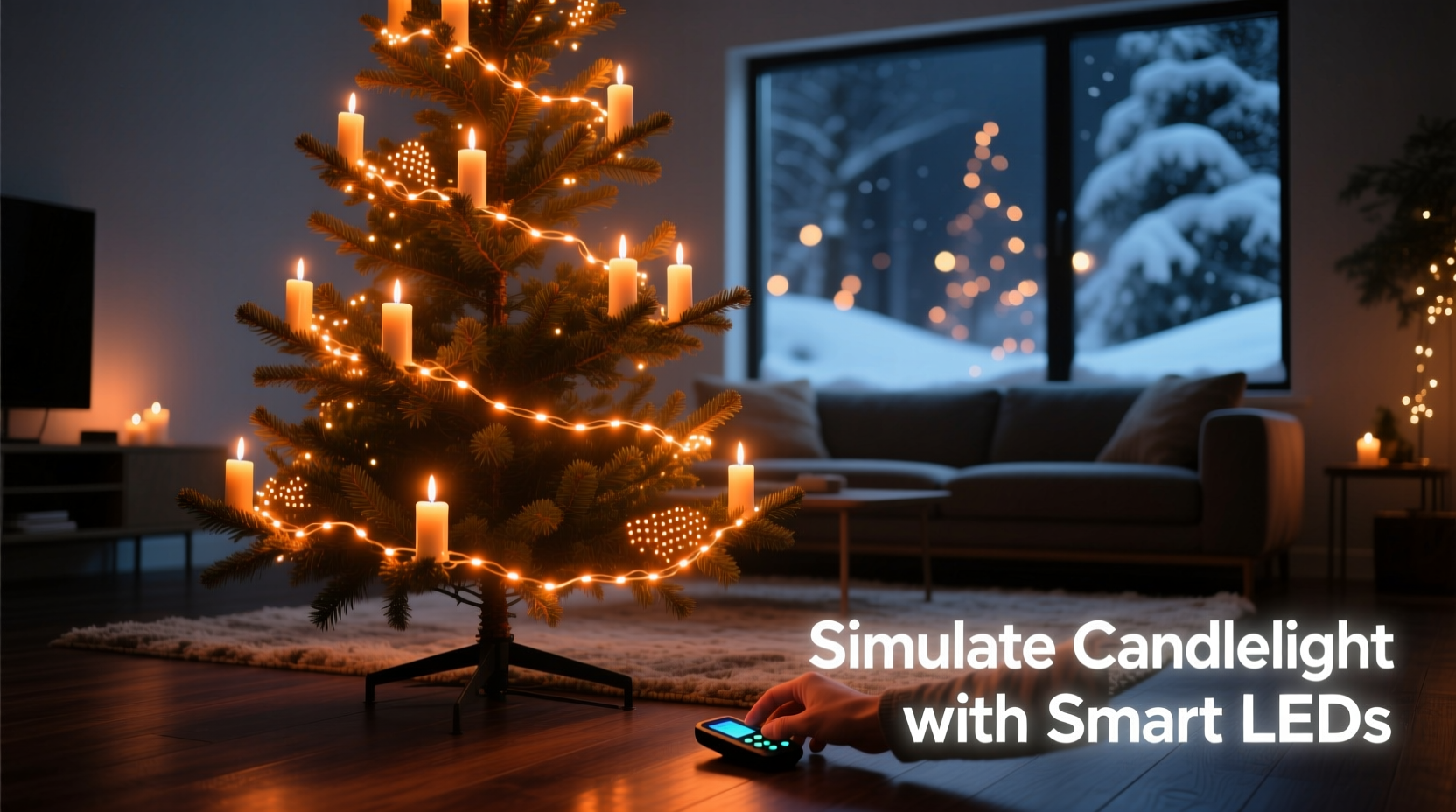
A genuine beeswax or paraffin candle emits light at approximately 1800–2000 Kelvin—a deep, amber-rich warmth far warmer than even “warm white” LEDs (typically 2700K–3000K). But color temperature alone doesn’t capture the effect. Candlelight also features three distinct physical characteristics:
- Dynamic intensity modulation: Flame height shifts subtly with air currents, causing luminance to rise and fall by ±15–25% every 2–5 seconds—not rapid strobing, but gentle breathing.
- Soft edge diffusion: No sharp shadows. Light scatters through wax, wick vapor, and ambient air, producing broad, low-contrast illumination with minimal specular highlights.
- Spectral richness: Candles emit across a continuous spectrum, especially strong in red-orange wavelengths (600–700 nm), with almost no blue or green. Most white LEDs use blue diodes + yellow phosphor, creating a spectral gap in deep reds—making them look “thin” or “flat” next to flame.
Modern “candle flicker” bulbs often miss two of these three elements—offering erratic, high-frequency pulses instead of organic rhythm, or pairing warm color with harsh, point-source optics. The solution lies not in chasing perfect replication, but in strategic compensation: layering multiple light sources, controlling placement and diffusion, and calibrating timing to human perception—not technical specs.
Step-by-Step: Building Authentic Candlelight Glow (Without Flame)
- Select base lights with true 1800–2200K output: Avoid generic “warm white.” Look for commercial-grade decorative LEDs explicitly rated at ≤2200K (e.g., Philips Hue Festive, Twinkly Pro Warm Amber, or GE ColorSmart C9 bulbs with custom Kelvin adjustment). Test before bulk purchase—many “amber” strings are actually 2400K+ and read cool under dimming.
- Add intentional diffusion: Place lights behind translucent materials: frosted glass globes, hand-blown milk glass sleeves, linen lampshades, or tightly woven burlap wrapped around branches. Diffusion reduces glare, softens edges, and mimics how candlelight wraps around objects—not shines *at* them.
- Introduce rhythmic variation: Use programmable controllers (like Twinkly, Nanoleaf Shapes, or Lumenplay) to set custom fade curves—not random flicker. Program 3–5 second cycles with smooth 10–20% brightness swings (e.g., 85% → 100% → 80% → 95%). Avoid abrupt on/off transitions—they trigger subconscious alertness, not calm.
- Layer directional and ambient sources: Mount primary lights low (within 18 inches of tabletops or mantels) and aim upward or sideways—not downward. Add secondary, lower-intensity lights (e.g., battery-operated tea lights inside mason jars) to fill shadow zones. This recreates the way candlelight pools and reflects off surfaces rather than flattening dimensionality.
- Anchor with warm-toned reflectors: Place unlit copper, brass, or antique gold ornaments near lights. These metals reflect warm wavelengths more efficiently than silver or chrome, reinforcing amber tones without adding electricity. A single aged brass candlestick—even empty—enhances perceived warmth through contextual association.
Do’s and Don’ts: Lighting Layering for Depth & Warmth
| Action | Do | Don’t |
|---|---|---|
| Color Temperature | Use dedicated 1800–2200K bulbs; supplement with amber gel filters on 2700K LEDs if needed | Mix 2200K and 2700K in the same fixture—creates visual dissonance and “cool spots” |
| Dimming | Dim to 40–60% max brightness; candlelight is inherently low-luminance (≈12–15 lumens per source) | Run at full brightness then add orange filters—wastes energy and creates unnatural saturation |
| Placement | Cluster 3–5 lights within 4-inch radius to mimic multi-wick candles or grouped taper holders | Space identical bulbs evenly along a garland—reads as decorative, not atmospheric |
| Control | Sync all lights on one channel with identical fade timing; avoid staggered flicker—it reads as malfunction, not ambiance | Use different flicker patterns per bulb (e.g., fast/slow/random)—breaks perceptual unity |
| Materials | Wrap wires in natural fiber (jute, wool roving) or tuck behind dried citrus, cinnamon sticks, or pinecones | Cover LEDs with plastic wrap or vinyl—traps heat, risks melting, and diffuses poorly |
Mini Case Study: The Heritage Hearth Mantel Revival
In Portland, Oregon, interior stylist Lena Ruiz transformed a 1920s marble fireplace mantel that felt “sterile despite vintage charm.” Her client loved candlelight but couldn’t risk open flame near heirloom woodwork. Lena rejected pre-programmed flicker strings and instead built a custom system: she mounted 12 Edison-style 2000K LED bulbs (Philips Warm Glow) inside repurposed antique brass sconces, wired them to a Lutron Caseta dimmer with custom fade timing (4.2-second cycle), and draped hand-dyed saffron silk over the upper mantel shelf to act as a secondary diffuser. She added three battery-powered amber LEDs inside hollowed-out walnuts placed asymmetrically on the hearth—unlit, but catching and reflecting the main glow. The result? Guests consistently comment on the “old-world warmth,” and the client reports spending 40% more time in the room during evenings. Crucially, the system uses 87% less energy than her previous incandescent setup—and requires zero bulb replacement over three seasons.
Expert Insight: The Neuroscience of Perceived Warmth
“The brain doesn’t process ‘candlelight’ as a color temperature reading—it integrates rhythm, contrast ratio, spatial distribution, and material context. A 2000K light placed high with sharp shadows feels cold. The same bulb, placed low behind linen, pulsing gently, triggers parasympathetic response—slower breathing, reduced cortisol. That’s the real target: neurophysiological resonance, not spectral matching.” — Dr. Aris Thorne, Lighting Psychologist, MIT Media Lab
This explains why technical perfection often fails: we don’t *see* candlelight—we *feel* it. Our peripheral vision detects subtle motion; our skin senses infrared radiation (which LEDs don’t emit, but warm-toned light psychologically substitutes for); our memory links amber hues with safety and hearth. Designing for those responses—not just lumens and Kelvins—is what separates convincing simulation from decorative imitation.
Frequently Asked Questions
Can I achieve this effect with non-smart, basic LED mini lights?
Yes—with constraints. Choose incandescent-replacement mini lights labeled “2200K” or “Amber” (not “Warm White”). String them through clear glass or ceramic beads for diffusion, and power them via an analog dimmer switch (not a standard wall switch). Manually dim to ~50% and accept static glow—no flicker, but still significantly warmer and softer than standard LEDs. Avoid cheap “orange-tinted” bulbs; they often leak green or blue in their spectrum.
Why does my “flicker” string look fake or unsettling?
Most consumer flicker modes use rapid, high-contrast on/off pulses (10–20 Hz), mimicking faulty wiring—not flame. True candle rhythm operates at 0.2–0.5 Hz (one cycle every 2–5 seconds) with smooth analog-like transitions. If your controller allows custom programming, reduce frequency and increase fade duration. If not, disable flicker entirely and rely on diffusion + warm color + strategic placement instead.
Do I need special wiring or electrician help?
No—for standard plug-in light strings used indoors, UL-listed products require no modification. For permanent installations (e.g., integrated into built-in shelving), consult a licensed electrician—but most effective candlelight effects come from portable, low-voltage options like battery-operated puck lights or USB-powered micro-LEDs, which eliminate wiring concerns entirely.
Conclusion: Light as Intentional Atmosphere
Simulating candlelight isn’t about tricking the eye—it’s about honoring the human need for warmth, rhythm, and tactile softness in our environments. Modern Christmas lights give us tools far beyond what candlemakers had centuries ago: precise color control, programmable motion, and safe, scalable illumination. But those tools only serve us when guided by observation—not marketing claims. Start small: take one strand of true 2000K LEDs, drape it behind a piece of unbleached linen stretched over a picture frame, and dim it to 55%. Sit with it for ten minutes. Notice where shadows pool, how the light catches texture, whether your shoulders relax. Then add one more element—rhythm, reflection, or clustering—and observe the shift. Authenticity emerges not from technical perfection, but from layered intention. Your home doesn’t need more light. It needs better light—thoughtful, warm, and quietly alive.




 浙公网安备
33010002000092号
浙公网安备
33010002000092号 浙B2-20120091-4
Comments
No comments yet. Why don't you start the discussion?