
The word \"recurring\" is one of those terms that appears frequently in professional, academic, and everyday writing. Whether you're describing a repeated expense, a persistent thought, or an ongoing event, getting the spelling and usage right matters. Misuse can undermine clarity and credibility. Yet, despite its common appearance, many writers pause—just for a second—wondering: Is it \"recurr\" or \"recur\"? One \"r\" or two? Hyphenated? And how exactly should it be used in a sentence?
This guide clarifies everything you need to know about spelling \"recurring\" correctly and using it effectively in context. From grammar rules to real-world examples, we’ll walk through common pitfalls and best practices so your writing remains precise and polished.
Understanding the Root: The Verb \"Recur\"
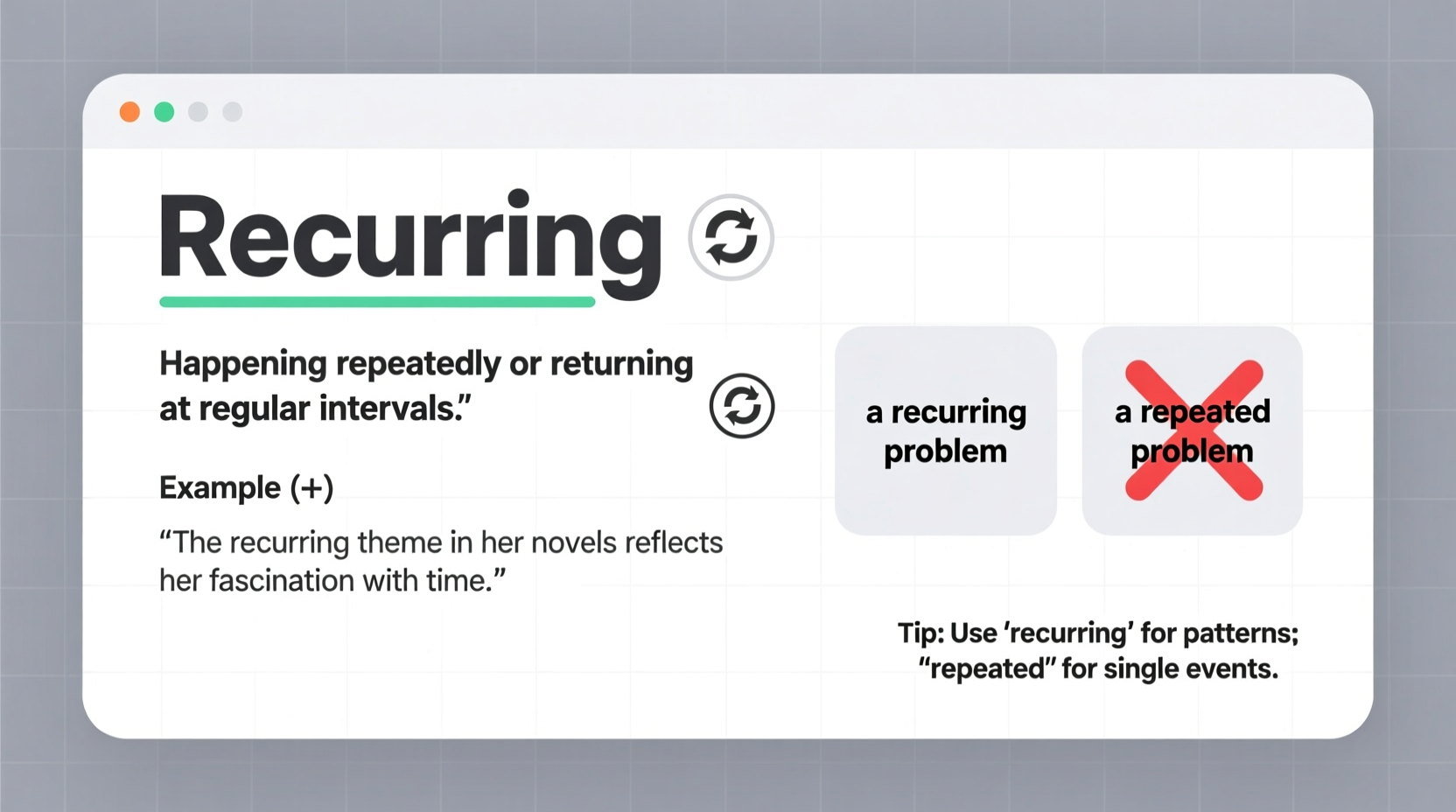
Before tackling \"recurring,\" it’s essential to understand its root verb: \"recur.\" This irregular verb means \"to happen again\" or \"to return repeatedly.\" It comes from the Latin *recurrere*, meaning \"to run back.\"
Unlike regular verbs that add \"-ed\" for past tense, \"recur\" follows an irregular pattern:
- Present: recur
- Past: recurred
- Past participle: recurred
- Present participle: recurring
The doubling of the final consonant—\"r\"—in \"recurring\" follows a standard English spelling rule: when a one-syllable verb ending in a single consonant is preceded by a single vowel, and the final syllable is stressed, the consonant is doubled before adding a suffix that begins with a vowel.
In \"recur,\" the stress falls on the second syllable (re-CUR), and the final consonant is \"r,\" preceded by the vowel \"u.\" Therefore, when forming the present participle or adjective, we double the \"r\": recurring.
Correct Spelling: Why \"Recurring\" Has Two R's
One of the most frequent errors with this word is misspelling it as \"recuring\" (with only one \"r\"). This mistake stems from misapplying phonetic logic or overlooking syllabic stress.
Consider these comparisons:
| Base Verb | Stress Pattern | Present Participle | Common Misspelling |
|---|---|---|---|
| refer | re-FER | referring | refering |
| occur | o-CUR | occurring | occuring |
| recur | re-CUR | recurring | recuring |
Notice the pattern: all three verbs end in \"r\" and are stressed on the final syllable, requiring the consonant to be doubled before \"-ing.\" Writers who spell \"occurring\" correctly but write \"recuring\" inconsistently may benefit from recognizing this shared rule.
“Consistency in spelling reflects attention to detail. Once you internalize patterns like consonant doubling, your writing becomes more authoritative.” — Dr. Lena Torres, Linguistics Professor at Boston University
How to Use \"Recurring\" in Sentences
\"Recurring\" functions primarily as an adjective or present participle. It describes something that happens repeatedly over time.
As an adjective:
- She reviewed her monthly budget, focusing on recurring expenses like rent and subscriptions.
- The doctor noted a recurring pain in the patient’s lower back.
- We scheduled a recurring team meeting every Monday at 9 a.m.
As a present participle (verb form):
- The issue is still recurring despite multiple software updates.
- Nightmares have been recurring since the accident.
Avoid confusing \"recurring\" with similar terms like \"recurrent\" or \"repeating.\" While they share meanings, their tone and usage differ:
- Recurrent is more formal, often used in medical or technical contexts (e.g., recurrent infections).
- Repeating emphasizes intentional duplication (e.g., a repeating pattern), whereas \"recurring\" implies natural or involuntary repetition.
Common Errors and How to Avoid Them
Even experienced writers slip up. Here are typical mistakes and corrections:
- Error: I keep having the same dream re-curring every week.
Fix: Remove the hyphen. \"Recurring\" is one word. - Error: The problem is occuring again.
Fix: Correct spelling: \"occurring.\" This reinforces the pattern applicable to \"recurring.\" - Error: We need to track recuring costs.
Fix: Add the missing \"r\": \"recurring.\"
Real-World Example: Business Communication
Samantha, a project manager at a mid-sized tech firm, drafted an email summarizing quarterly expenses. She wrote:
\"Our audit revealed that recuring software licenses accounted for 37% of operational costs.\"
The message was clear, but during proofreading, her colleague noticed the misspelling. After correcting it to \"recurring,\" Samantha realized the error could have diminished her professionalism, especially in a report presented to executives.
She adopted a new habit: reviewing high-frequency words with tricky spellings before sending critical messages. Over time, her confidence—and accuracy—improved significantly.
This example underscores how small spelling errors can impact perception, particularly in formal or business writing where precision is expected.
Step-by-Step Guide to Using \"Recurring\" Confidently
Follow these steps to ensure correct spelling and effective usage every time:
- Step 1: Know the base verb. Remember that \"recurring\" comes from \"recur.\"
- Step 2: Check syllable stress. Say \"re-CUR\" aloud—the stress on the second syllable signals that the \"r\" should be doubled.
- Step 3: Apply the doubling rule. When adding \"-ing,\" \"-ed,\" or \"-ence,\" double the final consonant: recurring, recurred, recurrence.
- Step 4: Proofread deliberately. Don’t skim. Pause at words like \"recurring\" and verify spelling.
- Step 5: Use in context. Practice with sample sentences: “The recurring theme in her novels is resilience.”
Quick Checklist for Writers
Use this checklist before finalizing any document:
- ✅ Is \"recurring\" spelled with two r’s?
- ✅ Is it used to describe something that happens repeatedly?
- ✅ Am I not confusing it with \"repeating\" or \"recurrent\"?
- ✅ Have I proofread specifically for high-risk words like this?
- ✅ Does the sentence sound natural and grammatically correct?
Frequently Asked Questions
Is \"recurring\" spelled with one 'r' or two?
It is spelled with two 'r's: recurring. The double 'r' results from the doubling rule applied to the verb \"recur,\" which is stressed on the final syllable.
What’s the difference between \"recurring\" and \"recurrent\"?
Both mean \"happening again,\" but \"recurring\" is more common in general usage (e.g., recurring meetings), while \"recurrent\" is often reserved for technical, medical, or formal contexts (e.g., recurrent episodes of depression).
Can \"recurring\" be used as a noun?
No, \"recurring\" is an adjective or present participle. However, the noun form \"recurrence\" exists and is widely used (e.g., \"The recurrence of errors suggests a systemic issue.\")
Final Thoughts: Precision Builds Trust
Spelling might seem like a small detail, but it shapes how readers perceive your competence and care. A word like \"recurring\"—common yet frequently misspelled—can quietly erode credibility if handled incorrectly. By understanding its root, applying spelling rules, and practicing mindful writing, you position yourself as a meticulous and trustworthy communicator.
Whether you’re drafting an email, writing a report, or editing a blog post, take a moment to confirm the spelling of words that matter. \"Recurring\" is just one example, but mastering it sets a standard for the rest of your work.




 浙公网安备
33010002000092号
浙公网安备
33010002000092号 浙B2-20120091-4
Comments
No comments yet. Why don't you start the discussion?