
The word “unparalleled” is often used to describe something extraordinary—so exceptional that there’s nothing quite like it. Yet, despite its powerful meaning, many people hesitate when spelling or using it. Is it “unparalelled”? “unparelleled”? Or perhaps “unparraleled”? The confusion is real, but the correct spelling is simpler than you think. More importantly, knowing how to use “unparalleled” effectively can elevate your writing and communication.
This guide breaks down the correct spelling, pronunciation, grammatical function, and contextual usage of “unparalleled.” Whether you're crafting a resume, writing an essay, or delivering a presentation, mastering this word adds precision and impact to your language.
Understanding the Spelling: Why \"Unparalleled\" Is Often Misspelled
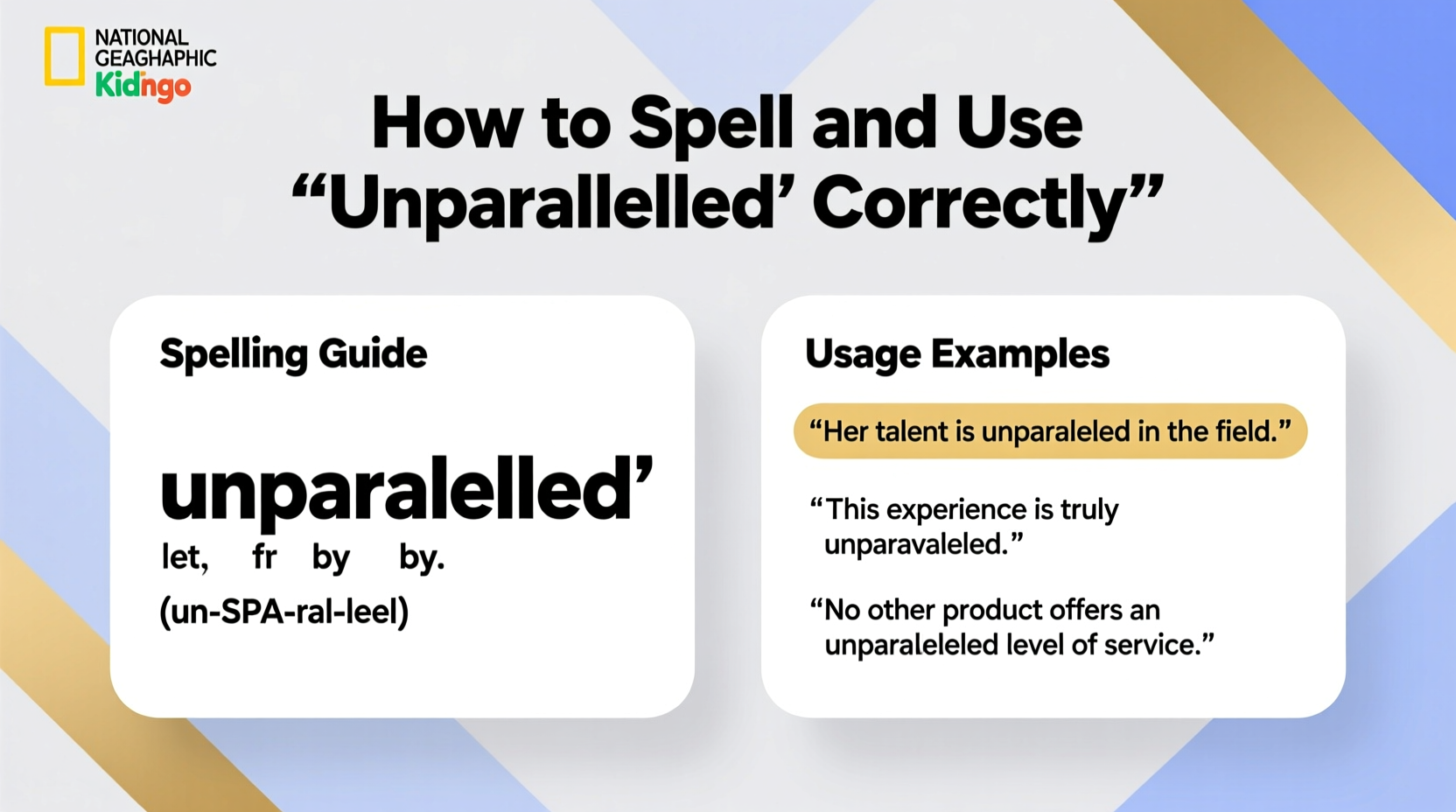
The root of the confusion lies in the base word: “parallel.” It contains a double “l” followed by a single “e,” which contradicts common English patterns. When the prefix “un-” and suffix “-ed” are added, forming “unparalleled,” the structure becomes easy to misread or misremember.
Common misspellings include:
- Unparalelled (missing one “l”)
- Unparelleled (incorrect vowel placement)
- Unparraleled (double “r” error)
- Unparallelled (extra “l” at the end)
The correct spelling is u-n-p-a-r-a-l-l-e-l-e-d. Note the sequence: after “parallel,” only one “e” is added before the final “d.” This follows standard adjectival formation rules in English.
Pronunciation and Syllable Stress
Correct pronunciation supports accurate spelling. “Unparalleled” is pronounced /ʌnˈpærəˌlɛld/ — approximately “uhn-PAR-uh-leld.”
The primary stress falls on the second syllable (“PAR”), and the secondary stress lands on the fourth (“lel”). The final “-ed” is pronounced as a full syllable due to the preceding “l” sound.
Mispronunciations such as “un-PAIR-elled” or “un-pa-RELLED” can lead to incorrect spelling because they distort the phonetic structure. Listening to native speakers or using online dictionaries with audio can help internalize the right rhythm.
Grammar and Usage: How to Use \"Unparalleled\" Correctly
“Unparalleled” functions exclusively as an adjective. It describes nouns that possess unmatched quality, degree, or excellence. It does not change form based on gender or number.
It typically appears before a noun (attributive position) or after a linking verb like “is,” “was,” or “remains” (predicative position).
“She has an unparalleled ability to remain calm under pressure.”
“The team’s success was unparalleled in the history of the league.”
Because “unparalleled” already implies a superlative level of comparison, avoid intensifiers like “very” or “most.” Saying “very unparalleled” is redundant—something either has no parallel or it does.
Common Contexts for Using \"Unparalleled\"
“Unparalleled” thrives in formal and persuasive contexts. It's frequently found in:
- Academic writing: “The study reveals an unparalleled rise in sea temperatures.”
- Business communication: “Our customer service offers unparalleled support.”
- Creative descriptions: “The view from the summit provided an unparalleled experience.”
- Historical analysis: “Few leaders have demonstrated such unparalleled influence.”
However, overuse can dilute its impact. Reserve “unparalleled” for truly exceptional cases—not just things that are good, but those that stand alone in their class.
Step-by-Step Guide to Mastering \"Unparalleled\"
- Learn the root word: Memorize “parallel” first—two “l’s,” one “e” after.
- Add the prefix: Attach “un-” to mean “not.” Now you have “unparallel.”
- Apply the suffix: Add “-ed” to form the adjective. Final form: “unparalleled.”
- Practice pronunciation: Say it aloud: uhn-PAR-uh-leld.
- Use in a sentence: Write two original sentences—one attributive, one predicative.
- Review for redundancy: Ensure you’re not pairing it with “very” or “more.”
- Get feedback: Share your sentences with a peer or use grammar tools to verify correctness.
Do’s and Don’ts When Using \"Unparalleled\"
| Do | Don't |
|---|---|
| Use it to describe truly unique or unmatched qualities. | Use it casually for things that are merely good or above average. |
| Place it before a noun or after a linking verb. | Modify it with comparative terms like “more” or “most.” |
| Pair it with concrete nouns: service, achievement, access, beauty. | Use it without context or evidence to support the claim. |
| Check spelling by breaking it into parts: un + parallel + ed. | Assume it’s spelled like “parallel” with extra letters haphazardly added. |
Real Example: From Resume to Reality
Consider Maya, a project manager applying for a senior role. In her initial draft, she wrote: “I led a team that achieved great results.” After refining her language, she revised it to: “I led a cross-functional team whose productivity reached unparalleled levels during Q3.”
The revised sentence doesn’t just state success—it emphasizes singularity. Recruiters noted the strength of her wording, and she received three interview invitations. While other factors mattered, precise language like “unparalleled” helped her stand out in a competitive pool.
This illustrates how one well-chosen word, correctly spelled and used, can shape perception and open doors.
Expert Insight on Word Choice and Impact
“Precision in language reflects precision in thought. Using words like ‘unparalleled’ correctly signals both confidence and competence.” — Dr. Lydia Chen, Linguistics Professor at Boston University
“In business writing, strong adjectives matter—but only if they’re credible. ‘Unparalleled’ should be reserved for moments where data or reputation truly justify it.” — Mark Reynolds, Executive Communication Coach
Frequently Asked Questions
Can “unparalleled” be used sarcastically?
Yes, though context is crucial. For example: “His punctuality is unparalleled”—if said after someone arrives two hours late—is clearly ironic. However, sarcasm relies on tone and shared understanding, so use it cautiously in writing.
Is “unparalleled” always positive?
Not necessarily. While usually positive, it can describe negative extremes. Example: “The region faced unparalleled destruction after the storm.” Here, it emphasizes scale, not value judgment.
What are synonyms for “unparalleled”?
Synonyms include: unmatched, unrivaled, unequaled, unprecedented, and singular. Each carries subtle differences. “Unprecedented” focuses on novelty; “unrivaled” implies dominance over competition; “unparalleled” emphasizes lack of equivalent.
Conclusion: Speak and Write with Confidence
Mastering “unparalleled” goes beyond spelling—it’s about wielding language with intention. When you use it correctly, you don’t just avoid errors; you command attention. Whether describing innovation, performance, or natural wonder, this word carries weight. But its power depends on accuracy and restraint.
Now that you know how to spell and use “unparalleled” properly, apply it wisely. Let your words reflect the depth of your thoughts. And remember: clarity, precision, and authenticity always make communication unparalleled.




 浙公网安备
33010002000092号
浙公网安备
33010002000092号 浙B2-20120091-4
Comments
No comments yet. Why don't you start the discussion?