
The word \"faeces\" is one of those terms that frequently trips people up—not because of its meaning, but because of its spelling. Often associated with medical, scientific, or bathroom-related discussions, it's a word many encounter but few feel confident writing. Whether you're drafting a health report, writing a parenting blog, or simply trying to improve your everyday vocabulary, knowing how to spell \"faeces\" correctly matters. More than just memorizing letters, understanding its origin, regional variations, and common pitfalls can help ensure you use it accurately and confidently.
Understanding the Correct Spelling: Faeces
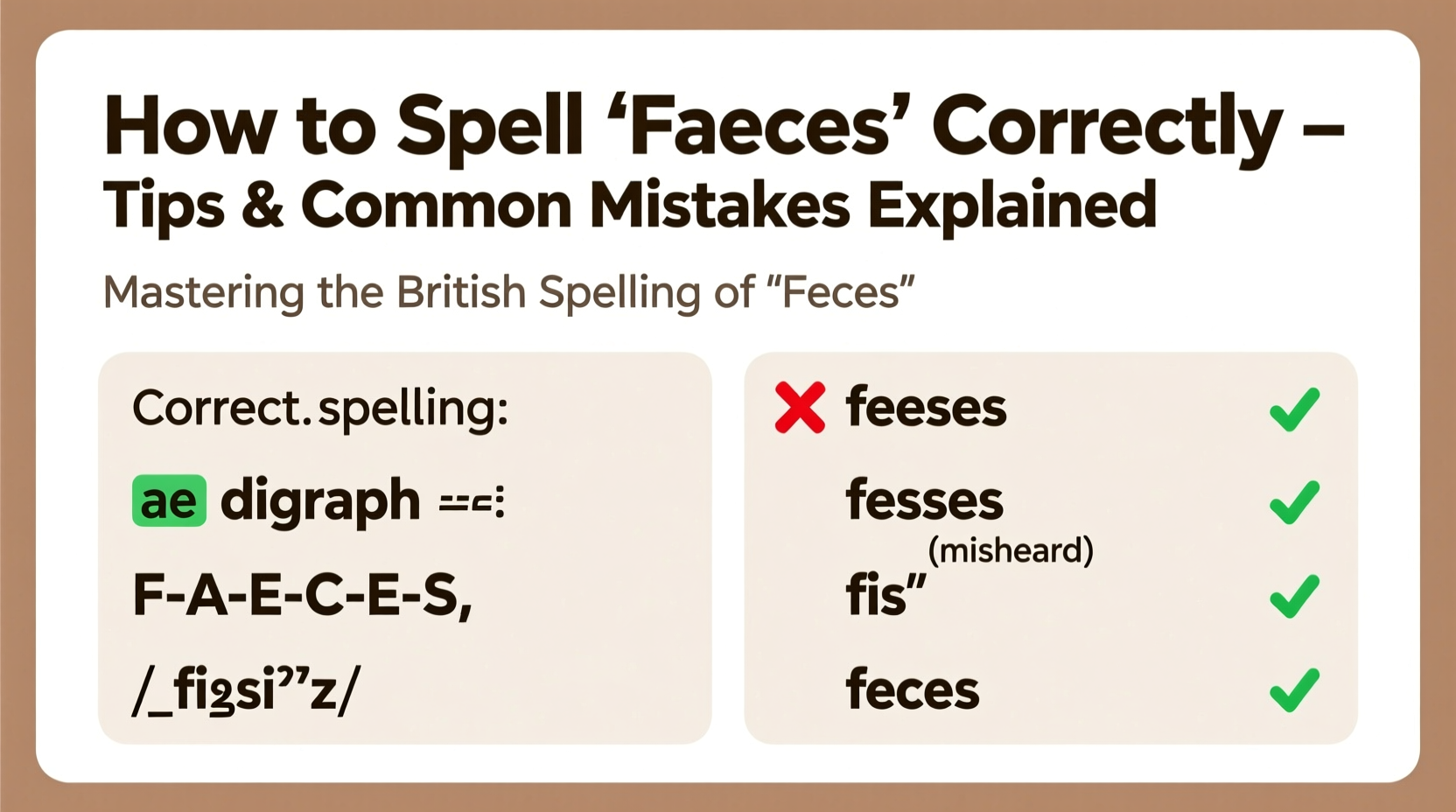
The correct spelling is faeces. It refers to bodily waste expelled during defecation—commonly known as stool or poop. This term is standard in British English and widely used in formal, medical, and scientific contexts across the UK, Australia, New Zealand, and other Commonwealth countries.
The confusion often arises from its Latin root. \"Faeces\" comes from the Latin word *faex*, meaning \"dregs\" or \"sediment.\" The spelling retains the digraph \"ae,\" which represents a diphthong in classical Latin. While modern pronunciation often simplifies this to sound like \"fees,\" the traditional spelling remains intact in British English.
Faeces vs. Feces: Regional Differences
A major source of confusion lies in the transatlantic divide between British and American English. In the United States, the preferred spelling is feces—without the \"a.\" This version simplifies the Latin \"ae\" into a single \"e,\" aligning with broader American English tendencies toward phonetic streamlining (e.g., \"color\" instead of \"colour\").
Both \"faeces\" and \"feces\" are correct—but context and audience determine which to use.
| Spelling | Region | Context | Example Usage |
|---|---|---|---|
| Faeces | UK, Australia, Canada, NZ, South Africa | Medical reports, academic writing, general use | \"The patient’s faeces showed signs of blood.\" |
| Feces | United States | Clinical documentation, research papers, informal speech | \"The lab tested the feces sample for parasites.\" |
“Precision in medical terminology starts with correct spelling. Using ‘faeces’ in a UK publication maintains professionalism and regional accuracy.” — Dr. Helen Reeves, Clinical Linguist and Medical Editor
Common Spelling Mistakes and How to Avoid Them
Despite its straightforward structure, \"faeces\" is frequently misspelled. Here are the most common errors and strategies to prevent them:
- Faces – One of the most frequent typos. Easily confused due to similar pronunciation. Always double-check if you mean human expressions or bodily waste.
- Faecials – A made-up variation. No such word exists. Stick to \"faeces\" for plural; there is no singular form in common usage (though \"faecis\" is technically Latin).
- Faeces\" with only one 'e' – E.g., \"faeces\" written as \"faeces\" (incorrectly as \"faeces\"). Remember: two 'e's—one after 'c', one at the end.
- Phonetic misspellings – Such as \"fesses\" or \"feaces.\" These arise from attempting to write what you hear. Focus on the root word and etymology.
Step-by-Step Guide to Mastering the Spelling
If you want to internalize the correct spelling and avoid future mistakes, follow this practical sequence:
- Break down the word: F-AE-C-E-S. Treat \"ae\" as a single unit, like in \"encyclopaedia.\"
- Pronounce it aloud: /ˈfiːsiːz/ (FEE-seez). Hearing it reinforces the double 'e' sound.
- Write it repeatedly: Copy the word 10 times, focusing on each letter.
- Use it in a sentence: “The dog’s faeces were collected from the park lawn.” Context strengthens memory.
- Test yourself: Cover the word and write it from memory. Repeat after 24 hours to reinforce retention.
Real-World Example: A Common Mix-Up in Healthcare Communication
In 2021, a clinic in Manchester issued a public apology after a printed leaflet mistakenly used \"faces\" instead of \"faeces\" in a section about infant digestion. The typo read: “Check your baby’s faces for colour changes.” Understandably, parents were confused—and some amused. Though the error was minor, it undermined the document’s credibility and required reprinting.
This incident highlights how a simple spelling mistake can distort meaning and damage professional trust. In healthcare, education, or journalism, precision isn’t optional—it’s essential.
Do’s and Don’ts When Using 'Faeces'
| Do’s | Don’ts |
|---|---|
| Use “faeces” in British English contexts | Never use “faces” when referring to waste |
| Double-check spelling in formal documents | Assume the American spelling is acceptable everywhere |
| Use lowercase unless starting a sentence | Create alternative spellings like “phaeces” |
| Pair with clinical terms: e.g., “abnormal faeces,” “faecal matter” | Use in casual conversation unless appropriate |
FAQ: Frequently Asked Questions
Is 'faeces' spelled differently in American English?
Yes. In American English, the word is spelled feces, dropping the \"a\" from the \"ae\" diphthong. Both are correct within their respective dialects.
What is the singular form of 'faeces'?
Technically, \"faeces\" is a plural noun derived from Latin. The singular \"faecis\" exists but is almost never used in modern English. In practice, \"faeces\" functions as both singular and plural in everyday usage. For example: “This faeces sample” is acceptable despite being grammatically plural.
Can I use 'poop' or 'stool' instead of 'faeces'?
Yes, depending on context. \"Stool\" is the preferred clinical synonym in both British and American English. \"Poop\" is informal and best avoided in professional or medical writing. \"Faeces\" strikes a balance between technical accuracy and accessibility in British English settings.
Expert Tips for Long-Term Spelling Confidence
Spelling isn't just about rote memorization—it's about building patterns and associations. Here’s a checklist to help you retain the correct spelling of \"faeces\" and apply it accurately:
- ✅ Identify your audience: Use \"faeces\" for UK readers, \"feces\" for US audiences.
- ✅ Proofread carefully: Watch for homophone traps like \"faces.\"
- ✅ Use spellcheck wisely: Note that spellcheck may flag \"faeces\" as incorrect if set to US English.
- ✅ Learn related terms: Familiarize yourself with \"faecal,\" \"faecal transplant,\" and \"faecal occult blood test.\"
- ✅ Practice in real writing: Incorporate the word into notes, emails, or reports to build familiarity.
Conclusion: Spell It Right, Every Time
Mastering the spelling of \"faeces\" is more than a linguistic detail—it's a mark of attention to detail, especially in fields like medicine, parenting, or education. Whether you're writing a school report, updating a health blog, or communicating with a doctor, using the correct form builds clarity and credibility. Now that you understand the origins, regional differences, and common pitfalls, you’re equipped to use \"faeces\" confidently and correctly.




 浙公网安备
33010002000092号
浙公网安备
33010002000092号 浙B2-20120091-4
Comments
No comments yet. Why don't you start the discussion?