
Grief is a word that carries profound emotional weight. It describes the deep sorrow experienced after loss—particularly the death of someone close. Yet despite its importance in both personal and written communication, \"grief\" is frequently misspelled. Whether you're writing a condolence letter, journaling your feelings, or composing a professional message, spelling this word correctly matters. More than just a matter of grammar, accurate spelling reflects respect and clarity during sensitive moments. This guide breaks down the correct spelling of \"grief,\" explores why it's often misspelled, and provides practical strategies to remember it. Along the way, you'll also gain a deeper understanding of what grief truly means—not only linguistically but emotionally.
Understanding the Correct Spelling: G-R-I-E-F
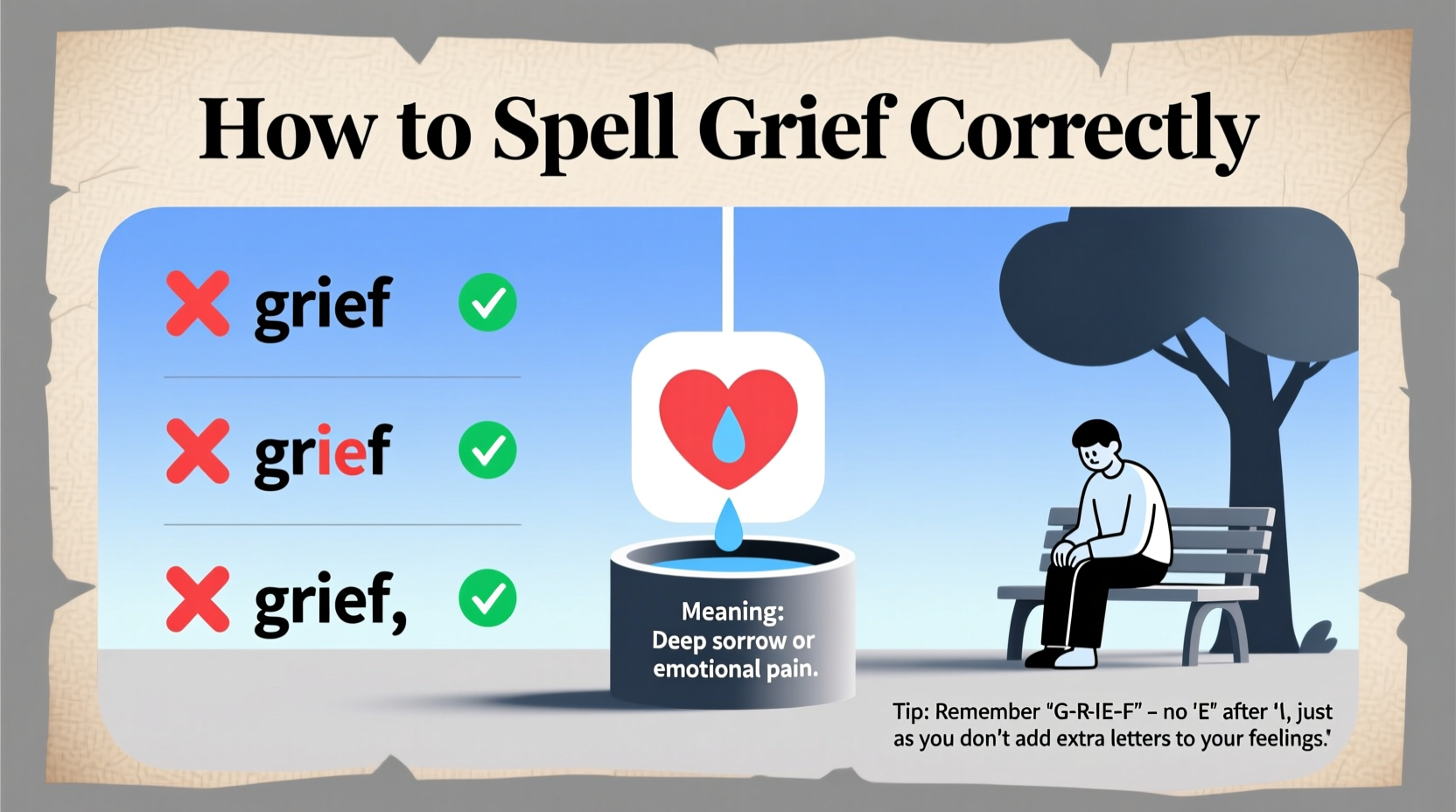
The correct spelling is grief: G-R-I-E-F. It’s a five-letter noun pronounced /ɡriːf/ (rhymes with “belief”). Despite its simplicity, many people inadvertently alter the order of letters or substitute vowels due to phonetic confusion or memory lapses.
Common errors include:
- “greef” – influenced by words like “green” or “sheep”
- “greif” – swapping the “i” and “e,” possibly due to Germanic-sounding names or misremembering “believe” patterns
- “grife” – reversing the last two letters, likely from rapid typing
Unlike some irregular English words, “grief” follows a relatively straightforward phonetic pattern once you recognize its root and structure.
Why People Misspell “Grief” — And How to Avoid It
Mistakes in spelling “grief” often stem from cognitive interference—when similar-sounding words cloud memory. For example, because English contains many exceptions to phonetic rules (like “receive” vs. “believe”), people apply inconsistent logic across words.
The confusion between “i” and “e” is especially common. While the classic rule “i before e except after c” applies to words like “receive,” it doesn’t govern “grief,” which has no “c” involved. Here, “ei” appears without a preceding “c,” making it an exception to the rule—and thus harder to recall.
To strengthen retention:
- Practice writing “grief” three times slowly, focusing on the sequence: G-R-I-E-F.
- Associate it visually with related words: belief, thief, chief, niece.
- Use mnemonic devices such as: “I E before F, feel the grief.”
“Spelling accuracy in emotionally charged contexts enhances empathy and professionalism.” — Dr. Laura Simmons, Linguistic Psychologist
Do’s and Don’ts When Using “Grief” in Writing
| Do | Don’t |
|---|---|
| Use “grief” when referring to deep emotional pain from loss | Confuse “grief” with “greif” (a rare surname) or “grievance” |
| Double-check spelling in formal messages or tributes | Assume autocorrect will catch all errors—sometimes it won’t |
| Pair it with supportive language: “offering condolences amid grief” | Use slang or abbreviations like “grf” in serious writing |
| Recognize its singular form; say “a period of grief,” not “griefs” | Treat it as interchangeable with “sadness”—grief is more complex |
Real-Life Example: A Letter That Got It Right
In 2022, a public relations manager named Maya Thompson wrote a memorial post for a colleague who had passed away unexpectedly. She drafted her message carefully, knowing hundreds would read it. Initially, she typed “greif” out of habit. But during proofreading, she noticed the error and corrected it to “grief.”
Later, a family member emailed her, saying: “Thank you for honoring him with thoughtful words—and getting even the small things right. It showed care.”
This moment reinforced for Maya how precise language can convey sincerity. A single misspelling might seem minor, but in contexts of mourning, attention to detail signals respect.
Expanding Your Understanding: What Does “Grief” Really Mean?
Beyond spelling, understanding the meaning of “grief” enriches your use of the word. Grief isn’t just sadness—it’s a multifaceted response to loss that can include shock, anger, numbness, guilt, and physical symptoms like fatigue or insomnia.
Psychologists often reference the **Five Stages of Grief** model developed by Elisabeth Kübler-Ross: denial, anger, bargaining, depression, and acceptance. While not everyone experiences these linearly, they provide a framework for recognizing emotional progression.
Grief also extends beyond death. People grieve job loss, relationship endings, health decline, or major life transitions. Recognizing this breadth helps you use the word appropriately and compassionately.
Step-by-Step Guide to Using “Grief” Accurately and Respectfully
- Step 1: Confirm the spelling. Write “grief” separately and verify each letter: G-R-I-E-F.
- Step 2: Understand the context. Ask yourself: Is this about profound emotional loss? If yes, “grief” fits.
- Step 3: Avoid overuse. Reserve “grief” for significant losses, not minor inconveniences.
- Step 4: Pair with empathy. Use phrases like “deep grief,” “profound grief,” or “coping with grief” to reflect gravity.
- Step 5: Proofread. Especially in emails, cards, or social media posts, review for spelling and tone.
Checklist: Mastering the Word “Grief”
- ☑ Spell it correctly: G-R-I-E-F
- ☑ Know the difference between “grief” and “grievance”
- ☑ Use it in appropriate emotional contexts
- ☑ Avoid common misspellings like “greif” or “grife”
- ☑ Review written messages containing the word
- ☑ Expand your vocabulary with synonyms: sorrow, mourning, bereavement
Frequently Asked Questions
Is “grief” ever pluralized?
No, “grief” is generally used as an uncountable noun. You wouldn’t say “three griefs.” Instead, express multiple instances with phrases like “different kinds of grief” or “periods of grief.”
What’s the difference between “grief” and “grieving”?
“Grief” is the noun—the emotional state itself. “Grieving” is the verb or adjective describing the process: “She is grieving” or “a grieving parent.”
Can animals experience grief?
Yes. Scientific studies show that many animals—especially elephants, dolphins, and primates—display behaviors consistent with grief, such as staying near the body of a deceased companion or showing reduced activity.
Conclusion: Precision Meets Compassion
Spelling “grief” correctly may seem like a small act, but in moments of loss, small acts carry great meaning. Getting the spelling right shows attention, care, and emotional intelligence. Beyond mechanics, understanding the depth of what grief represents allows you to communicate with authenticity and sensitivity.
Language shapes how we perceive and share emotions. When you write “grief” accurately, you honor both the person who’s suffering and the complexity of human emotion. In doing so, you contribute to a culture of thoughtful communication—one word at a time.




 浙公网安备
33010002000092号
浙公网安备
33010002000092号 浙B2-20120091-4
Comments
No comments yet. Why don't you start the discussion?