
The word \"secretariat\" appears frequently in professional, academic, and administrative contexts. Whether you're drafting an official letter, preparing a report, or communicating within an organization, spelling it correctly matters. Yet, many people hesitate when writing it—often misspelling due to its length and phonetic complexity. Getting it wrong can undermine credibility, especially in formal writing. This guide breaks down the correct spelling, explains common errors, and provides practical strategies to remember it with confidence.
Understanding the Word: What Does “Secretariat” Mean?
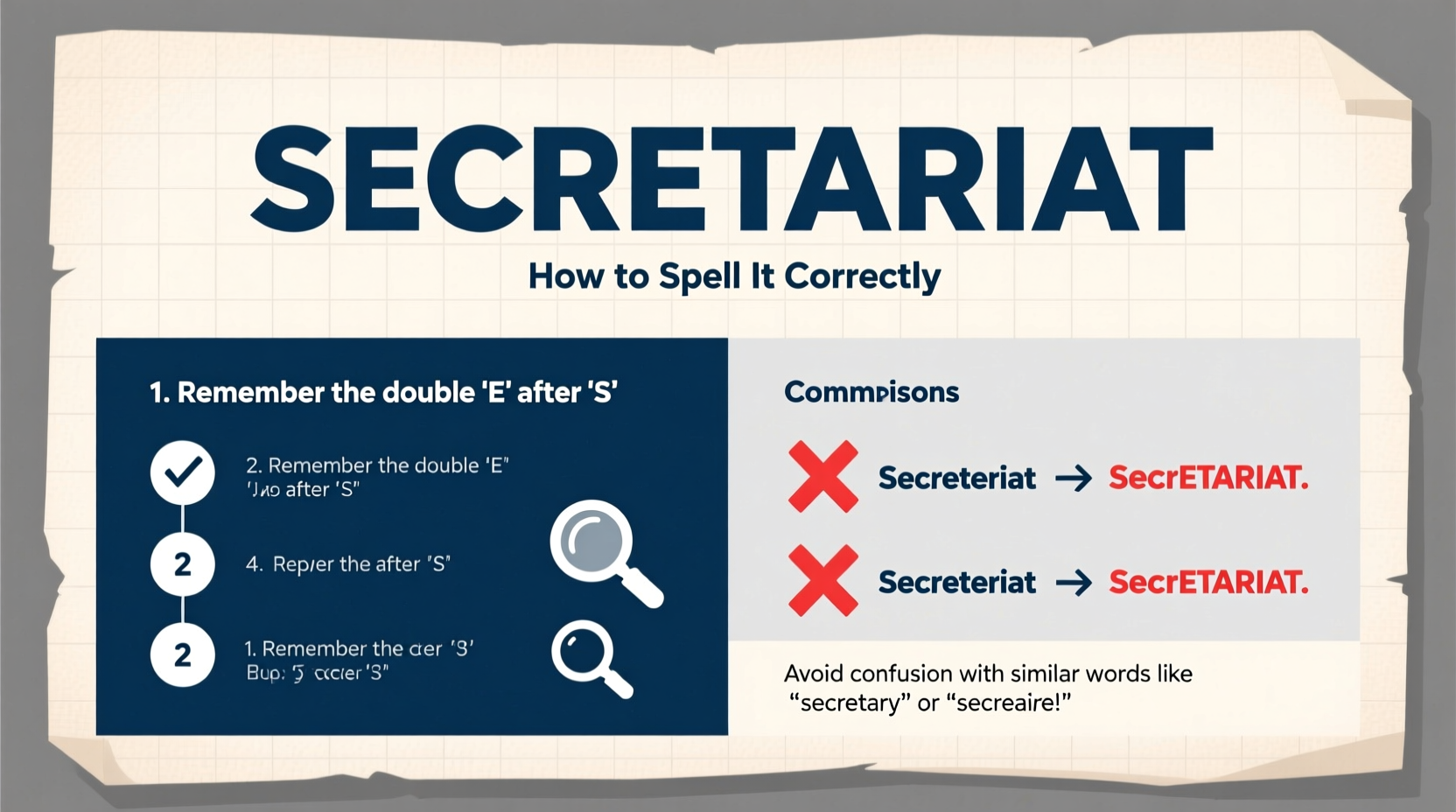
Before focusing on spelling, it helps to understand what the word means. A secretariat refers to either the office of a secretary or a group of officials who handle administrative tasks for an organization, committee, or international body. For example:
- The United Nations has a Secretariat responsible for implementing decisions made by member states.
- A corporate board may establish a secretariat to manage meeting records and communications.
The root comes from “secretary,” derived from the Latin *secretarius*, meaning “a person entrusted with secrets.” Over time, the suffix *-iat* (used to form nouns indicating office or position) was added, evolving into “secretariat.” Knowing this background makes the spelling more logical—it's not just a random string of letters, but a structured word rooted in history and function.
Step-by-Step Guide to Spelling “Secretariat” Correctly
Spelling long words becomes easier when approached systematically. Follow these steps to write “secretariat” accurately every time:
- Start with “secret” – This is the core of the word. Remember: C before E, no extra vowels.
- Add “ary” – Think of common endings like “library” or “secondary.” It sounds like “air-ee,” but spelled A-R-Y.
- Insert “i” before “at” – The ending isn’t “ate” or “et”; it’s “iat.” This is where most mistakes happen.
- Finalize with “at” – Not “et,” “it,” or “art.” Just A-T.
Putting it together: S-E-C-R-E-T-A-R-I-A-T. That’s 13 letters total. No double consonants, no silent letters—just one straightforward sequence once you know the pattern.
Common Misspellings and Why They Happen
Despite its regular structure, “secretariat” is often misspelled. Below are some frequent errors and explanations for why they occur:
| Incorrect Spelling | Why It’s Wrong | Reason for Error |
|---|---|---|
| secretariet | Ends with “iet” instead of “iat” | Pronunciation confusion—people hear “ee” sound and assume “e” is used |
| secrettariat | Double “t” after “secr” | Mishearing syllable breaks; overemphasis on “tet” sound |
| secreteriat | Uses “e” instead of “a” in “ar” | Confusion with similar-sounding words like “separator” |
| secretariet | “ie” instead of “ia” | Influence of common patterns like “believe” (i before e) |
| secretariot | Inserts “o” incorrectly | Vowel substitution based on pronunciation approximation |
These errors typically stem from phonetic assumptions—trying to match how the word sounds rather than how it’s constructed. English spelling doesn’t always follow sound-based rules, so relying solely on pronunciation can be misleading.
“One of the biggest challenges in English spelling is the gap between spoken and written forms. Words like ‘secretariat’ expose that disconnect clearly.” — Dr. Lydia Chen, Linguistics Professor at Oxford
Memory Tricks and Mnemonics for Lasting Recall
To internalize the correct spelling, use mnemonic devices—mental shortcuts that link the word to something memorable. Here are three effective techniques:
- Sentence Mnemonic: Create a sentence where each word starts with the same letter as “secretariat.” Example: “Sally’s Elegant Cat Ran Across The Ice And Twirled.” Visualizing the scene reinforces the letter order.
- Syllable Chunking: Divide the word into syllables: se-cre-tar-i-at. Say them aloud slowly, then speed up. Repeat five times daily for two days—it sticks.
- Keyboard Visualization: Imagine typing the word on a QWERTY keyboard. Trace the path: S→E→C→R→E→T→A→R→I→A→T. Muscle memory supports visual memory.
Checklist: How to Avoid Spelling Errors in Professional Writing
To ensure accuracy beyond just this one word, adopt habits that minimize spelling mistakes across all your documents:
- ✅ Proofread all emails and reports before sending
- ✅ Use spell-check tools—but don’t rely on them completely
- ✅ Keep a personal list of commonly misspelled words (including “secretariat”)
- ✅ Read your text backward to catch isolated spelling errors
- ✅ Ask a colleague to review critical documents
This proactive approach builds long-term spelling confidence and prevents embarrassing oversights.
Real-World Example: When a Misspelling Made a Difference
In 2021, a university student submitted a thesis proposal titled “Reforming the ASEAN Secretariat Structure.” Unfortunately, in the abstract, she wrote “secretariet” twice due to autocorrect interference she didn’t notice. Although minor, the error caught the attention of one reviewer who questioned her attention to detail. The proposal passed, but with feedback emphasizing proofreading. She later shared: “It wasn’t about intelligence—it was about care. One typo almost undermined months of work.”
This case illustrates how even small spelling errors can affect perception, particularly in high-stakes environments like academia or governance.
Frequently Asked Questions
Is “secretariat” spelled differently in British and American English?
No. Unlike words such as “organize/organise,” “secretariat” is spelled identically in both British and American English. There are no regional variations.
How do I pronounce “secretariat” correctly?
The standard pronunciation is /ˌsekrəˈtɛəriət/ (sek-ruh-TAIR-ee-ut). Emphasis falls on the third syllable (“tair”). Avoid stressing the final “at”—it should be soft and short.
Can I use “secretariat” for any office setting?
While technically possible, it’s best reserved for formal or institutional contexts. In everyday business, “administrative office” or “executive support team” may be clearer and more natural. Reserve “secretariat” for bodies like the UN, WHO, or parliamentary groups.
Conclusion: Master the Word, Strengthen Your Communication
Spelling “secretariat” correctly isn’t just about avoiding mistakes—it’s about demonstrating professionalism, precision, and respect for language. By understanding its structure, recognizing common pitfalls, and using memory aids, you can write it confidently in any context. More broadly, mastering challenging words elevates your overall communication skills, whether in emails, reports, or public speaking.




 浙公网安备
33010002000092号
浙公网安备
33010002000092号 浙B2-20120091-4
Comments
No comments yet. Why don't you start the discussion?