
Automatic watches represent the pinnacle of mechanical craftsmanship, combining engineering precision with timeless design. Unlike quartz watches powered by batteries, automatic movements harness the natural motion of the wearer’s wrist to power the timepiece. But not all automatic movements are created equal. The difference between a reliable, long-lasting movement and one that falters under pressure often lies in subtle details—details only discerning collectors and enthusiasts know how to identify.
Understanding what separates a premium movement from a mediocre one empowers you to make smarter purchases, whether you're investing in your first luxury watch or expanding a curated collection. From finish quality to functional components, this guide breaks down the essential characteristics of high-quality automatic movements and equips you with expert-backed strategies to evaluate them confidently.
Core Components of an Automatic Movement
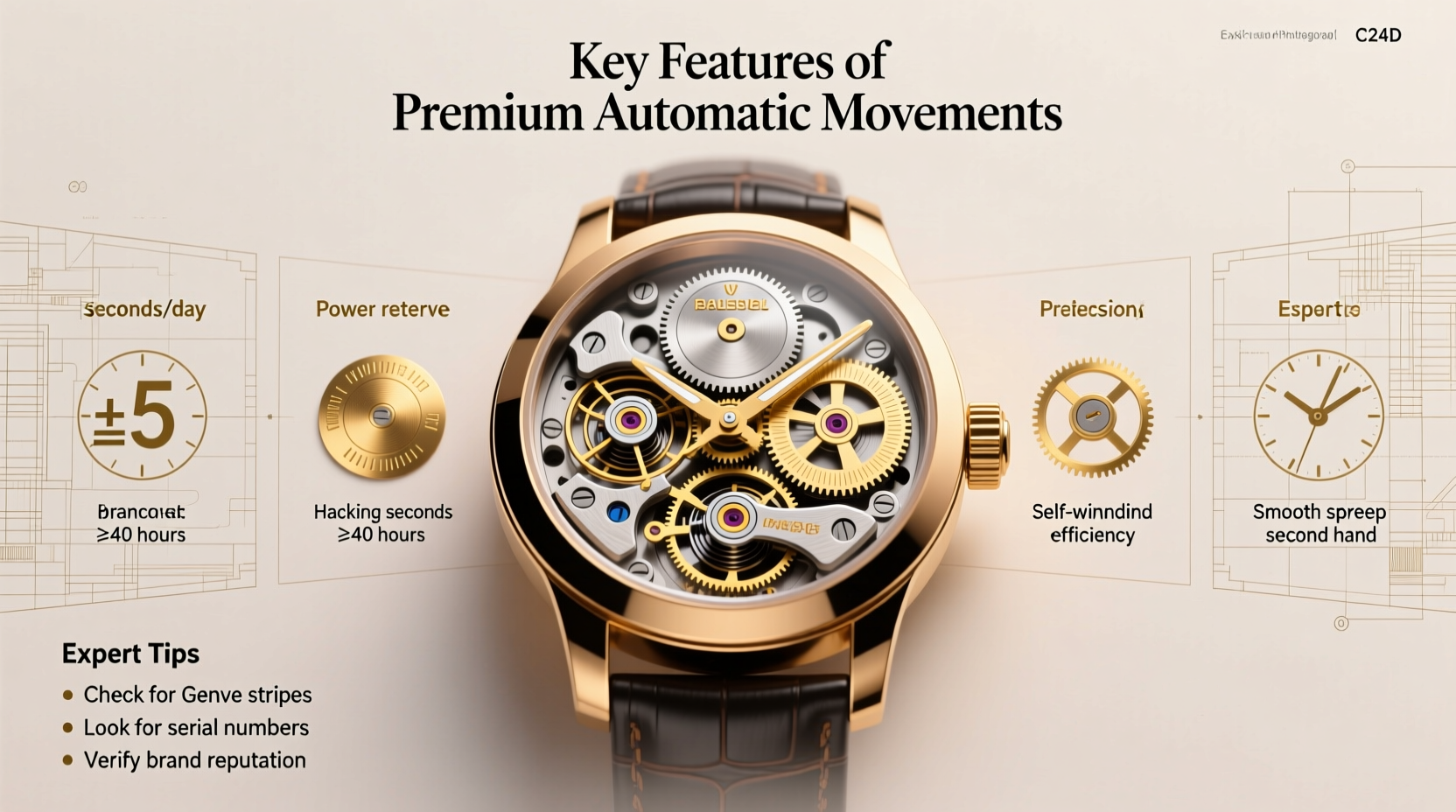
An automatic movement is composed of hundreds of tiny parts working in harmony. While most are hidden beneath the dial, their construction and finishing offer critical insight into overall quality.
- Mainspring: Stores energy generated by the rotor’s motion. High-grade alloys ensure consistent power delivery and longevity.
- Rotor (oscillating weight): Rotates with wrist movement to wind the mainspring. In premium movements, it’s often unidirectional, efficient, and quietly balanced.
- Escapement: Regulates energy release to the balance wheel. A well-tuned escapement ensures accuracy and stability.
- Bridges and plates: Structural elements holding components in place. Top-tier movements feature hand-beveled edges and perlage (circular graining).
- Jewels: Synthetic rubies reduce friction at pivot points. While more jewels aren’t always better, 21–36 indicate thoughtful engineering in a standard time-only movement.
Visual and Technical Indicators of Quality
High-end movements don’t just perform better—they look different. Manufacturers like Rolex, Patek Philippe, and Grand Seiko invest heavily in both function and aesthetics, treating the movement as part of the watch’s artistry.
Finishing techniques such as Geneva stripes ( Côtes de Genève ), anglage (hand-beveled edges), and perlage are not merely decorative. They prevent dust accumulation, reduce corrosion, and reflect attention to detail. Mass-produced movements typically lack these refinements, relying on flat, machine-finished surfaces.
Regulating systems also reveal quality. Watches with a free-sprung balance (where timing is adjusted via screws on the balance wheel itself) are generally more stable than those using regulator pins, which can introduce timing inconsistencies over time.
“Movement decoration isn’t vanity—it’s a proxy for build philosophy. When a brand finishes visible parts by hand, you can trust the invisible ones were made with equal care.” — Daniel Richards, Horology Conservator at the British Watch & Clock Association
Performance Metrics That Matter
A beautiful movement means little if it doesn’t keep accurate time. Precision, power reserve, and resistance to positional variance separate true performers from the rest.
| Metric | Standard Movement | High-Quality Movement |
|---|---|---|
| Accuracy | +/- 15 seconds per day | +/- 2 to -2 seconds per day (COSC certified) |
| Power Reserve | 38–42 hours | 70+ hours (e.g., ETA 2846-2, Sellita SW300-1) |
| Frequency | 21,600 vph (3 Hz) | 28,800 vph (4 Hz) or higher |
| Adjustments | Uncalibrated or single position | Adjusted to 5 or 6 positions for consistent rate |
COSC (Contrôle Officiel Suisse des Chronomètres) certification is a strong indicator of performance. To earn it, movements must pass rigorous tests over 15 days in various temperatures and positions. However, some elite brands—like Grand Seiko with its Spring Drive or Rolex with its Superlative Chronometer standard—exceed COSC requirements without submitting to third-party testing.
Step-by-Step Guide to Evaluating a Movement
Whether you’re shopping online or examining a watch in-store, follow this sequence to assess movement quality objectively.
- Check the brand and caliber: Research the movement’s model number (e.g., ETA 2824-2, Sellita SW200, Miyota 9015). Reputable base movements are widely documented and trusted.
- Inspect through a display case back: Look for consistent finishing, jewel count, and presence of decoration. Avoid movements with rough edges or uneven striping.
- Verify certifications: Confirm if the watch carries COSC, METAS Master Chronometer, or proprietary standards like Rolex’s +2/-2 seconds/day tolerance.
- Test timekeeping: Wear the watch for 24–48 hours. Use a timegrapher app (if accessible) to check beat rate, amplitude, and timing deviation.
- Assess power reserve: Fully wind the watch, then let it run untouched. A high-end movement should maintain accuracy beyond 60 hours.
Real Example: Comparing Two Popular Movements
Consider two common automatic calibers: the Miyota 8215 (used in many affordable automatics) and the ETA 2824-2 (found in mid-range Swiss watches).
The Miyota 8215 is reliable and cost-effective, offering a 40-hour power reserve and 21,600 vph frequency. However, it uses a bidirectional winding system with lower efficiency and lacks fine adjustment capabilities. Finishing is utilitarian, with minimal decoration.
In contrast, the ETA 2824-2 delivers 38–42 hours of power but operates at 28,800 vph, improving timekeeping stability. It features a unidirectional winding rotor, Incabloc shock protection, and is available in COSC-certified versions. Its bridges are typically striped, and edges are beveled—clear signs of superior craftsmanship.
This comparison illustrates that while both movements work, the ETA 2824-2 offers measurable advantages in precision, serviceability, and long-term reliability—justifying its use in watches priced significantly higher.
Common Pitfalls to Avoid
- Overvaluing complications: A chronograph or moonphase adds complexity but not necessarily quality. Simpler time-and-date movements are often better regulated and more durable.
- Ignoring service history: Even the finest movement degrades without maintenance. Aim for servicing every 5–7 years to preserve performance.
- Trusting marketing over mechanics: Terms like “Swiss Made” guarantee origin but not excellence. Scrutinize the actual movement specs behind the label.
- Assuming in-house means better: Some brands market “in-house” movements that are lightly modified base calibers. True in-house development involves full design, manufacturing, and finishing control.
Frequently Asked Questions
Do all automatic watches need manual winding?
No, but they benefit from it. If worn daily, the rotor keeps the mainspring wound. However, watches stored for long periods should be manually wound every few weeks to maintain lubrication and prevent stiction.
What’s the difference between ETA and Sellita movements?
Both are Swiss-made and highly respected. ETA was historically exclusive to Swatch Group brands but now sells more widely. Sellita emerged as an alternative, producing clones of ETA designs (e.g., SW200 mirrors ETA 2824-2) with comparable quality and often better availability for independent brands.
Are Chinese automatic movements improving?
Yes. Calibers like the Beihai 2121 (based on ETA 2824) and Seagull’s ST2500 series have closed the gap significantly. While still lagging in long-term durability data, they offer impressive value for budget-conscious buyers.
Final Checklist Before Buying
- ✔️ Research the caliber:
- Know whether it’s ETA, Sellita, Seiko, or in-house—and read user reviews.
- ✔️ Look for finishing details:
- Geneva stripes, perlage, and beveled edges signal care in assembly.
- ✔️ Verify accuracy claims:
- Check for COSC, METAS, or brand-specific chronometer standards.
- ✔️ Consider serviceability:
- Common movements like ETA 2824 are easier and cheaper to repair than obscure in-house calibers.
- ✔️ Test wearability:
- Ensure the watch runs consistently after a full day’s wear, not just when shaken.
Conclusion
Spotting a high-quality automatic watch movement goes beyond brand names or price tags. It requires attention to technical details, appreciation of finishing, and understanding of performance benchmarks. Whether you’re drawn to the elegance of a vintage-inspired hand-wound piece or the convenience of a modern self-winding marvel, the movement inside defines the soul of the watch.
Use the insights and checklist provided here to cut through marketing hype and focus on what truly matters: precision, durability, and craftsmanship. The next time you consider a new timepiece, lift the lid—look through the exhibition case back—and judge it not by its face, but by the beating heart within.




 浙公网安备
33010002000092号
浙公网安备
33010002000092号 浙B2-20120091-4
Comments
No comments yet. Why don't you start the discussion?