
The 1964 Special Mint Set (SMS) Kennedy half dollar holds a unique place in American numismatics. Struck during a transitional period between proof and business strike production methods, these coins were not officially designated as proofs but exhibit characteristics of both high-quality proofs and standard circulation strikes. Due to their rarity, historical significance, and the confusion surrounding their origin, they are frequent targets for counterfeiting and misrepresentation. For serious collectors, knowing how to authenticate a genuine 1964 SMS half dollar is essential.
Understanding the 1964 SMS Half Dollar: A Brief History
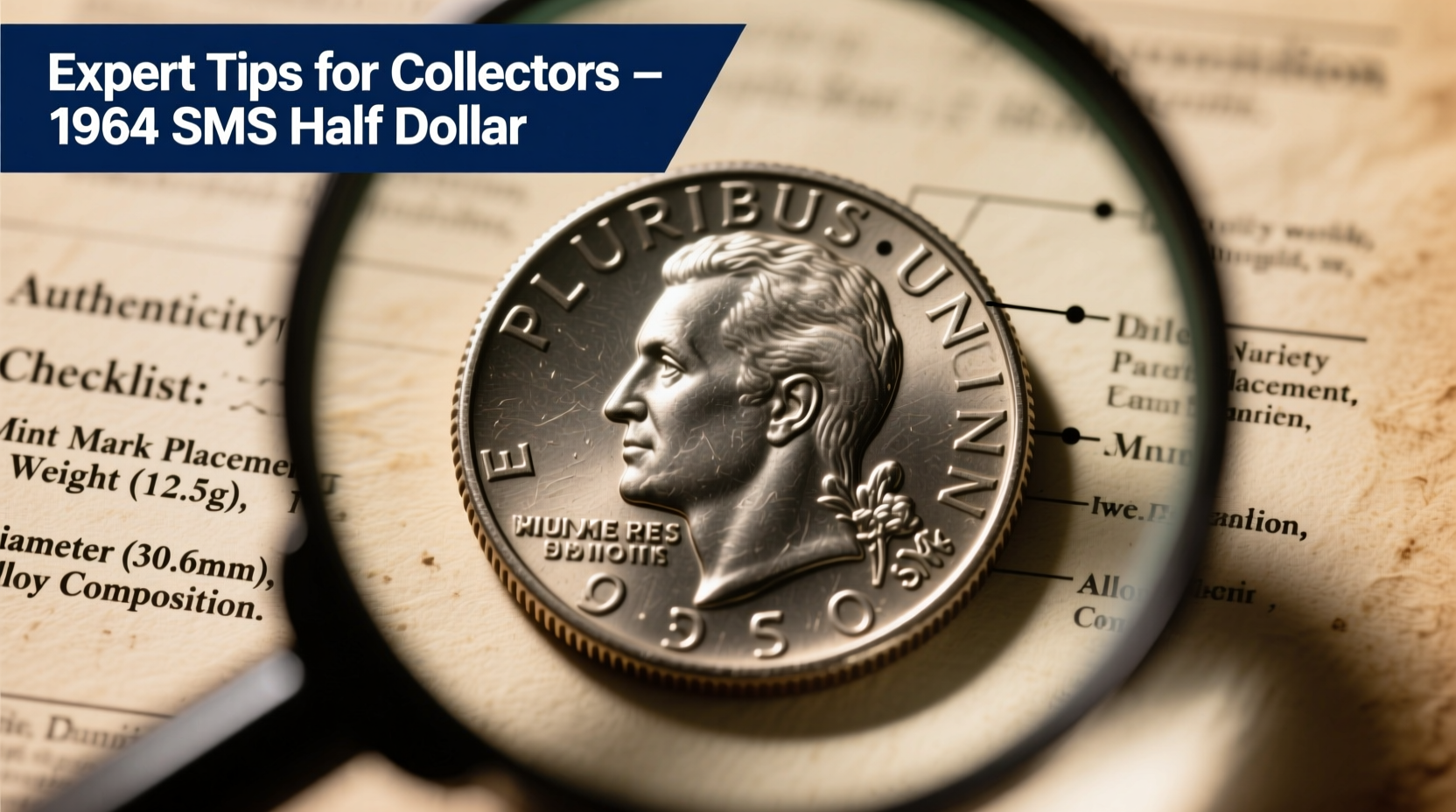
Following President John F. Kennedy’s assassination in November 1963, Congress authorized a new half dollar to honor his memory. The first Kennedy half dollars were struck in early 1964 at the Philadelphia, Denver, and San Francisco Mints. While millions were produced for circulation, a small number of specially finished coins were also created using a unique process now known as the \"Special Mint Set\" (SMS).
These SMS coins were not released through regular channels. Instead, they were sold in special two-coin sets (one from Philadelphia, one from Denver) directly to collectors by the U.S. Treasury. Unlike traditional proofs, which used polished dies and planchets, the 1964 SMS coins were struck with higher pressure and on specially burnished blanks, resulting in a satin-like finish, sharp detail, and reduced die chatter.
Only about 4,000 of these sets were produced, making authentic 1964 SMS half dollars extremely rare. Their scarcity has driven values into the thousands—even tens of thousands—of dollars depending on condition and certification.
“Many collectors don’t realize that the 1964 SMS was an experimental product. It wasn't until decades later that its true nature was fully understood.” — Dr. Q. David Bowers, Numismatic Author and Historian
Key Characteristics of a Genuine 1964 SMS Half Dollar
Authenticating a 1964 SMS half dollar requires close inspection of several visual and tactile features. Unlike modern proofs, these coins do not have mirrored fields or deeply frosted devices. Instead, they display a distinctive satin luster and crisp detail.
- Satin-Like Finish: The surface has a smooth, semi-reflective texture—neither mirror-like nor dull. Look for a consistent, fine-grained sheen across the entire coin.
- Sharp Detail: High-pressure striking results in full hair strands above Kennedy’s ear and strong definition in the eagle’s feathers on the reverse.
- Burnished Planchet: The blank metal disc was specially treated before striking, giving it a clean, frosty appearance without the pitting or graininess seen in regular circulation strikes.
- No Clarity Lines: Unlike proofs made in later years, 1964 SMS coins lack the concentric “clarity lines” often visible under magnification on mirror-finish proofs.
- Minimal Die Clash Marks: While some die evidence may be present, excessive die clash or tooling marks suggest a non-SMS issue.
Step-by-Step Guide to Verifying Authenticity
Follow this systematic approach when evaluating a potential 1964 SMS half dollar:
- Inspect the Surface Finish: Hold the coin under a soft light source. Rotate it slowly. A real SMS will reflect light evenly with a soft glow, not bright flashes like a proof.
- Check for Strike Quality: Focus on Kennedy’s hair near the temple and the ribbon behind the eagle. Full detail indicates high-pressure striking typical of SMS.
- Weigh the Coin: A genuine 1964 half dollar should weigh exactly 12.5 grams. Any deviation may indicate a counterfeit or altered piece.
- Measure Diameter and Thickness: Use calipers to confirm dimensions: 30.6 mm diameter, ~2.15 mm thickness.
- Examine Edge Lettering: Must read “E PLURIBUS UNUM” clearly and uniformly. Replicas often have uneven or poorly spaced lettering.
- Submit for Professional Grading: Send the coin to PCGS, NGC, or ANACS. Only encapsulated coins with “SMS” designation are reliably authenticated.
Common Red Flags and Counterfeit Tactics
Fake 1964 SMS half dollars are surprisingly common. Some are altered circulation strikes, while others are entirely fabricated replicas. Be wary of the following warning signs:
| Red Flag | What to Look For | Action |
|---|---|---|
| Mirror-like Reflectivity | True SMS coins are not reflective like modern proofs | Reject unless verified by a top-tier grading service |
| Die Polish Lines | Fine parallel lines from polishing tools on dies | Indicates post-1964 minting technique; likely fake |
| Inconsistent Luster | Spotty or patchy surface texture | Suggests artificial treatment or sandblasting |
| Overly Aggressive Detail | Too-sharp features unnatural for 1964 technology | Possible modern reproduction |
| Missing or Incorrect Packaging | Reproduced boxes or certificates of authenticity | Original SMS sets came in simple government packaging |
Real Example: How One Collector Avoided a Costly Mistake
A collector in Ohio purchased what appeared to be a 1964 SMS half dollar at a regional coin show for $1,800. The seller claimed it had been in his family since 1965 and showed no documentation. Upon closer inspection at home, the buyer noticed the coin reflected light like a mirror—a major inconsistency. He consulted a local PCGS-approved dealer who immediately flagged it as a reprocessed business strike artificially enhanced to mimic an SMS finish. After submitting it to NGC, the coin was rejected and returned as “altered surface.” The collector recovered part of his loss through mediation, but the experience reinforced the importance of third-party verification.
Grading and Certification: Why It Matters
Even if a coin appears genuine, only professional grading services can confirm its status. Both PCGS and NGC recognize the 1964 SMS designation and use strict criteria to authenticate them. Coins graded as “Kennedy Half, SMS, MS-65” or higher can command significant premiums.
When submitting your coin:
- Choose a reputable submission service with tracking and insurance.
- Select tiered grading options that include authentication review.
- Review population reports—fewer than 200 1964 SMS halves have been graded MS-66 or higher by PCGS.
“The 1964 SMS half dollar is one of the most frequently faked modern U.S. issues. If it hasn’t been slabbed by PCGS or NGC, treat it as suspect.” — John Albanese, Founder of CAC (Certified Acceptance Corporation)
Essential Checklist for Buyers and Collectors
Before purchasing or accepting a 1964 SMS half dollar as genuine, complete this checklist:
- ✅ Verified satin-luster surface under multiple lighting angles
- ✅ No mirror-like reflectivity or die polish lines
- ✅ Precise weight (12.5g) and dimensions confirmed with tools
- ✅ Full, sharp details in high-relief areas (hair, eagle feathers)
- ✅ Encapsulated by PCGS, NGC, or ANACS with explicit “SMS” designation
- ✅ Population report matches known mintage data
- ✅ Purchased from a reputable dealer or auction house with return policy
Frequently Asked Questions
Is a 1964 SMS half dollar the same as a proof?
No. Although similar in quality, the 1964 SMS was not produced using proof techniques. Proofs have mirrored fields and frosted devices; SMS coins have a uniform satin finish and were struck on burnished planchets without die polishing.
How much is a genuine 1964 SMS half dollar worth?
Values vary by grade. In MS-65 condition, expect $2,500–$4,000. MS-66 examples can sell for $7,000–$12,000, and the finest known specimens exceed $20,000 at auction.
Can I clean a 1964 SMS half dollar to improve its appearance?
No. Cleaning any collectible coin, especially a rare one like the SMS half dollar, reduces its value. Even mild cleaning can leave micro-scratches detectable under magnification and will disqualify it from top-tier grading.
Final Thoughts and Call to Action
The 1964 SMS Kennedy half dollar is more than just a coin—it's a piece of numismatic history born from national tragedy and minting innovation. Its blend of rarity, beauty, and mystery makes it a prized addition to any collection. But with great value comes great risk. Counterfeits abound, and even experienced collectors can be misled by clever reproductions.
Your best defense is knowledge, caution, and reliance on trusted grading services. Whether you're acquiring your first SMS coin or expanding a specialized collection, take the time to verify every detail. Consult experts, study certified examples, and never rush a high-stakes purchase.




 浙公网安备
33010002000092号
浙公网安备
33010002000092号 浙B2-20120091-4
Comments
No comments yet. Why don't you start the discussion?